Syria Air Conditioner Market (2026-2032) | Outlook, Competition, Drivers, Trends, Demand, Competitive, Strategic Insights, Companies, Challenges, Strategy, Consumer Insights, Analysis, Opportunities, Growth, Size, Share, Industry, Revenue, Segments, Value, Segmentation, Supply, Forecast, Restraints,
Market Forecast By Product Type (Residential Air Conditioner (RAC) (Window Air Conditioner, Split Air Conditioner), Light Commercial AC (LCAC) (Concealed, Cassette, Free Standing), Commercial AC (CAC) (VRF, Package, Chillers), By Climate Class (T3, T1), By Refrigerant Used (R32, R410A), By Application (Residential, Healthcare, Commercial Offices & Retail, Transportation and Infrastructure, Hospitality, Manufacturing, Oil & Gas, Others (Education, BFSI, etc.)), By Sales Channel (Online, Offline) And Competitve Landscape
| Product Code: ETC13413787 | Publication Date: May 2026 | Updated Date: May 2026 | Product Type: Report | |
| Publisher: 6Wresearch | No. of Pages: 93 | No. of Figures: 32 | No. of Tables: 15 | |
Topics Covered in Syria Air Conditioner Market Report
Syria Air Conditioner Market Report thoroughly covers the market by product type, climate class, refrigerant used, application and sales channel. Syria Air Conditioner Market Outlook report provides an unbiased and detailed analysis of the ongoing Syria Air Conditioner Market trends, opportunities/high growth areas, and market drivers. This would help stakeholders devise and align their market strategies according to the current and future market dynamics.
Syria Air Conditioner Market Synopsis
The Syria air conditioner market is witnessing steady growth, driven by post-conflict reconstruction, rising urbanization, and increasing cooling demand across residential, commercial, hospitality, and infrastructure sectors. With most of the population concentrated in urban and pre-urban areas in 2025, rebuilding activity in cities such as Damascus, Aleppo, and Homs is creating strong installation demand for air conditioning systems.
According to the World Bank, Syria’s infrastructure damage is high, while heavy investment is required for full construction, indicating a large long-term pipeline for cooling demand in housing, healthcare, transport, and commercial assets. Major projects such as the Damascus International Airport redevelopment, Damascus Metro, Damascus Towers City, and Tartus Port redevelopment are further strengthening demand for split units, packaged systems, centralized HVAC, and industrial cooling solutions.
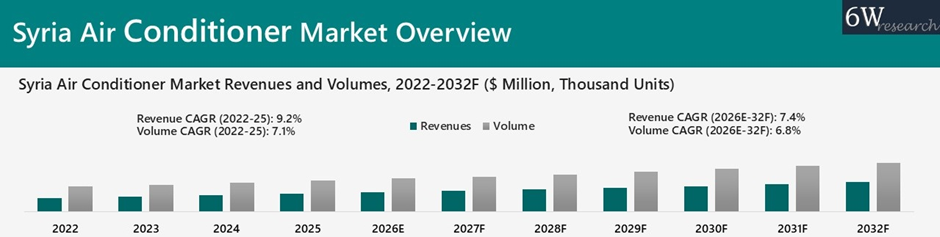
According to 6Wresearch, Syria Air Conditioner Market is projected to grow at a revenue CAGR of 7.4% from 2026-2032F, driven by rising average temperatures, improving electricity availability, and expanding tourism and infrastructure investments. Syria recorded peak heatwave temperatures of 46°C in 2024, compared to a historical baseline of 28°C, making cooling an increasingly essential requirement rather than a seasonal luxury. Additional momentum is coming from Syria’s decided 2026 national budget, a infrastructure fund, and rapid tourism recovery, with total visitor demand projected to rise. These developments are expected to accelerate demand for residential ACs, inverter and solar-compatible systems, hotel HVAC installations, VRF systems, and chillers for large-scale projects.
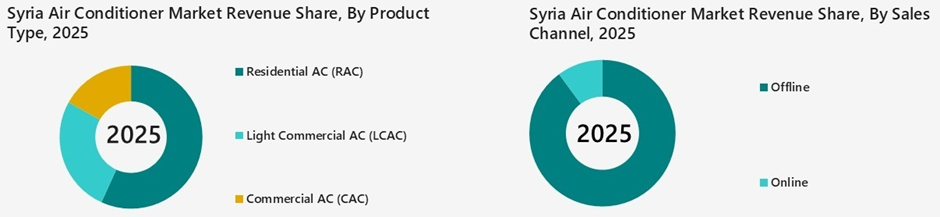
Market Segmentation By Product Type
Residential AC represents the highest Growth in Syria’s air conditioner market by 2032F, driven by large-scale housing reconstruction, sustained urban cooling demand, and rising household adoption. Expanding apartment redevelopment, improving electricity access, and growing need for affordable, efficient home cooling solutions are expected to keep residential AC as the market’s biggest revenue pool.
Market Segmentation By Climate Class
T3 climate class ACs lead Syria’s highest growth due to their heavy-duty compressor design and wider operational tolerance. Unlike standard T1 units, T3 systems maintain performance without frequent thermal shutdowns—critical for prolonged summer peaks. Importers prioritize T3 models for higher resale value and lower warranty claims. As buyers become technically aware, demand shifts toward ruggedized units built for extreme ambient conditions.
Market Segmentation By Refrigerant Used
R32 leads Syria's refrigerant transition due to its lower cost per kilogram. Importers Favor R32 for easier logistics and wider compatibility with affordable split AC units flooding the market. As global production phases down high-GWP refrigerants, Syria's unregulated import channels rapidly shift to R32 for its balance of safety, efficiency, and price advantage.
Market Segmentation By Application
Healthcare applications will register the highest growth in Syria's air conditioner market, driven by massive rehabilitation of damaged hospitals and clinics under reconstruction funding. Upgraded medical facilities require precise temperature and humidity control for operating theaters, pharmacies, and patient wards. Unlike residential or retail segments, healthcare cooling demands continuous, reliable operation—making it a priority for NGO-backed infrastructure spending.
Market Segmentation By Sales Channel
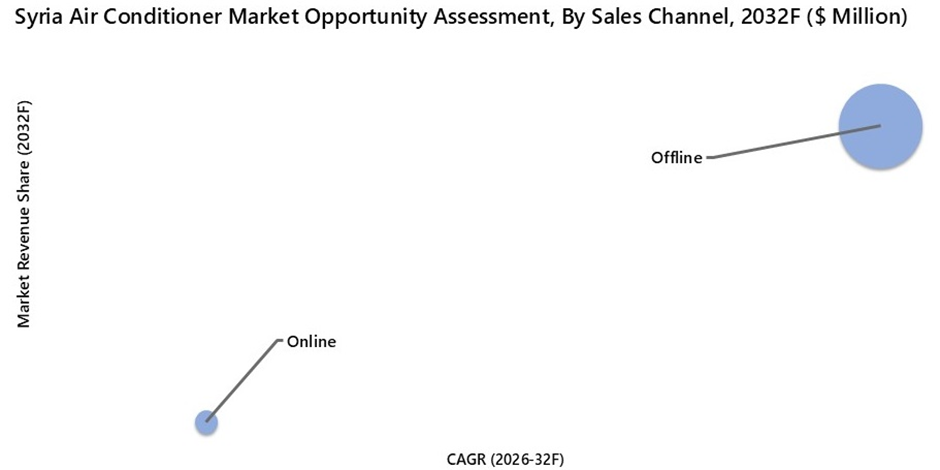
Offline channels will register the highest growth in Syria's air conditioner market. Despite digital expansion, buyers prioritize in-person inspection, cash transactions, and immediate delivery—especially for heavy, high-value units. Local dealers offer trusted after-sales service and installation support, which online cannot match. Reconstruction activity concentrates in dense urban hubs where offline retail networks dominate, making physical stores the preferred purchasing route.
Key Attractiveness of the Report
- 10 Years Market Numbers.
- Historical Data Starting from 2022 to 2025
- Base Year: 2025
- Forecast Data until 2032
- Key Performance Indicators Impacting the Market.
- Major Upcoming Developments and Projects.
Key Highlights of the Report:
- Syria Air Conditioner Market Overview
- Syria Air Conditioner Market Outlook
- Syria Air Conditioner Market Forecast
- Historical Data and Forecast of Syria Air Conditioner Market Revenues and Volume for the Period 2022-2032F
- Historical Data and Forecast of Syria Air Conditioner Market Revenues and Volume, By Product Type for the Period 2022-2032F
- Historical Data and Forecast of Syria Air Conditioner Market Revenues and Volume, By Climate Class for the Period 2022-2032F
- Historical Data and Forecast of Syria Air Conditioner Market Revenues and Volume, By Refrigerant used for the Period 2022-2032F
- Historical Data and Forecast of Syria Air Conditioner Market Revenues, By Application for the Period 2022-2032F
- Historical Data and Forecast of Syria Air Conditioner Market Revenues, By Sales Channel for the Period 2022-2032F
- Porter’s Five Force Analysis
- Syria Air Conditioner Market Drivers and Restraints
- Syria Air Conditioner Market Trends
- Syria Air Conditioner Market Opportunity Assessment, By Product Type
- Syria Air Conditioner Market Opportunity Assessment, By Application
- Syria Air Conditioner Market Opportunity Assessment, By Sales Channel
- Syria Air Conditioner Market Revenue Ranking, By Top Companies
- Market Competitive Benchmarking
- Company Profiles
Market Scope and Segmentation
The report provides a detailed analysis of the following market segments:
By Product Type
- Residential Air Conditioner (RAC)
- Window Air Conditioner
- Split Air Conditioner
- Light Commercial AC (LCAC)
- Concealed
- Cassette
- Free Standing
- Commercial AC (CAC)
- VRF
- Package
- Chillers
By Climate Class
- T3
- T1
By Refrigerant used
- R32
- R410A
By Application
- Residential
- Healthcare
- Commercial Offices & Retail
- Transportation and Infrastructure
- Hospitality
- Manufacturing
- Oil & Gas
- Others (Education, BFSI, etc)
By Sales Channel
- Online
- Offline
Syria Air Conditioner Market (2026-2032): FAQs
Syria Air Conditioner Market is projected to grow at a CAGR of 7.4% from 2026-2032F.
Urbanization & Post Conflict Reconstruction and Increasing Average Temperatures, Heatwaves, and Electricity Demand are driving the growth of market.
The market faces restraints due to Import Dependency and Price Sensitivity with Currency Devaluation & Affordability Crisis.
Syria Air Conditioner Market Report thoroughly covers the market by product type, climate class, refrigerant used, application and sales channel.
6Wresearch actively monitors the Syria Air Conditioner Market and publishes its comprehensive annual report, highlighting emerging trends, growth drivers, revenue analysis, and forecast outlook. Our insights help businesses to make data-backed strategic decisions with ongoing market dynamics. Our analysts track relevent industries related to the Syria Air Conditioner Market, allowing our clients with actionable intelligence and reliable forecasts tailored to emerging regional needs.
Yes, we provide customisation as per your requirements. To learn more, feel free to contact us on sales@6wresearch.com
| 1. Executive Summary |
| 2. Introduction |
| 2.1 Report Description |
| 2.2 Key Highlights of the Report |
| 2.3 Market Scope & Segmentation |
| 2.4 Research Methodology |
| 2.5 Assumptions |
| 3. Global Air Conditioner Market Overview |
| 3.1 Global Air Conditioner Market Revenues and Volume, 2022-2032F |
| 4. Syria Air Conditioner Market Overview |
| 4.1 Syria Macroeconomic Indicators |
| 4.2 Syria Air Conditioner Market Revenues and Volume, 2022-2032F |
| 4.3 Syria Air Conditioner Market Industry Life Cycle |
| 4.4 Syria Air Conditioner Market Porter's Five Forces |
| 5. Syria Air Conditioner Market Dynamics |
| 5.1 Impact Analysis |
| 5.2 Market Drivers |
| 5.3 Market Restraints |
| 6. Syria Air Conditioner Market Trends & Evolution |
| 7. Syria Air Conditioner Market Overview, By Product Type |
| 7.1. Syria Air Conditioner Market Revenue Share, By Product Type, 2025 & 2032F |
| 7.1.1. Syria Air Conditioner Market Revenues, By Residential AC (RAC), 2022-2032F |
| 7.1.2. Syria Air Conditioner Market Revenues, By Light Commercial AC (LCAC), 2022-2032F |
| 7.1.3. Syria Air Conditioner Market Revenues, By Commercial AC (CAC), 2022-2032F |
| 7.2. Syria Air Conditioner Market Volume Share, By Product Type, 2025 & 2032F |
| 7.1.1. Syria Air Conditioner Market Volume, By Residential AC (RAC), 2022-2032F |
| 7.1.2. Syria Air Conditioner Market Volume, By Light Commercial AC (LCAC), 2022-2032F |
| 7.1.3. Syria Air Conditioner Market Volume, By Commercial AC (CAC), 2022-2032F |
| 7.1.1 Syria Air Conditioner Market Revenue Share, By Residential AC (RAC), 2022-2032F |
| 7.1.1.1. Syria Air Conditioner Market Revenues, By Window Air Conditioner, 2022-2032F |
| 7.1.1.2. Syria Air Conditioner Market Revenues and, By Split Air Conditioner, 2022-2032F |
| 7.1.1. Syria Air Conditioner Market Volume Share , By Residential AC (RAC), 2025 & 2032F |
| 7.1.1.1. Syria Air Conditioner Market Volume, By Window Air Conditioner, 2022-2032F |
| 7.1.1.2. Syria Air Conditioner Market Volume, By Split Air Conditioner, 2022-2032F |
| 7.1.2. Syria Air Conditioner Market Revenue Share, By Light Commercial AC (LCAC), 2025 & 2032F |
| 7.1.2.1. Syria Air Conditioner Market Revenues, By Concealed, 2022-2032F |
| 7.1.2.2. Syria Air Conditioner Market Revenues , By Cassette, 2022-2032F |
| 7.1.2.3. Syria Air Conditioner Market Revenues , By Free Standing, 2022-2032F |
| 7.1.2. Syria Air Conditioner Market Volume Share, By Light Commercial AC (LCAC), 2025 & 2032F |
| 7.1.2.1. Syria Air Conditioner Market Volume, By Concealed, 2022-2032F |
| 7.1.2.2. Syria Air Conditioner Market Volume, By Cassette, 2022-2032F |
| 7.1.2.3. Syria Air Conditioner Market Volume, By Free Standing, 2022-2032F |
| 7.1.3. Syria Air Conditioner Market Volume Share, By Commercial AC (CAC), 2025 & 2032F |
| 7.1.3.1. Syria Air Conditioner Market Revenues, By VRF, 2022-2032F |
| 7.1.3.2. Syria Air Conditioner Market Revenues, By Package, 2022-2032F |
| 7.1.3.3. Syria Air Conditioner Market Revenues, By Chillers, 2022-2032F |
| 8. Syria Air Conditioner Market Overview, By Climate Class |
| 8.1. Syria Air Conditioner Market Revenue Share, By Climate Class, 2025 & 2032F |
| 8.1.1. Syria Air Conditioner Market Revenues, By T3, 2022-2032F |
| 8.1.2. Syria Air Conditioner Market Revenues, By T1, 2022-2032F |
| 9. Syria Air Conditioner Market Overview, By Refrigerant used |
| 9.1. Syria Air Conditioner Market Revenue Share, By Refrigerant used, 2025 & 2032F |
| 9.1.1. Syria Air Conditioner Market Revenues, By R32, 2022-2032F |
| 9.1.2. Syria Air Conditioner Market Revenues, By R410A, 2022-2032F |
| 10. Syria Air Conditioner Market Overview, By Application |
| 10.1. Syria Air Conditioner Market Revenue and Volume Share, By Application, 2025 & 2032F |
| 10.1.1. Syria Air Conditioner Market Revenues and Volume, By Residential, 2022-2032F |
| 10.1.2. Syria Air Conditioner Market Revenues and Volume, By Healthcare, 2022-2032F |
| 10.1.3. Syria Air Conditioner Market Revenues and Volume, By Commercial Offices & Retail, 2022-2032F |
| 10.1.4. Syria Air Conditioner Market Revenues and Volume, By Transportation & Infrastructure, 2022-2032F |
| 10.1.5. Syria Air Conditioner Market Revenues and Volume, By Hospitality, 2022-2032F |
| 10.1.6. Syria Air Conditioner Market Revenues and Volume, By Manufacturing, 2022-2032F |
| 10.1.7. Syria Air Conditioner Market Revenues and Volume, By Oil & Gas, 2022-2032F |
| 10.1.8. Syria Air Conditioner Market Revenues and Volume, By Others (Education, BFSI, etc), 2022-2032F |
| 11. Syria Air Conditioner Market Overview, By Sales Channel |
| 11.1. Syria Air Conditioner Market Revenue, By Sales Channel, 2025 & 2032F |
| 11.1.1. Syria Air Conditioner Market Revenues, By Online, 2022-2032F |
| 11.1.2. Syria Air Conditioner Market Revenues, By Offline, 2022-2032F |
| 12. Syria Air Conditioner Market Key Performance Indicators |
| 13. Syria Air Conditioner Market Opportunity Assessment |
| 13.1. Syria Air Conditioner Market Opportunity Assessment, By Product Type, 2032F |
| 13.2. Syria Air Conditioner Market Opportunity Assessment, By Residential, 2032F |
| 13.3. Syria Air Conditioner Market Opportunity Assessment, By Light Commercial, 2032F |
| 13.4. Syria Air Conditioner Market Opportunity Assessment, By Commercial, 2032F |
| 13.5. Syria Air Conditioner Market Opportunity Assessment, By Climate Class, 2032F |
| 13.6. Syria Air Conditioner Market Opportunity Assessment, By Refrigerant Type, 2032F |
| 13.7. Syria Air Conditioner Market Opportunity Assessment, By Application, 2032F |
| 13.8. Syria Air Conditioner Market Opportunity Assessment, By Sales Channel, 2032F |
| 14. Syria Air Conditioner Market Competitive Landscape |
| 14.1. Syria Air Conditioner Market Revenue Share, By Top Companies, 2025 |
| 14.2. Syria Air Conditioner Market Key Companies Competitive Benchmarking, By Technical & Operating Parameters |
| 15. Company Profiles |
| 15.1. LG Electronics Inc. |
| 15.2. Daikin Industries Ltd. |
| 15.3. Carrier Corporation |
| 15.4. Mitsubishi Electric Corporation |
| 15.5. Gree Electrical Appliances Inc. |
| 15.6. Panasonic Corporation |
| 15.7. Midea Group |
| 15.8. Trane Inc. |
| 15.9. Samsung Electronics |
| 15.10. Al-Hafiz Group |
| 16. Key Strategic Recommendations |
| 17. Disclaimer |
| List of Figures |
| 1. Syria Air Conditioner Market Revenues, 2022-2032F (USD Million) |
| 2. Syria’s Gross Domestic Product Value, 2021-2025E ($ Billion) |
| 3. Syria’s Inflation Rate, January & February 2023-January & February 2025 (%) |
| 4. Syria Air Conditioner Market Revenues and Volumes, 2022-2032F ($ Million, Units) |
| 5. Urban vs Rural Population Distribution in Syria, 2025 (In %) |
| 6. Avg. Baseline vs. 2024 Peak Heatwave Temp (°C) |
| 7. Syria Daily Electricity Supply vs Target by 2030 (Hours/Day) |
| 8. Syria Air Conditioner Market Revenue Share, By Product Type, 2025 & 2032F |
| 9. Syria Air Conditioner Market Volume Share, By Product Type, 2025 & 2032F |
| 10. Syria Air Conditioner Market Revenue Share, By Residential AC, 2025 & 2032F |
| 11. Syria Air Conditioner Market Volume Share, Residential AC, 2025 & 2032F |
| 12. Syria Air Conditioner Market Revenue Share, By Light Commercial AC, 2025 & 2032F |
| 13. Syria Air Conditioner Market Volume Share, By Light Commercial AC, 2025 & 2032F |
| 14. Syria Air Conditioner Market Revenue Share, By Commercial AC, 2025 & 2032F |
| 15. Syria Air Conditioner Market Volume Share, By Commercial AC, 2025 & 2032F |
| 16. Syria Air Conditioner Market Revenue Share, By Climate Class, 2024 & 2031F |
| 17. Syria Air Conditioner Market Revenue Share, By Refrigerant used, 2024 & 2031F |
| 18. Syria Air Conditioner Market Revenue Share, By Application 2025 & 2032F |
| 19. Syria Air Conditioner Market Volume Share, By Application 2025 & 2032F |
| 20. Syria Air Conditioner Market Revenue Share, By Sales Channel, 2024 & 2031F |
| 21. Total Number of Tourist Demand in Syria, 2024-2026E (In Million) |
| 22. Total Number of Tourist Demand in Syria by Origin, 2025 (In Million) |
| 23. Syria’s New Number of Hotel under National Tourism Strategy by Type, (2026–2030) in Units |
| 24. Syria Air Conditioner Market Opportunity Assessment, By Product Type, 2032F ($ Million) |
| 25. Syria Air Conditioner Market Opportunity Assessment, By Residential AC, 2031F ($ Million) |
| 26. Syria Air Conditioner Market Opportunity Assessment, By Light Commercial AC, 2032F ($ Million) |
| 27. Syria Air Conditioner Market Opportunity Assessment, By Commercial AC , 2031F ($ Million) |
| 28. Syria Air Conditioner Market Opportunity Assessment, By Climate Class , 2031F ($ Million) |
| 29. Syria Air Conditioner Market Opportunity Assessment, By Refrigerant used, 2032F ($ Million) |
| 30. Syria Air Conditioner Market Opportunity Assessment, By Application , 2031F ($ Million) |
| 31. Syria Air Conditioner Market Opportunity Assessment, By Sales Channel, 2032F ($ Million) |
| 32. Syria Air Conditioner Market Revenue Ranking, By Top Companies, 2025 |
| List of tables |
| 1. Syria Key Upcoming Construction Projects |
| 2. Syria Air Conditioner Market Revenues, By Product Type, 2022-2032F, ($ Million) |
| 3. Syria Air Conditioner Market Volume, By Product Type, 2022-2032F, ($ Million) |
| 4. Syria Air Conditioner Market Revenues, By Residential AC, 2022-2032F, ($ Million) |
| 5. Syria Air Conditioner Market Volume, By Residential AC, 2022-2032F, ($ Million) |
| 6. Syria Air Conditioner Market Revenues, By Light Commercial AC, 2022-2032F, ($ Million) |
| 7. Syria Air Conditioner Market Volume, By Light Commercial AC, 2022-2032F, ($ Million) |
| 8. Syria Air Conditioner Market Revenues, By Commercial AC, 2022-2032F, ($ Million) |
| 9. Syria Air Conditioner Market Volume, By Commercial AC, 2022-2032F, ($ Million) |
| 10. Syria Air Conditioner Market Revenues, By Climate Class, 2021-2031F, ($ Millions) |
| 11. Syria Air Conditioner Market Revenues, By Refrigerant used, 2022-2032F, ($ Million) |
| 12. Syria Air Conditioner Market Revenues, By Application, 2022-2032F, ($ Millions) |
| 13. Syria Air Conditioner Market Volume, By Application, 2022-2032F, ($ Millions) |
| 14. Syria Air Conditioner Market Revenues, By Sales Channel, 2021-2031F, ($ Millions) |
| 15. Major Infrastructure & Real Estate Project Pipeline (2026) |
Global Go To Market Strategy - 2030
Export potential enables firms to identify high-growth global markets with greater confidence by combining advanced trade intelligence with a structured quantitative methodology. The framework analyzes emerging demand trends and country-level import patterns while integrating macroeconomic and trade datasets such as GDP and population forecasts, bilateral import–export flows, tariff structures, elasticity differentials between developed and developing economies, geographic distance, and import demand projections. Using weighted trade values from 2020–2024 as the base period to project country-to-country export potential for 2030, these inputs are operationalized through calculated drivers such as gravity model parameters, tariff impact factors, and projected GDP per-capita growth. Through an analysis of hidden potentials, demand hotspots, and market conditions that are most favorable to success, this method enables firms to focus on target countries, maximize returns, and global expansion with data, backed by accuracy.
By factoring in the projected importer demand gap that is currently unmet and could be potential opportunity, it identifies the potential for the Exporter (Country) among 190 countries, against the general trade analysis, which identifies the biggest importer or exporter.
To discover high-growth global markets and optimize your business strategy:
Click Here
Pricing
- Single User License$ 1,995
- Department License$ 2,400
- Site License$ 3,120
- Global License$ 3,795

Leadership Perspectives from Industry Events
Search
Thought Leadership and Analyst Meet





Our Clients








6WResearch In News
- India Export Attractiveness Tracker 2026
- India Air Conditioner Market Set for Strong Rebound in 2026 After Weather-Led Correction and GST-Driven Recovery: 6Wresearch
- ADAS in India: How Automatic Emergency Braking, Blind Spot Detection & Driver Monitoring are Transforming Road Safety
- Doha a strategic location for EV manufacturing hub: IPA Qatar
- Demand for luxury TVs surging in the GCC, says Samsung
- Empowering Growth: The Thriving Journey of Bangladesh’s Cable Industry
Latest Reports
- Nicaragua RPG Gaming Market (2026-2032)
- New Zealand RPG Gaming Market (2026-2032)
- Netherlands RPG Gaming Market (2026-2032)
- Nauru RPG Gaming Market (2026-2032)
- Namibia RPG Gaming Market (2026-2032)
- Mozambique RPG Gaming Market (2026-2032)
- Montenegro RPG Gaming Market (2026-2032)
- Mongolia RPG Gaming Market (2026-2032)
- Monaco RPG Gaming Market (2026-2032)
- Micronesia RPG Gaming Market (2026-2032)
Industry Events and Analyst Meet

EV India Expo 2026

HIMTEX 2026

India Refining Summit 2026

India EV Show 2026

EV tech India Expo 2026
Whitepaper
- Middle East & Africa Commercial Security Market Click here to view more.
- Middle East & Africa Fire Safety Systems & Equipment Market Click here to view more.
- GCC Drone Market Click here to view more.
- Middle East Lighting Fixture Market Click here to view more.
- GCC Physical & Perimeter Security Market Click here to view more.


