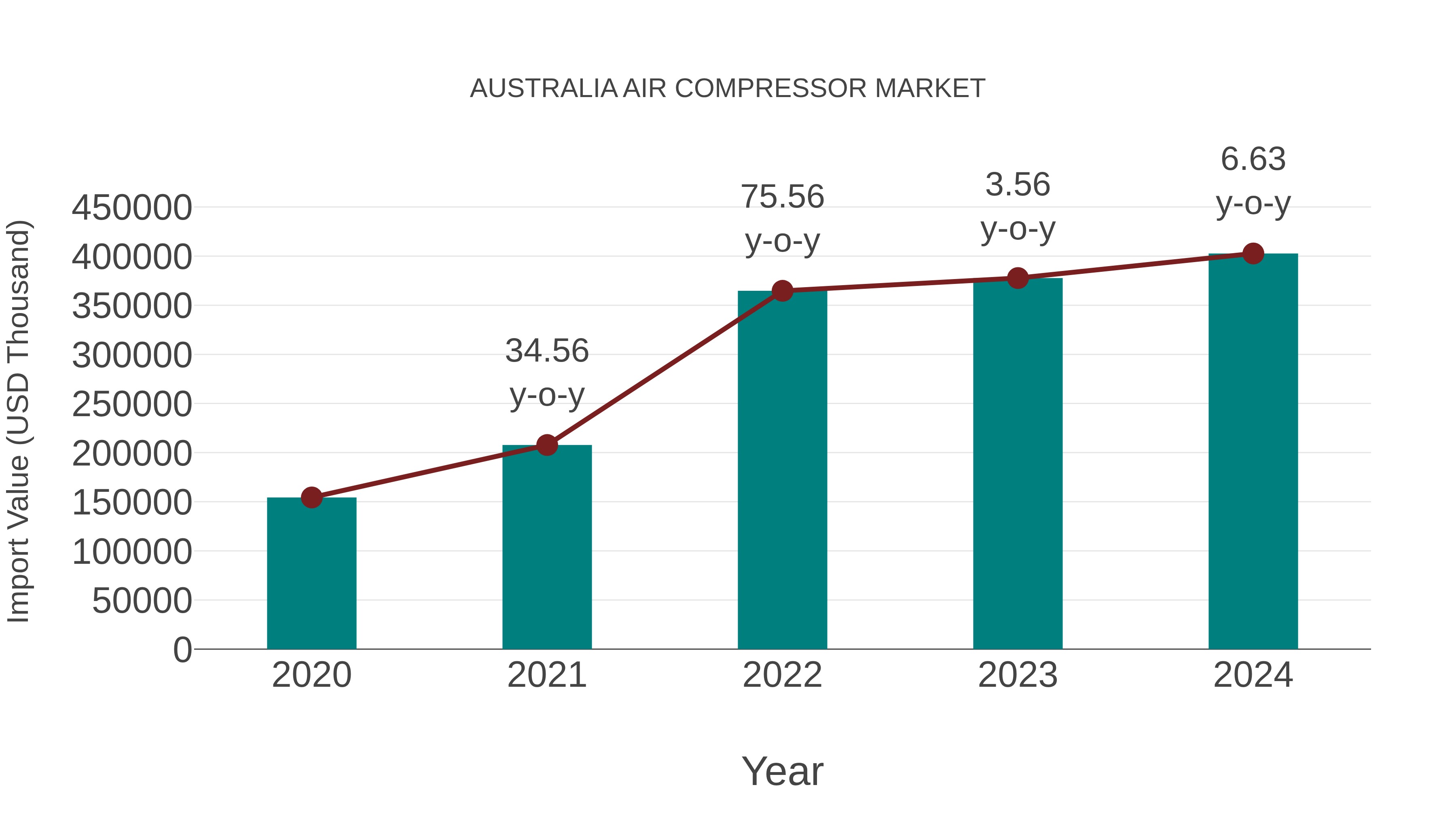
Australia Air Compressor Market: Import Trend Analysis
Australia`s air compressor market experienced a notable import trend from 2023 to 2024, with a growth rate of 6.63%. The compound annual growth rate (CAGR) for imports from 2020 to 2024 stood at 27.08%. This substantial increase in import momentum can be attributed to a growing demand for air compressors in various industries, indicating a positive market stability and a robust trade environment during this period.
Topics Covered in the Australia Air Compressor Market Report
The Australia Air Compressor Market report thoroughly covers the market by type, product, lubrication, and application. The market report provides an unbiased and detailed analysis of ongoing market trends, opportunities/high growth areas, and market drivers, which help stakeholders devise and align their market strategies according to the current and future market dynamics.
Australia Air Compressor Market Growth Rate
According to 6Wresearch internal database and industry insights, the Australia Air Compressor Market is projected to grow at a compound annual growth rate (CAGR) of 5.6% during the forecast period (2026-2032).
Australia Air Compressor Market Highlights
| Report Name | Australia Air Compressor Market |
| Forecast Period | 2026–2032 |
| CAGR | 5.60% |
| Growing Sector | Manufacturing & Industrial Automation |
Australia Air Compressor Market Synopsis
Australia Air Compressor Market is anticipated to record steady growth by rising industrial automation, expanding mining operations, and high demand for energy-efficient compressed air solutions. Air compressors play a critical role across manufacturing, food processing, healthcare, and energy sectors. In addition, stringent workplace safety standards and the growing preference for oil-free and low-noise compressors are driving technology upgrade cycles, while ongoing infrastructure development projects across Australia continue to support sustained market expansion.
Evaluation of Growth Drivers in the Australia Air Compressor Market
Below mentioned are some prominent drivers and their influence on the market dynamics:
| Drivers | Primary Segments Affected | Why it Matters (Evidence) |
| Industrial Automation Growth | Rotary/Screw Compressors; Manufacturing | Automated production lines rely on uninterrupted and reliable compressed air systems to maintain efficiency and productivity. |
| Mining & Infrastructure Expansion | Portable & Stationary Compressors; Energy & Others | Mining operations depend on high-capacity compressors for drilling, excavation, and material handling processes. |
| Demand for Energy Efficiency | Oil-Free Compressors; Manufacturing | Energy-efficient compressor systems help industries reduce operational costs and comply with sustainability targets. |
| Growth in Food & Beverage Processing | Oil-Free Compressors; Food & Beverage | Hygienic, contaminant-free air is critical to meet food safety regulations and maintain product quality. |
| Healthcare Infrastructure Development | Oil-Free Compressors; Healthcare & Medical | Medical air applications require contaminant-free compressed air, driving demand for oil-free compressor technologies. |
Australia Air Compressor Market is expected to grow at the CAGR of 5.6% during the forecast period of 2026-2032. Growth is driven by expanding industrial activity, rising adoption of automation technologies, and increasing emphasis on energy-efficient equipment. Additionally, government-backed infrastructure investments and sustainability initiatives are supporting the replacement of outdated compressor systems with advanced, low-emission alternatives across manufacturing and energy sectors.
Evaluation of Restraints in the Australia Air Compressor Market
Below mentioned are some major restraints and their influence on the market dynamics:
| Restraints | Primary Segments Affected | What This Means (Evidence) |
| High Initial Equipment Cost | Centrifugal Compressors; Manufacturing | High upfront capital investment can discourage small and mid-sized manufacturers from adopting advanced compressor systems. |
| Maintenance & Energy Costs | Oil-Filled Compressors; Industrial Users | Frequent servicing requirements and higher energy consumption increase total cost of ownership for end users. |
| Skilled Workforce Shortage | All Compressor Types; Manufacturing | A limited pool of trained compressor system technicians can negatively impact operational efficiency and system reliability. |
| Noise & Environmental Concerns | Portable Compressors; Construction | Stricter noise and emission regulations are limiting the use of older compressor models at construction sites. |
| Fluctuating Raw Material Prices | All Products; Others | Volatility in raw material prices directly affects manufacturing costs and compressor pricing. |
Australia Air Compressor Industry Challenges
Irrespective of strong demand, the Australia Air Compressor Industry faces challenges like high upfront cost of investment, concern around energy consumption, as well as a requirement for well-skilled individuals in maintaining the system. Furthermore, strict requirements for environmental protection and noise reduction add to operational challenges. In addition, dependence on imported components, along with the need to reduce emissions presents a major challenge for manufacturers in the mining sector.
Australia Air Compressor Market Trends
Key trends evaluating the landscape of the Australia Air Compressor Market Growth are:
- Adoption of energy-efficient compressor technologies: Various manufacturers are using variable speed drive compressor technologies which help them to save on energy consumption.
- Increasing Market Scope for Oil-Free Air Compressors: The food-processing sector, beverage industry, and healthcare facilities are adopting oil-free air compressors in their operations in order to maintain contamination-free operations.
- Growth of Portable Air Compressors: Infrastructure development projects, along with various other location-based tasks, require portable air compressors which keeping demand high in the industry.
Investment Opportunities in the Australia Air Compressor Market
Some prominent investment opportunities in the Australia Air Compressor Market include:
- Investment in Energy-Efficient and Low-Emission Compressor Manufacturing: Investing in energy-efficient and low-emission compressor manufacturing in Australia supports sustainable demand growth, driven by tightening environmental regulations and increasing emphasis on energy efficiency across industrial sectors.
- Oil-Free Air Compressors: The development of medical-grade oil-free air compressors presents promising market opportunities, supported by the rising number of hospitals and clinics across Australia.
- Aftermarket Services and Maintenance Networks: Expanding in-country aftermarket service and maintenance infrastructure which can help manufacturers ensure long-term customer retention while generating stable and recurring revenue streams.
Top 5 Leading Players in the Australia Air Compressor Market
Some leading players operating in the Australia Air Compressor Market include:
1. Atlas Copco
| Company Name | Atlas Copco |
| Established Year | 1873 |
| Headquarters | Stockholm, Sweden |
| Official Website | Click Here |
Atlas Copco offers a comprehensive range of energy-efficient and oil-free air compressors widely used across Australia mining, manufacturing, and healthcare industries, supported by strong local service networks.
2. Ingersoll Rand
| Company Name | Ingersoll Rand |
| Established Year | 1871 |
| Headquarters | Davidson, North Carolina, USA |
| Official Website | Click Here |
Ingersoll Rand supplies robust rotary and reciprocating air compressors, catering to Australia’s industrial, construction, and energy sectors with a focus on durability and performance.
3. KAESER Kompressoren
| Company Name | KAESER Kompressoren |
| Established Year | 1919 |
| Headquarters | Coburg, Germany |
| Official Website | Click Here |
KAESER Kompressoren provides high-efficiency compressed air systems and advanced monitoring solutions, increasingly adopted by manufacturers seeking energy optimization.
4. Hitachi Industrial Equipment Systems
| Company Name | Hitachi Industrial Equipment Systems |
| Established Year | 2002 |
| Headquarters | Tokyo, Japan |
| Official Website | Click Here |
Hitachi offers oil-free and oil-lubricated compressors used in electronics, food processing, and industrial applications across Australia, emphasizing reliability and low lifecycle costs.
5. ELGi Equipments
| Company Name | ELGi Equipments |
| Established Year | 1960 |
| Headquarters | Coimbatore, India |
| Official Website | Click Here |
ELGi Equipments supplies a wide range of stationary and portable air compressors in Australia, focusing on energy efficiency, compact design, and strong aftermarket support.
Government Regulations Introduced in the Australia Air Compressor Market
According to Australian Government data, Various initiatives are taken to promote the usage of efficient technology equipment for industrial equipment, including the National Energy Productivity Plan, which drives the efforts of different industries to reduce the energy intensity of their activities through the implementation of an efficient technology set, including efficient machinery like air compressors, etc. At the state level, the promotion of modernization of industries with initiatives like workplace safety concerning noise levels also acts to improve the compression facility in industries.
Future Insights of the Australia Air Compressor Market
The future outlook for the Australia air compressor market is promising as automation is continuously rising, and there is a high emphasis on sustainability and efficiency. Improvements in smart air compressor solutions, development of new applications around oil-free solutions, and rising service-oriented business models are anticipated to boost market potential. In addition, government policies to promote eco-friendly production and minimize emissions ensure better market accessibility to new-generation air compressor solutions across various application areas.
Market Segmentation Analysis
The report offers a comprehensive study of the subsequent market segments and their leading categories.
Stationary Air Compressors to Dominate the Market – By Type
According to Mohit, Senior Research Analyst, 6Wresearch, the Stationary segment dominates the Australia Air Compressor Market Share due to extensive usage in manufacturing, mining, and energy facilities. The increasing investments in automated production lines and stationary structures will enhance the need for stationary air compression systems in Australia.
Rotary/Screw Compressors to Lead – By Product
Rotary/Screw compressor has the highest market share compared to the other types due to it is more energy-efficient and has low operating costs. Australia industries are also using rotary screw types of compressors, especially in the fields of manufacture and mines, as the compressed air has to run continuously.
Oil-Free Compressors to Dominate – By Lubrication
Due to increasing product requirements from industries such as food & beverages, healthcare, and electronic manufacturing industries. These air compressors guarantee zero-contaminated air, to meet highly stringent quality requirements.
Key Attractiveness of the Report
- 10 Years of Market Numbers.
- Historical Data Starting from 2022 to 2025.
- Base Year: 2025.
- Forecast Data until 2032.
- Key Performance Indicators Impacting the Market.
- Major Upcoming Developments and Projects.
Key Highlights of the Report:
- Australia Air Compressor Market Overview
- Australia Air Compressor Market Outlook
- Australia Air Compressor Market Forecast
- Australia Air Compressor Market Size
- Historical & Forecast Data of Australia Air Compressor Market Revenues & Volume for the Period 2022-2032F
- Historical & Forecast Data of Australia Portable Air Compressor Market Revenues & Volume for the Period 2022-2032F
- Historical & Forecast Data of Australia Stationary Air Compressor Market Revenues & Volume for the Period 2022-2032F
- Historical & Forecast Data of Australia Oil Injected Air Compressor Market Revenues & Volume for the Period 2022-2032F
- Historical & Forecast Data of Australia Oil-Free Air Compressor Market Revenues & Volume for the Period 2022-2032F
- Historical & Forecast Data of Australia Rotary Air Compressor Market Revenues & Volume for the Period 2022-2032F
- Historical & Forecast Data of Australia Centrifugal Air Compressor Market Revenues & Volume for the Period 2022-2032F
- Historical & Forecast Data of Australia Reciprocating Air Compressor Market Revenues & Volume for the Period 2022-2032F
- Historical & Forecast Data of Australia Air Compressor Applications Market Revenues for the period 2022-2032F
- Historical & Forecast Data of Australia Air Compressor Regional Market Revenues for the Period 2022-2032F
- Market Drivers and Restraints
- Australia Air Compressor Market Trends & Industry Life Cycle
- Porter’s Five Forces Analysis
- Market Opportunity Assessment
- Australia Air Compressor Market Overview, By Competitive Benchmarking
- Market Share, By Technology
- Recent Market Trends
- Recommendations
Market Segmentation
The report provides a detailed analysis of the following market segments:
By Types
- Portable
- Stationary
By Lubrication Method
- Oil-Injected
- Oil Free
By Technology
- Rotary (0-75kW, 76-160kW, And Above 160kW)
- Centrifugal (0-500kW And Above 500kW)
- Reciprocating (0-10kW And Above 10kW)
By Applications
- Industrial
- Construction
- Oil & Gas
- Food & Beverages
- Others






































