Australia Lawn Mowers Market (2026-2032) | Trends, Industry, Segmentation, Share, Analysis, Growth, Size, Revenue, Value, & Outlook
Market Forecast By Product (Manual, Electric, Petrol, Robotic, Others), By End-use (Residential, Commercial/Government) And Competitive Landscape
| Product Code: ETC426511 | Publication Date: Oct 2022 | Updated Date: Nov 2025 | Product Type: Market Research Report | |
| Publisher: 6Wresearch | Author: Ravi Bhandari | No. of Pages: 75 | No. of Figures: 35 | No. of Tables: 20 |
Australia Lawn Mowers Market | Country-Wise Share and Competition Analysis
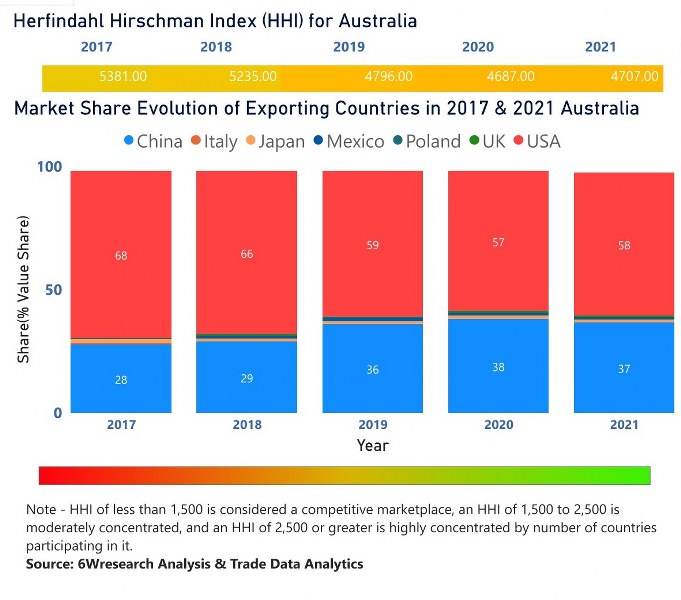
In the year 2021, USA was the largest exporter in terms of value, followed by China. It has registered a growth of 74.26% over the previous year. While China registered a growth of 64.06% as compare to the previous year. In the year 2017 USA was the largest exporter followed by China. In term of Herfindahl Index, which measures the competitiveness of countries exporting, Australia has the Herfindahl index of 5381 in 2017 which signifies high concentration also in 2021 it registered a Herfindahl index of 4707 which signifies high concentration in the market.
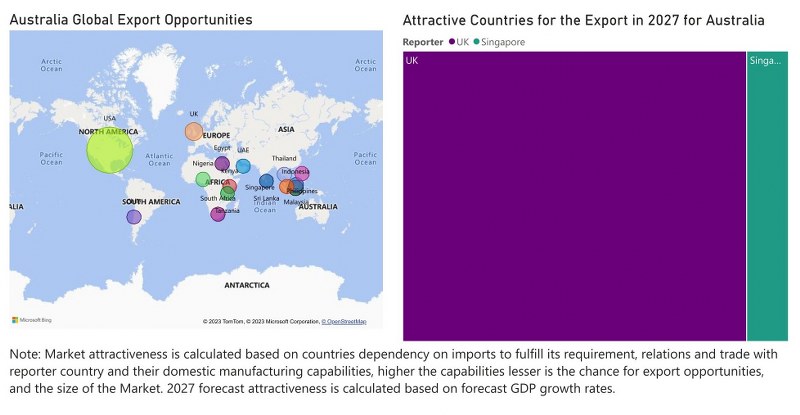
Australia Lawn Mowers Market - Export Market Opportunities
Australia Lawn Mowers Market Growth Rate
According to 6Wresearch internal database and industry insights,
Five-Year Growth Trajectory of the Australia Lawn Mowers Market with Core Drivers
Below mentioned are the evaluation of years-wise growth rate along with key growth drivers:
| Year | Est. Annual Growth (%) | Growth Drivers |
| 2021 | 2.6 | Household lawn care activities grew over the years and increased demand for basic manual and electric mowers. |
| 2022 | 3.8 | Due to convenience and low maintenance, the adoption of cordless and battery-powered devices accelerated. |
| 2023 | 4.8 | Residential development occurred and boosted outdoor landscaping and thereby lawn mower purchases. |
| 2024 | 5.6 | Popularity of automated robotic mowers increased and enhanced the technology acceptance of market. |
| 2025 | 6.5 | Sustainability-oriented equipment and low-noise electric mowers gained traction among urban users. |
Topics Covered in the Australia Lawn Mowers Market Report
The Australia Lawn Mowers Market report thoroughly covers the market by product and by end-use, and. The report provides an unbiased and detailed analysis of ongoing market trends, opportunities/high growth areas, and market drivers, which would help stakeholders devise and align their market strategies according to current and future market dynamics.
Australia Lawn Mowers Market Highlights
| Report Name | Australia Lawn Mowers Market |
| Forecast period | 2026-2032 |
| CAGR | 7.2% |
| Growing Sector | Consumers Goods |
Australia Lawn Mowers Market Synopsis
Australia Lawn Mowers Market is experiencing moderate development over the years owing to rising focus on outdoor aesthetics, growing residential landscaping activities, and development of energy-efficient gardening equipment. Consumers are transitioning towards automated and low-maintenance lawn care machinery due to busy lifestyles. Further, gardening culture, expansion of urban greenery development, and improved availability of technologically advanced lawn mowers are supporting market adoption across residential and commercial spaces.
Evaluation of Growth Drivers in the Australia Lawn Mowers Market
Below mentioned are some major growth factors and their impacts on the market dynamics:
| Drivers | Primary Segments Affected | Why it matters (evidence) |
| Rising Residential Landscaping Activities | By End-use | Home gardening and backyard maintenance is growing and expands the demand for manual and electric mowers. |
| Shift Toward Battery-Powered Equipment | By Product | Cordless mowers have eco-friendly operation, low noise, and do not need servicing due to which attracts the wide customer adoption. |
| Smart & Automated Lawn Care Adoption | By Product | Robotic lawn mowers are providing the autonomous mowing, improving convenience and reducing labour dependency. |
| Growth in Commercial Landscaping Contracts | By End-use | Government and municipal bodies require durable petrol and robotic mowers for large-scale maintenance. |
| Focus on Low-Emission Gardening Tools | By Product | Environmental policies are promoting the use of electric and robotic models, driving product innovation. |
Australia Lawn Mowers Market Size is estimated for modest growth at a strong CAGR of 7.2% during the forecast period 2026-2032. Owing to several growth drivers such as expanding residential spaces, higher inclination toward garden maintenance, and rising adoption of electric equipment are contributing to market progression. Further, awareness regarding sustainable lawn care is increasing and this is pushing the adoption. Advancements are occurring in robotic mowing systems, and development of silent, efficient, and user-friendly models further accelerate market demand. The market is further driven by sustainability initiatives and innovations in smart robotic mowing systems.
Evaluation of Restraints in the Australia Lawn Mowers Market
Below mentioned are some major restraints and their influence on the market dynamics:
| Restraints | Primary Segments Affected | What this means (evidence) |
| High Purchase Cost of Robotic Models | By Product | Advanced robotic mowers are costly and discouraging the price-sensitive residential buyers. |
| Noise Pollution from Petrol Mowers | By End-use | Concerns are rising regarding noise and emissions which reduce adoption in urban residential zones. |
| Limited Battery Backup in Electric Mowers | By Product | The run-time of lawn mowers is low which restricts the suitability for large gardens and extensive commercial landscaping tasks. |
| Lack of Awareness in Remote Areas | By End-use | There is a limited access to modern lawn care solutions which reduces the adoption of advanced product categories. |
| Maintenance Requirements | By Product | Petrol mowers need constant servicing needs which affects the long-term operational costs, reducing preference. |
Australia Lawn Mowers Market Challenges
Australia Lawn Mowers Market is dealing with some challenges which need to be addressed for the maintenance of growth such as high initial investment for robotic mowing solutions, insufficient charging infrastructure in rural areas. There is limited product awareness among elderly and remote-region consumers, affecting the expansion. There is lack of skilled requirements for handling advanced equipment and concerns over battery disposal limit wider acceptance. The presence of cheaper low-quality imports also challenges the market by affecting brand competitiveness and customer trust.
Australia Lawn Mowers Market Trends
There are some major trends noticed in the Australia Lawn Mowers Industry, including:
- Rise of AI-Integrated Robotic Mowers: Manufacturers are deploying AI navigation and mapping systems to improve cutting precision and autonomous lawn management.
- Expanding Battery-Powered Mower Lineups: Lithium-ion technology is seeing growth which enables longer runtime and quicker charging, encouraging consumers to shift from petrol models.
- Growth of Smart Garden Ecosystems: Lawn mowers are integrated with mobile apps and IoT-based control systems which are enabling remote monitoring and scheduling of mowing activities.
- Demand for Low-Noise Urban-Friendly Models: The preference for quiet, emission-free equipment is growing and accelerating the use of electric and robotic solutions in city environments.
- Lightweight and Ergonomic Design Innovations: Consumer preference for easy-to-operate equipment encourages development of compact, foldable, and lightweight mower designs.
Investment Opportunities in the Australia Lawn Mowers Industry
Here is the list of lucrative opportunities in the Australia Lawn Mowers Market, including:
- Electric & Battery Mower Expansion: Awareness of sustainability is growing and creates strong potential for expanding rechargeable mower portfolios.
- Robotic Mower Penetration: The demand is growing for automated home solutions offers high scalability for robotic lawn care products.
- Commercial Landscaping Solutions: Public infrastructure is growing and municipal landscaping open demand for heavy-duty and high-performance mowers.
- Regional Distribution Network Growth: There is a strong availability in suburban and regional markets which can unlock broader customer acquisition opportunities.
- Smart Garden Technology Platforms: Funds are raised in app-controlled mowing and real-time equipment monitoring solutions are supporting the frequent service-led revenue.
Top 5 Leading Players in the Australia Lawn Mowers Market
Some of leading companies are present in the Australia Lawn Mowers Market which include:
1. Victa
| Company Name | Victa |
|---|---|
| Established Year | 1952 |
| Headquarters | Sydney, Australia |
| Official Website | Click Here |
This company offers a wide range of petrol, electric, and battery-operated lawn mowers known for durability and efficiency in residential applications.
2. Husqvarna Group
| Company Name | Husqvarna Group |
|---|---|
| Established Year | 1689 |
| Headquarters | Stockholm, Sweden |
| Official Website | Click Here |
This company provides advanced robotic and electric lawn mowers with smart technology features designed for residential and commercial needs.
3. STIHL
| Company Name | STIHL |
|---|---|
| Established Year | 1926 |
| Headquarters | Waiblingen, Germany |
| Official Website | Click Here |
This company delivers high-performance electric and petrol mowers supported by robust design, precision cutting systems, and strong dealer networks.
4. Honda Power Equipment
| Company Name | Honda Power Equipment |
|---|---|
| Established Year | 1948 |
| Headquarters | Tokyo, Japan |
| Official Website | Click Here |
This company is known for reliable petrol-powered and electric mowers engineered for long-lasting performance and fuel efficiency.
5. Makita Corporation
| Company Name | Makita Corporation |
|---|---|
| Established Year | 1915 |
| Headquarters | Aichi, Japan |
| Official Website | Click Here |
Makita Corporation mainly focused on battery-powered mowers offering quiet operation, ergonomic design, and compatibility with multi-use battery systems.
Government Regulations Introduced in the Australia Lawn Mowers Market
According to Australian Government data, regulations in the lawn care equipment industry emphasize environmental performance, safety standards, and emission control. Agencies such as the Australian Competition and Consumer Commission (ACCC) and the Department of Climate Change, Energy, the Environment and Water ensure product compliance with noise limits, fuel efficiency guidelines, and electrical safety standards. Further, government initiatives promoting low-emission and battery-powered equipment support the transition toward sustainable landscaping practices across the country.
Future Insights of the Australia Lawn Mowers Market
In the coming years, this industry is predicted to grow at moderate rate in the coming years owing to several growth factors for example, technological advancements, rising demand for robotic mowers, and continuous development of eco-friendly solutions. The adoption of smart garden systems, AI-based mowing features, and lightweight cordless models will further enhance customer engagement. With the time, people have started increasing landscaping services as residential outdoor renovation, is growing and supportive sustainability regulations are expected to create favourable conditions for Australia Lawn Mowers Market Growth.
Market Segmentation Analysis
The report offers a comprehensive study of the following market segments and their leading categories:
Electric Lawn Mowers to Dominate the Market – By Product
According to Vasu, Senior Research Analyst, 6Wresearch, electric lawn mowers are expected to dominate the market as they provide low-noise operation, reduced emissions, and easy maintenance. Their suitability for residential users, combined with advancements in cordless battery technology, makes them the preferred choice among environmentally conscious consumers.
Residential Sector to Dominate the Market – By End-use
Residential applications are set to hold the largest Australia Lawn Mowers Market Share as home gardening activities expand and homeowners increasingly invest in outdoor aesthetics. The ease of use, affordability, and availability of compact electric and robotic models make residential users the largest contributors to market demand.
Key attractiveness of the Report
- 10 Years Market Numbers.
- Historical Data Starting from 2022 to 2025.
- Base Year: 2025.
- Forecast Data until 2032.
- Key Performance Indicators Impacting the Market.
- Major Upcoming Developments and Projects.
Key Highlights of the Report:
- Australia Lawn Mowers Market Outlook
- Market Size of Australia Lawn Mowers Market, 2024
- Forecast of Australia Lawn Mowers Market, 2031
- Historical Data and Forecast of Australia Lawn Mowers Revenues & Volume for the Period 2021 - 2031F
- Australia Lawn Mowers Market Trend Evolution
- Australia Lawn Mowers Market Drivers and Challenges
- Australia Lawn Mowers Price Trends
- Australia Lawn Mowers Porter's Five Forces
- Australia Lawn Mowers Industry Life Cycle
- Historical Data and Forecast of Australia Lawn Mowers Market Revenues & Volume By Product for the Period 2021 - 2031F
- Historical Data and Forecast of Australia Lawn Mowers Market Revenues & Volume By Manual for the Period 2021 - 2031F
- Historical Data and Forecast of Australia Lawn Mowers Market Revenues & Volume By Electric for the Period 2021 - 2031F
- Historical Data and Forecast of Australia Lawn Mowers Market Revenues & Volume By Petrol for the Period 2021 - 2031F
- Historical Data and Forecast of Australia Lawn Mowers Market Revenues & Volume By Robotic for the Period 2021 - 2031F
- Historical Data and Forecast of Australia Lawn Mowers Market Revenues & Volume By Others for the Period 2021 - 2031F
- Historical Data and Forecast of Australia Lawn Mowers Market Revenues & Volume By End-use for the Period 2021 - 2031F
- Historical Data and Forecast of Australia Lawn Mowers Market Revenues & Volume By Residential for the Period 2021 - 2031F
- Historical Data and Forecast of Australia Lawn Mowers Market Revenues & Volume By Commercial/Government for the Period 2021 - 2031F
- Australia Lawn Mowers Import Export Trade Statistics
- Market Opportunity Assessment By Product
- Market Opportunity Assessment By End-use
- Australia Lawn Mowers Top Companies Market Share
- Australia Lawn Mowers Competitive Benchmarking By Technical and Operational Parameters
- Australia Lawn Mowers Company Profiles
- Australia Lawn Mowers Key Strategic Recommendations
Market Covered
The report offers a comprehensive study of the subsequent market segments:
By Product
- Manual
- Electric
- Petrol
- Robotic
- Others
By End-Use
- Residential
- Commercial/Government
Australia Lawn Mowers Market (2025-2031) : FAQs
Australia Lawn Mowers Market is projected to grow at a CAGR of 6.6% during the forecast period
Government initiatives such as ARENA’s support for electric equipment, city council rebate programs, and noise/emission standards under the Environment Protection Act are driving growth.
Robotics Lawn Mowers are anticipated to dominate due to rising adoption of automation, smart home integration, and eco-friendly solutions.
The Residential segment will dominate, driven by backyard renovations, modern housing projects, and rising household investment in outdoor living spaces.
6Wresearch actively monitors the Australia Lawn Mowers Market and publishes its comprehensive annual report, highlighting emerging trends, growth drivers, revenue analysis, and forecast outlook. Our insights help businesses to make data-backed strategic decisions with ongoing market dynamics. Our analysts track relevent industries related to the Australia Lawn Mowers Market, allowing our clients with actionable intelligence and reliable forecasts tailored to emerging regional needs.
Yes, we provide customisation as per your requirements. To learn more, feel free to contact us on sales@6wresearch.com
| 1 Executive Summary |
| 2 Introduction |
| 2.1 Key Highlights of the Report |
| 2.2 Report Description |
| 2.3 Market Scope & Segmentation |
| 2.4 Research Methodology |
| 2.5 Assumptions |
| 3 Australia Lawn Mowers Market Overview |
| 3.1 Australia Country Macro Economic Indicators |
| 3.2 Australia Lawn Mowers Market Revenues & Volume, 2022 & 2032F |
| 3.3 Australia Lawn Mowers Market - Industry Life Cycle |
| 3.4 Australia Lawn Mowers Market - Porter's Five Forces |
| 3.5 Australia Lawn Mowers Market Revenues & Volume Share, By Product, 2022 & 2032F |
| 3.6 Australia Lawn Mowers Market Revenues & Volume Share, By End-use, 2022 & 2032F |
| 4 Australia Lawn Mowers Market Dynamics |
| 4.1 Impact Analysis |
| 4.2 Market Drivers |
| 4.2.1 Increasing demand for landscaping services and maintenance of green spaces in Australia. |
| 4.2.2 Growing trend towards home gardening and DIY lawn care activities. |
| 4.2.3 Technological advancements in lawn mower equipment leading to increased efficiency and convenience. |
| 4.3 Market Restraints |
| 4.3.1 Seasonal fluctuations in demand due to weather conditions impacting the frequency of lawn mowing. |
| 4.3.2 High initial cost of purchasing quality lawn mower equipment. |
| 4.3.3 Competition from alternative methods of lawn maintenance such as artificial turf or professional landscaping services. |
| 5 Australia Lawn Mowers Market Trends |
| 6 Australia Lawn Mowers Market, By Types |
| 6.1 Australia Lawn Mowers Market, By Product |
| 6.1.1 Overview and Analysis |
| 6.1.2 Australia Lawn Mowers Market Revenues & Volume, By Product, 2022 & 2032F |
| 6.1.3 Australia Lawn Mowers Market Revenues & Volume, By Manual, 2022 & 2032F |
| 6.1.4 Australia Lawn Mowers Market Revenues & Volume, By Electric, 2022 & 2032F |
| 6.1.5 Australia Lawn Mowers Market Revenues & Volume, By Petrol, 2022 & 2032F |
| 6.1.6 Australia Lawn Mowers Market Revenues & Volume, By Robotic, 2022 & 2032F |
| 6.1.7 Australia Lawn Mowers Market Revenues & Volume, By Others, 2022 & 2032F |
| 6.2 Australia Lawn Mowers Market, By End-use |
| 6.2.1 Overview and Analysis |
| 6.2.2 Australia Lawn Mowers Market Revenues & Volume, By Residential, 2022 & 2032F |
| 6.2.3 Australia Lawn Mowers Market Revenues & Volume, By Commercial/Government, 2022 & 2032F |
| 7 Australia Lawn Mowers Market Import-Export Trade Statistics |
| 7.1 Australia Lawn Mowers Market Export to Major Countries |
| 7.2 Australia Lawn Mowers Market Imports from Major Countries |
| 8 Australia Lawn Mowers Market Key Performance Indicators |
| 8.1 Average frequency of lawn mowing per household in Australia. |
| 8.2 Adoption rate of robotic or smart lawn mowers in the market. |
| 8.3 Number of new entrants offering innovative lawn mower products or services. |
| 8.4 Customer satisfaction ratings and reviews for lawn mower brands. |
| 8.5 Percentage of households with a designated lawn or outdoor space for maintenance. |
| 9 Australia Lawn Mowers Market - Opportunity Assessment |
| 9.1 Australia Lawn Mowers Market Opportunity Assessment, By Product, 2022 & 2032F |
| 9.2 Australia Lawn Mowers Market Opportunity Assessment, By End-use, 2022 & 2032F |
| 10 Australia Lawn Mowers Market - Competitive Landscape |
| 10.1 Australia Lawn Mowers Market Revenue Share, By Companies, 2022-2032 |
| 10.2 Australia Lawn Mowers Market Competitive Benchmarking, By Operating and Technical Parameters |
| 11 Company Profiles |
| 12 Recommendations |
| 13 Disclaimer |
Export potential assessment - trade Analytics for 2030
Export potential enables firms to identify high-growth global markets with greater confidence by combining advanced trade intelligence with a structured quantitative methodology. The framework analyzes emerging demand trends and country-level import patterns while integrating macroeconomic and trade datasets such as GDP and population forecasts, bilateral import–export flows, tariff structures, elasticity differentials between developed and developing economies, geographic distance, and import demand projections. Using weighted trade values from 2020–2024 as the base period to project country-to-country export potential for 2030, these inputs are operationalized through calculated drivers such as gravity model parameters, tariff impact factors, and projected GDP per-capita growth. Through an analysis of hidden potentials, demand hotspots, and market conditions that are most favorable to success, this method enables firms to focus on target countries, maximize returns, and global expansion with data, backed by accuracy.
By factoring in the projected importer demand gap that is currently unmet and could be potential opportunity, it identifies the potential for the Exporter (Country) among 190 countries, against the general trade analysis, which identifies the biggest importer or exporter.
To discover high-growth global markets and optimize your business strategy:
Click Here
Pricing
- Single User License$ 1,995
- Department License$ 2,400
- Site License$ 3,120
- Global License$ 3,795

Search
Thought Leadership and Analyst Meet





Our Clients








Latest Reports
- India Electromagnetic Bulk Flow Meter Market (2026-2032) | Analysis, Challenges, Strategic Insights, Supply, Forecast, Growth, Share, Consumer Insights, Competitive, Value, Outlook, Size & Demand,
- India Battery Powered Bulk Flow Meter Market (2026-2032) | Outlook, Analysis, Competitive Landscape, Growth, Size, Trends, Value, Revenue, Companies, Segmentation, Share & Forecast
- Bosnia and Herzegovina Fuel-Efficient Winglets Market (2026-2032) | Growth, Competition, Strategy, Restraints, Trends, Challenges, segmentation, Value, Outlook, Investment Opportunities, Analysis, Revenue, Companies, Insights, Pricing, Size, Drivers, Demand, Share, Forecast
- Canada Cloud CFD Market (2026-2032) | Size & Revenue, Industry, Growth, Competitive Landscape, Forecast, Segmentation, Value, Outlook, Trends, Share, Analysis, Companies
- Taiwan Food Delivery Platform Market (2026-2032) | Companies, Outlook, Analysis, Trends, Value, Revenue, Segmentation, Share, Forecast, Competitive Landscape, Growth, Size & Forecast
- United Kingdom (UK) Long-term Care Insurance Market (2026-2032) | Growth, Share, Consumer Insights, Drivers, Opportunities, Competition, Pricing Analysis, Segments, Restraints, Companies, Competitive, Value, Outlook, Size, Demand, Analysis, Challenges, Strategic Insights, Investment Trends, Revenue, Trends, Supply, Forecast
- United Kingdom (UK) Long Term Care Market (2026-2032) | Companies, Outlook, Analysis, Trends, Value, Revenue, Segmentation, Share, Forecast, Competitive Landscape, Growth, Size & Forecast
- Iraq Insulation and Waterproofing Market (2026-2032) | Outlook, Drivers, Growth, Size, Share, Industry, Revenue, Trends, Demand, Competitive, Strategic Insights, Opportunities, Segments, Companies, Challenges, Strategy, Consumer Insights, Analysis, Investment Trends, Value, Segmentation, Forecast, Restraints
- India Switchgear Market Outlook (2026-2032) | Size, Share, Trends, Growth, Revenue, Forecast, Analysis, Value, Outlook
- Pakistan Contraceptive Implants Market (2025-2031) | Demand, Growth, Size, Share, Industry, Pricing Analysis, Competitive, Strategic Insights, Strategy, Consumer Insights, Analysis, Investment Trends, Opportunities, Revenue, Segments, Value, Segmentation, Supply, Forecast, Restraints, Outlook, Competition, Drivers, Trends, Companies, Challenges
Industry Events and Analyst Meet

India EV Show 2026

EV tech India Expo 2026

Auto Tech Asia 2026

Battery Tech India 2026

Smart Production Solutions Guangzhou 2026
Whitepaper
- Middle East & Africa Commercial Security Market Click here to view more.
- Middle East & Africa Fire Safety Systems & Equipment Market Click here to view more.
- GCC Drone Market Click here to view more.
- Middle East Lighting Fixture Market Click here to view more.
- GCC Physical & Perimeter Security Market Click here to view more.
6WResearch In News
- Doha a strategic location for EV manufacturing hub: IPA Qatar
- Demand for luxury TVs surging in the GCC, says Samsung
- Empowering Growth: The Thriving Journey of Bangladesh’s Cable Industry
- Demand for luxury TVs surging in the GCC, says Samsung
- Video call with a traditional healer? Once unthinkable, it’s now common in South Africa
- Intelligent Buildings To Smooth GCC’s Path To Net Zero


