Australia Oil and Gas Market (2026-2032) | Segmentation, Share, Size & Revenue, Value, Trends, Growth, Outlook, Forecast, Analysis, Industry, Companies, Competitive Landscape
Market Forecast By Type (Upstream, Midstream, Downstream) And Competitive Landscape
| Product Code: ETC6186681 | Publication Date: Sep 2024 | Updated Date: Mar 2026 | Product Type: Market Research Report | |
| Publisher: 6Wresearch | Author: Ravi Bhandari | No. of Pages: 75 | No. of Figures: 35 | No. of Tables: 20 |
Australia Oil and Gas Market: Import Trend Analysis
During 2020-2024, the Australia oil and gas market witnessed a Compound Annual Growth Rate (CAGR) of 2.32%. In 2023-2024, the year-on-year growth rate was -0.53%. Despite the slight decline in 2023-2024, the overall trend indicated an increase in imports over the period, driven by the positive CAGR.
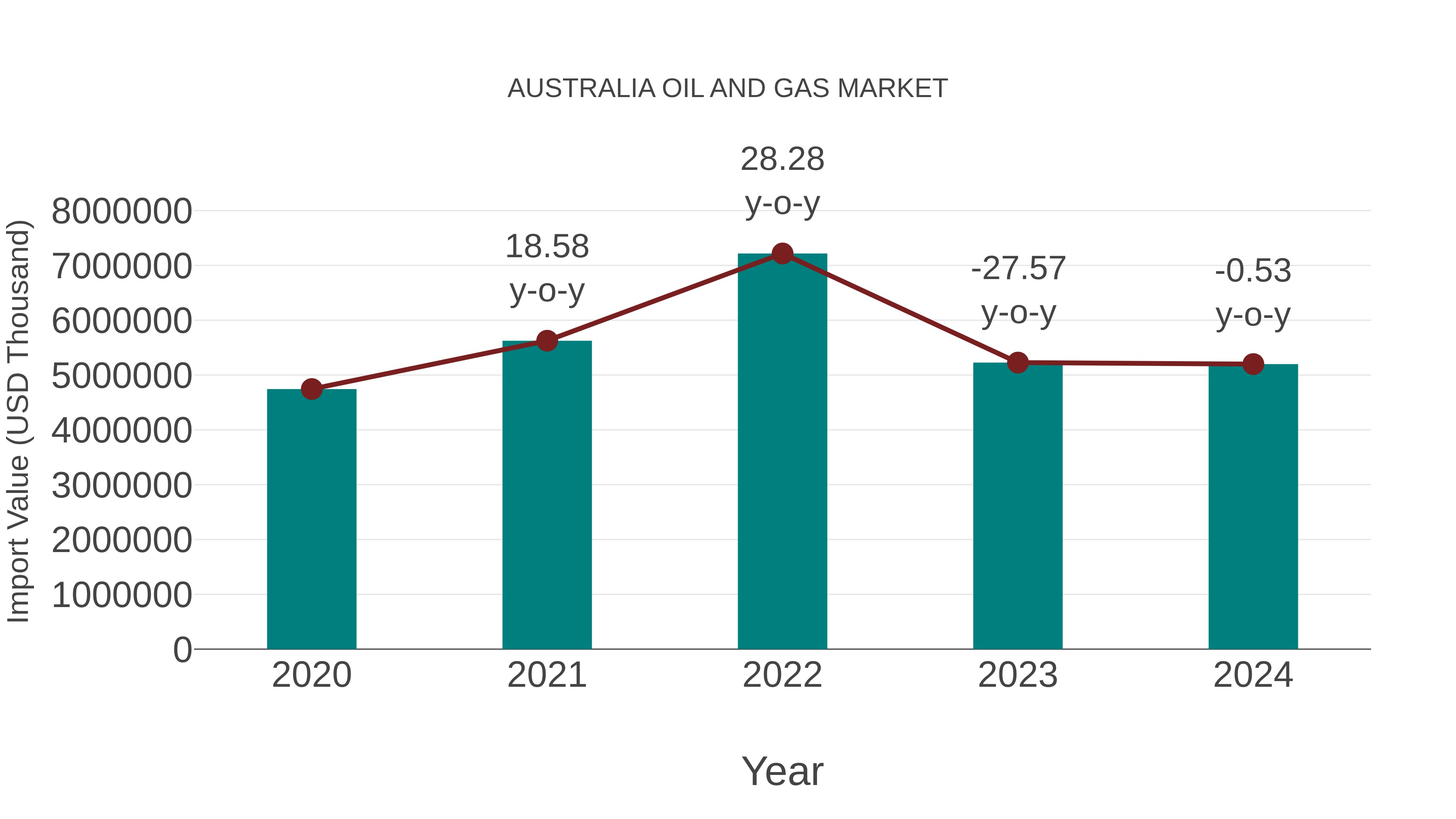
Australia Oil and Gas Market Growth Rate
According to 6Wresearch internal database and industry insights, the Australia Oil and Gas Market is projected to grow at a compound annual growth rate (CAGR) of 5.7% during the forecast period (2026-2032).
Five-Year Growth Trajectory of the Australia Oil and Gas Market with Core Drivers
Below mentioned are the evaluation of years-wise growth rate along with key growth drivers:
| Year | CAGR (%) | Growth Drivers |
| 2021 | 1.9 | Gradual recovery in upstream activity and stable LNG export demand |
| 2022 | 2.4 | Higher LNG utilization rates and renewed offshore maintenance investments |
| 2023 | 3.3 | Expansion of gas processing capacity and improved pipeline efficiency |
| 2024 | 3.9 | Policy clarity supporting gas as a transition fuel and LNG asset optimization |
| 2025 | 4.7 | Strengthening domestic gas security focus and midstream infrastructure upgrades |
Topics Covered in the Australia Oil and Gas Market Report
The Australia Oil and Gas Market report thoroughly covers the market by type. The market report provides an unbiased and detailed analysis of ongoing market trends, opportunities/high growth areas, and market drivers, which help stakeholders devise and align their market strategies according to the current and future market dynamics.
Australia Oil and Gas Market Highlights
| Report Name | Australia Oil and Gas Market |
| Forecast period | 2026-2032 |
| CAGR | 5.7% |
| Growing Sector | LNG Development |
Australia Oil and Gas Market Synopsis
Australia Oil and Gas Market is anticipated to record steady growth supported by strong LNG export positioning, continuous upstream gas development, and modernization of midstream logistics that enhances domestic supply reliability. Apart from this, the market benefits from long-term gas supply strategies, increased investment in offshore safety and integrity, and the role of gas in supporting industrial energy needs and grid stability. In addition to this, emissions management frameworks are encouraging operators to capitalize in efficiency-driven upgrades and lower-emission operations across the oil and gas value chain.
Evaluation of Growth Drivers in the Australia Oil and Gas Market
Below mentioned are some prominent drivers and their influence to the market dynamics:
| Drivers | Primary Segments Affected | Why it Matters (Evidence) |
| LNG Export Demand and Long-Term Contracts | Upstream; Midstream | Stable LNG demand supports continued production, processing upgrades, and export infrastructure utilization. |
| Domestic Gas Security Measures | Midstream; Downstream | Focus on local gas availability improves confidence for pipeline, storage, and processing investments. |
| Offshore Regulatory Modernization | Upstream | Enhanced safety and compliance standards encourage investment in asset integrity and operational reliability. |
| Emissions Management Frameworks | All Types | Facilities invest in efficiency and emission reduction projects to maintain operational competitiveness. |
| Expansion of Gas Processing Capacity | Midstream | Improved processing capability reduces bottlenecks and strengthens supply to industrial consumers. |
Australia Oil and Gas Market is expected to grow at the CAGR of 5.7% during the forecast period of 2026-2032. Due to LNG-linked upstream activity, domestic gas supply reliability initiatives, and continued investments in midstream efficiency and infrastructure modernization, the growth of this industry is expected to maintain its upward momentum. Besides, the government-backed gas security mechanisms and infrastructure-led programs are strengthening domestic supply chains while supporting price stability for industrial and power generation consumers.
Evaluation of Restraints in the Australia Oil and Gas Market
Below mentioned are some major restraints and their influence to the market dynamics:
| Restraints | Primary Segments Affected | What This Means (Evidence) |
| High Emissions Compliance Costs | Midstream; Downstream | Increased spending on abatement measures impacts operating margins. |
| Offshore Project Approval Complexity | Upstream | Extended regulatory procedures can delay project execution timelines. |
| Regional Domestic Gas Price Volatility | Midstream; Downstream | Unstable pricing largely stimulates contracting and long-term supply planning. |
| Cost Inflation in Offshore Services | Upstream | Accelerating service and equipment costs highly compels project economics. |
| Community and Environmental Scrutiny | All Types | Growth in stakeholder expectations necessitates higher compliance and reporting efforts. |
Australia Oil and Gas Industry Challenges
The growth potential for the Australia Oil and Gas Industry is expected to remain significant. However, there are a few impediments which could hamper its growth such as managing emissions compliance alongside production goals, circumnavigating complex offshore regulatory frameworks, and maintaining cost efficiency in between inflationary pressures. Other hinderances are regional gas supply tightness, infrastructure constraints, and heightened environmental scrutiny as it can restrict the pace of new developments.
Australia Oil and Gas Market Trends
There are several pivotal trends which are shaping the Australia Oil and Gas Market Growth are:
- LNG Asset Optimization and Debottlenecking: Operators are focusing on brownfield expansions and reliability upgrades to enhance throughput and maximize existing asset value.
- Initiatives for Emissions Reduction: Growing investments in electrification, methane management, and efficiency retrofits help facilities align with emissions targets.
- Digitalization of Offshore Operations: Widespread adoption of remote monitoring, predictive maintenance, and automation improves safety, uptime, and cost control.
Investment Opportunities in the Australia Oil and Gas Market
There are various investment opportunities in the Australia Oil and Gas Market which includes:
- Development of Midstream Infrastructure– The development of pipelines, compression stations, and gas storage facilities to boost domestic supply dependability open new avenues for growth.
- Low-Emission LNG and Gas Operations – Huge Capitalization in carbon management solutions and efficiency technologies to support sustainable operations.
- Offshore Safety and Asset Integrity Solutions – Advanced inspection, monitoring, and maintenance services aligned with stringent safety requirements further provides opportunities and enhance market attractiveness.
Top 5 Leading Players in the Australia Oil and Gas Market
Some leading players dominating the Australia Oil and Gas Market Share include:
1. Woodside Energy Group Ltd
| Company Name | Woodside Energy Group Ltd |
|---|---|
| Established Year | 1954 |
| Headquarters | Perth, Australia |
| Official Website | Click Here |
Woodside Energy Group Ltd is a leading Australian oil and gas producer with strong upstream operations and integrated LNG export capabilities, supporting both domestic and regional energy demand.
2. Santos Ltd
| Company Name | Santos Ltd |
|---|---|
| Established Year | 1954 |
| Headquarters | Adelaide, Australia |
| Official Website | Click Here |
Santos Ltd operates across upstream gas production, LNG development, and domestic supply infrastructure, with a strong focus on reliable and efficient energy delivery.
3. Chevron Australia Pty Ltd
| Company Name | Chevron Australia Pty Ltd |
|---|---|
| Established Year | 1879 |
| Headquarters | San Ramon, USA |
| Official Website | Click Here |
Chevron Australia plays a significant role in Australia’s LNG sector, contributing large-scale gas production capacity and long-term export operations.
4. ExxonMobil Australia
| Company Name | ExxonMobil Australia |
|---|---|
| Established Year | 1870 |
| Headquarters | Spring, USA |
| Official Website | Click Here |
ExxonMobil Australia supports the country’s oil and gas market through upstream asset participation and technical expertise across production and supply chains.
5. Shell Australia Pty Ltd
| Company Name | Shell Australia Pty Ltd |
|---|---|
| Established Year | 1907 |
| Headquarters | London, United Kingdom |
| Official Website | Click Here |
Shell Australia Pty Ltd is actively involved in LNG and integrated gas operations, supporting efficient project execution and the deployment of advanced energy solutions.
Government Regulations Introduced in the Australia Oil and Gas Market
According to Australian Government Data, the introduction of several initiatives is supporting the oil and gas sector. Main example includes the Future Gas Strategy which outlines the role of gas in ensuring energy security, affordability, and emissions reduction. Apart from this, gas market review mechanisms focus on improving domestic supply availability and price transparency. Offshore petroleum operations are regulated through strict safety and environmental frameworks, encouraging responsible development and operational compliance.
Future Insights of the Australia Oil and Gas Market
In the future years, the outlook for the Australia Oil and Gas Market is expected to look promising on account of continued LNG export demand, rising domestic gas reliability initiatives, and increasing investment in efficiency-driven operations. Apart from this, there will increasing emphasis on emissions reduction, digitalization, and infrastructure resilience which in turn creates long-term growth opportunities across upstream, midstream, and downstream segments.
Market Segmentation Analysis
The report offers a comprehensive study of the subsequent market segments and their leading categories.
Upstream to Dominate the Market – By Type
According to Rahul, Senior Research Analyst, 6Wresearch, the Upstream segment holds the largest market share in the Australia Oil and Gas Market. This dominance is driven by strong gas production capacity, offshore field development activities, and LNG-linked supply requirements that sustain investments in exploration, drilling, and production optimization.
Key Attractiveness of the Report
- 10 Years of Market Numbers.
- Historical Data Starting from 2022 to 2025.
- Base Year: 2025.
- Forecast Data until 2032.
- Key Performance Indicators Impacting the Market.
- Major Upcoming Developments and Projects.
Key Highlights of the Report:
- Australia Oil and Gas Market Outlook
- Market Size of Australia Oil and Gas Market, 2025
- Forecast of Australia Oil and Gas Market, 2032
- Historical Data and Forecast of Australia Oil and Gas Revenues & Volume for the Period 2022- 2032
- Australia Oil and Gas Market Trend Evolution
- Australia Oil and Gas Market Drivers and Challenges
- Australia Oil and Gas Price Trends
- Australia Oil and Gas Porter's Five Forces
- Australia Oil and Gas Industry Life Cycle
- Historical Data and Forecast of Australia Oil and Gas Market Revenues & Volume By Type for the Period 2022- 2032
- Historical Data and Forecast of Australia Oil and Gas Market Revenues & Volume By Upstream for the Period 2022- 2032
- Historical Data and Forecast of Australia Oil and Gas Market Revenues & Volume By Midstream for the Period 2022- 2032
- Historical Data and Forecast of Australia Oil and Gas Market Revenues & Volume By Downstream for the Period 2022- 2032
- Australia Oil and Gas Import Export Trade Statistics
- Market Opportunity Assessment By Type
- Australia Oil and Gas Top Companies Market Share
- Australia Oil and Gas Competitive Benchmarking By Technical and Operational Parameters
- Australia Oil and Gas Company Profiles
- Australia Oil and Gas Key Strategic Recommendations
Market Covered
The report offers a comprehensive study of the subsequent market segments:
By Type
- Upstream
- Midstream
- Downstream
Australia Oil and Gas Market (2026-2032): FAQs
Australia Oil and Gas Market is projected to grow at a CAGR of 5.7% between 2026-2032.
Growth is driven by sustained LNG export demand, domestic gas reliability initiatives, and investments in upstream and midstream efficiency.
Key challenges are Emissions compliance requirements, offshore regulatory complexity, and regional gas supply constraints.
Key trends are rising focus on LNG asset optimization, emissions reduction initiatives, and digitalization of offshore operations are shaping the industry landscape.
6Wresearch actively monitors the Australia Oil and Gas Market and publishes its comprehensive annual report, highlighting emerging trends, growth drivers, revenue analysis, and forecast outlook. Our insights help businesses to make data-backed strategic decisions with ongoing market dynamics. Our analysts track relevent industries related to the Australia Oil and Gas Market, allowing our clients with actionable intelligence and reliable forecasts tailored to emerging regional needs.
Yes, we provide customisation as per your requirements. To learn more, feel free to contact us on sales@6wresearch.com
| 1 Executive Summary |
| 2 Introduction |
| 2.1 Key Highlights of the Report |
| 2.2 Report Description |
| 2.3 Market Scope & Segmentation |
| 2.4 Research Methodology |
| 2.5 Assumptions |
| 3 Australia Oil and Gas Market Overview |
| 3.1 Australia Country Macro Economic Indicators |
| 3.2 Australia Oil and Gas Market Revenues & Volume, 2022 & 2032F |
| 3.3 Australia Oil and Gas Market - Industry Life Cycle |
| 3.4 Australia Oil and Gas Market - Porter's Five Forces |
| 3.5 Australia Oil and Gas Market Revenues & Volume Share, By Type, 2022 & 2032F |
| 4 Australia Oil and Gas Market Dynamics |
| 4.1 Impact Analysis |
| 4.2 Market Drivers |
| 4.2.1 Increasing energy demand in Australia |
| 4.2.2 Growth in exploration and production activities |
| 4.2.3 Technological advancements in the oil and gas sector |
| 4.3 Market Restraints |
| 4.3.1 Environmental concerns and regulations |
| 4.3.2 Volatility in global oil prices |
| 4.3.3 Competition from alternative energy sources |
| 5 Australia Oil and Gas Market Trends |
| 6 Australia Oil and Gas Market, By Types |
| 6.1 Australia Oil and Gas Market, By Type |
| 6.1.1 Overview and Analysis |
| 6.1.2 Australia Oil and Gas Market Revenues & Volume, By Type, 2022- 2032F |
| 6.1.3 Australia Oil and Gas Market Revenues & Volume, By Upstream, 2022- 2032F |
| 6.1.4 Australia Oil and Gas Market Revenues & Volume, By Midstream, 2022- 2032F |
| 6.1.5 Australia Oil and Gas Market Revenues & Volume, By Downstream, 2022- 2032F |
| 7 Australia Oil and Gas Market Import-Export Trade Statistics |
| 7.1 Australia Oil and Gas Market Export to Major Countries |
| 7.2 Australia Oil and Gas Market Imports from Major Countries |
| 8 Australia Oil and Gas Market Key Performance Indicators |
| 8.1 Rig count in Australia |
| 8.2 Investment in oil and gas infrastructure |
| 8.3 Exploration and drilling success rates |
| 9 Australia Oil and Gas Market - Opportunity Assessment |
| 9.1 Australia Oil and Gas Market Opportunity Assessment, By Type, 2022 & 2032F |
| 10 Australia Oil and Gas Market - Competitive Landscape |
| 10.1 Australia Oil and Gas Market Revenue Share, By Companies, 2022-2032F |
| 10.2 Australia Oil and Gas Market Competitive Benchmarking, By Operating and Technical Parameters |
| 11 Company Profiles |
| 12 Recommendations |
| 13 Disclaimer |
Export potential assessment - trade Analytics for 2030
Export potential enables firms to identify high-growth global markets with greater confidence by combining advanced trade intelligence with a structured quantitative methodology. The framework analyzes emerging demand trends and country-level import patterns while integrating macroeconomic and trade datasets such as GDP and population forecasts, bilateral import–export flows, tariff structures, elasticity differentials between developed and developing economies, geographic distance, and import demand projections. Using weighted trade values from 2020–2024 as the base period to project country-to-country export potential for 2030, these inputs are operationalized through calculated drivers such as gravity model parameters, tariff impact factors, and projected GDP per-capita growth. Through an analysis of hidden potentials, demand hotspots, and market conditions that are most favorable to success, this method enables firms to focus on target countries, maximize returns, and global expansion with data, backed by accuracy.
By factoring in the projected importer demand gap that is currently unmet and could be potential opportunity, it identifies the potential for the Exporter (Country) among 190 countries, against the general trade analysis, which identifies the biggest importer or exporter.
To discover high-growth global markets and optimize your business strategy:
Click Here
Pricing
- Single User License$ 1,995
- Department License$ 2,400
- Site License$ 3,120
- Global License$ 3,795

Search
Thought Leadership and Analyst Meet





Our Clients








Latest Reports
- Taiwan Food Delivery Platform Market (2026-2032) | Companies, Outlook, Analysis, Trends, Value, Revenue, Segmentation, Share, Forecast, Competitive Landscape, Growth, Size & Forecast
- United Kingdom (UK) Long-term Care Insurance Market (2026-2032) | Growth, Share, Consumer Insights, Drivers, Opportunities, Competition, Pricing Analysis, Segments, Restraints, Companies, Competitive, Value, Outlook, Size, Demand, Analysis, Challenges, Strategic Insights, Investment Trends, Revenue, Trends, Supply, Forecast
- United Kingdom (UK) Long Term Care Market (2026-2032) | Companies, Outlook, Analysis, Trends, Value, Revenue, Segmentation, Share, Forecast, Competitive Landscape, Growth, Size & Forecast
- Iraq Insulation and Waterproofing Market (2026-2032) | Outlook, Drivers, Growth, Size, Share, Industry, Revenue, Trends, Demand, Competitive, Strategic Insights, Opportunities, Segments, Companies, Challenges, Strategy, Consumer Insights, Analysis, Investment Trends, Value, Segmentation, Forecast, Restraints
- India Switchgear Market Outlook (2026-2032) | Size, Share, Trends, Growth, Revenue, Forecast, Analysis, Value, Outlook
- Pakistan Contraceptive Implants Market (2025-2031) | Demand, Growth, Size, Share, Industry, Pricing Analysis, Competitive, Strategic Insights, Strategy, Consumer Insights, Analysis, Investment Trends, Opportunities, Revenue, Segments, Value, Segmentation, Supply, Forecast, Restraints, Outlook, Competition, Drivers, Trends, Companies, Challenges
- Sri Lanka Packaging Market (2026-2032) | Outlook, Competition, Drivers, Trends, Demand, Pricing Analysis, Competitive, Strategic Insights, Companies, Challenges, Strategy, Consumer Insights, Analysis, Investment Trends, Opportunities, Growth, Size, Share, Industry, Revenue, Segments, Value, Segmentation, Supply, Forecast, Restraints
- India Kids Watches Market (2026-2032) | Strategy, Consumer Insights, Analysis, Investment Trends, Opportunities, Growth, Size, Share, Industry, Revenue, Segments, Value, Segmentation, Supply, Forecast, Restraints, Outlook, Competition, Drivers, Trends, Demand, Pricing Analysis, Competitive, Strategic Insights, Companies, Challenges
- Saudi Arabia Core Assurance Service Market (2025-2031) | Strategy, Consumer Insights, Analysis, Investment Trends, Opportunities, Growth, Size, Share, Industry, Revenue, Segments, Value, Segmentation, Supply, Forecast, Restraints, Outlook, Competition, Drivers, Trends, Demand, Pricing Analysis, Competitive, Strategic Insights, Companies, Challenges
- Romania Uninterruptible Power Supply (UPS) Market (2026-2032) | Industry, Analysis, Revenue, Size, Forecast, Outlook, Value, Trends, Share, Growth & Companies
Industry Events and Analyst Meet

India EV Show 2026

EV tech India Expo 2026

Auto Tech Asia 2026

Battery Tech India 2026

Smart Production Solutions Guangzhou 2026
Whitepaper
- Middle East & Africa Commercial Security Market Click here to view more.
- Middle East & Africa Fire Safety Systems & Equipment Market Click here to view more.
- GCC Drone Market Click here to view more.
- Middle East Lighting Fixture Market Click here to view more.
- GCC Physical & Perimeter Security Market Click here to view more.
6WResearch In News
- Doha a strategic location for EV manufacturing hub: IPA Qatar
- Demand for luxury TVs surging in the GCC, says Samsung
- Empowering Growth: The Thriving Journey of Bangladesh’s Cable Industry
- Demand for luxury TVs surging in the GCC, says Samsung
- Video call with a traditional healer? Once unthinkable, it’s now common in South Africa
- Intelligent Buildings To Smooth GCC’s Path To Net Zero


