Australia Olive Oil Market (2026-2032) | Value, Size, Forecast, Growth, Share, Analysis, Revenue, Industry, Trends & Companies
Market Forecast By Nature (Conventional, Organic), By Type (Virgin Olive Oil, Refined Olive Oil, Extra Virgin Olive Oil, Olive Pomace Oil), By Distribution Channel (Supermarket/Hypermarket, Convenience stores, Online Channel, Others), By Application (Food and Beverage, Pharmaceuticals, Cosmetics, Others) And Competitive Landscape
| Product Code: ETC223055 | Publication Date: Aug 2022 | Updated Date: Feb 2026 | Product Type: Market Research Report | |
| Publisher: 6Wresearch | Author: Ravi Bhandari | No. of Pages: 70 | No. of Figures: 35 | No. of Tables: 5 |
Australia Olive Oil Market Size Growth Rate
The Australia Olive Oil Market is projected to witness mixed growth rate patterns during 2025 to 2029. The growth rate begins at 3.57% in 2025, climbs to a high of 3.58% in 2026, and moderates to 2.88% by 2029.
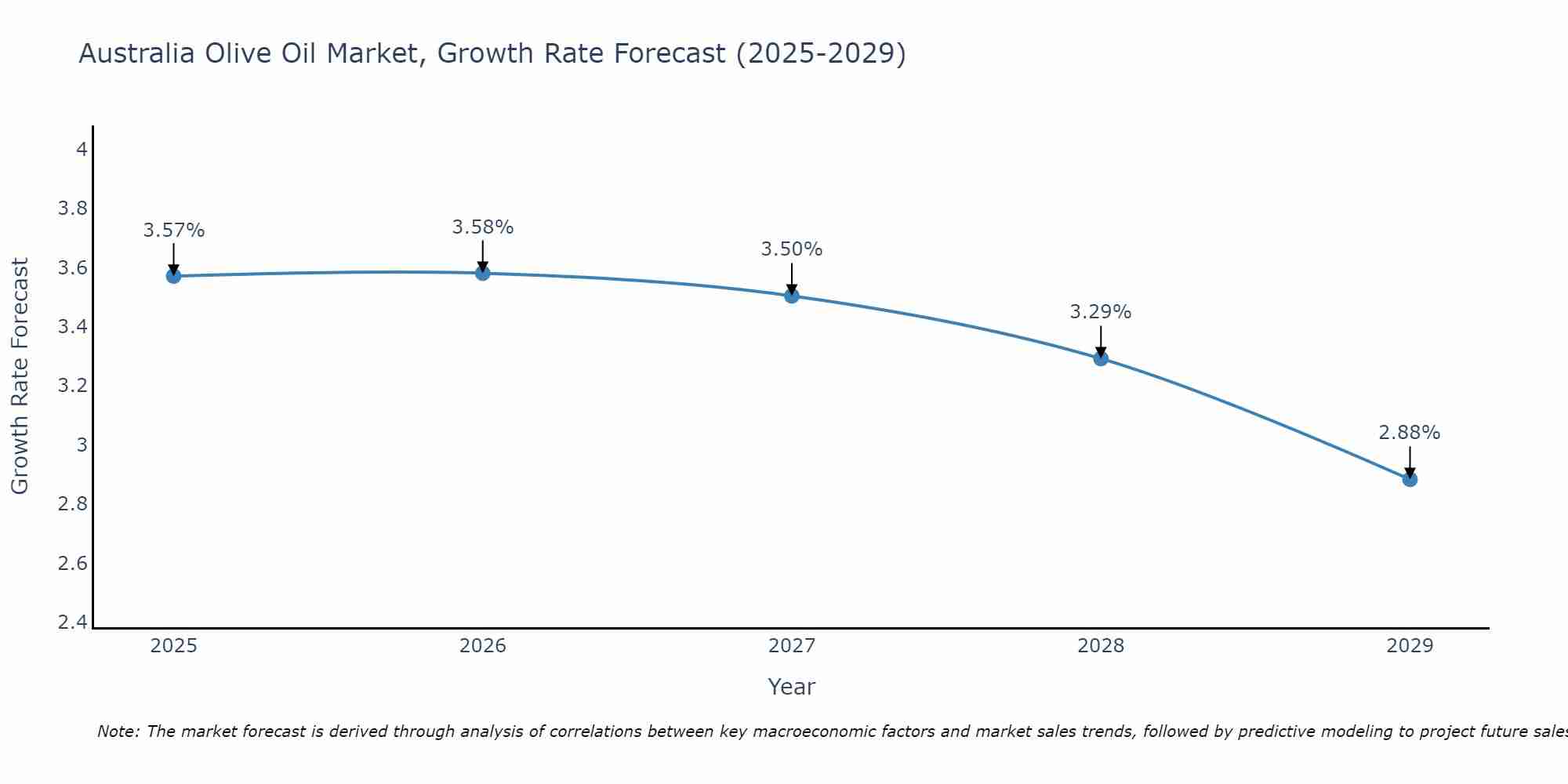
Australia Olive Oil Market Growth Rate
According to 6Wresearch internal database and industry insights, the Australia Olive Oil Market is projected to grow at a compound annual growth rate (CAGR) of 7.6% during the forecast period 2026–2032.
Topics Covered in the Australia Olive Oil Market Report
The Australia Olive Oil Market report thoroughly covers the market by nature, type, distribution channel, and application. It provides an unbiased and detailed analysis of ongoing market trends, opportunities, challenges, and market drivers, helping stakeholders align strategies with current and future market dynamics.
Australia Olive Oil Market Highlights
| Report Name | Australia Olive Oil Market |
| Forecast Period | 2026–2032 |
| CAGR | 7.6% |
| Growing Sector | Extra Virgin Olive Oil |
Australia Olive Oil Market Synopsis
The Australia Olive Oil Market is anticipated to undergo fierce growth.It is owing to increasing consumer preference for healthier dietary oils, expanding retail distribution networks, and a rising trend toward organic and premium products. Extra virgin olive oil, recognized for its superior flavor and health benefits, persist to gain popularity in both households and the foodservice industry. Market expansion is supported by rising use of olive oil in pharmaceuticals and cosmetics. The growing penetration of e‑commerce platforms has made diverse olive oil products more accessible to end‑users across urban and regional areas.
Evaluation of Growth Drivers in the Australia Olive Oil Market
Below mentioned are some prominent drivers and their influence on the Australia Olive Oil Market dynamics:
| Drivers | Primary Segment Affected | Why It Matters (Evidence) |
| Health & Wellness Trend | Food & Beverage | Transition toward heart‑healthy diets raises the need for olive oil as a preferred cooking and dressing oil. |
| Organic Product Adoption | Organic Nature | Growing awareness about health has helped in proliferating consumers to select certified organic olive oil. |
| Retail Expansion | Supermarket/Hypermarket, Online | Enhancement in product reach owing to broad obtainability across supermarkets and online stores. |
| Rising Disposable Incomes | All Segments | Increasing disposable income enables consumers to buy high-quality olive oil categories, like extra virgin. |
| Growth in Non‑Culinary Use | Pharmaceuticals & Cosmetics | Olive oil’s benefits in skin and hair care are accelerating deployment in cosmetic and pharmaceutical applications. |
The Australia Olive Oil Market is projected to grow at a CAGR of 7.6% from 2026 to 2032. The growing health consciousness among consumers and growing fixed utilisation of olive oil in diverse applications—culinary, pharmaceutical, and cosmetic—are major factors accelerating market growth. Market penetration is further supported by modern retail and online channels, making olive oil more obtainable throughout the country. The growth of the premium segment of the market is accelerating owing to the growing need for organic and sustainably sourced olive oil.
Evaluation of Restraints in the Australia Olive Oil Market
Below mentioned are some major restraints and their influence on the Australia Olive Oil Market dynamics:
| Restraints | Primary Segment Affected | What This Means (Evidence) |
| High Product Prices | Premium Olive Oil Types | Premium categories like extra virgin and organic olive oil may be less affordable for price-sensitive consumers. |
| Competition from Local Oils | Food & Beverage | Traditional and locally produced cooking oils can limit olive oil adoption among certain consumer segments. |
| Limited Consumer Awareness | Rural Consumers | The knowledge of olive oil’s benefits continues to be restricted in some regions, which limits its consumption. |
| Import Dependence | All Segments | The dependence on olive oil imports in Australia makes the market susceptible to changes in global supply and foreign exchange rates. |
| Quality Perception Issues | All Segments | Certain consumers might find olive oil less appropriate for specific cooking techniques. |
Australia Olive Oil Market Challenges
The Australia Olive Oil Industry goes through numerous challenges. It consist of rising retail costs for quality olive oils, competition from locally produced edible oils, and reliability on imported supply which can expose the market to price volatility are some of the restrictions. Complications are created as a consequence of lack of knowledge in rural regions and consumer scepticism regarding counterfeit or adulterated olive oil products. Market players should focus on consumer education, quality assurance labelling, and rise of cost‑effective product portfolios to overcome these challenges.
Australia Olive Oil Market Trends
Several notable trends shaping the Australia Olive Oil Market dynamics:
- Shift Toward Premium Oils: Owing to superior nutritional profiles and taste there is high preference for high-quality extra virgin olive oil and consumers are willing to pay a premium for higher quality products that cater health benefits.
- E-Commerce Growth: Growing sales through online channels, proliferated by convenience and broader product variety and there is rising adoption of e-commerce platforms is making it simpler for consumers to access a broad range of olive oil products.
- Organic Product Adoption: Incredible consumer inclination toward certified organic olive oils for healthier lifestyles and as consumers want transparency, the need for organic and clean-label products is growing.
- Multi-Use Applications: Rise in non-culinary applications of olive oil in cosmetics, skincare, and pharmaceuticals.
Investment Opportunities in the Australia Olive Oil Industry
Some notable investment opportunities in the Australia Olive Oil Industry are:
- Expansion of Organic Production: Rising certified organic olive oil offerings to align with growing demand and fund allocation in organic farming practices and certification programs will cater to the rising consumer preference.
- Brand Building & Marketing: Allocation of funds in marketing campaigns that highlight health benefits and quality credentials. Brand differentiation, particularly through storytelling about product origin and sustainability, can majorly affect consumer choice in a competitive market.
- Supply Chain Enhancement: Solidifying logistics and cold-chain capabilities to ensure product quality and optimizing the supply chain and augmenting distribution networks will help decrease product spoilage.
Top 5 Leading Players in the Australia Olive Oil Market
Below is the list of prominent companies leading in the Australia Olive Oil Market:
1. Cobram Estate
| Company Name | Cobram Estate |
|---|---|
| Established Year | 1988 |
| Headquarters | Victoria, Australia |
| Official Website | Click Here |
Cobram Estate is a major olive oil producer known for high quality extra virgin olive oils catering to both domestic and export markets.
2. Boundy’s Olive Company
| Company Name | Boundy’s Olive Company |
|---|---|
| Established Year | 2005 |
| Headquarters | Adelaide, Australia |
| Official Website | - |
Specializing in premium and flavored olive oils, Boundy’s has robust retail presence across supermarkets and specialty stores.
3. Olio Bello
| Company Name | Olio Bello |
|---|---|
| Established Year | 2008 |
| Headquarters | South Australia |
| Official Website | Click Here |
Olio Bello concentrates on small batch, high quality olive oils, with a strong consumer base seeking artisanal products.
4. Red Island Extra Virgin Olive Oil
| Company Name | Red Island Extra Virgin Olive Oil |
|---|---|
| Established Year | 2010 |
| Headquarters | South Australia |
| Official Website | Click Here |
Red Island provides a range of extra virgin and infused olive oils, popular in both culinary and gourmet segments.
5. Oleo Mondo
| Company Name | Oleo Mondo |
|---|---|
| Established Year | 2012 |
| Headquarters | Sydney, Australia |
| Official Website | Click Here |
Oleo Mondo is recognized for its high-quality olive oil products and innovation in retail packaging and product formats.
Government Regulations Introduced in the Australia Olive Oil Market
According to Australian government data, the government has executed quality and food safety regulations to ensure the authenticity of olive oil. Food standards set by Food Standards Australia New Zealand (FSANZ) specify labeling and purity requirements that manufacturers must meet and programs promoting agricultural sustainability and export incentives for high‑quality Australian olive oil brands support market growth. Regulations on environmental sustainability supports olive oil producers to adopt eco-friendly practices. This helps in aligning the industry having environmental objectives.
Future Insights of the Australia Olive Oil Market
The Australia Olive Oil Market Growth is expected to increase steadily, supported by rising health awareness, premiumization trends, and expanding applications beyond culinary use. As consumer demand for organic and extra virgin olive oils increases, producers are likely to introduce new product lines and fortified offerings. Retail expansion through digital and modern sales channels will further enhance accessibility. Government focus on food quality standards and sustainability certifications will continue to strengthen market credibility, opening new avenues for growth from 2026 through 2032.
Market Segmentation Analysis
The report offers a comprehensive study of the following Australia Olive Oil Market segments and their leading categories:
Extra Virgin Olive Oil to Dominate the Market – By Type
According to Parth, Senior Research Analyst at 6Wresearch, the Extra Virgin Olive Oil category is expected to lead the Australia Olive Oil Market Share owing to its superior nutritional profile and premium positioning, resulting in high consumer preference in both household and foodservice applications.
Organic to Dominate the Market – By Nature
The Organic segment is anticipated to lead owing to rising consumer inclination toward organic and clean‑label food products, driven by health and wellness trends and organic olive oil is becoming a favoured choice as concerns over pesticide use and food transparency grow.
Supermarket/Hypermarket to Dominate the Market – By Distribution Channel
The Supermarket/Hypermarket segment is anticipated to hold the largest share, supported by the expansive retail presence and consumer preference for one‑stop shopping experiences.
Food & Beverage to Dominate the Market – By Application
The Food and Beverage application segment is forecast to lead the market due to high usage of olive oil in daily cooking, salad dressings, and gourmet cuisines. As more consumers transition toward healthier cooking options, the need for olive oil, particularly extra virgin varieties, persist to increase across both household and foodservice sectors.
Key Attractiveness of the Report
- 10 Years of Market Numbers.
- Historical Data Starting from 2022 to 2025.
- Base Year: 2025.
- Forecast Data until 2032.
- Key Performance Indicators Impacting the Market.
- Major Upcoming Developments and Projects.
Key Highlights of the Report:
- Australia Olive Oil Market Outlook
- Market Size of Australia Olive Oil Market, 2025
- Forecast of Australia Olive Oil Market, 2032
- Historical Data and Forecast of Australia Olive Oil Revenues & Volume for the Period 2022-2032
- Australia Olive Oil Market Trend Evolution
- Australia Olive Oil Market Drivers and Challenges
- Australia Olive Oil Price Trends
- Australia Olive Oil Porter's Five Forces
- Australia Olive Oil Industry Life Cycle
- Historical Data and Forecast of Australia Olive Oil Market Revenues & Volume By Nature for the Period 2022-2032
- Historical Data and Forecast of Australia Olive Oil Market Revenues & Volume By Conventional for the Period 2022-2032
- Historical Data and Forecast of Australia Olive Oil Market Revenues & Volume By Organic for the Period 2022-2032
- Historical Data and Forecast of Australia Olive Oil Market Revenues & Volume By Type for the Period 2022-2032
- Historical Data and Forecast of Australia Olive Oil Market Revenues & Volume By Virgin Olive Oil for the Period 2022-2032
- Historical Data and Forecast of Australia Olive Oil Market Revenues & Volume By Refined Olive Oil for the Period 2022-2032
- Historical Data and Forecast of Australia Olive Oil Market Revenues & Volume By Extra Virgin Olive Oil for the Period 2022-2032
- Historical Data and Forecast of Australia Olive Oil Market Revenues & Volume By Olive Pomace Oil for the Period 2022-2032
- Historical Data and Forecast of Australia Olive Oil Market Revenues & Volume By Distribution Channel for the Period 2022-2032
- Historical Data and Forecast of Australia Olive Oil Market Revenues & Volume By Supermarket/Hypermarket for the Period 2022-2032
- Historical Data and Forecast of Australia Olive Oil Market Revenues & Volume By Convenience stores for the Period 2022-2032
- Historical Data and Forecast of Australia Olive Oil Market Revenues & Volume By Online Channel for the Period 2022-2032
- Historical Data and Forecast of Australia Olive Oil Market Revenues & Volume By Others for the Period 2022-2032
- Historical Data and Forecast of Australia Olive Oil Market Revenues & Volume By Application for the Period 2022-2032
- Historical Data and Forecast of Australia Olive Oil Market Revenues & Volume By Food and Beverage for the Period 2022-2032
- Historical Data and Forecast of Australia Olive Oil Market Revenues & Volume By Pharmaceuticals for the Period 2022-2032
- Historical Data and Forecast of Australia Olive Oil Market Revenues & Volume By Cosmetics for the Period 2022-2032
- Historical Data and Forecast of Australia Olive Oil Market Revenues & Volume By Others for the Period 2022-2032
- Australia Olive Oil Import Export Trade Statistics
- Market Opportunity Assessment By Nature
- Market Opportunity Assessment By Type
- Market Opportunity Assessment By Distribution Channel
- Market Opportunity Assessment By Application
- Australia Olive Oil Top Companies Market Share
- Australia Olive Oil Competitive Benchmarking By Technical and Operational Parameters
- Australia Olive Oil Company Profiles
- Australia Olive Oil Key Strategic Recommendations
Markets Covered
The market report has been segmented and sub-segmented into the following categories:
By Nature
- Conventional
- Organic
By Type
- Virgin Olive Oil
- Refined Olive Oil
- Extra Virgin Olive Oil
- Olive Pomace Oil
By Distribution Channel
- Supermarket/Hypermarket
- Convenience Stores
- Online Channel
- Others
By Application
- Food and Beverage
- Pharmaceuticals
- Cosmetics
- Others
Australia Olive Oil Market (2026-2032): FAQs
The Australia Olive Oil Market is expected to grow at a CAGR of approximately 7.6% during the forecast period from 2026 to 2032.
Rising health awareness, growing demand for premium and organic olive oil products, and expanding retail and online distribution channels are major growth drivers.
Trends include the rise of organic products, product innovations like flavoured oils and growth of online retail channels.
The main challenges consist of high product prices, competition from local oils, and limited consumer awareness in certain regions.
6Wresearch actively monitors the Australia Olive Oil Market and publishes its comprehensive annual report, highlighting emerging trends, growth drivers, revenue analysis, and forecast outlook. Our insights help businesses to make data-backed strategic decisions with ongoing market dynamics. Our analysts track relevent industries related to the Australia Olive Oil Market, allowing our clients with actionable intelligence and reliable forecasts tailored to emerging regional needs.
Yes, we provide customisation as per your requirements. To learn more, feel free to contact us on sales@6wresearch.com
| 1 Executive Summary |
| 2 Introduction |
| 2.1 Key Highlights of the Report |
| 2.2 Report Description |
| 2.3 Market Scope & Segmentation |
| 2.4 Research Methodology |
| 2.5 Assumptions |
| 3 Australia Olive Oil Market Overview |
| 3.1 Australia Country Macro Economic Indicators |
| 3.2 Australia Olive Oil Market Revenues & Volume, 2022 & 2032F |
| 3.3 Australia Olive Oil Market - Industry Life Cycle |
| 3.4 Australia Olive Oil Market - Porter's Five Forces |
| 3.5 Australia Olive Oil Market Revenues & Volume Share, By Nature, 2022 & 2032F |
| 3.6 Australia Olive Oil Market Revenues & Volume Share, By Type, 2022 & 2032F |
| 3.7 Australia Olive Oil Market Revenues & Volume Share, By Distribution Channel, 2022 & 2032F |
| 3.8 Australia Olive Oil Market Revenues & Volume Share, By Application, 2022 & 2032F |
| 4 Australia Olive Oil Market Dynamics |
| 4.1 Impact Analysis |
| 4.2 Market Drivers |
| 4.2.1 Increasing consumer awareness about the health benefits of olive oil |
| 4.2.2 Growing demand for premium and organic olive oil products |
| 4.2.3 Rising popularity of Mediterranean cuisine in Australia |
| 4.3 Market Restraints |
| 4.3.1 Fluctuations in olive oil production due to weather conditions |
| 4.3.2 Competition from other cooking oils like canola and sunflower oil |
| 4.3.3 Price volatility in the global olive oil market |
| 5 Australia Olive Oil Market Trends |
| 6 Australia Olive Oil Market, By Types |
| 6.1 Australia Olive Oil Market, By Nature |
| 6.1.1 Overview and Analysis |
| 6.1.2 Australia Olive Oil Market Revenues & Volume, By Nature, 2022-2032F |
| 6.1.3 Australia Olive Oil Market Revenues & Volume, By Conventional, 2022-2032F |
| 6.1.4 Australia Olive Oil Market Revenues & Volume, By Organic, 2022-2032F |
| 6.2 Australia Olive Oil Market, By Type |
| 6.2.1 Overview and Analysis |
| 6.2.2 Australia Olive Oil Market Revenues & Volume, By Virgin Olive Oil, 2022-2032F |
| 6.2.3 Australia Olive Oil Market Revenues & Volume, By Refined Olive Oil, 2022-2032F |
| 6.2.4 Australia Olive Oil Market Revenues & Volume, By Extra Virgin Olive Oil, 2022-2032F |
| 6.2.5 Australia Olive Oil Market Revenues & Volume, By Olive Pomace Oil, 2022-2032F |
| 6.3 Australia Olive Oil Market, By Distribution Channel |
| 6.3.1 Overview and Analysis |
| 6.3.2 Australia Olive Oil Market Revenues & Volume, By Supermarket/Hypermarket, 2022-2032F |
| 6.3.3 Australia Olive Oil Market Revenues & Volume, By Convenience stores, 2022-2032F |
| 6.3.4 Australia Olive Oil Market Revenues & Volume, By Online Channel, 2022-2032F |
| 6.3.5 Australia Olive Oil Market Revenues & Volume, By Others, 2022-2032F |
| 6.4 Australia Olive Oil Market, By Application |
| 6.4.1 Overview and Analysis |
| 6.4.2 Australia Olive Oil Market Revenues & Volume, By Food and Beverage, 2022-2032F |
| 6.4.3 Australia Olive Oil Market Revenues & Volume, By Pharmaceuticals, 2022-2032F |
| 6.4.4 Australia Olive Oil Market Revenues & Volume, By Cosmetics, 2022-2032F |
| 6.4.5 Australia Olive Oil Market Revenues & Volume, By Others, 2022-2032F |
| 7 Australia Olive Oil Market Import-Export Trade Statistics |
| 7.1 Australia Olive Oil Market Export to Major Countries |
| 7.2 Australia Olive Oil Market Imports from Major Countries |
| 8 Australia Olive Oil Market Key Performance Indicators |
| 8.1 Consumer adoption rate of olive oil in cooking |
| 8.2 Percentage of households using olive oil as their primary cooking oil |
| 8.3 Number of new product launches in the premium and organic olive oil segment |
| 8.4 Average retail price of olive oil compared to other cooking oils |
| 8.5 Frequency of olive oil consumption in restaurants and food service establishments |
| 9 Australia Olive Oil Market - Opportunity Assessment |
| 9.1 Australia Olive Oil Market Opportunity Assessment, By Nature, 2022 & 2032F |
| 9.2 Australia Olive Oil Market Opportunity Assessment, By Type, 2022 & 2032F |
| 9.3 Australia Olive Oil Market Opportunity Assessment, By Distribution Channel, 2022 & 2032F |
| 9.4 Australia Olive Oil Market Opportunity Assessment, By Application, 2022 & 2032F |
| 10 Australia Olive Oil Market - Competitive Landscape |
| 10.1 Australia Olive Oil Market Revenue Share, By Companies, 2025 |
| 10.2 Australia Olive Oil Market Competitive Benchmarking, By Operating and Technical Parameters |
| 11 Company Profiles |
| 12 Recommendations |
| 13 Disclaimer |
Export potential assessment - trade Analytics for 2030
Export potential enables firms to identify high-growth global markets with greater confidence by combining advanced trade intelligence with a structured quantitative methodology. The framework analyzes emerging demand trends and country-level import patterns while integrating macroeconomic and trade datasets such as GDP and population forecasts, bilateral import–export flows, tariff structures, elasticity differentials between developed and developing economies, geographic distance, and import demand projections. Using weighted trade values from 2020–2024 as the base period to project country-to-country export potential for 2030, these inputs are operationalized through calculated drivers such as gravity model parameters, tariff impact factors, and projected GDP per-capita growth. Through an analysis of hidden potentials, demand hotspots, and market conditions that are most favorable to success, this method enables firms to focus on target countries, maximize returns, and global expansion with data, backed by accuracy.
By factoring in the projected importer demand gap that is currently unmet and could be potential opportunity, it identifies the potential for the Exporter (Country) among 190 countries, against the general trade analysis, which identifies the biggest importer or exporter.
To discover high-growth global markets and optimize your business strategy:
Click Here
Pricing
- Single User License$ 1,995
- Department License$ 2,400
- Site License$ 3,120
- Global License$ 3,795

Search
Thought Leadership and Analyst Meet





Our Clients








Latest Reports
- Taiwan Food Delivery Platform Market (2026-2032) | Companies, Outlook, Analysis, Trends, Value, Revenue, Segmentation, Share, Forecast, Competitive Landscape, Growth, Size & Forecast
- United Kingdom (UK) Long-term Care Insurance Market (2026-2032) | Growth, Share, Consumer Insights, Drivers, Opportunities, Competition, Pricing Analysis, Segments, Restraints, Companies, Competitive, Value, Outlook, Size, Demand, Analysis, Challenges, Strategic Insights, Investment Trends, Revenue, Trends, Supply, Forecast
- United Kingdom (UK) Long Term Care Market (2026-2032) | Companies, Outlook, Analysis, Trends, Value, Revenue, Segmentation, Share, Forecast, Competitive Landscape, Growth, Size & Forecast
- Iraq Insulation and Waterproofing Market (2026-2032) | Outlook, Drivers, Growth, Size, Share, Industry, Revenue, Trends, Demand, Competitive, Strategic Insights, Opportunities, Segments, Companies, Challenges, Strategy, Consumer Insights, Analysis, Investment Trends, Value, Segmentation, Forecast, Restraints
- India Switchgear Market Outlook (2026-2032) | Size, Share, Trends, Growth, Revenue, Forecast, Analysis, Value, Outlook
- Pakistan Contraceptive Implants Market (2025-2031) | Demand, Growth, Size, Share, Industry, Pricing Analysis, Competitive, Strategic Insights, Strategy, Consumer Insights, Analysis, Investment Trends, Opportunities, Revenue, Segments, Value, Segmentation, Supply, Forecast, Restraints, Outlook, Competition, Drivers, Trends, Companies, Challenges
- Sri Lanka Packaging Market (2026-2032) | Outlook, Competition, Drivers, Trends, Demand, Pricing Analysis, Competitive, Strategic Insights, Companies, Challenges, Strategy, Consumer Insights, Analysis, Investment Trends, Opportunities, Growth, Size, Share, Industry, Revenue, Segments, Value, Segmentation, Supply, Forecast, Restraints
- India Kids Watches Market (2026-2032) | Strategy, Consumer Insights, Analysis, Investment Trends, Opportunities, Growth, Size, Share, Industry, Revenue, Segments, Value, Segmentation, Supply, Forecast, Restraints, Outlook, Competition, Drivers, Trends, Demand, Pricing Analysis, Competitive, Strategic Insights, Companies, Challenges
- Saudi Arabia Core Assurance Service Market (2025-2031) | Strategy, Consumer Insights, Analysis, Investment Trends, Opportunities, Growth, Size, Share, Industry, Revenue, Segments, Value, Segmentation, Supply, Forecast, Restraints, Outlook, Competition, Drivers, Trends, Demand, Pricing Analysis, Competitive, Strategic Insights, Companies, Challenges
- Romania Uninterruptible Power Supply (UPS) Market (2026-2032) | Industry, Analysis, Revenue, Size, Forecast, Outlook, Value, Trends, Share, Growth & Companies
Industry Events and Analyst Meet

India EV Show 2026

EV tech India Expo 2026

Auto Tech Asia 2026

Battery Tech India 2026

Smart Production Solutions Guangzhou 2026
Whitepaper
- Middle East & Africa Commercial Security Market Click here to view more.
- Middle East & Africa Fire Safety Systems & Equipment Market Click here to view more.
- GCC Drone Market Click here to view more.
- Middle East Lighting Fixture Market Click here to view more.
- GCC Physical & Perimeter Security Market Click here to view more.
6WResearch In News
- Doha a strategic location for EV manufacturing hub: IPA Qatar
- Demand for luxury TVs surging in the GCC, says Samsung
- Empowering Growth: The Thriving Journey of Bangladesh’s Cable Industry
- Demand for luxury TVs surging in the GCC, says Samsung
- Video call with a traditional healer? Once unthinkable, it’s now common in South Africa
- Intelligent Buildings To Smooth GCC’s Path To Net Zero


