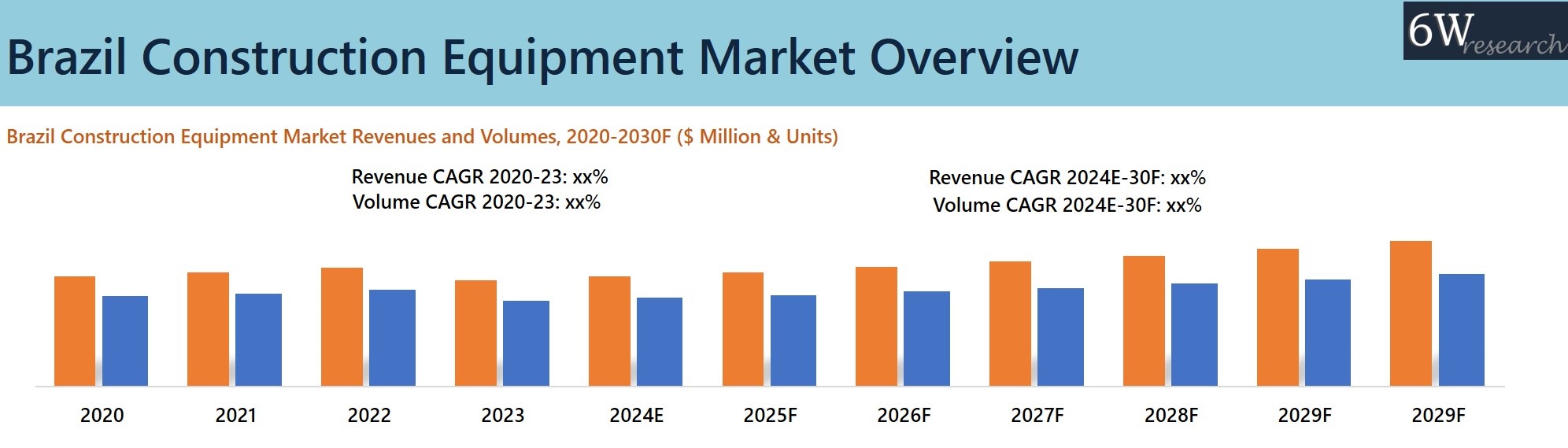
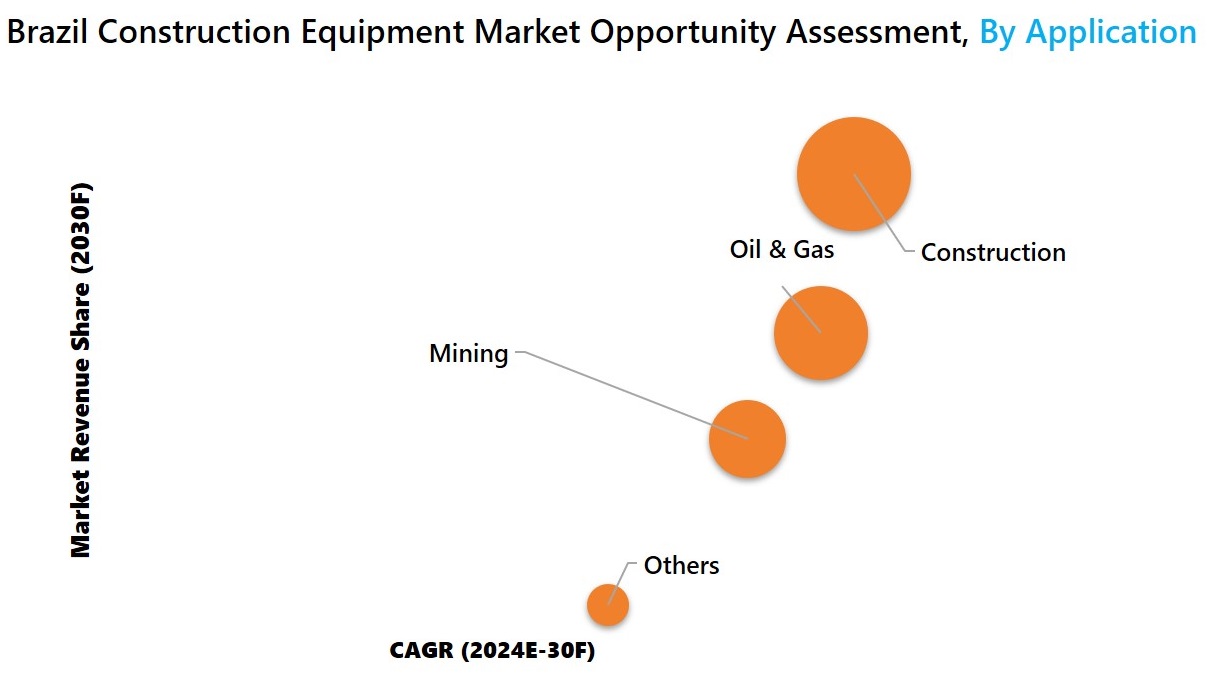
Brazil Construction Equipment Market Size & Growth Rate
According to 6Wresearch internal database and industry insights, the Brazil Construction Equipment Market was valued at USD 3.85 Billion in 2025 and is projected to reach USD 5.87 Billion by 2032, growing at a CAGR of approximately 6.2% during 2026–2032.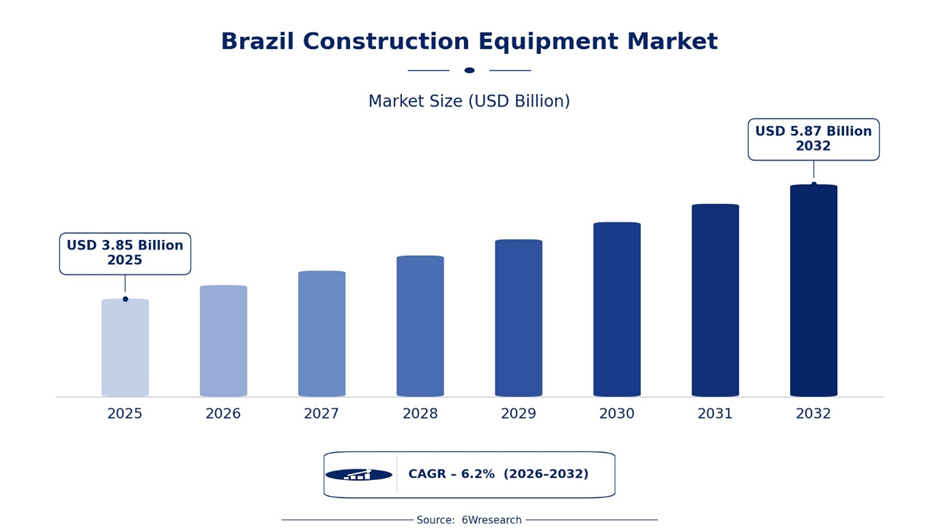
Brazil Construction Equipment Market Highlights
|
Report Metric |
Details |
|
Report Name |
Brazil Construction Equipment Market (2026-2032) |
|
Market Size 2025 |
USD 3.85 Billion |
|
Market Size 2032 |
USD 5.87 Billion |
|
Absolute Growth 2025–2032 |
USD 2.02 Billion |
|
CAGR 2026–2032 |
6.2% |
|
Peak Annual Growth |
6.8% in 2029 |
|
Forecast Period |
2026–2032 |
|
Historical Data |
2022–2025 |
|
Base Year |
2025 |
|
Leading Type, 2025 |
Earthmoving Equipment (24% share) |
|
Fastest-Growing Type |
Aerial Work Equipment (8.1% CAGR) |
|
Leading Application, 2025 |
Corporate Enterprise (38% share) |
|
Fastest-Growing Application |
Mining (7.5% CAGR) |
|
Growing Sector |
Mining |
|
Key End Users |
Construction contractors, mining operators, oil and gas operators, equipment rental companies, infrastructure concessionaires, state and municipal road authorities |
Brazil Construction Equipment Market Year-wise Growth Rate and Key Drivers (2022–2032)
This graph illustrates the annual growth rates of the market from 2022 to 2032, highlighting a steady upward trajectory and projected market expansion over the forecast period.
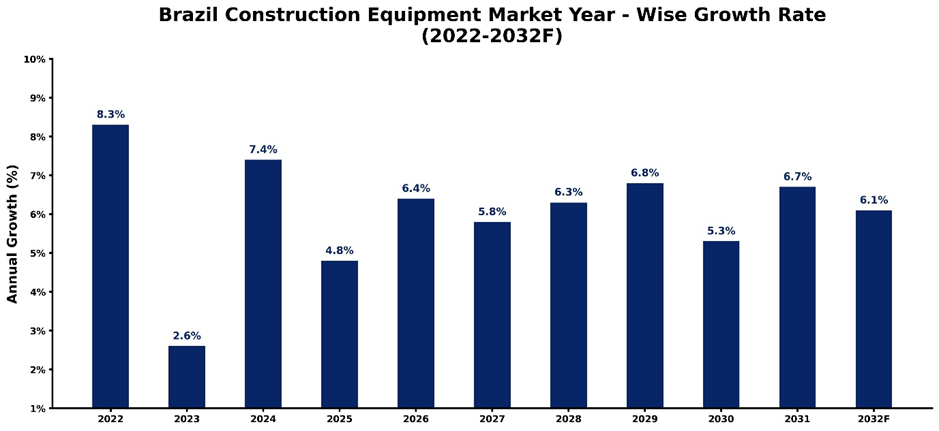
The following table presents the estimated annual growth rate for each year together with the principal factor influencing market performance. The values are intended to highlight year-specific drivers rather than to provide a direct comparison between individual years.
| Year | Estimated Annual Growth (%) | Market Rationale |
| 2022 | 8.3% | Post-pandemic reopening, firm commodity prices and election-year public works spending lifted machinery demand across Brazilian construction and mining sites. |
| 2023 | 2.6% | The Selic policy rate remained above 11 percent throughout the year, raising borrowing costs and delaying equipment purchases. |
| 2024 | 7.4% | Reconstruction after the May 2024 Rio Grande do Sul floods and the first Novo PAC project starts revived earthmoving orders. |
| 2025 | 4.8% | A weaker real raised imported machine and component prices, moderating replacement purchases after the 2024 public works revival. |
| 2026 | 6.4% | Gradual monetary easing and wider execution of federal infrastructure and housing projects are expected to restore order momentum. |
| 2027 | 5.8% | A new federal term is expected to review project priorities, delaying some awards and tempering order growth. |
| 2028 | 6.3% | Road, rail and port concession auctions are scheduled to move into construction, raising heavy equipment procurement. |
| 2029 | 6.8% | Peak mobilisation of iron ore expansions and energy-transition projects is expected to drive the strongest fleet additions of the period. |
| 2030 | 5.3% | Completion of major mine expansion phases is expected to shift demand towards maintenance, rebuilds and rental fleets. |
| 2031 | 6.7% | Tighter off-road emission requirements are expected to prompt replacement of older machines with cleaner, electric-ready models. |
| 2032 | 6.1% | Fleet renewal cycles are expected to mature as public investment settles at a steadier pace. |
Note: Market size estimations and growth projections presented in this report are based on 6Wresearch's proprietary forecasting methodology, utilizing the latest available industry data, government publications, and primary research inputs.
Brazil Construction Equipment Market Synopsis
The Brazil Construction Equipment Market is anticipated to expand, driven by federal infrastructure initiatives, mining investments and growing requirements for advanced construction machinery. Demand for earthmoving equipment, mobile cranes, bulldozers, dump trucks and road construction machinery is being reinforced by infrastructure development and large iron ore extraction operations. Pre-salt oil projects are also supporting demand for material handling and specialised equipment. Meanwhile, the expansion of equipment rental companies and manufacturing operations in São Paulo and Paraná is improving market accessibility.
Market Dynamics Impact Analysis (2026–2032)
|
Factor |
Type |
Impact |
Primary Segment Affected |
|
Federal infrastructure and housing investment pipeline |
Driver |
High |
Road Construction Equipment |
|
Iron ore and mineral expansion projects |
Driver |
High |
Dump Trucks |
|
Rental and fleet-as-a-service adoption |
Opportunity |
High |
Aerial Work Equipment |
|
Electric and low-emission machinery |
Opportunity |
Medium |
Material Handling Equipment |
|
High borrowing costs for machinery buyers |
Restraint |
High |
Earthmoving Equipment |
|
Exchange-rate volatility and imported content |
Restraint |
Medium |
Mobile Cranes |
|
Shortage of skilled operators and technicians |
Challenge |
Medium |
Construction Tractors and Bulldozers |
|
Long distances and thin service coverage in remote regions |
Challenge |
Medium |
Mining |
Evaluation of Drivers in the Brazil Construction Equipment Market (2026–2032)
Below mentioned are some major drivers and their influence on the market dynamics:
|
Drivers |
Primary Segment Affected |
Why It Matters (Evidence) |
|
Federal infrastructure and housing investment pipeline |
Road Construction Equipment |
Large multi-year programmes for highways, ports, energy and housing create sustained demand for paving and earthmoving fleets, with the Novo PAC relaunched in 2023 targeting about R$1.7 trillion in investment. |
|
Iron ore and mineral expansion projects |
Dump Trucks |
Open-pit operations need high-capacity haul and loading fleets, and Brazil ranks among the two largest iron ore producers globally with Carajás as the largest mine. |
|
Pre-salt oil and gas activity |
Mobile Cranes |
Offshore support bases, terminals and refinery works require heavy lifting capacity, and pre-salt fields supply more than 70 percent of national crude oil output. |
|
Local assembly by global manufacturers |
Earthmoving Equipment |
Domestic production shortens delivery times and reduces exposure to import costs, with Caterpillar plants at Piracicaba and Campo Largo and JCB assembly at Sorocaba. |
|
Housing construction and rental penetration |
Aerial Work Equipment |
Builders increasingly rent access platforms for facade, fit-out and industrial maintenance work, and the 2023 relaunch of Minha Casa, Minha Vida sustains residential building activity. |
Market expansion is supported by Brazil's structural infrastructure needs, growing renewable energy investments and the increasing scale of agribusiness operations. Urbanisation of around 87% is sustaining construction activity across housing, sanitation and transport networks. The rapid development of solar and wind generation facilities is increasing demand for machinery used in land clearing, foundation preparation, road building and transmission corridor development. Additionally, expanding grain and agricultural exports are driving investment in storage infrastructure, railway connectivity and inland distribution centres.
Evaluation of Restraints in the Brazil Construction Equipment Market
Below mentioned are some major restraints and their influence on the market dynamics:
|
Market Restraint |
Primary Segment Affected |
Why It Matters (Evidence) |
|
High interest rates and costly credit |
Earthmoving Equipment |
Most machines are financed, so expensive credit lengthens replacement cycles and shrinks orders, and the Selic policy rate reached 15 percent in 2025. |
|
Exchange-rate volatility and imported content |
Mobile Cranes |
Machines and key components are priced in US dollars, so a weaker real raises landed costs, and the real traded near 6 per US dollar in late 2024. |
|
Limits on public spending growth |
Road Construction Equipment |
Fiscal rules restrict discretionary investment, causing project awards to slip and contractors to postpone purchases, with the 2023 framework capping real spending growth at 2.5 percent a year. |
|
Lengthy environmental licensing |
Mining |
Licensing for mines, linear infrastructure and energy sites can take years, which delays mobilisation and defers equipment deliveries to project owners. |
|
Price competition from locally assembled Chinese brands |
Construction Tractors and Bulldozers |
Sany and XCMG operate Brazilian plants and offer lower-priced machines, which compresses margins and pushes established brands towards discounting. |
Brazil Construction Equipment Market Challenges
Despite favourable growth prospects, the Brazil Construction Equipment Market faces several challenges, including economic uncertainty, high borrowing costs and limited purchasing capacity among small contractors. A shortage of trained operators and technicians, in a sector with more than 2 million formal workers, leaves advanced machines underused and raises downtime. Distances across 8.5 million square kilometres, with thin rail coverage, inflate delivery and parts costs and slow service at remote sites. Tighter emission norms and connected-fleet features force costly model redesigns that smaller contractors struggle to absorb. Buyers also defer orders in election years such as 2026 until fiscal visibility returns.
Brazil Construction Equipment Market Trends
Notable trends influencing the Brazil Construction Equipment Industry are listed below:
- Shift from Ownership to Rental and Fleet Services: Contractors are moving away from outright purchase towards renting and leasing to protect cash flow under costly financing. Listed rental groups such as Mills are widening access platform, crane and earthmoving fleets, while manufacturers add service contracts and buy-back offers. The trend favours suppliers that can bundle finance, maintenance and telematics with machine supply.
- Transition from Diesel to Electric and Low-Emission Machines: Global manufacturers are introducing electric compact excavators and loaders, and Brazil's PROCONVE programme for off-road machinery, which began its MAR-I phase in 2015, continues to raise engine standards. Early demand comes from urban building sites and indoor logistics, giving an advantage to suppliers with battery, charging and service support.
- Digital Fleet Management Emerging as a Purchase Criterion: Customers increasingly look for pre-installed telematics, such as Komatsu's Komtrax and Caterpillar's Product Link systems, providing visibility of hours, fuel consumption and maintenance remotely. Large-scale miners and rental companies use telematics data for planning maintenance and resales. Companies failing to provide connectivity solutions may not get their equipment chosen for fleet tenders.
Investment Opportunities in the Brazil Construction Equipment Market
Key investment prospects in the Brazil Construction Equipment Market are outlined below:
- Spare Parts, Remanufacturing and Service Hubs: High cost of spare parts and high installed base of construction equipment in Brazil provide significant demand for local aftermarket capabilities. Investors may set up component reconditioning centres and spare parts depots in the States of São Paulo, Minas Gerais and Paraná, focusing on engines, hydraulics and undercarriage. It is easier to enter the market via partnerships between dealers and manufacturers' authorized remanufacturing centres.
- Mining Haulage and Support Fleets in Minas Gerais and Pará: Continuing iron ore and mineral projects around Carajás and the Quadrilátero Ferrífero need haul trucks, loaders and water and fuel support vehicles. Investors can supply or lease fleets and operate maintenance workshops on site. The usual route is a long-term service contract with mine operators, often alongside an established local dealer.
- Electric Compact Equipment Assembly in Paraná and São Paulo: Urban contractors and rental firms are seeking quieter, lower-emission machines, yet most electric models are still imported. Investment in battery pack assembly, charging infrastructure and final assembly can build on existing manufacturing clusters in Paraná and São Paulo. Partnering with an established OEM plant or a contract manufacturer reduces certification and supply chain risk.
Leading Players in Brazil Construction Equipment Market
A detailed compilation of major companies active in the Brazil Construction Equipment Market is presented below:
1. Caterpillar Inc.
|
Company Name |
Caterpillar Inc. |
|---|---|
|
Established Year |
1925 |
|
Headquarters |
Deerfield, Illinois, USA |
|
Official Website |
Caterpillar Inc. dominates the Latin American heavy construction market, operating regional manufacturing plants (such as in Brazil) and an extensive dealer network (including Finning and Cat Dealers) to supply hydraulic excavators, motor graders, bulldozers, and wheel loaders.
2. Komatsu Ltd. (Komatsu Latin America)
|
Company Name |
Komatsu Ltd. (Komatsu Latin America) |
|---|---|
|
Established Year |
1921 |
|
Headquarters |
Tokyo, Japan |
|
Official Website |
Komatsu Ltd. maintains a strong operational footprint across Central and South America, delivering hydraulic excavators, dump trucks, and earthmoving machinery supported by local assembly facilities, sales financing, and integrated machine-tracking telemetry.
3. Volvo Construction Equipment (Volvo CE Latin America)
|
Company Name |
Volvo Construction Equipment (Volvo CE Latin America) |
|---|---|
|
Established Year |
1832 |
|
Headquarters |
Gothenburg, Sweden |
|
Official Website |
Volvo CE manufactures and distributes fuel-efficient hydraulic excavators, articulated haulers, wheel loaders, and compaction equipment across Latin America, supported by a regional manufacturing base in Pederneiras, Brazil.
4. Deere & Company (John Deere Construction & Forestry)
|
Company Name |
Deere & Company (John Deere Construction & Forestry) |
|---|---|
|
Established Year |
1837 |
|
Headquarters |
Moline, Illinois, USA |
|
Official Website |
John Deere supplies heavy earthmoving machinery, backhoe loaders, crawler dozers, and road-building equipment, backed by regional manufacturing hubs and integrated dealer operations throughout the Latin American construction and forestry sectors.
Government Initiatives in the Brazil Construction Equipment Market
Federal policy support rests on the Novo PAC, relaunched in 2023 with planned investment of about R$1.7 trillion across transport, energy, housing and urban infrastructure, and on the Nova Indústria Brasil strategy launched in 2024, which committed R$300 billion in financing through 2026 for industrial modernisation and domestic machinery production. Together these programmes underpin a multi-year pipeline of civil works and industrial investment.
Implementation is led by the BNDES, whose Finame line finances domestically produced machinery, and by the Ministry of Cities through Minha Casa, Minha Vida, relaunched in 2023 with a target of two million homes by 2026. After the May 2024 floods in Rio Grande do Sul, a federal reconstruction package exceeding R$50 billion funded road, bridge and housing rebuilding, sustaining demand for earthmoving and lifting machinery.
Future Insights of the Brazil Construction Equipment Market
The Brazil Construction Equipment Market Growth is expected to expand as several developments support wider fleet modernisation and new project activity. Brazil's climate commitment to reduce emissions by 59 to 67 percent by 2035 is expected to accelerate the adoption of cleaner, electric-ready machines. Port, rail and inland terminal upgrades will improve export logistics and generate sustained civil works. Rising data centre and industrial park construction near major cities will add to building activity, while digital fleet platforms will improve machine utilisation and encourage faster replacement.
Market Segmentation Analysis
The report offers a comprehensive study of the market across its key segments. The chart below highlights the leading segment by market share in 2025 and the fastest-growing segment by CAGR over 2026–2032, followed by a detailed analysis of each segment.
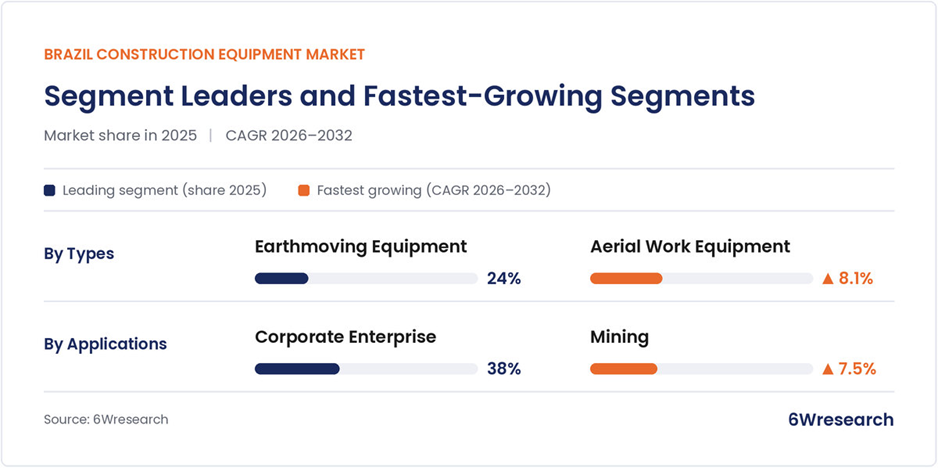
By Types – Earthmoving Equipment Leads, Aerial Work Equipment Expected to Grow Fastest
According to Ravi Bhandari, Research Head at 6Wresearch, Earthmoving Equipment captured about 24% share in 2025, supported by excavator, loader and backhoe demand from highway, housing and energy projects across Brazil and by local assembly in São Paulo and Paraná. Meanwhile, Aerial Work Equipment is projected to record the fastest CAGR of 8.1% during 2026–2032, driven by rising rental penetration, industrial plant maintenance and stricter site safety requirements in Brazilian cities.
By Applications – Corporate Enterprise Leads, Mining Expected to Grow Fastest
Corporate Enterprise accounted for the largest 2025 share at 38%, as commercial developers, industrial park owners, logistics operators and housing builders in São Paulo, Minas Gerais and the South region operate the largest private fleets in the country. On the other hand, Mining, which is projected to advance at a 7.5% CAGR during 2026–2032 on iron ore expansions in Pará and Minas Gerais and rising investment in copper, gold and critical mineral projects.
Key Attractiveness of the Report
- 10 Years of Market Numbers
- Historical Data Starting from 2022 to 2025
- Base Year 2025
- Forecast Data until 2032
- Key Performance Indicators Impacting the Market
- Major Upcoming Developments and Projects
Key Highlights of the Report:
Brazil Construction Equipment Market Overview
Brazil Construction Equipment Market Outlook
Brazil Construction Equipment Market Forecast
Historical Data and Forecast of Brazil Construction Equipment Market Revenues for the Period 2022-2032F
Historical Data and Forecast of Brazil Construction Equipment Market Revenues, By Types, for the Period 2022-2032F
Historical Data and Forecast of Brazil Construction Equipment Market Revenues, By Application, for the Period 2022-2032F
Market Drivers and Restraints
Industry Life Cycle
Porter’s Five Force
Market Trends
Key Performance Indicators
Brazil Construction Equipment Market Revenue Ranking, By Companies, 2025
Key Competitors Analysis
Competitive Benchmarking
Company Profiles
Key Strategic Recommendations
Market Covered
The report offers an extensive study of the following market segments.
By Types
- Mobile Cranes
- Construction Tractors and Bulldozers
- Earthmoving Equipment
- Aerial Work Equipment
- Material Handling Equipment
- Dump Trucks
- Road Construction Equipment
By Applications
- Corporate Enterprise
- Oil and Gas
- Mining
- Others (Municipality and Road Construction)