Cambodia Container Market (2026-2032) | Size & Revenue, Outlook, Share, Companies, Growth, Value, Industry, Segmentation, Forecast, Trends, Competitive Landscape, Analysis
Market Forecast By Product (20 Feet, 40 Feet, 45 Feet), By End-use (Food & Beverage, Consumer Goods, Industrial Goods, Healthcare, Others) And Competitive Landscape
| Product Code: ETC6610646 | Publication Date: Sep 2024 | Updated Date: Jan 2026 | Product Type: Market Research Report | |
| Publisher: 6Wresearch | Author: Sumit Sagar | No. of Pages: 75 | No. of Figures: 35 | No. of Tables: 20 |
cambodia container market
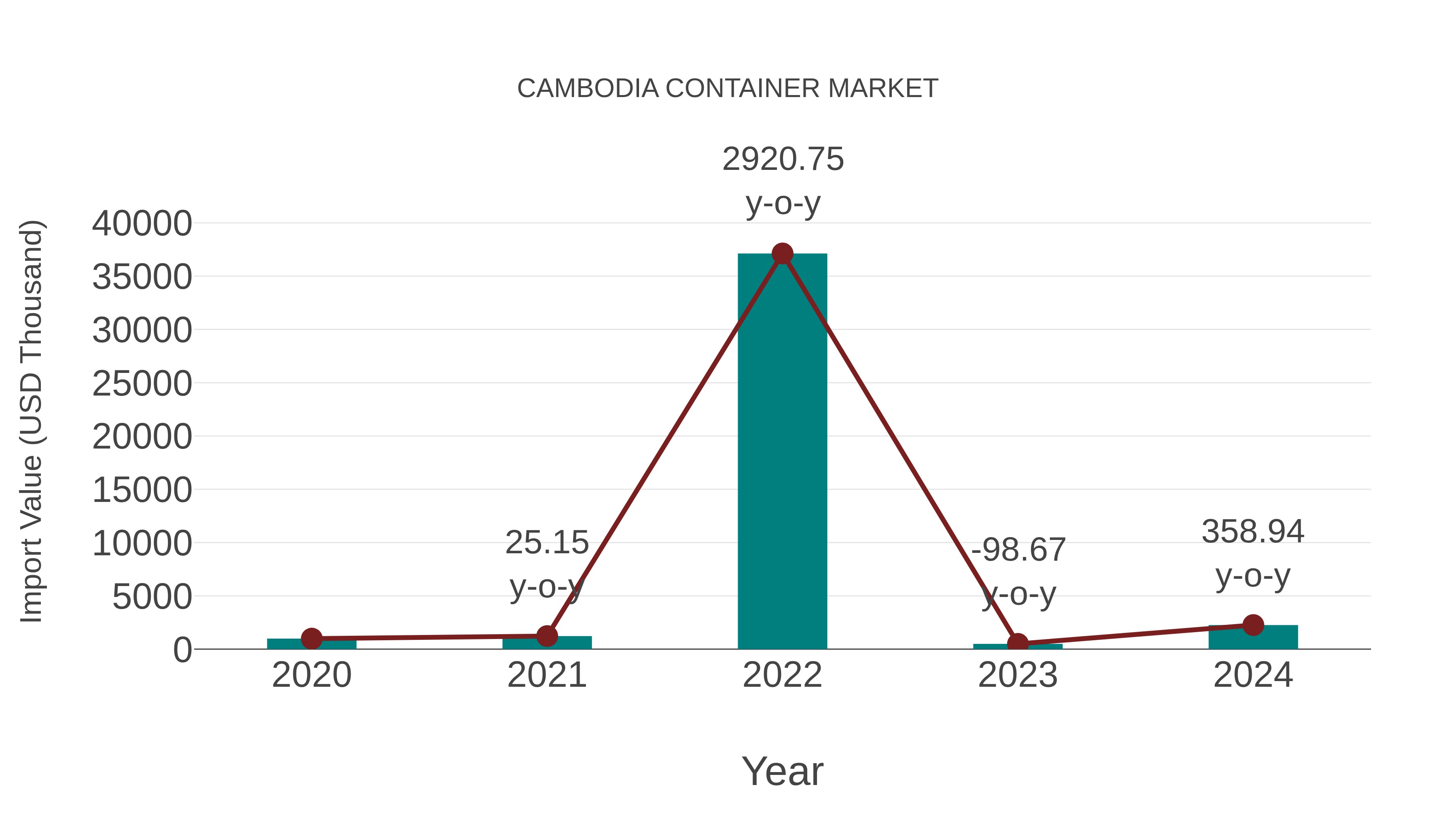
Cambodia Container Market Growth Rate
According to 6Wresearch internal database and industry insights, the Cambodia Container Market is projected to grow at a compound annual growth rate (CAGR) of 8% during the forecast period from 2026 to 2032.
Five-Year Growth Trajectory of the Cambodia Container Market with Core Drivers
Below mentioned are the evaluation of year-wise growth rate along with key drivers:
| Years | CAGR (%) | Growth Drivers |
| 2021 | 6.8 | Increasing international trade and demand for containerized shipping solutions. |
| 2022 | 7 | Upgrading transport infrastructure and expanding port facilities. |
| 2023 | 7.2 | Growing demand for containerized transport in the food & beverage sector. |
| 2024 | 7.4 | Growth in manufacturing and retail driving increased container demand. |
| 2025 | 7.8 | Increasing foreign investments and government focus on logistics and trade development. |
Topics Covered in the Cambodia Container Market Report
The Cambodia Container Market report thoroughly covers the market by product type and end-use, providing an unbiased and detailed analysis of ongoing market trends, opportunities, challenges, and market drivers, helping stakeholders align their strategies with current and future market dynamics.
Cambodia Container Market Highlights
| Report Name | Cambodia Container Market |
| Forecast period | 2026-2032 |
| CAGR | 8% |
| Growing Sector | Containers |
Cambodia Container Market Synopsis
Strong growth in the Cambodia Container Market is propelled by increasing international trade as well as government initiatives aimed at enhancing trade and logistics infrastructure within Cambodia. The demand for containers, especially from industries like food & beverage, consumer goods, and manufacturing, is increasing rapidly. The support of the Cambodian Government by developing new port facilities, improving transport infrastructure, and Cambodia geographical location within Southeast Asia will enable further growth of container shipping capabilities. The growth of these factors will continue to drive continued container growth in Cambodia for the foreseeable future.
Evaluation of Growth Drivers in the Cambodia Container Market
Below mentioned are some prominent drivers and their impact on the market dynamics:
| Drivers | Primary Segments Affected | Why It Matters (Evidence) |
| Increasing International Trade | 20 Feet, 40 Feet, 45 Feet Containers | Rising Cambodian exports in agriculture and manufacturing are boosting demand for 20- and 40-foot containers. |
| Expansion of Port Infrastructure | 20 Feet, 40 Feet, 45 Feet Containers | Improvements at key ports support higher container handling and market growth. |
| Demand from Food & Beverage Sector | 20 Feet, 40 Feet Containers | Growth in perishable food exports raises need for 20- and 40-foot containers. |
| Government Initiatives for Logistics | 20 Feet, 40 Feet, 45 Feet Containers | Container shipping is likewise increasing guest delays in construction and internet procurement. |
| Growth in Consumer Goods Manufacturing | 40 Feet, 45 Feet Containers | Growth in Cambodia’s consumer goods sector boosts demand for large export containers. |
The Cambodia Container Market is projected to grow at a CAGR of 8% from 2026 to 2032. With an increase of international trade through the expansion of port Facilities and an increasing number of containerized freight supported by food & beverages, consumer goods, and manufacturing key sectors. The Cambodia Container Market is continuing to grow. The Government is working to improve infrastructure for logistics to increase trade advantage in Cambodia's Strategic Position as one of the major countries within Southeast Asia. The growing demand for freight containers will enable Cambodia to develop into a major player within the regional logistic sector and thus help Cambodia develop into a regional hub for logistics.
Evaluation of Restraints in the Cambodia Container Market
Below mentioned are some major restraints and their influence on the market dynamics:
| Restraints | Primary Segments Affected | What This Means (Evidence) |
| High Cost of Container Purchase | 20 Feet, 40 Feet, 45 Feet Containers | Expensive containers limit access for small Cambodian businesses. |
| Limited Port Infrastructure | 20 Feet, 40 Feet, 45 Feet Containers | Handling large cargo volumes remains a challenge for ports. |
| Regulatory Barriers | All Product Segments | Strict import/export rules raise costs and slow container flow. |
| Competition from Other Southeast Asian Ports | 20 Feet, 40 Feet, 45 Feet Containers | Ports in Vietnam, Thailand, and Malaysia offer stronger competition. |
| Risk of Congestion at Major Ports | 20 Feet, 40 Feet Containers | Port Sihanoukville experiences time lags and inefficiencies from the high number of containers. |
Cambodia Container Market Challenges
The Cambodia Container Industry continues to experience several hurdles, including a lack of infrastructure outside of the main ports, resulting in congestion and delays. The high cost of renting or buying containers, especially specialized containers, limits the number of customers in certain industries. In addition, due to Cambodia small domestic market, local demand for containers is limited, leading to a greater dependence on international trade. Nevertheless, the ongoing government efforts to improve logistical infrastructure will aid in solving many of these challenges.
Cambodia Container Market Trends
Here are some major trends changing the Cambodia Container Market dynamics:
- Expansion of Port and Infrastructure Development: Major investments in Phnom Penh and Sihanoukville ports are increasing Cambodia’s container handling capacity, supporting market growth.
- Increased Demand for Specialty Containers: Increased exports of perishable items and large cargo are driving increased demand for specialty containers such as refrigerated containers for food and 45-foot containers for heavy industrial shipments.
- Increased Demand for E-Commerce and Retail: E-commerce and retail imports will continue to show significant growth in the container consumer goods sector, particularly for bulk consumer goods.
- More Government Support for Trade: By reducing bureaucratic hurdles, improving infrastructure, and developing logistics, the government aims to strengthen container transportation and the containerized shipping market.
Investment Opportunities in the Cambodia Container Market
The Cambodia Container Market presents several investment opportunities, including:
- Infrastructure Development: Enhanced port and rail facilities are fueling the rising demand for containerized shipments.
- Technology Integration in Container Tracking: as technology advances, container tracking will become more efficient through the use of digital systems that offer increased efficiency and cost savings.
- Specialized Container Manufacturing: Manufacturers currently have opportunities to manufacture specialized, refrigerated containers that meet the specific demand of customers while providing them with a cost-effective solution.
- Public-Private Partnerships: Public-private partnerships with the government enable investors and local businesses to collaborate on improving infrastructure and boosting trade.
Top 5 Leading Players in the Cambodia Container Market
Below is the list of prominent companies leading the Cambodia Container Market Share:
1. Maersk Line
| Company Name | Maersk Line |
|---|---|
| Established Year | 1904 |
| Headquarters | Copenhagen, Denmark |
| Official Website | Click Here |
Maersk is one of the world’s largest container shipping companies, providing both container transportation and logistics services across global trade routes, including Cambodia.
2. CMA CGM Group
| Company Name | CMA CGM Group |
|---|---|
| Established Year | 1978 |
| Headquarters | Marseille, France |
| Official Website | Click Here |
CMA CGM is a major player in the global container shipping market, with extensive operations in Southeast Asia, including Cambodia, offering containerized transport solutions for a range of industries.
3. China COSCO Shipping Corporation
| Company Name | China COSCO Shipping Corporation |
|---|---|
| Established Year | 2016 |
| Headquarters | Shanghai, China |
| Official Website | Click Here |
As one of the largest shipping companies globally, COSCO provides a wide range of container services across Cambodia, facilitating international trade and container handling services.
4. Evergreen Marine Corporation
| Company Name | Evergreen Marine Corporation |
|---|---|
| Established Year | 1968 |
| Headquarters | Taoyuan City, Taiwan |
| Official Website | Click Here |
Evergreen is a leading global shipping company with a strong presence in Cambodia, focusing on containerized transportation and logistics services across Southeast Asia.
5. Panalpina
| Company Name | Panalpina |
|---|---|
| Established Year | 1895 |
| Headquarters | Basel, Switzerland |
| Official Website | Click Here |
Panalpina is a logistics company offering a variety of containerized shipping services, including freight forwarding and transportation solutions in Cambodia and across global markets.
Government Regulations Introduced in the Cambodia Container Market
According to Cambodian Government data, the government initiated measures designed to promote better logistics and container handling through reduced import, export tariffs and the enhancement of port infrastructure. Additionally, customs modernisation has improved international trade and enhanced Cambodia's ability to compete in the global marketplace for trade, with the development of key projects such as the Sihanoukville and Phnom Penh ports, including support for the container market.
Future Insights of the Cambodia Container Market
The outlook for Cambodia Container Market is positive, supported by rising international trade, infrastructure upgrades, and government initiatives. Rising demand for specialized containers and continued investments in port facilities will drive Cambodia Container Market Growth. Cambodia strategic location in Southeast Asia positions it as a major hub for regional containerized shipping, creating long-term opportunities for expansion. Together, these factors indicate a strong growth trajectory for Cambodia’s container market in the coming years.
Market Segmentation Analysis
The report offers a comprehensive study of the following market segments and their leading categories:
By Product - 40 Feet to Dominate the Market
According to Ritika Kalra, Senior Research Analyst, 6Wresearch, 40 feet containers are expected to dominate the Cambodia container market due to their larger capacity and versatility in handling both industrial goods and consumer products.]
By End-use - Food & Beverage to Dominate the Market
The food & beverage sector is expected to be the leading end-use segment due to Cambodia’s increasing agricultural exports and rising demand for containerized shipping of perishable goods.
Key Attractiveness of the Report
- 10 Years of Market Numbers
- Historical Data Starting from 2022 to 2025
- Base Year: 2025
- Forecast Data until 2032
- Key Performance Indicators Impacting the Market
- Major Upcoming Developments and Projects
Key Highlights of the Report:
- Cambodia Container Market Outlook
- Market Size of Cambodia Container Market, 2025
- Forecast of Cambodia Container Market, 2032
- Historical Data and Forecast of Cambodia Container Revenues & Volume for the Period 2022- 2032
- Cambodia Container Market Trend Evolution
- Cambodia Container Market Drivers and Challenges
- Cambodia Container Price Trends
- Cambodia Container Porter's Five Forces
- Cambodia Container Industry Life Cycle
- Historical Data and Forecast of Cambodia Container Market Revenues & Volume By Product for the Period 2022- 2032
- Historical Data and Forecast of Cambodia Container Market Revenues & Volume By 20 Feet for the Period 2022- 2032
- Historical Data and Forecast of Cambodia Container Market Revenues & Volume By 40 Feet for the Period 2022- 2032
- Historical Data and Forecast of Cambodia Container Market Revenues & Volume By 45 Feet for the Period 2022- 2032
- Historical Data and Forecast of Cambodia Container Market Revenues & Volume By End-use for the Period 2022- 2032
- Historical Data and Forecast of Cambodia Container Market Revenues & Volume By Food & Beverage for the Period 2022- 2032
- Historical Data and Forecast of Cambodia Container Market Revenues & Volume By Consumer Goods for the Period 2022- 2032
- Historical Data and Forecast of Cambodia Container Market Revenues & Volume By Industrial Goods for the Period 2022- 2032
- Historical Data and Forecast of Cambodia Container Market Revenues & Volume By Healthcare for the Period 2022- 2032
- Historical Data and Forecast of Cambodia Container Market Revenues & Volume By Others for the Period 2022- 2032
- Cambodia Container Import Export Trade Statistics
- Market Opportunity Assessment By Product
- Market Opportunity Assessment By End-use
- Cambodia Container Top Companies Market Share
- Cambodia Container Competitive Benchmarking By Technical and Operational Parameters
- Cambodia Container Company Profiles
- Cambodia Container Key Strategic Recommendations
Market Covered
The report offers a comprehensive study of the subsequent market segments:
By Product:
- 20 Feet
- 40 Feet
- 45 Feet
By End-use
- Food & Beverage
- Consumer Goods
- Industrial Goods
- Healthcare
- Others
Cambodia Container Market (2026-2032): FAQs
The Cambodia Container Market is projected to grow at a CAGR of 8% between 2026–2032.
40 Feet containers are expected to dominate due to their higher capacity and versatility.
Major investment opportunities lie in infrastructure development, technology integration, and specialized container manufacturing.
Government initiatives include port infrastructure investments and the reduction of trade barriers to encourage trade growth.
6Wresearch actively monitors the Cambodia Container Market and publishes its comprehensive annual report, highlighting emerging trends, growth drivers, revenue analysis, and forecast outlook. Our insights help businesses to make data-backed strategic decisions with ongoing market dynamics. Our analysts track relevent industries related to the Cambodia Container Market, allowing our clients with actionable intelligence and reliable forecasts tailored to emerging regional needs.
Yes, we provide customisation as per your requirements. To learn more, feel free to contact us on sales@6wresearch.com
| 1 Executive Summary |
| 2 Introduction |
| 2.1 Key Highlights of the Report |
| 2.2 Report Description |
| 2.3 Market Scope & Segmentation |
| 2.4 Research Methodology |
| 2.5 Assumptions |
| 3 Cambodia Container Market Overview |
| 3.1 Cambodia Country Macro Economic Indicators |
| 3.2 Cambodia Container Market Revenues & Volume, 2022 & 2032F |
| 3.3 Cambodia Container Market - Industry Life Cycle |
| 3.4 Cambodia Container Market - Porter's Five Forces |
| 3.5 Cambodia Container Market Revenues & Volume Share, By Product, 2022 & 2032F |
| 3.6 Cambodia Container Market Revenues & Volume Share, By End-use, 2022 & 2032F |
| 4 Cambodia Container Market Dynamics |
| 4.1 Impact Analysis |
| 4.2 Market Drivers |
| 4.2.1 Increasing import and export activities in Cambodia |
| 4.2.2 Growth of the manufacturing and industrial sector in the country |
| 4.2.3 Government initiatives to improve infrastructure and logistics network |
| 4.3 Market Restraints |
| 4.3.1 Limited port infrastructure and handling capacity |
| 4.3.2 Dependence on neighboring countries for transshipment services |
| 4.3.3 Fluctuations in global trade policies and economic conditions |
| 5 Cambodia Container Market Trends |
| 6 Cambodia Container Market, By Types |
| 6.1 Cambodia Container Market, By Product |
| 6.1.1 Overview and Analysis |
| 6.1.2 Cambodia Container Market Revenues & Volume, By Product, 2022- 2032F |
| 6.1.3 Cambodia Container Market Revenues & Volume, By 20 Feet, 2022- 2032F |
| 6.1.4 Cambodia Container Market Revenues & Volume, By 40 Feet, 2022- 2032F |
| 6.1.5 Cambodia Container Market Revenues & Volume, By 45 Feet, 2022- 2032F |
| 6.2 Cambodia Container Market, By End-use |
| 6.2.1 Overview and Analysis |
| 6.2.2 Cambodia Container Market Revenues & Volume, By Food & Beverage, 2022- 2032F |
| 6.2.3 Cambodia Container Market Revenues & Volume, By Consumer Goods, 2022- 2032F |
| 6.2.4 Cambodia Container Market Revenues & Volume, By Industrial Goods, 2022- 2032F |
| 6.2.5 Cambodia Container Market Revenues & Volume, By Healthcare, 2022- 2032F |
| 6.2.6 Cambodia Container Market Revenues & Volume, By Others, 2022- 2032F |
| 7 Cambodia Container Market Import-Export Trade Statistics |
| 7.1 Cambodia Container Market Export to Major Countries |
| 7.2 Cambodia Container Market Imports from Major Countries |
| 8 Cambodia Container Market Key Performance Indicators |
| 8.1 Average turnaround time at Cambodian ports |
| 8.2 Utilization rate of container terminals in Cambodia |
| 8.3 Number of new trade agreements signed by Cambodia |
| 8.4 Percentage of container traffic growth through Cambodian ports |
| 8.5 Efficiency of customs clearance processes in Cambodia |
| 9 Cambodia Container Market - Opportunity Assessment |
| 9.1 Cambodia Container Market Opportunity Assessment, By Product, 2022 & 2032F |
| 9.2 Cambodia Container Market Opportunity Assessment, By End-use, 2022 & 2032F |
| 10 Cambodia Container Market - Competitive Landscape |
| 10.1 Cambodia Container Market Revenue Share, By Companies, 2022 & 2032F |
| 10.2 Cambodia Container Market Competitive Benchmarking, By Operating and Technical Parameters |
| 11 Company Profiles |
| 12 Recommendations |
| 13 Disclaimer |
Export potential assessment - trade Analytics for 2030
Export potential enables firms to identify high-growth global markets with greater confidence by combining advanced trade intelligence with a structured quantitative methodology. The framework analyzes emerging demand trends and country-level import patterns while integrating macroeconomic and trade datasets such as GDP and population forecasts, bilateral import–export flows, tariff structures, elasticity differentials between developed and developing economies, geographic distance, and import demand projections. Using weighted trade values from 2020–2024 as the base period to project country-to-country export potential for 2030, these inputs are operationalized through calculated drivers such as gravity model parameters, tariff impact factors, and projected GDP per-capita growth. Through an analysis of hidden potentials, demand hotspots, and market conditions that are most favorable to success, this method enables firms to focus on target countries, maximize returns, and global expansion with data, backed by accuracy.
By factoring in the projected importer demand gap that is currently unmet and could be potential opportunity, it identifies the potential for the Exporter (Country) among 190 countries, against the general trade analysis, which identifies the biggest importer or exporter.
To discover high-growth global markets and optimize your business strategy:
Click Here
Pricing
- Single User License$ 1,995
- Department License$ 2,400
- Site License$ 3,120
- Global License$ 3,795

Search
Thought Leadership and Analyst Meet





Our Clients








Related Reports
- Saudi Arabia Core Assurance Service Market (2025-2031) | Strategy, Consumer Insights, Analysis, Investment Trends, Opportunities, Growth, Size, Share, Industry, Revenue, Segments, Value, Segmentation, Supply, Forecast, Restraints, Outlook, Competition, Drivers, Trends, Demand, Pricing Analysis, Competitive, Strategic Insights, Companies, Challenges
- Romania Uninterruptible Power Supply (UPS) Market (2026-2032) | Industry, Analysis, Revenue, Size, Forecast, Outlook, Value, Trends, Share, Growth & Companies
- Saudi Arabia Car Window Tinting Film, Paint Protection Film (PPF), and Ceramic Coating Market (2025-2031) | Strategy, Consumer Insights, Analysis, Investment Trends, Opportunities, Growth, Size, Share, Industry, Revenue, Segments, Value, Segmentation, Supply, Forecast, Restraints, Outlook, Competition, Drivers, Trends, Demand, Pricing Analysis, Competitive, Strategic Insights, Companies, Challenges
- South Africa Stationery Market (2025-2031) | Share, Size, Industry, Value, Growth, Revenue, Analysis, Trends, Segmentation & Outlook
- Afghanistan Rocking Chairs And Adirondack Chairs Market (2026-2032) | Size & Revenue, Competitive Landscape, Share, Segmentation, Industry, Value, Outlook, Analysis, Trends, Growth, Forecast, Companies
- Afghanistan Apparel Market (2026-2032) | Growth, Outlook, Industry, Segmentation, Forecast, Size, Companies, Trends, Value, Share, Analysis & Revenue
- Canada Oil and Gas Market (2026-2032) | Share, Segmentation, Value, Industry, Trends, Forecast, Analysis, Size & Revenue, Growth, Competitive Landscape, Outlook, Companies
- Germany Breakfast Food Market (2026-2032) | Industry, Share, Growth, Size, Companies, Value, Analysis, Revenue, Trends, Forecast & Outlook
- Australia Briquette Market (2025-2031) | Growth, Size, Revenue, Forecast, Analysis, Trends, Value, Share, Industry & Companies
- Vietnam System Integrator Market (2026-2032) | Size, Companies, Analysis, Industry, Value, Forecast, Growth, Trends, Revenue & Share
Industry Events and Analyst Meet

Stationery & Paper Expo Saudi Arabia 2026

Kids & Toys Expo Saudi Arabia 2026

Gifts & Homeware Expo Saudi Arabia 2026

Smart Home Expo 2026

Industrial Facilities Management Expo 2025
Whitepaper
- Middle East & Africa Commercial Security Market Click here to view more.
- Middle East & Africa Fire Safety Systems & Equipment Market Click here to view more.
- GCC Drone Market Click here to view more.
- Middle East Lighting Fixture Market Click here to view more.
- GCC Physical & Perimeter Security Market Click here to view more.
6WResearch In News
- Doha a strategic location for EV manufacturing hub: IPA Qatar
- Demand for luxury TVs surging in the GCC, says Samsung
- Empowering Growth: The Thriving Journey of Bangladesh’s Cable Industry
- Demand for luxury TVs surging in the GCC, says Samsung
- Video call with a traditional healer? Once unthinkable, it’s now common in South Africa
- Intelligent Buildings To Smooth GCC’s Path To Net Zero


