Colombia Managed Security Services Market Summary
The colombia managed security services market was estimated at USD 321 Million in 2025 and is projected to reach USD 440 Million by 2032, growing at a CAGR of 5.2% from 2026 to 2032.
Colombia Managed Security Services Market Year-wise Growth Rate and Key Drivers
This graph highlights how the Colombia Managed Security Services Market has steadily grown over the past five years, supported by major growth factors.
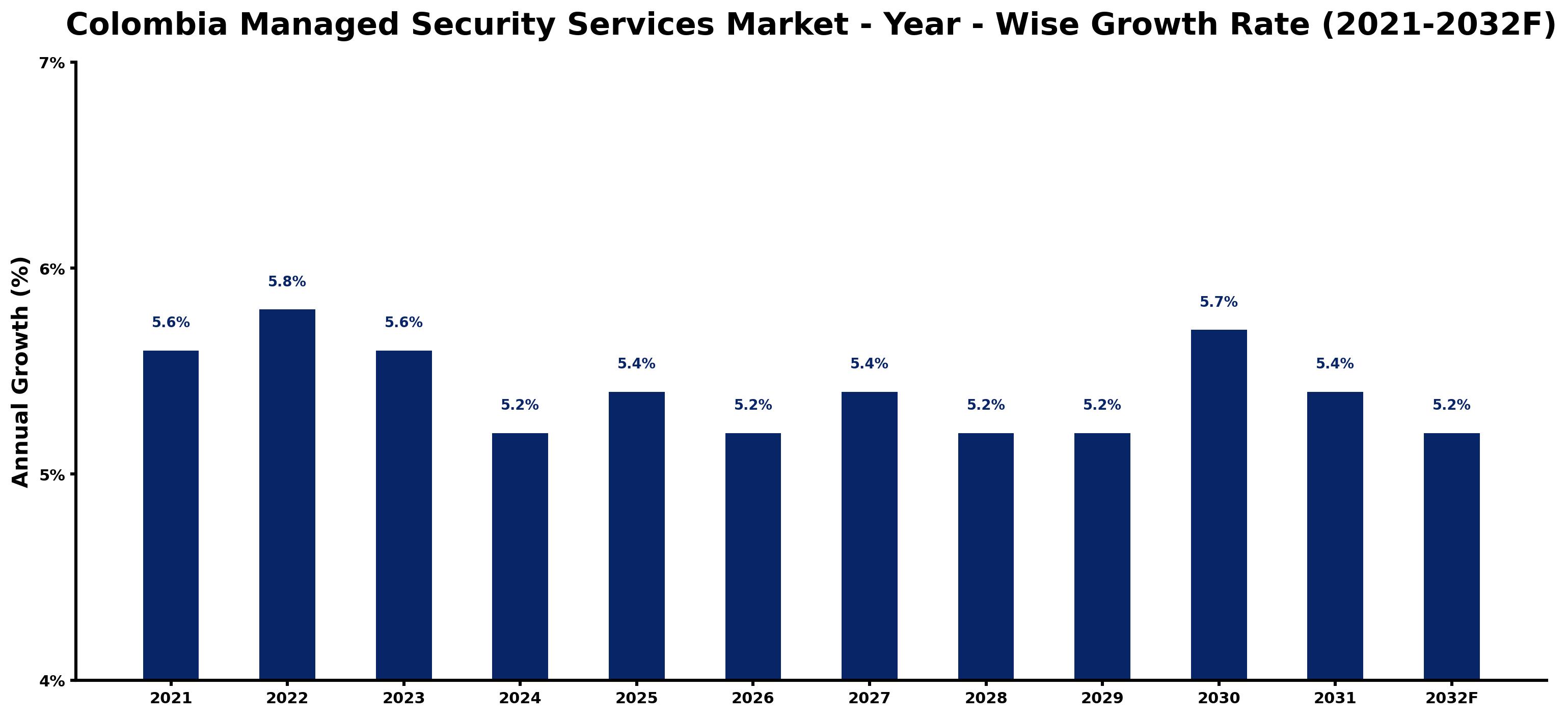
The table below presents the year wise growth rates along with the key drivers influencing the market
| Year | Growth Rate | Major Drivers |
| 2021 | 5.6% | Cybersecurity concerns prompted companies to enhance their digital defense mechanisms. |
| 2022 | 5.8% | Local businesses increasingly sought third-party expertise to manage security operations effectively. |
| 2023 | 5.6% | Remote work trends spotlighted vulnerabilities, elevating demand for robust managed security services. |
| 2024 | 5.2% | Investments in IT infrastructure supported the growth of managed security service providers. |
| 2025 | 5.4% | Increased cyber threats underscored the necessity for comprehensive security protocols across sectors. |
| 2026 | 5.2% | Corporate mergers and acquisitions heightened the focus on safeguarding sensitive information. |
| 2027 | 5.4% | Collaboration between tech firms and security providers created innovative service delivery models. |
| 2028 | 5.2% | Expansion of internet connectivity in rural areas fueled additional security service requirements. |
| 2029 | 5.2% | Emerging technologies necessitated specialized security approaches to protect advanced systems. |
| 2030 | 5.7% | Consumer electronics penetration drove businesses to prioritize cybersecurity in their operations. |
| 2031 | 5.4% | Awareness campaigns emphasized the importance of managed security in safeguarding assets. |
| 2032 | 5.2% | Sustainability efforts led companies to seek environmentally friendly security solutions. |
Note - Market size estimations and growth projections presented in this report are based on 6Wresearch's advanced forecasting approach, validated with industry datasets as of June 2026.
Colombia Managed Security Services Market Synopsis
The Colombia Managed Security Services Market is projected to reach 5.2% and witness significant growth during the forecast period (2026-2032). This anticipated growth is primarily driven by the escalating demand for sophisticated cybersecurity solutions, fueled by the rapid adoption of cloud computing, the Internet of Things (IoT), and big data analytics technologies. The IT sector in Colombia is experiencing a robust expansion, supported by governmental initiatives that facilitate foreign direct investment and the establishment of free trade zones, thereby attracting global investment. Furthermore, the surge in digitization across various sectors, including banking, financial services, insurance (BFSI), healthcare and life sciences, and retail and e-commerce, is propelling the growth of managed security services within the country.
Colombia Managed Security Services Market Growth Drivers
Several key factors are contributing to the growth of the Colombia Managed Security Services Market:
- The increasing incidence of cyber threats has heightened the need for advanced security measures, as organizations seek to protect sensitive data from potential breaches.
- Growth in cloud computing adoption has created a demand for managed security services that can offer scalable and remote security solutions to organizations of all sizes.
- Innovation in IoT devices has expanded the attack surface for cybercriminals, prompting companies to implement robust security protocols to safeguard their networks.
- The adoption of big data analytics in organizations necessitates enhanced security measures to protect valuable insights from unauthorized access and exploitation.
- Regulatory compliance requirements in sectors like BFSI and healthcare are driving organizations to invest in managed security services to meet legal obligations regarding data protection.
Colombia Managed Security Services Market Challenges and Restraints
Despite the positive prospects for growth, the Colombia Managed Security Services Market faces several challenges:
- The rapid evolution of cybersecurity threats requires continuous adaptation of security solutions, which can be resource-intensive for service providers and clients alike.
- The lack of skilled cybersecurity professionals in Colombia poses a barrier to the effective implementation of managed security services, limiting the market's growth potential.
- Budgetary constraints in certain organizations may restrict the investment in comprehensive security solutions, especially among small to medium-sized enterprises.
- Data privacy concerns and the complexity of compliance with international regulations may deter some businesses from fully embracing managed security services.
- The competitive landscape can lead to price wars among service providers, potentially undermining service quality and innovation.
Colombia Managed Security Services Market Government Investment and Initiatives
The Colombian government has been proactive in creating an environment conducive to the growth of the managed security services market. Key initiatives include:
- Implementing policies that facilitate foreign direct investment, thereby bringing in advanced technologies and expertise in cybersecurity.
- Establishing free trade zones that encourage the influx of tech companies focused on developing and delivering security solutions.
- Investing in education and training programs aimed at building a skilled workforce in cybersecurity, critical for addressing the industry's talent gap.
- Developing public-private partnerships that enhance collaboration between government entities and private sector players, driving innovation in security practices.
- Encouraging the adoption of national cybersecurity frameworks that help organizations standardize their security practices and compliance efforts.
Colombia Managed Security Services Market Latest Developments (May 2025 - June 2026)
During the period from May 2025 to June 2026, the Colombia Managed Security Services Market has witnessed several notable developments:
- The introduction of comprehensive cybersecurity legislation aimed at strengthening data protection and enhancing the accountability of organizations handling sensitive information.
- Increased investments in research and development by local tech companies to innovate managed security solutions tailored to the unique challenges faced by Colombian businesses.
- Growing collaborations between universities and cybersecurity firms to provide specialized training programs that are addressing the skills gap in the industry.
- The expansion of managed security services offerings to include advanced threat detection and response capabilities, reflecting the evolving nature of cyber threats.
- A rise in awareness campaigns by the government and private sector aimed at educating organizations about the importance of cybersecurity and proper management of sensitive data.
Colombia Managed Security Services Market - Key Attractiveness of the Report
- 10 Years of Market Numbers
- Historical Data Starting from 2022 to 2025
- Base Year: 2025
- Forecast Data until 2032
- Key Performance Indicators Impacting the Market
- Major Upcoming Developments and Projects
Key Highlights of the Report:
- Colombia Managed Security Services Market Outlook
- Market Size of Colombia Managed Security Services Market, 2025
- Forecast of Colombia Managed Security Services Market, 2032
- Historical Data and Forecast of Colombia Managed Security Services Revenues & Volume for the Period 2022-2032
- Colombia Managed Security Services Market Trend Evolution
- Colombia Managed Security Services Market Drivers and Challenges
- Colombia Managed Security Services Price Trends
- Colombia Managed Security Services Porter's Five Forces
- Colombia Managed Security Services Industry Life Cycle
- Historical Data and Forecast of Colombia Managed Security Services Market Revenues & Volume By Type for the Period 2022-2032
- Historical Data and Forecast of Colombia Managed Security Services Market Revenues & Volume By Unified threat management for the Period 2022-2032
- Historical Data and Forecast of Colombia Managed Security Services Market Revenues & Volume By DDoS for the Period 2022-2032
- Historical Data and Forecast of Colombia Managed Security Services Market Revenues & Volume By Managed SIEM for the Period 2022-2032
- Historical Data and Forecast of Colombia Managed Security Services Market Revenues & Volume By Managed endpoint threat detection for the Period 2022-2032
- Historical Data and Forecast of Colombia Managed Security Services Market Revenues & Volume By Managed two factor authentication for the Period 2022-2032
- Historical Data and Forecast of Colombia Managed Security Services Market Revenues & Volume By Compliance management for the Period 2022-2032
- Historical Data and Forecast of Colombia Managed Security Services Market Revenues & Volume By Vulnerability management for the Period 2022-2032
- Historical Data and Forecast of Colombia Unified threat management Managed Security Services Market Revenues & Volume By Others for the Period 2022-2032
- Historical Data and Forecast of Colombia Managed Security Services Market Revenues & Volume By Deployment for the Period 2022-2032
- Historical Data and Forecast of Colombia Managed Security Services Market Revenues & Volume By Cloud-based for the Period 2022-2032
- Historical Data and Forecast of Colombia Managed Security Services Market Revenues & Volume By On-premise for the Period 2022-2032
- Historical Data and Forecast of Colombia Managed Security Services Market Revenues & Volume By Organization for the Period 2022-2032
- Historical Data and Forecast of Colombia Managed Security Services Market Revenues & Volume By Small and medium enterprises for the Period 2022-2032
- Historical Data and Forecast of Colombia Managed Security Services Market Revenues & Volume By Large enterprises for the Period 2022-2032
- Historical Data and Forecast of Colombia Managed Security Services Market Revenues & Volume By Applications for the Period 2022-2032
- Historical Data and Forecast of Colombia Managed Security Services Market Revenues & Volume By BFSI for the Period 2022-2032
- Historical Data and Forecast of Colombia Managed Security Services Market Revenues & Volume By Government/defense for the Period 2022-2032
- Historical Data and Forecast of Colombia Managed Security Services Market Revenues & Volume By Healthcare for the Period 2022-2032
- Historical Data and Forecast of Colombia Managed Security Services Market Revenues & Volume By Manufacturing for the Period 2022-2032
- Historical Data and Forecast of Colombia Managed Security Services Market Revenues & Volume By Telecom & IT for the Period 2022-2032
- Historical Data and Forecast of Colombia Managed Security Services Market Revenues & Volume By Retail for the Period 2022-2032
- Historical Data and Forecast of Colombia Managed Security Services Market Revenues & Volume By Others for the Period 2022-2032
- Colombia Managed Security Services Import Export Trade Statistics
- Market Opportunity Assessment By Type
- Market Opportunity Assessment By Deployment
- Market Opportunity Assessment By Organization
- Market Opportunity Assessment By Applications
- Colombia Managed Security Services Top Companies Market Share
- Colombia Managed Security Services Competitive Benchmarking By Technical and Operational Parameters
- Colombia Managed Security Services Company Profiles
- Colombia Managed Security Services Key Strategic Recommendations






































