Europe Dietary Supplements Market Size & Growth Rate
According to 6Wresearch internal database and industry insights, the Europe Dietary Supplements Market was valued at USD 55 billion in 2025 and is projected to reach USD 114.19 billion by 2032, growing at a CAGR of approximately 11% during 2026–2032.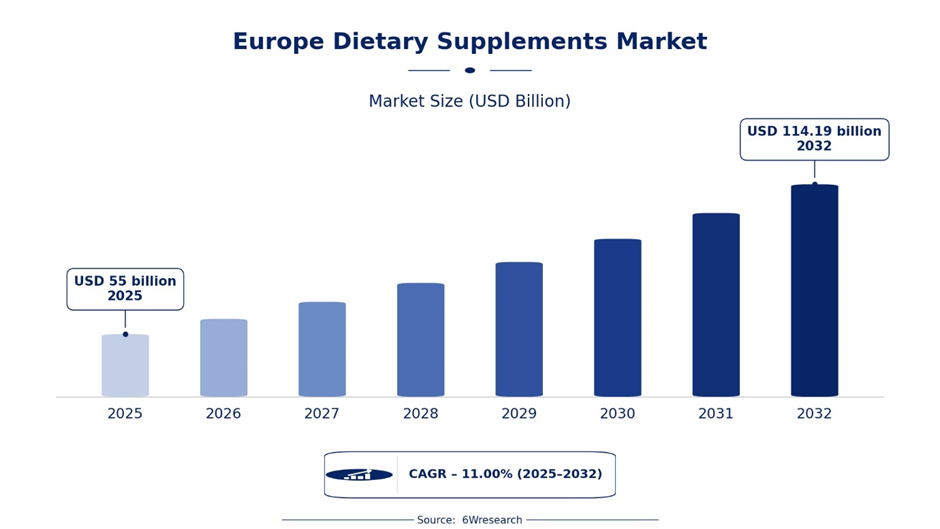
Europe Dietary Supplements Market Highlights
|
Report Metric |
Details |
|
Report Name |
Europe Dietary Supplements Market (2026-2032) |
|
Market Size 2025 |
USD 55 billion |
|
Market Size 2032 |
USD 114.19 billion |
|
Absolute Growth 2025–2032 |
USD 59.19 billion |
|
CAGR 2026–2032 |
11% |
|
Peak Annual Growth |
12.0% in 2028 |
|
Forecast Period |
2026–2032 |
|
Historical Data |
2022–2025 |
|
Base Year |
2025 |
|
Leading Types, 2025 |
Vitamins (38% share) |
|
Fastest-Growing Types |
Amino Acids (12.9% CAGR) |
|
Leading Function Type, 2025 |
Additional Supplements (52% share) |
|
Fastest-Growing Function Type |
Sports Nutrition (13.1% CAGR) |
|
Leading Form, 2025 |
Tablets (36% share) |
|
Fastest-Growing Form |
Powder (12.8% CAGR) |
|
Leading End Users, 2025 |
Adult (58% share) |
|
Fastest-Growing End Users |
Others, covering Pregnant Women and Elders (12.6% CAGR) |
|
Leading Countries, 2025 |
Germany (29% share) |
|
Fastest-Growing Countries |
Italy (12.4% CAGR) |
|
Growing Sector |
Sports Nutrition and Online Retail |
|
Key End Users |
Health-conscious adults, pregnant women, older consumers, athletes and fitness users, parents purchasing for children, pharmacies and specialist health retailers |
Europe Dietary Supplements Market Year-wise Growth Rate and Key Drivers (2022–2032)
This graph illustrates the annual growth rates of the market from 2022 to 2032, highlighting a steady upward trajectory and projected market expansion over the forecast period.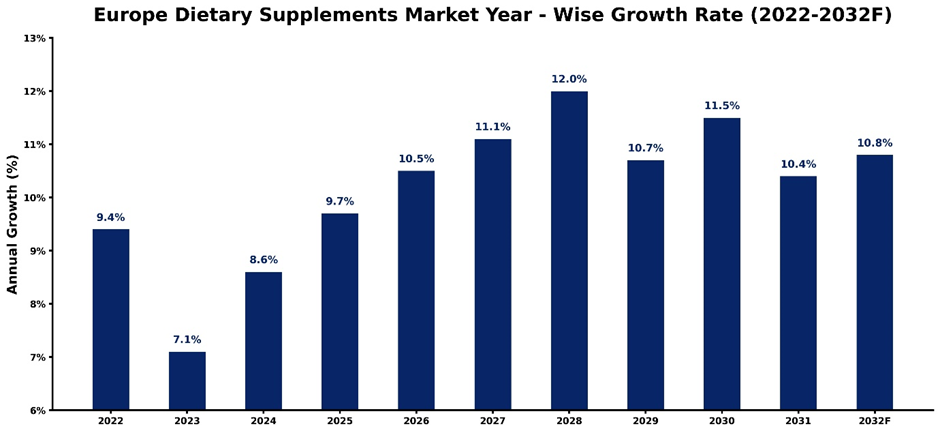
The following table presents the estimated annual growth rate for each year together with the principal factor influencing market performance. The values are intended to highlight year-specific drivers rather than to provide a direct comparison between individual years.
|
Year |
Estimated Annual Growth (%) |
Market Rationale |
|
2022 |
9.4% |
Post-pandemic focus on immunity and general wellness sustained strong supplement purchasing across European households as lockdown-era habits persisted. |
|
2023 |
7.1% |
High energy-driven inflation led consumers to trade down to cheaper brands and trim discretionary supplement baskets, moderating growth. |
|
2024 |
8.6% |
Stabilising consumer confidence and heavy retailer promotions supported a rebound in supplement volumes across major European markets. |
|
2025 |
9.7% |
Higher consumer interest in gut health and protein products lifted sales through pharmacies and sports retailers across major European markets. |
|
2026 |
10.5% |
Retail rollout of condition-specific products through pharmacy chains is expected to raise average basket values across Germany, France and Italy. |
|
2027 |
11.1% |
Expansion of e-commerce and subscription services is expected to raise repeat purchases and extend reach beyond major European cities. |
|
2028 |
12.0% |
Commercial scaling of personalised and microbiome-based formulations is expected to lift prices and accelerate premium adoption across leading markets. |
|
2029 |
10.7% |
Maturing demand in Western Europe and stricter ingredient safety enforcement are expected to normalise growth after the 2028 peak. |
|
2030 |
11.5% |
Growth in endurance and strength training participation is expected to raise demand for protein and performance products. |
|
2031 |
10.4% |
Intensifying private-label competition is expected to compress prices and slow value growth in mature categories. |
|
2032 |
10.8% |
Replacement demand and gradual approval of novel ingredients are expected to hold growth close to the long-term average. |
Note: Market size estimations and growth projections presented in this report are based on 6Wresearch’s proprietary forecasting methodology, utilizing the latest available industry data, government publications, and primary research inputs.
Europe Dietary Supplements Market Synopsis
The Europe Dietary Supplements Market is expected to grow at a rapid pace through 2032. The industry comprise of vitamins, minerals, botanicals, amino acids and related ingestible products sold as tablets, capsules, powders, liquids and gel caps for general wellness, sports performance and medical support. Development of the industry shaped by an ageing population, with around one in five Europeans aged 65 or above, and by the harmonised EU food supplement framework under Directive 2002/46/EC, which allows cross-border trade. Growth is further spurred by rising online pharmacy sales, robust sports participation in Germany and the United Kingdom, and expanding preventive-health awareness among adults in Italy and France.
Market Dynamics Impact Analysis (2026–2032)
|
Factor |
Type |
Impact |
Primary Segment Affected |
|
Ageing population and preventive health spending |
Driver |
High |
Adult |
|
Growth of online pharmacy and direct-to-consumer retail |
Driver |
High |
Capsules |
|
Expansion of personalised and microbiome-based formulations |
Opportunity |
Medium |
Botanicals |
|
Rising sports and active-lifestyle participation |
Opportunity |
High |
Sports Nutrition |
|
Strict health-claim and novel-food approval rules |
Restraint |
High |
Botanicals |
|
Price competition from private-label ranges |
Restraint |
Medium |
Vitamins |
|
Dependence on imported raw materials |
Challenge |
High |
Amino Acids |
|
Product quality and contamination scrutiny |
Challenge |
Medium |
Powder |
Evaluation of Drivers in the Europe Dietary Supplements Market (2026–2032)
Below mentioned are some major drivers and their influence on the market dynamics:
|
Drivers |
Primary Segment Affected |
Why It Matters (Evidence) |
|
Ageing population and preventive health spending |
Adult |
Older consumers buy bone, joint, eye and cardiovascular products on a repeat basis, which lifts household spending on nutrition, and about 21% of EU residents were aged 65 or above in 2023. |
|
Online and direct-to-consumer retail |
Capsules |
Digital storefronts and subscription refills widen access beyond pharmacies. |
|
Fitness participation |
Sports Nutrition |
Regular training raises demand for protein and recovery products, and over 60 million fitness club members were recorded across Europe in 2023. |
|
Widespread nutrient shortfalls |
Vitamins |
Documented deficiencies, particularly in vitamin D, support routine supplementation during low-sunlight months. |
|
Pharmacist-led recommendation |
Medical Supplements |
Pharmacists give condition-specific advice that adds clinical credibility. |
Europe Dietary Supplements Market Growth is supported by a deep ingredient and contract-manufacturing base that gives brand owners access to formulation expertise and flexible production runs. Continued investment by ingredient producers such as DSM-Firmenich and BASF in European nutrition capacity shortens supply chains and improves product consistency. Additionally, rising household incomes in Central and Eastern Europe are widening the consumer base for discretionary wellness products, with nominal wages in Poland increasing by more than 10% annually during 2023 and 2024. Clinical research on ingredient efficacy is solidifying consumer confidence, and wellness-focused social media content is proliferating product discovery among younger shoppers.
Evaluation of Restraints in the Europe Dietary Supplements Market
Below mentioned are some major restraints and their influence on the market dynamics:
|
Market Restraint |
Primary Segment Affected |
Why It Matters (Evidence) |
|
Stringent health-claim regulation |
Botanicals |
Only claims authorised under Regulation (EC) No 1924/2006 may appear on labels, which restricts marketing of plant-based benefits and slows differentiation. |
|
Lengthy novel-food approvals |
Others |
New ingredients need authorisation under Regulation (EU) 2015/2283, and dossiers can take two to three years to clear. |
|
Price sensitivity during cost-of-living pressure |
Vitamins |
Shoppers facing tighter budgets switch to private-label or skip non-essential purchases. |
|
Absence of harmonised maximum nutrient levels |
Minerals |
Directive 2002/46/EC envisaged EU-wide maximum levels for vitamins and minerals but none have been adopted. |
|
Reformulation burden from additive bans |
Tablets |
The EU ban on titanium dioxide (E171) in food from 2022 forced removal from tablet coatings. |
Europe Dietary Supplements Market Challenges
Import dependence is a structural challenge, because China supplies more than 90% of global vitamin C and many amino acid intermediates, exposing European brands to price swings and shipping disruption. Post-Brexit divergence since January 2021 compels companies serving both the United Kingdom and the EU to maintain separate registrations and labels, raising compliance costs for mid-sized brands. Packaging rules applicable from August 2026 require recyclable formats, pushing redesign expenses onto smaller companies operating on thin margins. Cross-border online sales add a further difficulty, since enforcement is divided among 27 national authorities and unverified sellers can reach consumers, weakening trust in compliant brands.
Trends in the Europe Dietary Supplements Market
Emerging trends shaping the Europe Dietary Supplements Market include the following:
- Shift from Generic Multivitamins to Personalised Nutrition: European consumers are moving from one-size-fits-all multivitamins towards formulations based on questionnaires, lifestyle data and blood tests, as seen in subscription services such as Vitl in the United Kingdom. The change favours suppliers able to deliver small-batch, data-linked production and gives pharmacies a stronger advisory role.
- Transition from Traditional Pills to Gummies and Chewables: Shoppers who dislike swallowing large tablets are shifting to gummies and chewable formats, and brands such as Vitabiotics and Holland & Barrett have widened their ranges accordingly. The shift benefits suppliers of pectin-based gummy lines and sugar-reduced formulations, while raising entry barriers for firms without depositing equipment or flavour-masking expertise.
- Gut Health Emerging as a Mainstream Category: Probiotics and prebiotic fibres are moving from specialist stores to mainstream pharmacy and supermarket shelves, supported by ingredient developers such as Novonesis, formed in January 2024 through the merger of Novozymes and Chr. Hansen. Suppliers with strain-level clinical evidence gain preference from brand owners and can command premium prices.
Investment Opportunities in the Europe Dietary Supplements Market
Strategic investment opportunities in the Europe Dietary Supplements Market include the following:
- Life-Stage Formulations for Pharmacy Channels: Pharmacy groups in Germany, France and Italy are widening shelf space for products tailored to fertility, prenatal and menopause care, which creates room for clinically supported formulations. Investors can develop evidence-backed ranges or acquire niche brands, entering through supply agreements with pharmacy groups, regulatory partners in each country and clinical studies run with European university hospitals.
- Probiotic and Fermentation Capacity: Rising use of probiotics has created demand for strain production, freeze-drying and stability testing near end markets. Investors can build or acquire fermentation and drying capacity in Denmark, France or Poland, or form joint ventures with established culture producers, and should secure quality certifications before supplying brand owners.
- Gummy and Chewable Contract Manufacturing: Brand owners are seeking outsourced gummy depositing and chewable production because in-house lines are costly to build. Investors can set up GMP-certified capacity in Poland, Hungary or Spain where operating costs are lower, partnering with local food manufacturers and securing ISO 22000 certification to serve private-label and branded customers across Western Europe.
Leading Players in Europe Dietary Supplements Market
A list of leading companies operating in the Europe Dietary Supplements Market is presented below:
1. Bayer AG
|
Company Name |
Bayer AG |
|---|---|
|
Established Year |
1863 |
|
Headquarters |
Leverkusen, Germany |
|
Official Website |
Bayer AG is a diversified life-science company whose consumer health division markets multivitamin and mineral brands through pharmacies and retailers. It is a established supplier of branded supplements across German-speaking and wider European markets.
2. Haleon plc
|
Company Name |
Haleon plc |
|---|---|
|
Established Year |
2022 |
|
Headquarters |
Weybridge, United Kingdom |
|
Official Website |
Haleon plc is a consumer healthcare company that markets branded vitamin, mineral and supplement ranges in major European markets. It supplies pharmacies and grocery retailers across the region.
3. Nestlé Health Science
|
Company Name |
Nestlé Health Science |
|---|---|
|
Established Year |
2011 |
|
Headquarters |
Epalinges, Switzerland |
|
Official Website |
Nestlé Health Science is a nutritional science company offering consumer supplements, probiotics and medical nutrition products. It serves European consumers through pharmacies, specialist retailers and online channels.
4. Holland & Barrett
|
Company Name |
Holland & Barrett |
|---|---|
|
Established Year |
1870 |
|
Headquarters |
Nuneaton, United Kingdom |
|
Official Website |
Holland & Barrett is a specialist health and wellness retailer and brand owner offering own-label and third-party supplements. It maintains a strong store and online presence in the United Kingdom and selected European markets.
5. Vitabiotics
|
Company Name |
Vitabiotics |
|---|---|
|
Established Year |
1971 |
|
Headquarters |
London, United Kingdom |
|
Official Website |
Vitabiotics is a supplement manufacturer and brand owner focused on life-stage and targeted nutrition products. It distributes mainly through pharmacies and retailers in the United Kingdom and other European markets.
Government Initiatives in the Europe Dietary Supplements Market
Food supplements across the EU are governed by Directive 2002/46/EC, which harmonises rules on vitamins and minerals, and by Regulation (EC) No 1924/2006, which permits only health claims authorised after scientific assessment by the European Food Safety Authority. Regulation (EU) 2015/2283 sets pre-market approval for novel ingredients, while Europe’s Beating Cancer Plan, launched in 2021, mobilises €4 billion for prevention and healthy-lifestyle measures.
The European Food Safety Authority, headquartered in Parma, evaluates health-claim and novel-ingredient dossiers, while national authorities such as Germany’s BVL, France’s ANSES, which runs a nutrivigilance scheme established in 2009, and Italy’s Ministry of Health handle notification and surveillance. The EU4Health programme for 2021–2027 supports health-promotion projects across 27 member states.
Future Insights of the Europe Dietary Supplements Market
The Europe Dietary Supplements Market is expected to grow at a rapid pace through 2032. Advances in artificial intelligence are expected to speed formulation development and improve demand forecasting for brand owners, lowering time to market and stock waste. Additionally, wider use of wearables and connected health applications will keep consumers engaged with daily health routines and reinforce habitual use. Public research funding is set to deepen understanding of metabolic health and nutrient absorption, with Horizon Europe allocating about €95.5 billion across 2021–2027. Furthermore, continued innovation in encapsulation and delivery technologies should improve bioavailability and support premium positioning in less penetrated Southern and Eastern European markets.
Market Segmentation Analysis
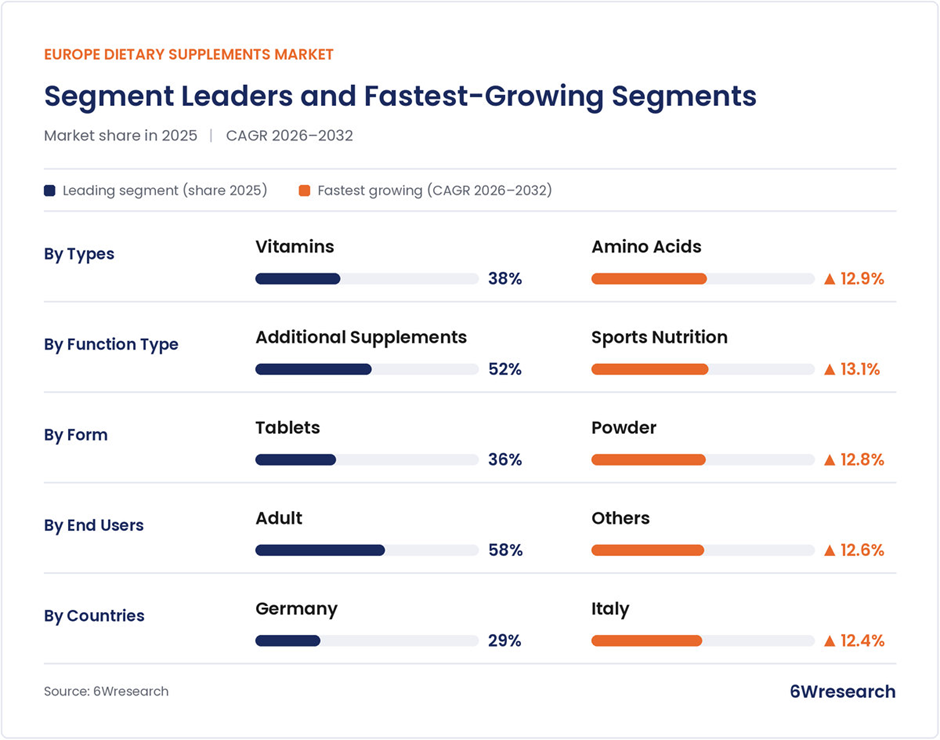
The report offers a comprehensive study of the market across its key segments. The chart below highlights the leading segment by market share in 2025 and the fastest-growing segment by CAGR over 2026–2032, followed by a detailed analysis of each segment.
By Types – Vitamins Lead, Amino Acids Expected to Grow Fastest
According to Ravi Bhandari, Research Head at 6Wresearch, Vitamins led the segment with a 38% Europe Dietary Supplements Market Share in 2025, supported by long-standing consumer familiarity, dense pharmacy and supermarket distribution, and established multivitamin brands across Germany, France and Italy. At the same time, Amino Acids are expected to grow fastest at a CAGR of 12.9% during 2026–2032, as collagen and protein-based formulations broaden into beauty-from-within and mobility regimens sold through German and French pharmacies.
By Function Type – Additional Supplements Lead, Sports Nutrition Expected to Grow Fastest
Additional Supplements accounted for the largest share at 52% in 2025, as everyday health top-ups are bought without prescription through drugstore and grocery chains such as dm-drogerie markt, Rossmann and Boots, which keeps volumes high. In parallel, Sports Nutrition is projected to expand fastest, at a CAGR of 13.1% over 2026–2032, helped by direct-to-consumer specialists such as Myprotein and the popularity of endurance events across the United Kingdom and Germany.
By Form – Tablets Lead, Powder Expected to Grow Fastest
Tablets held the leading 36% share in 2025 as they offer low cost per dose, long shelf life and suitability for multi-nutrient combinations, which suits high-volume private-label and drugstore ranges across Europe. In parallel, Powder is set to record the fastest CAGR of 12.8% during 2026–2032, driven by German and Central European demand for protein and collagen blends and by the cost efficiency of bulk formats ordered online.
By End Users – Adult Leads, Others Expected to Grow Fastest
Adult consumers dominated with a 58% share in 2025, since working-age buyers hold the highest purchasing power and use supplements for energy, stress management and immunity, mostly through pharmacies and online stores in Germany, the United Kingdom and France. At the same time, The Others category, covering pregnant women and elders, is forecasted to grow fastest at a CAGR of 12.6% over 2026–2032, as prenatal programmes and age-specific formulations gain pharmacy support.
By Countries – Germany Leads, Italy Expected to Grow Fastest
Germany held the largest share in 2025 at 29%, supported by the largest consumer base in the EU, extensive drugstore networks and the presence of manufacturers such as Bayer. Meanwhile, Italy is expected to grow fastest at a CAGR of 12.4% through 2026–2032, helped by a pharmacy network of close to 20,000 outlets and rising use of integratori alimentari for everyday health.
Key Attractiveness of the Report
- 10 Years of Market Numbers
- Historical Data Starting from 2022 to 2025
- Base Year 2025
- Forecast Data until 2032
- Key Performance Indicators Impacting the Market
- Major Upcoming Developments and Projects
Key Highlights of the Report:
- Europe Dietary Supplements Market Outlook
- Market Size of Europe Dietary Supplements Market, 2025
- Forecast of Europe Dietary Supplements Market, 2032
- Historical Data and Forecast of Dietary Supplements Revenues & Volume for the Period 2022-2032
- Europe Dietary Supplements Market Trend Evolution
- Europe Dietary Supplements Market Drivers and Challenges
- Dietary Supplements Price Trends
- Dietary Supplements Porter’s Five Forces
- Dietary Supplements Industry Life Cycle
- Historical Data and Forecast of Europe Dietary Supplements Market Revenues & Volume By Types for the Period 2022-2032
- Historical Data and Forecast of Europe Dietary Supplements Market Revenues & Volume By Vitamins for the Period 2022-2032
- Historical Data and Forecast of Europe Dietary Supplements Market Revenues & Volume By Minerals for the Period 2022-2032
- Historical Data and Forecast of Europe Dietary Supplements Market Revenues & Volume By Botanicals for the Period 2022-2032
- Historical Data and Forecast of Europe Dietary Supplements Market Revenues & Volume By Amino Acids for the Period 2022-2032
- Historical Data and Forecast of Europe Dietary Supplements Market Revenues & Volume By Others for the Period 2022-2032
- Historical Data and Forecast of Europe Dietary Supplements Market Revenues & Volume By Function Type for the Period 2022-2032
- Historical Data and Forecast of Europe Dietary Supplements Market Revenues & Volume By Additional Supplements for the Period 2022-2032
- Historical Data and Forecast of Europe Dietary Supplements Market Revenues & Volume By Sports Nutrition for the Period 2022-2032
- Historical Data and Forecast of Europe Dietary Supplements Market Revenues & Volume By Medical Supplements for the Period 2022-2032
- Historical Data and Forecast of Europe Dietary Supplements Market Revenues & Volume By Form for the Period 2022-2032
- Historical Data and Forecast of Europe Dietary Supplements Market Revenues & Volume By Tablets for the Period 2022-2032
- Historical Data and Forecast of Europe Dietary Supplements Market Revenues & Volume By Capsules for the Period 2022-2032
- Historical Data and Forecast of Europe Dietary Supplements Market Revenues & Volume By Powder for the Period 2022-2032
- Historical Data and Forecast of Europe Dietary Supplements Market Revenues & Volume By Others (Liquid and Gel Caps) for the Period 2022-2032
- Historical Data and Forecast of Europe Dietary Supplements Market Revenues & Volume By End Users for the Period 2022-2032
- Historical Data and Forecast of Europe Dietary Supplements Market Revenues & Volume By Infant for the Period 2022-2032
- Historical Data and Forecast of Europe Dietary Supplements Market Revenues & Volume By Children for the Period 2022-2032
- Historical Data and Forecast of Europe Dietary Supplements Market Revenues & Volume By Adult for the Period 2022-2032
- Historical Data and Forecast of Europe Dietary Supplements Market Revenues & Volume By Others (Pregnant Women and Elders) for the Period 2022-2032
- Historical Data and Forecast of Europe Dietary Supplements Market Revenues & Volume By Countries for the Period 2022-2032
- Historical Data and Forecast of Europe Dietary Supplements Market Revenues & Volume By Germany for the Period 2022-2032
- Historical Data and Forecast of Europe Dietary Supplements Market Revenues & Volume By Italy for the Period 2022-2032
- Historical Data and Forecast of Europe Dietary Supplements Market Revenues & Volume By France for the Period 2022-2032
- Historical Data and Forecast of Europe Dietary Supplements Market Revenues & Volume By United Kingdom for the Period 2022-2032
- Historical Data and Forecast of Europe Dietary Supplements Market Revenues & Volume By Rest of Europe for the Period 2022-2032
- Dietary Supplements Import Export Trade Statistics
- Market Opportunity Assessment By Types
- Market Opportunity Assessment By Function Type
- Market Opportunity Assessment By Form
- Market Opportunity Assessment By End Users
- Market Opportunity Assessment By Countries
- Dietary Supplements Top Companies Market Share
- Dietary Supplements Competitive Benchmarking By Technical and Operational Parameters
- Dietary Supplements Company Profiles
- Dietary Supplements Key Strategic Recommendations
Market Covered
The report offers an extensive study of the following market segments.
By Types
- Vitamins
- Minerals
- Botanicals
- Amino Acids
- Others
By Function Type
- Additional Supplements
- Sports Nutrition
- Medical Supplements
By Form
- Tablets
- Capsules
- Powder
- Others (Liquid and Gel Caps)
By End Users
- Infant
- Children
- Adult
- Others (Pregnant Women and Elders)
By Countries
- Germany
- Italy
- France
- United Kingdom
- Rest of Europe