Germany Musical Instrument Market (2026-2032) | Size, Share, Companies, Trends, Growth, Analysis, Value, Industry, Revenue & Forecast
Market Forecast By Product (String Instruments, Pianos And Keyboards, Drums And Percussion Instruments, Others) And Competitive Landscape
| Product Code: ETC334211 | Publication Date: Aug 2022 | Updated Date: Mar 2026 | Product Type: Market Research Report | |
| Publisher: 6Wresearch | Author: Shubham Padhi | No. of Pages: 70 | No. of Figures: 35 | No. of Tables: 5 |
Germany Musical Instrument Market: Import Trend Analysis
Germany`s musical instrument market saw a 5.13% growth in imports from 2023 to 2024, contrasting with a -2.1% compound annual growth rate (CAGR) from 2020 to 2024. This shift in import momentum may reflect evolving consumer preferences or a rebound in the market post-pandemic, indicating potential market stability.
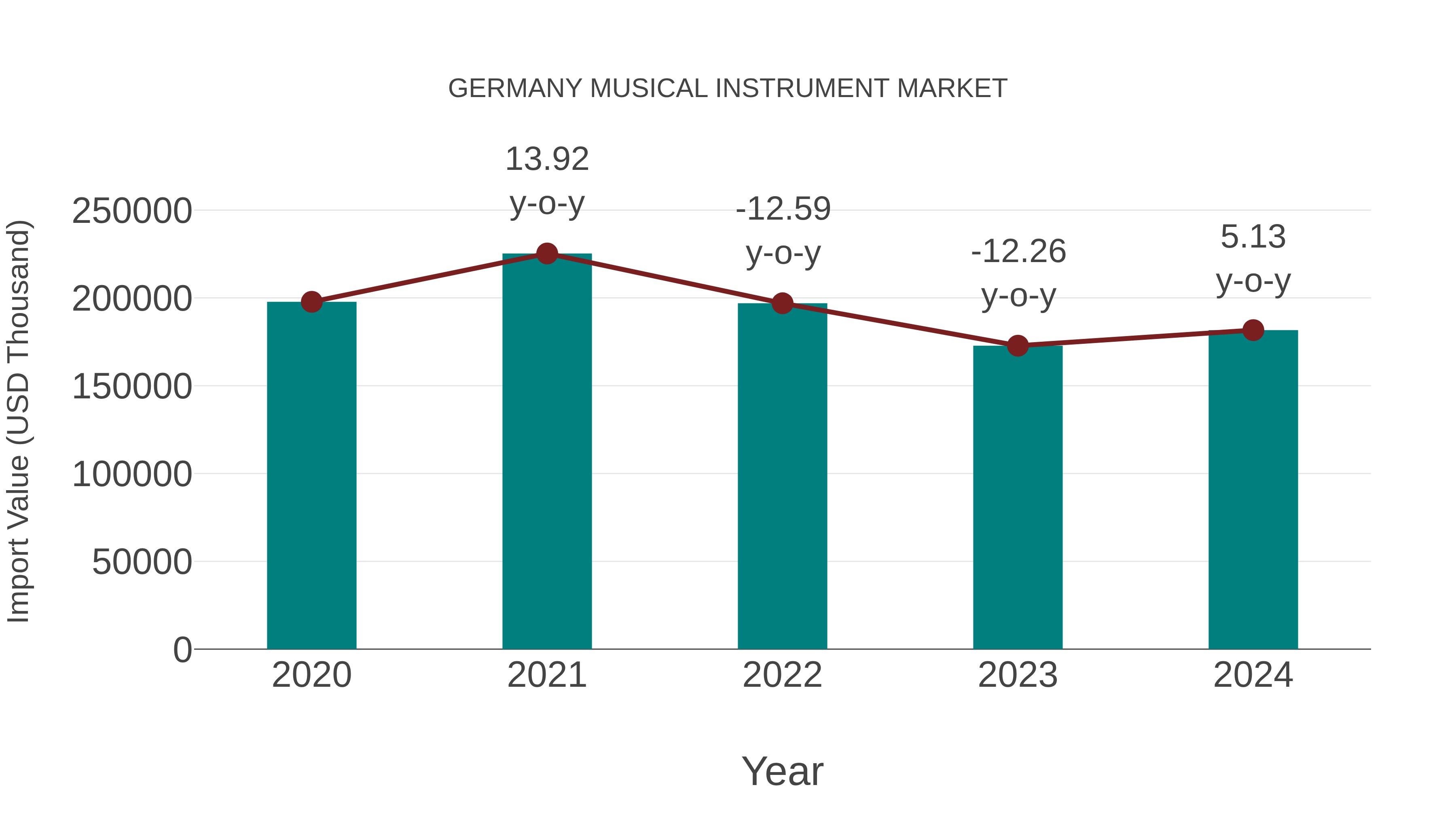
Germany Musical Instrument Market Growth Rate
According to 6Wresearch internal database and industry insights, the Germany Musical Instrument Market is projected to grow at a compound annual growth rate (CAGR) of 5.7% during the forecast period (2026–2032).
Topics Covered in the Germany Musical Instrument Market Report
The Germany Musical Instrument Market report thoroughly covers the market by product. The report provides a detailed analysis of ongoing market trends, opportunities/high-growth areas, and market drivers that will help stakeholders align strategies based on current and future market dynamics.
Germany Musical Instrument Market Highlights
| Report Name | Germany Musical Instrument Market |
| Forecast Period | 2026–2032 |
| CAGR | 5.7% |
| Growing Sector | Music Education and Live Performance Industry |
Germany Musical Instrument Market Synopsis
Germany Musical Instrument Market is projected to record consistent growth in the coming years on account of country’s strong cultural heritage in classical and contemporary music. Generally, Germany is globally known for producing high-quality musical instruments and is home to several historic instrument manufacturers. The growth of this industry is being proliferated by widespread popularity of music education programs and increasing participation in orchestras, bands, and music schools are stimulating demand for musical instruments across the country. On the other hand, the growth of digital music production and home recording studios is encouraging musicians to purchase keyboards, digital pianos, and percussion equipment.
Evaluation of Growth Drivers in Germany Musical Instrument Market
Below are some prominent drivers and their influence on the market dynamics:
| Drivers | Primary Segments Affected | Why It Matters |
| Music Education Expansion | By Product (String Instruments, Pianos and Keyboards) | Growing number of music schools increases instrument purchases. |
| Live Music and Concert Culture | By Product (Drums and Percussion Instruments) | Concerts and festivals increase demand for performance instruments. |
| Digital Music Production | By Product (Pianos and Keyboards) | Home studios require electronic keyboards and synthesizers. |
| Cultural Heritage of Classical Music | By Product (String Instruments) | Germany’s classical music tradition supports violin and cello demand. |
| Online Instrument Retail | By Product (Others) | E-commerce platforms improve accessibility to instruments nationwide. |
Germany Musical Instrument Market is projected to grow at a CAGR of 5.7% during the forecast period (2026–2032). The demand for the musical instrument will be fuelled by growing interest in music education, expansion of existing orchestras, and a growing number of musicians using digital production technology to create music. Furthermore, the growing number of global instrument manufacturers who are in business and the amount of money that consumers are willing to spend on cultural activities will also help develop a positive market environment. Finally, government support for arts and music education will further stimulate Germany musical instrument market growth in the coming years.
Evaluation of Restraints in Germany Musical Instrument Market
Below are some prominent restraints and their influence on the market dynamics:
| Restraints | Primary Segments Affected | What This Means |
| High Cost of Professional Instruments | By Product (String Instruments, Pianos) | Premium instruments may limit accessibility for beginners. |
| Competition from Digital Music Software | By Product (Others) | Software-based music tools reduce dependence on traditional instruments. |
| Maintenance Costs | By Product (String Instruments, Pianos) | Instruments require regular tuning and repairs. |
| Market Saturation in Urban Areas | By Product (All) | Mature music markets may experience slower growth. |
| Counterfeit Instruments | By Product (Others) | Low-quality replicas may affect brand reputation. |
Germany Musical Instrument Market Challenges
Germany Musical Instrument Industry is expected to maintain steady expansion during the forecast period. However, the industry faces certain challenges such as rising manufacturing costs for premium instruments and increasing competition from digital music production tools. Apart from this, traditional instruments require regular maintenance and skilled craftsmanship, which may increase production expenses for manufacturers. Additionally, younger generations are increasingly using digital music applications and electronic devices for music creation, which could slightly affect demand for conventional musical instruments. Nevertheless, Germany’s strong musical culture and institutional support for music education are expected to sustain long-term demand.
Germany Musical Instrument Market Trends
The Germany Musical Instrument Market is affected by many evolving trends such as:
- Digital Pianos & Electronic Keyboards: The modern musician now prefers to play a digital piano or synthesizer due to their ability to travel well, their sophisticated sound technology and ability to work with a computer.
- The Popularity of Music Education: There is an increasing number of academies and conservatories that provide music education to both novice and intermediate level musicians. This is resulting in an increased demand for beginner and intermediate musical instruments.
- Online Retail Distribution: The future of instrument retailing is based on the internet and will exist in various E-commerce formats and via traditional retail, providing consumers the ability to compare products through reviews and place orders for instruments.
Investment Opportunities in the Germany Musical Instrument Market
In the Germany Musical Instrument Market, there are many investment opportunities available such as:
- High-End Handmade Instruments: The reputation of Germany for producing high-quality handmade musical instruments provides manufacturers of grafting premium violins, pianos, and guitars an opportunity to capitalize on this expertise.
- Music Education Infrastructure: Investing in music schools and academies offering courses in music will be a sound investment as interest in learning music continues to grow.
- Digital Musical Instruments: Investing in digital musical instruments such as pianos, synthesizers and electronic drums provides an opportunity for manufacturers of digital musical instruments to capitalize on the growing demand from contemporary musicians and producers.
Top 5 Leading Players in the Germany Musical Instrument Market
Below is a list of prominent companies leading the Germany Musical Instrument Market:
1. Bechstein Pianoforte AG
| Company Name | Bechstein Pianoforte AG |
|---|---|
| Established Year | 1853 |
| Headquarters | Berlin, Germany |
| Official Website | Click Here |
Bechstein is one of the world’s most prestigious piano manufacturers known for producing high-quality grand and upright pianos used by professional musicians and concert halls worldwide.
2. Thomann GmbH
| Company Name | Thomann GmbH |
|---|---|
| Established Year | 1954 |
| Headquarters | Burgebrach, Germany |
| Official Website | Click Here |
Thomann is one of Europe’s largest musical instrument retailers offering a wide range of instruments, studio equipment, and audio technology through its global e-commerce platform.
3. Yamaha Music Europe GmbH
| Company Name | Yamaha Music Europe GmbH |
|---|---|
| Established Year | 1966 (European Operations) |
| Headquarters | Rellingen, Germany |
| Official Website | Click Here |
Yamaha Music Europe distributes pianos, keyboards, guitars, and percussion instruments and has a strong presence in Germany’s musical instrument market.
4. Roland Europe Group Ltd.
| Company Name | Roland Europe Group Ltd. |
|---|---|
| Established Year | 1972 |
| Headquarters | Germany Regional Office – Hamburg |
| Official Website | Click Here |
Roland specializes in electronic musical instruments including synthesizers, digital pianos, drum machines, and studio equipment used by musicians and producers worldwide.
5. Steinway & Sons
| Company Name | Steinway & Sons |
|---|---|
| Established Year | 1853 |
| Headquarters | Hamburg, Germany (European Manufacturing Facility) |
| Official Website | Click Here |
Steinway & Sons manufactures luxury grand pianos widely used in concert halls and professional music studios, maintaining a strong presence in Germany’s classical music sector.
Government Regulations in the Germany Musical Instrument Market
According to German Government Data, authorities have introduced several initiatives aimed at supporting cultural activities and music education across the country. One of these initiatives is the “Kulturförderung Program” which gives financial support to music institutions, orchestras, and music schools to enable them to provide artistic education and develop musical talent. In addition, the Deutscher Musikrat works with government bodies to provide more support for music education and increase the amount of grant funding that professional musicians can receive via cultural initiatives. Through the Creative Europe Programme (supported by the European Union and adopted by Germany), there are additional opportunities for cross-border cultural collaboration on education, concerts and projects of a cultural nature as well as providing financial support for music education programs.
Future Insights of the Germany Musical Instrument Market
The Germany Musical Instrument Market is projected to grow steadily due to an increase in the number of people participating in music education as well as a growing adoption rate of digital music production technologies. Therefore, it seems most likely that hybrid musical instruments that combine traditional craftsmanship with digital features will gain considerable popularity in the future. Also, by enabling more individuals to make music as a profession or hobby through the ability to create visual content via streaming music services and social media, the number of people seeking to produce music and purchase musical instruments of all types will increase.
Market Segmentation Analysis
The report offers a comprehensive study of the following market segments and their leading categories:
By Product – Pianos and Keyboards to Lead the Market
According to Sachin, Senior Research Analyst, 6Wresearch, the Pianos and Keyboards segment is anticipated to dominate the Germany Musical Instrument Market share due to Germany’s strong classical music heritage and increasing adoption of digital keyboards among modern musicians.
Key Attractiveness of the Report
- 10 Years of Market Numbers
- Historical Data Starting from 2022 to 2025
- Base Year: 2025
- Forecast Data until 2032
- Key Performance Indicators Impacting the Market
- Major Upcoming Developments and Projects
Key Highlights of the Report:
- Germany Musical Instrument Market Outlook
- Market Size of Germany Musical Instrument Market, 2025
- Forecast of Germany Musical Instrument Market, 2032
- Historical Data and Forecast of Germany Musical Instrument Revenues & Volume for the Period 2022 - 2032F
- Germany Musical Instrument Market Trend Evolution
- Germany Musical Instrument Market Drivers and Challenges
- Germany Musical Instrument Price Trends
- Germany Musical Instrument Porter's Five Forces
- Germany Musical Instrument Industry Life Cycle
- Historical Data and Forecast of Germany Musical Instrument Market Revenues & Volume By Product for the Period 2022 - 2032F
- Historical Data and Forecast of Germany Musical Instrument Market Revenues & Volume By String Instruments for the Period 2022 - 2032F
- Historical Data and Forecast of Germany Musical Instrument Market Revenues & Volume By Pianos And Keyboards for the Period 2022 - 2032F
- Historical Data and Forecast of Germany Musical Instrument Market Revenues & Volume By Drums And Percussion Instruments for the Period 2022 - 2032F
- Historical Data and Forecast of Germany Musical Instrument Market Revenues & Volume By Others for the Period 2022 - 2032F
- Germany Musical Instrument Import Export Trade Statistics
- Market Opportunity Assessment By Product
- Germany Musical Instrument Top Companies Market Share
- Germany Musical Instrument Competitive Benchmarking By Technical and Operational Parameters
- Germany Musical Instrument Company Profiles
- Germany Musical Instrument Key Strategic Recommendations
Market Segmentation
The Marketreport covers a detailed analysis of the following market segments:
By Product
- String Instruments
- Pianos And Keyboards
- Drums And Percussion Instruments
- Others
Germany Musical Instrument Market (2026-2032): FAQs
Germany Musical Instrument Market is projected to grow at a CAGR of 5.7% during the forecast period 2026–2032.
The growing demand for music education, the rise in live music attendance across various genres and the influence of social media on interest in multiple genres of music.
String instruments such as guitars and violins continue to experience high demand, particularly among younger demographics and professional musicians.
The musical instrument market in Germany will likely continue to grow due to a combination of modern and traditional styles of music being integrated together.
6Wresearch actively monitors the Germany Musical Instrument Market and publishes its comprehensive annual report, highlighting emerging trends, growth drivers, revenue analysis, and forecast outlook. Our insights help businesses to make data-backed strategic decisions with ongoing market dynamics. Our analysts track relevent industries related to the Germany Musical Instrument Market, allowing our clients with actionable intelligence and reliable forecasts tailored to emerging regional needs.
Yes, we provide customisation as per your requirements. To learn more, feel free to contact us on sales@6wresearch.com
| 1 Executive Summary |
| 2 Introduction |
| 2.1 Key Highlights of the Report |
| 2.2 Report Description |
| 2.3 Market Scope & Segmentation |
| 2.4 Research Methodology |
| 2.5 Assumptions |
| 3 Germany Musical Instrument Market Overview |
| 3.1 Germany Country Macro Economic Indicators |
| 3.2 Germany Musical Instrument Market Revenues & Volume, 2022 & 2032F |
| 3.3 Germany Musical Instrument Market - Industry Life Cycle |
| 3.4 Germany Musical Instrument Market - Porter's Five Forces |
| 3.5 Germany Musical Instrument Market Revenues & Volume Share, By Product, 2022 & 2032F |
| 4 Germany Musical Instrument Market Dynamics |
| 4.1 Impact Analysis |
| 4.2 Market Drivers |
| 4.2.1 Increasing interest in music education and cultural activities in Germany |
| 4.2.2 Technological advancements leading to innovative musical instruments |
| 4.2.3 Growth in disposable income and consumer spending on leisure activities |
| 4.3 Market Restraints |
| 4.3.1 Economic downturn impacting consumer purchasing power |
| 4.3.2 Competition from alternative forms of entertainment |
| 4.3.3 Stringent government regulations impacting the import/export of musical instruments |
| 5 Germany Musical Instrument Market Trends |
| 6 Germany Musical Instrument Market, By Types |
| 6.1 Germany Musical Instrument Market, By Product |
| 6.1.1 Overview and Analysis |
| 6.1.2 Germany Musical Instrument Market Revenues & Volume, By Product, 2022-2032F |
| 6.1.3 Germany Musical Instrument Market Revenues & Volume, By String Instruments, 2022-2032F |
| 6.1.4 Germany Musical Instrument Market Revenues & Volume, By Pianos And Keyboards, 2022-2032F |
| 6.1.5 Germany Musical Instrument Market Revenues & Volume, By Drums And Percussion Instruments, 2022-2032F |
| 6.1.6 Germany Musical Instrument Market Revenues & Volume, By Others, 2022-2032F |
| 7 Germany Musical Instrument Market Import-Export Trade Statistics |
| 7.1 Germany Musical Instrument Market Export to Major Countries |
| 7.2 Germany Musical Instrument Market Imports from Major Countries |
| 8 Germany Musical Instrument Market Key Performance Indicators |
| 8.1 Number of music schools and institutions offering musical education programs |
| 8.2 Rate of adoption of digital and connected musical instruments in the market |
| 8.3 Consumer sentiment towards spending on musical instruments |
| 8.4 Number of music festivals and events promoting musical instruments |
| 8.5 Investment in research and development for new musical instrument technologies |
| 9 Germany Musical Instrument Market - Opportunity Assessment |
| 9.1 Germany Musical Instrument Market Opportunity Assessment, By Product, 2022 & 2032F |
| 10 Germany Musical Instrument Market - Competitive Landscape |
| 10.1 Germany Musical Instrument Market Revenue Share, By Companies, 2025 |
| 10.2 Germany Musical Instrument Market Competitive Benchmarking, By Operating and Technical Parameters |
| 11 Company Profiles |
| 12 Recommendations |
| 13 Disclaimer |
Export potential assessment - trade Analytics for 2030
Export potential enables firms to identify high-growth global markets with greater confidence by combining advanced trade intelligence with a structured quantitative methodology. The framework analyzes emerging demand trends and country-level import patterns while integrating macroeconomic and trade datasets such as GDP and population forecasts, bilateral import–export flows, tariff structures, elasticity differentials between developed and developing economies, geographic distance, and import demand projections. Using weighted trade values from 2020–2024 as the base period to project country-to-country export potential for 2030, these inputs are operationalized through calculated drivers such as gravity model parameters, tariff impact factors, and projected GDP per-capita growth. Through an analysis of hidden potentials, demand hotspots, and market conditions that are most favorable to success, this method enables firms to focus on target countries, maximize returns, and global expansion with data, backed by accuracy.
By factoring in the projected importer demand gap that is currently unmet and could be potential opportunity, it identifies the potential for the Exporter (Country) among 190 countries, against the general trade analysis, which identifies the biggest importer or exporter.
To discover high-growth global markets and optimize your business strategy:
Click Here
Pricing
- Single User License$ 1,995
- Department License$ 2,400
- Site License$ 3,120
- Global License$ 3,795

Search
Thought Leadership and Analyst Meet





Our Clients








Latest Reports
- Taiwan Food Delivery Platform Market (2026-2032) | Companies, Outlook, Analysis, Trends, Value, Revenue, Segmentation, Share, Forecast, Competitive Landscape, Growth, Size & Forecast
- United Kingdom (UK) Long-term Care Insurance Market (2026-2032) | Growth, Share, Consumer Insights, Drivers, Opportunities, Competition, Pricing Analysis, Segments, Restraints, Companies, Competitive, Value, Outlook, Size, Demand, Analysis, Challenges, Strategic Insights, Investment Trends, Revenue, Trends, Supply, Forecast
- United Kingdom (UK) Long Term Care Market (2026-2032) | Companies, Outlook, Analysis, Trends, Value, Revenue, Segmentation, Share, Forecast, Competitive Landscape, Growth, Size & Forecast
- Iraq Insulation and Waterproofing Market (2026-2032) | Outlook, Drivers, Growth, Size, Share, Industry, Revenue, Trends, Demand, Competitive, Strategic Insights, Opportunities, Segments, Companies, Challenges, Strategy, Consumer Insights, Analysis, Investment Trends, Value, Segmentation, Forecast, Restraints
- India Switchgear Market Outlook (2026-2032) | Size, Share, Trends, Growth, Revenue, Forecast, Analysis, Value, Outlook
- Pakistan Contraceptive Implants Market (2025-2031) | Demand, Growth, Size, Share, Industry, Pricing Analysis, Competitive, Strategic Insights, Strategy, Consumer Insights, Analysis, Investment Trends, Opportunities, Revenue, Segments, Value, Segmentation, Supply, Forecast, Restraints, Outlook, Competition, Drivers, Trends, Companies, Challenges
- Sri Lanka Packaging Market (2026-2032) | Outlook, Competition, Drivers, Trends, Demand, Pricing Analysis, Competitive, Strategic Insights, Companies, Challenges, Strategy, Consumer Insights, Analysis, Investment Trends, Opportunities, Growth, Size, Share, Industry, Revenue, Segments, Value, Segmentation, Supply, Forecast, Restraints
- India Kids Watches Market (2026-2032) | Strategy, Consumer Insights, Analysis, Investment Trends, Opportunities, Growth, Size, Share, Industry, Revenue, Segments, Value, Segmentation, Supply, Forecast, Restraints, Outlook, Competition, Drivers, Trends, Demand, Pricing Analysis, Competitive, Strategic Insights, Companies, Challenges
- Saudi Arabia Core Assurance Service Market (2025-2031) | Strategy, Consumer Insights, Analysis, Investment Trends, Opportunities, Growth, Size, Share, Industry, Revenue, Segments, Value, Segmentation, Supply, Forecast, Restraints, Outlook, Competition, Drivers, Trends, Demand, Pricing Analysis, Competitive, Strategic Insights, Companies, Challenges
- Romania Uninterruptible Power Supply (UPS) Market (2026-2032) | Industry, Analysis, Revenue, Size, Forecast, Outlook, Value, Trends, Share, Growth & Companies
Industry Events and Analyst Meet

India EV Show 2026

EV tech India Expo 2026

Auto Tech Asia 2026

Battery Tech India 2026

Smart Production Solutions Guangzhou 2026
Whitepaper
- Middle East & Africa Commercial Security Market Click here to view more.
- Middle East & Africa Fire Safety Systems & Equipment Market Click here to view more.
- GCC Drone Market Click here to view more.
- Middle East Lighting Fixture Market Click here to view more.
- GCC Physical & Perimeter Security Market Click here to view more.
6WResearch In News
- Doha a strategic location for EV manufacturing hub: IPA Qatar
- Demand for luxury TVs surging in the GCC, says Samsung
- Empowering Growth: The Thriving Journey of Bangladesh’s Cable Industry
- Demand for luxury TVs surging in the GCC, says Samsung
- Video call with a traditional healer? Once unthinkable, it’s now common in South Africa
- Intelligent Buildings To Smooth GCC’s Path To Net Zero


