India Air Conditioner Market Size & Growth Rate
According to 6Wresearch internal database and industry insights, the India Air Conditioner Market was valued at USD 5,452.7 million in 2024 and is projected to reach USD 13,312.51 million by 2031, growing at a CAGR of approximately 13.6% during 2025–2031.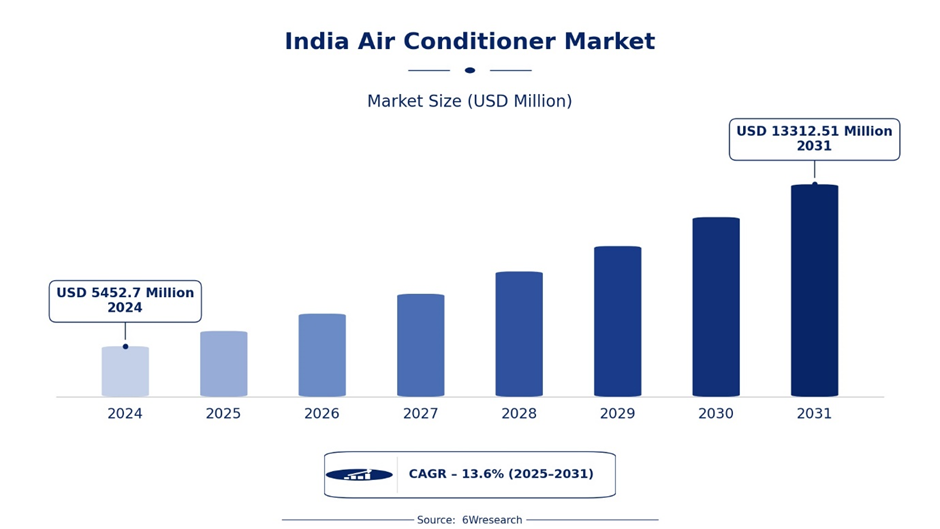
India Air Conditioner Market Highlights
|
Report Metric |
Details |
|
Report Name |
India Air Conditioner Market (2025-2031) |
|
Market Size 2024 |
USD 5,452.7 million |
|
Market Size 2031 |
USD 13,312.51 million |
|
Absolute Growth 2024–2031 |
USD 7,859.81 million |
|
CAGR 2025–2031 |
13.6% |
|
Peak Annual Growth (Forecast Period) |
15.8% in 2028 |
|
Forecast Period |
2025–2031 |
|
Historical Data |
2021–2024 |
|
Base Year |
2024 |
|
Leading Product Type, 2024 |
Room Air Conditioner (RAC), 88% share |
|
Fastest-Growing Product Type |
Packaged Air Conditioner (PAC), 15.4% CAGR |
|
Leading Region, 2024 |
Urban, 78% share |
|
Fastest-Growing Region |
Rural, 16.2% CAGR |
|
Growing Sector |
Commercial and digital infrastructure cooling |
|
Key End Users |
Households, real estate developers, hospitality operators, healthcare providers, retail chains, IT and data centre operators, institutional buyers |
India Air Conditioner Market Year-wise Growth Rate and Key Drivers (2021–2031)
This graph illustrates the annual growth rates of the market from 2021 to 2031, highlighting gradual market development in the historical period and stronger expansion during the forecast period.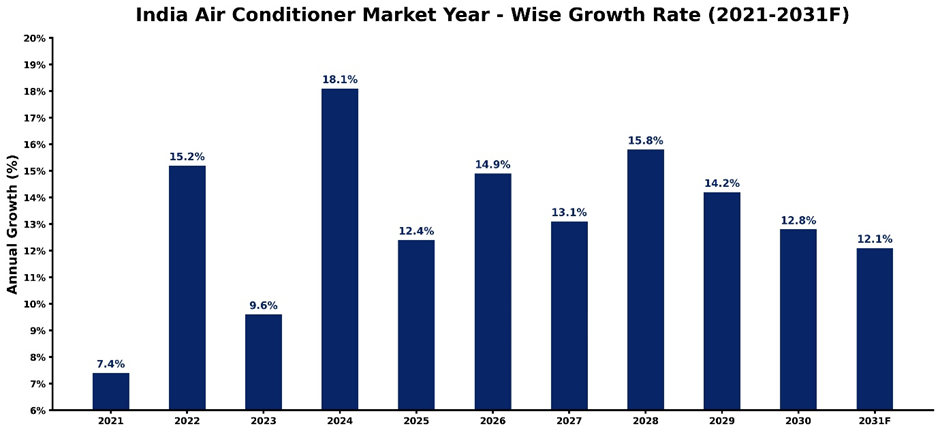
The following table presents the estimated annual growth rate for each year together with the principal factor influencing market performance.
|
Year |
Estimated Annual Growth (%) |
Market Rationale |
|
2021 |
7.4% |
The second COVID-19 wave in April and May 2021 disrupted retail and installations and limited recovery after the 2020 lockdown. |
|
2022 |
15.2% |
Pent-up demand and an early, severe heatwave in March and April 2022 lifted purchases after lockdown restrictions eased. |
|
2023 |
9.6% |
Unseasonal spring rainfall and a high 2022 base softened summer sales and left dealers with surplus inventory. |
|
2024 |
18.1% |
Record heatwaves across northern and central India lengthened the selling season and drove unusually strong sales from April through June. |
|
2025 |
12.4% |
An early and active monsoon is expected to shorten the peak buying season and moderate growth after the record year. |
|
2026 |
14.9% |
The September 2025 GST cut from 28 per cent to 18 per cent is expected to lower purchase prices. |
|
2027 |
13.1% |
Periodic tightening of BEE star-rating bands is expected to raise unit prices and slow entry-level purchases. |
|
2028 |
15.8% |
Large-scale housing completions across tier-two cities are expected to add fresh households and drive the strongest annual expansion. |
|
2029 |
14.2% |
Replacement demand from units sold during the 2022 and 2024 heatwave years is expected to sustain volumes. |
|
2030 |
12.8% |
Saturation among large metropolitan households is expected to moderate growth even as adoption widens elsewhere. |
|
2031 |
12.1% |
A larger installed base and maturing product cycle are expected to settle annual growth near its lower bound. |
Note: Market size estimations and growth projections presented in this report are based on 6Wresearch’s proprietary forecasting methodology, utilizing the latest available industry data, government publications, and primary research inputs.
India Air Conditioner Market Synopsis
The India air conditioner market witnessed growth during 2021–2025, supported by rapid urbanization, infrastructure expansion, and rising consumer affordability. The government’s Smart Cities Mission, completed by 2025, drove large-scale adoption of centralized and residential cooling systems. Rural electrification initiatives enabled wider penetration into Tier II, Tier III cities, and villages, expanding the addressable market for affordable and energy-efficient models. The growing middle-class share, accounting for some percent of population in 2025 and rising disposable incomes 2023 to 2024, boosted sales of inverter and premium split ACs.
In addition, the real estate sector’s expansion, luxury home sales priced higher and above rising in 2024 and the hospitality sector recording some branded hotel signings in 2024, within emerging cities, fueled demand for VRF and large-capacity commercial ACs. Meanwhile, office and retail infrastructure saw robust growth, with new office supply in Q2 2025. Collectively, these developments positioned the India AC market for sustained growth through 2025, supported by both policy initiatives and evolving consumer preferences.

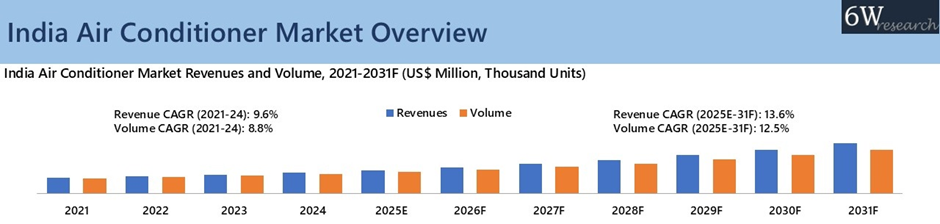
According to 6Wresearch, the India Air Conditioner Market is projected to grow at a CAGR of 13.6% in revenue and 12.5% in volume from 2025 to 2031, driven by growing demand for eco-friendly systems and supported by increasing consumer spending power. Government initiatives, including the Production-Linked Incentive (PLI) scheme, scheduled to run from FY 2021-22 to FY 2028F-29F, under which in 2025, some companies have committed investments for local manufacturing of key AC components, and policies promoting sustainable consumption are boosting domestic production and adoption of energy-efficient appliances.
The tourism sector, contributing annually from 2019-2030 to GDP through hotels, travel, and airlines, is expected to increase demand for large-scale cooling solutions. Similarly, real estate expansion, with new mall supply expected across major cities by 2027, alongside luxury housing and commercial developments, would drive residential and commercial AC installations. Increasing consumer focus on indoor comfort, smart home integration, and online availability further supports market expansion, positioning the India air conditioner market for sustained growth.

Market Dynamics Impact Analysis (2025–2031)
|
Factor |
Type |
Impact |
Primary Segment Affected |
|
Rising temperatures and peak cooling load |
Driver |
High |
Room Air Conditioner (RAC) |
|
Expansion of commercial and digital infrastructure |
Driver |
High |
Packaged Air Conditioner (PAC) |
|
Small-town demand expansion |
Opportunity |
High |
Rural |
|
Local component manufacturing |
Opportunity |
Medium |
Room Air Conditioner (RAC) |
|
Import dependence for compressors |
Restraint |
High |
Room Air Conditioner (RAC) |
|
High upfront cost relative to coolers and fans |
Restraint |
Medium |
Rural |
|
Shortage of trained installers |
Challenge |
Medium |
Room Air Conditioner (RAC) |
|
Refrigerant and efficiency compliance |
Challenge |
Medium |
Packaged Air Conditioner (PAC) |
Evaluation of Drivers in India Air Conditioner Market (2025–2031)
Below mentioned are some major drivers and their influence on market dynamics.
|
Drivers |
Primary Segments Affected |
Why it matters (evidence) |
|
Rising Urbanization and Disposable Income |
Residential and Commercial |
Massive urban development and increasing middle-class income levels are augmenting demand for air conditioners across cities and towns. |
|
Expanding Commercial Infrastructure |
Commercial Segment |
Enormous growth in offices, malls, and hospitality projects is accelerating the installation of large-scale HVAC systems. |
|
Technological Advancements |
Product and Technology |
The introduction of inverter-based and smart connected ACs is driving replacement and new demand. |
|
Government Energy Efficiency Initiatives |
Residential and Institutional |
The promotion of BEE-rated energy-efficient air conditioners encourages consumer adoption of sustainable cooling solutions. |
|
Rising Temperature and Climate Change |
Residential and Industrial |
Immense climate change in India are contributing to a stable rise in cooling equipment demand. |
Market growth is supported by growing demand for eco-friendly systems and supported by increasing consumer spending power. Government initiatives, which include the Production-Linked Incentive (PLI) scheme, scheduled to run from FY 2021-22 to FY 2028F-29F, under which in 2025, some companies have committed investments for local manufacturing of key AC components, and policies promoting sustainable consumption are boosting domestic production and adoption of energy-efficient appliances.
The tourism sector, contributing annually from 2019-2030 to GDP through hotels, travel, and airlines is likely to increase demand for large-scale cooling solutions in the country. Also, real estate expansion, with new mall supply expected across major cities by 2027, alongside luxury housing and commercial developments, would drive residential and commercial AC installations. Along with this, increasing consumer focus on indoor comfort, smart home integration, and online availability further supports market expansion, positioning the India air conditioner market for sustained growth.
Evaluation of Restraints in the India Air Conditioner Market
Below mentioned are some major restraints and their influence on the market dynamics:
|
Restraints |
Primary Segments Affected |
What this means (evidence) |
|
High Initial and Maintenance Cost |
Residential |
High initial servicing cost of premium and inverter models curbs affordability among middle-class. |
|
Power Supply Constraints in Rural Areas |
Rural and Semi-Urban |
Inadequate electricity access and oscillations limit the use of air conditioners in rural regions. |
|
Intense Market Competition |
All Segments |
Intense competition among major brands compresses profit margins and bounds differentiation. |
|
Environmental Regulations on Refrigerants |
Manufacturing |
Transition to eco-friendly refrigerants upsurges production cost and compliance burden. |
|
Changes in Seasonal Demand |
Residential and Retail |
Heavy dependency on summer sales cycles impacts steady market development throughout the year. |
India Air Conditioner Market Challenges
On the other hand, there are several challenges, such as technician capacity is a persistent obstacle as installation and servicing depend on informally trained workers, which shortens product life and increases warranty costs for brands. Another one is refrigerant choices, which add technical risk, since R-32 carries a global warming potential near 675 and manufacturers must redesign circuits and retrain service networks before tighter international norms apply. Competition from more than ten national brands keeps promotional pricing intense, compressing margins for mid-range models. Buyer behaviour is also shifting towards waiting for festive offers and expected price cuts, as seen around the September 2025 GST revision, which makes quarterly volumes harder to forecast for dealers and distributors.
Trends in the India Air Conditioner Market
Below mentioned are some of the trends shaping the India Air Conditioner Market growth.
- Shift from Fixed-Speed to Inverter Air Conditioners: Buyers are moving away from fixed-speed models as inverter units lower electricity bills and tolerate voltage fluctuation. Leading brands including Voltas, Daikin and LG Electronics now headline inverter models in their annual launches. The trend favours suppliers of variable-speed compressors, controllers and sensors, and rewards buyers who calculate lifetime running cost rather than purchase price.
- Transition from Metro-Led to Small-Town Demand: Sales growth is broadening from the largest cities to tier-two and tier-three towns as brands add exclusive outlets and authorised service centres. Heat exposure in northern and central India makes these towns natural adoption centres. Suppliers gain from widening dealer networks and regional service hubs, while buyers benefit from shorter service response times.
- Shift from Imported to Domestically Manufactured Components: Air conditioner makers are moving away from fully imported sub-assemblies as contract manufacturers such as Amber Enterprises and PG Electroplast expand heat exchanger, printed circuit board and assembly capacity. Localisation reduces currency exposure and shortens lead times, though compressors still rely heavily on imports. Brands and component suppliers that establish Indian plants early gain cost advantages and procurement preference.
Investment Opportunities in the India Air Conditioner Market
Some of the investment opportunities in the India Air Conditioner Market are mentioned below.
- Compressor and Motor Manufacturing: Heavy dependence on imported compressors creates a clear gap for local production. Investors can establish rotary compressor, BLDC motor and copper-tube capacity in Tamil Nadu, Andhra Pradesh and Uttar Pradesh clusters. Entry is most practical through joint ventures with global compressor makers or supply agreements with established brands, supported by eligibility under the white goods incentive scheme.
- Certified Installation and After-Sales Service Networks: Installation quality and service response influence brand choice, yet technician supply is thin outside major cities. Investors can fund training academies, mobile service fleets and annual maintenance platforms in tier-two cities. Collaboration with OEMs for certified training along with agreements with housing developers and property managers, creates dependable service revenue.
- Refrigerant Reclamation and Low-GWP Technology: Forthcoming hydrofluorocarbon controls will require recovery, reclamation and safe disposal infrastructure that is largely undeveloped. Investors can set up refrigerant reclaim centres and supply low-GWP gas blends and retrofit components near manufacturing clusters in Gujarat, Maharashtra and the National Capital Region. Entry through licensed handling certification and partnerships with large OEMs and service chains ensures steady volumes.
Leading Players in India Air Conditioner Market
Stated below are some of the leading companies contributing significantly to the India Air Conditioner Market share.
1. Daikin Industries, Ltd.
| Company Name | Company Name |
|---|---|
| Established Year | 1924 |
| Headquarters | Osaka, Japan |
| Official Website | Click Here |
Daikin Industries, Ltd. is a global air conditioning and refrigerant manufacturer with local manufacturing and sales operations in India. It is a recognised supplier of inverter room air conditioners and commercial HVAC systems.
2. Samsung Electronics Co., Ltd.
| Company Name | Company Name |
|---|---|
| Established Year | 1969 |
| Headquarters | Suwon, South Korea |
| Official Website | Click Here |
Samsung Electronics Co., Ltd. offers consumer electronics and room air conditioners in India through its local operations. It competes mainly in inverter air conditioners and connected-appliance categories.
3. Carrier Global Corporation
| Company Name | Company Name |
|---|---|
| Established Year | 1915 |
| Headquarters | Palm Beach Gardens, Florida, USA |
| Official Website | Click Here |
Carrier Global Corporation provides advanced HVAC solutions, including high-efficiency air conditioning systems featuring inverter technologies and environmentally friendly refrigerants for residential and commercial applications.
Government Initiatives in the India Air Conditioner Market
India’s Cooling Action Plan, released in 2019, targets a 20 to 25 per cent reduction in cooling demand and a 25 to 30 per cent cut in refrigerant demand by 2037-38, aligning the sector with efficiency goals. Mandatory star labelling by the Bureau of Energy Efficiency under the Energy Conservation Act, 2001 governs room air conditioners, while Kigali Amendment commitments direct a hydrofluorocarbon phase-down beginning in 2032.
The Production Linked Incentive scheme for white goods, approved in April 2021 with an outlay of INR 6,238 crore, supports domestic production of air conditioner components such as compressors, copper tubing and controllers through 2028-29. Housing programmes such as Pradhan Mantri Awas Yojana-Urban 2.0, approved in 2024 for 1 crore urban homes, are expanding new residential stock, while state agencies and the Ministry of Power promote efficient cooling.
Future Insight of the India Air Conditioner Market
Growth over the forecast period will be supported by wider adoption of connected, inverter-based cooling that lowers running costs and encourages upgrades. Tighter energy-efficiency norms will keep stimulating replacement of older units as consumers shift to higher-rated products. Expanding grid and renewable capacity, supported by the national goal of 500 GW of non-fossil power by 2030 and net-zero emissions by 2070, will improve electricity availability for cooling loads. Continued private investment in manufacturing, logistics and service networks will strengthen supply, while new commercial and digital infrastructure will broaden installation opportunities nationwide.
Market Segmentation Analysis
The report offers a comprehensive study of the market across its key segments. The chart below highlights the leading segment by market share in 2025 and the fastest-growing segment by CAGR over 2026–2032, followed by a detailed analysis of each segment.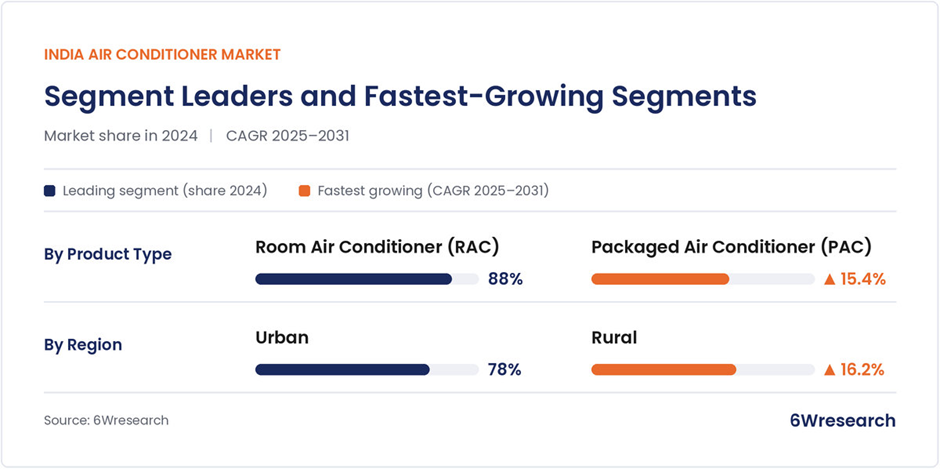
By Product Type – Room Air Conditioner (RAC) Leads, Packaged Air Conditioner (PAC) Expected to Grow Fastest
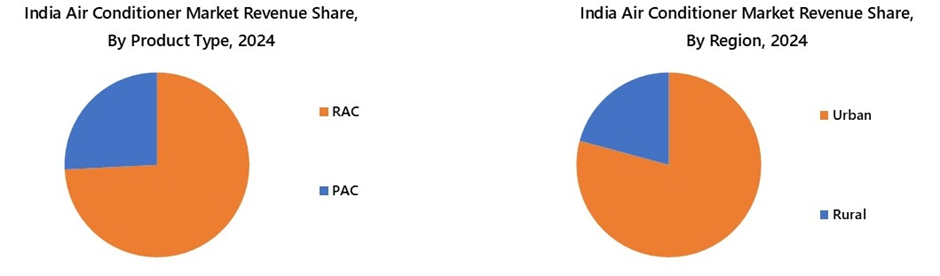
According to Ravi Bhandari, Research Head at 6Wresearch, Room Air Conditioner (RAC) accounts for an 88% share in 2024, supported by low household penetration, widespread split-unit adoption and summer temperatures that regularly exceed 40°C across the northern plains. Packaged Air Conditioner (PAC) is expected to record the fastest 2025–2031 CAGR of 15.4%, supported by new hospital, retail and office projects in major cities.
By Region – Urban Leads, Rural Expected to Grow Fastest
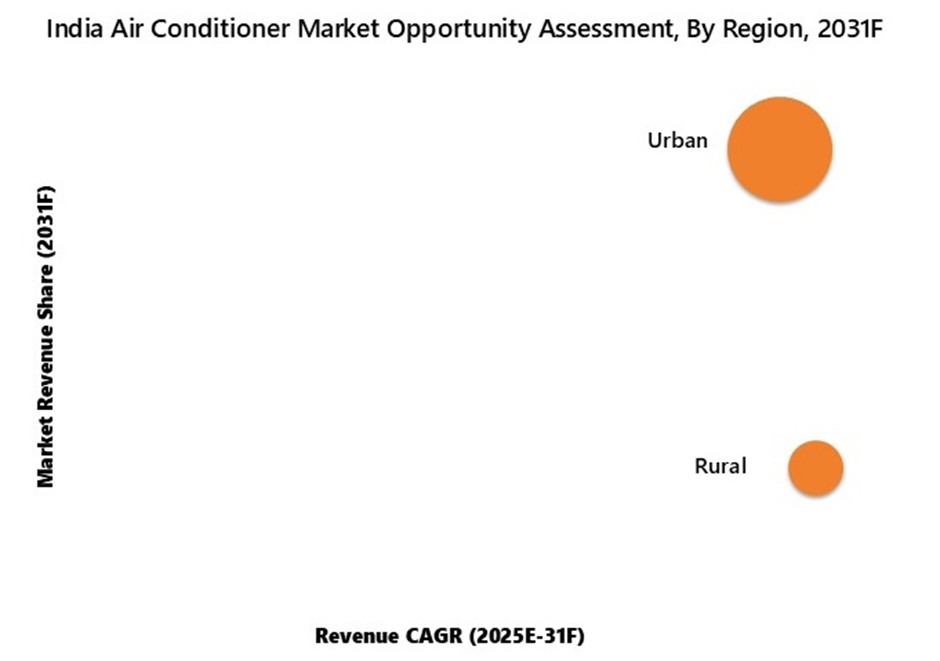
Urban India holds the leading 78% share in 2024 on higher disposable incomes, concentrated organised retail and dense apartment stock in metropolitan areas such as Delhi NCR, Mumbai and Bengaluru. Rural India is projected to post the fastest 2025–2031 CAGR of 16.2%, as near-universal household electrification and rising farm and remittance incomes move households from coolers to air conditioners.
Key Attractiveness of the Report
- 10 Years Market Numbers.
- Historical Data: Starting from 2021 to 2024
- Base Year: 2024
- Forecast Data until 2031
- Key Performance Indicators Impacting the Market.
- Major Upcoming Developments and Projects.
Key Highlights of the Report:
- India Air Conditioner Market Outlook
- Market Size of India Air Conditioner Market, 2024
- Forecast of India Air Conditioner Market, 2031
- Historical Data and Forecast of Air Conditioner Revenues & Volume for the Period 2021-2031
- India Air Conditioner Market Trend Evolution
- India Air Conditioner Market Drivers and Challenges
- Air Conditioner Price Trends
- Air Conditioner Porter’s Five Forces
- Air Conditioner Industry Life Cycle
- Historical Data and Forecast of India Air Conditioner Market Revenues & Volume By Product Type for the Period 2021-2031
- Historical Data and Forecast of India Air Conditioner Market Revenues & Volume By Room Air Conditioner (RAC) for the Period 2021-2031
- Historical Data and Forecast of India Air Conditioner Market Revenues & Volume By Packaged Air Conditioner (PAC) for the Period 2021-2031
- Historical Data and Forecast of India Air Conditioner Market Revenues & Volume By Region for the Period 2021-2031
- Historical Data and Forecast of India Air Conditioner Market Revenues & Volume By Urban for the Period 2021-2031
- Historical Data and Forecast of India Air Conditioner Market Revenues & Volume By Rural for the Period 2021-2031
- Air Conditioner Import Export Trade Statistics
- Market Opportunity Assessment By Product Type
- Market Opportunity Assessment By Region
- Air Conditioner Top Companies Market Share
- Air Conditioner Competitive Benchmarking By Technical and Operational Parameters
- Air Conditioner Company Profiles
- Air Conditioner Key Strategic Recommendations
Market Covered
The report offers an extensive study of the following market segments.
By Product Type
- Room Air Conditioner (RAC)
- Packaged Air Conditioner (PAC)
By Region
- Urban
- Rural