India Gin Market (2025-2031) | Outlook, Revenue, Growth, Industry, Analysis, Trends, Forecast, Value, Share, Size & Companies
Market Forecast By Product Type (London Dry Gin, Plymouth Gin, Genever/Dutch Gin, Old Tim Gin, New American Gin), By Production Method (Pot Distilled Gin, Column Distilled Gin, Compound Gin), By Distribution Channel (Hypermarkets and Supermarkets, Specialty Stores, Drug Stores, Online Channel, HoReCa, Others) And Competitive Landscape
| Product Code: ETC127354 | Publication Date: Aug 2023 | Updated Date: Nov 2025 | Product Type: Report | |
| Publisher: 6Wresearch | Author: Ravi Bhandari | No. of Pages: 70 | No. of Figures: 35 | No. of Tables: 5 |
India Gin Market Growth Rate
According to 6Wresearch internal database and industry insights, the India Gin Market is projected to grow at a compound annual growth rate (CAGR) of 8.1% during the forecast period (2025–2031).
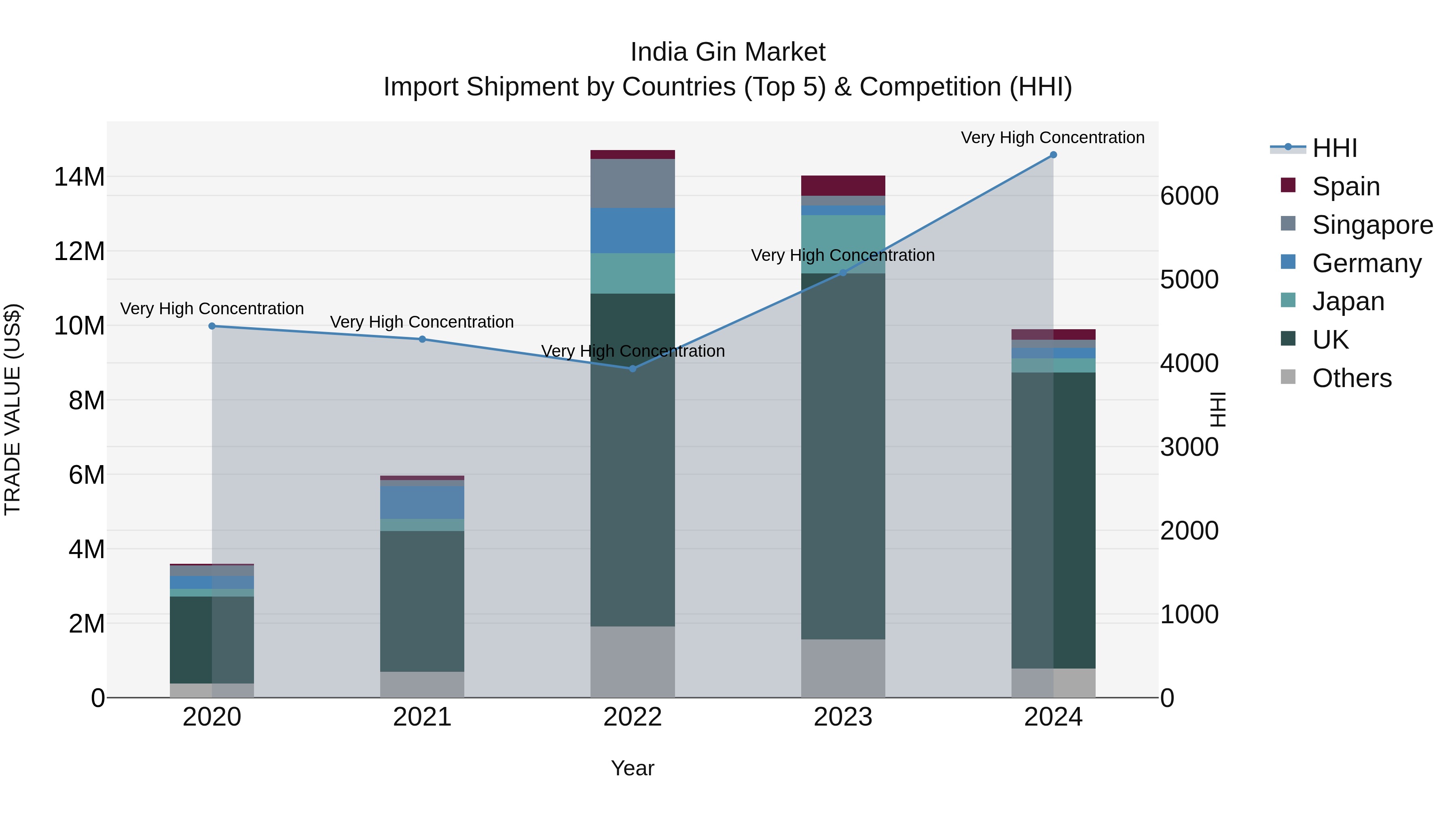
India Gin Market Top 5 Importing Countries and Market Competition (HHI) Analysis
India`s gin import market in 2024 continued to showcase a strong reliance on key exporting countries such as the UK, Japan, Spain, Germany, and Singapore. Despite the high concentration of import shipments, the market experienced a significant growth with a remarkable compound annual growth rate (CAGR) of 28.86% from 2020 to 2024. However, there was a notable decline in growth rate from 2023 to 2024, recording a -29.39%. The dynamics of the gin import market in India indicate both opportunities and challenges for stakeholders to navigate in the coming years.
India Gin Market Highlights
| Report Name | India Gin Market |
| Forecast period | 2025-2031 |
| CAGR | 8.1% |
| Growing Sector | Alcoholic Beverages |
Five-Year Growth Trajectory of the India Gin Market with Core Drivers
Below mentioned are the evaluation of year-wise growth rate along with key drivers:
| Years | Est. Annual Growth (%) | Growth Drivers |
| 2020 | 1.80% | Limited premium spirit awareness and dominance of brown spirits like whisky. |
| 2021 | 3.20% | Gradual exposure to global cocktail culture and demand from metropolitan consumers. |
| 2022 | 4.60% | Emergence of craft distilleries and expansion of domestic premium gin brands. |
| 2023 | 6.20% | Increased HoReCa consumption and urban retail penetration of premium gins. |
| 2024 | 7.40% | Rising preference for locally distilled gins with Indian botanicals and export expansion. |
Topics Covered in the India Gin Market Report
The India Gin Market report thoroughly covers the market by product type, production method, and distribution channel. The report provides an unbiased and detailed analysis of ongoing market trends, opportunities/high-growth areas, and market drivers that will help stakeholders devise and align strategies according to current and future market dynamics.
India Gin Market Synopsis
The India Gin Market is poised for considerable growth which is mainly attributable to the premium and craft spirits; the urban population's higher income and changing consumer tastes. The trend of cocktail consumption in big cities and the entry of native, botanic gins have started to change the spirits market in the country. The growth of tourism, the establishment of high-end bars, and the serving of gin-based drinks at fine dining restaurants are also contributing to the market. The government measures that promote craft drink production and research into local plants for gin flavoring are among the factors which will make the market grow.
Evaluation of Growth Drivers in the India Gin Market
Below mentioned are some prominent drivers and their influence on the India Gin Market dynamics:
| Drivers | Primary Segments Affected | Why it Matters (Evidence) |
| Rising Urbanization and Changing Lifestyles | HoReCa, Retail | Increasing social drinking culture in metropolitan areas is driving gin consumption. |
| Growth of Craft Distilleries | London Dry, Pot Distilled | Emergence of boutique gin makers promoting locally sourced botanicals. |
| Rising Tourism and Hospitality Sector | HoReCa | Expansion of premium bars and luxury hotels boosts gin-based cocktail demand. |
| Expanding Export Opportunities | London Dry, Column Distilled | Indian gins gaining international recognition for unique flavor profiles. |
| Government Support for Manufacturing | All Types | Policies like “Make in India” and state microbrewery licensing promote domestic production. |
India Gin Market is expected to grow steadily at 8.1% CAGR between 2025 and 2031. The growth of the market is supported by the premiumization trend, craft distilling innovations, and growing HoReCa consumption. India Gin Market Growth is further driven by the increasing preference for refined, locally inspired flavors and evolving consumer sophistication. Furthermore, London Dry Gin dominates the market due to its clean, crisp, and balanced profile, making it ideal for cocktails. However, Indian distilleries are innovating with indigenous botanicals such as coriander, lemongrass, and cardamom, creating unique flavor identities, and enhancing the appeal of homegrown premium spirits.
Evaluation of Restraints in the India Gin Market
Below mentioned are some major restraints and their influence on the India Gin Market dynamics:
| Restraints | Primary Segments Affected | What this Means (Evidence) |
| Stringent State Excise Regulations | All Distribution Channels | Varying taxes and licensing policies limit nationwide distribution. |
| High Retail Prices | Premium Brands | Imported and craft gins face limited reach due to pricing. |
| Dominance of Brown Spirits | Mass Market | Whisky and rum overshadow gin in total alcohol consumption. |
| Supply Chain and Ingredient Costs | Craft Distilleries | Sourcing of exotic botanicals adds cost pressures. |
| Limited Consumer Awareness Beyond Metro Cities | Retail, Online | Consumption concentrated in urban regions restricts rural market growth. |
India Gin Market Challenges
The India Gin Industry struggles with numerous issues, including stringent excise laws, poor market reach for small distillers, and strong competition from whisky and other brown spirits. Complicated licensing processes and high production costs limit the ability of small producers to scale operations. Subsequently, low awareness of gin in smaller cities and inefficient export facilities restrict market development. Furthermore, profitability remains constrained, and the adoption of high-end gin brands is slower across the country.
India Gin Market Trends
Several significant trends are impacting the India Gin Industry:
- Growth of Craft and Boutique Gins: Consumers are showing heightened interest in small-scale distilleries highlighting native botanicals.
- Introduction of Indian Botanical Profiles: Use of herbs like tulsi, cardamom, and citrus peel enhances distinct brand character.
- Shift Toward Premium Spirits: Drinkers are moving away from generic liquors to artisanal, high-quality gin varieties.
- Expansion of Online and Direct Sales: Digital platforms now provide curated gin assortments and home delivery convenience.
- Global Recognition of Indian Brands: Exports to Europe and the Middle East are elevating India presence in the premium spirits market.
Investment Opportunities in the India Gin Industry
Some of the notable investment opportunities are:
- Boutique Distillery Ventures: Setting up small-scale distilleries emphasizing native botanicals to position brands in the luxury gin market.
- Global Market Collaborations: Establish export tie-ups using India trade agreements to reach new international audiences.
- Gin Tourism Initiatives: Create experiential centers with tasting sessions and guided facility visits to build brand awareness.
- Sustainable Operations: Promote energy-efficient distillation and recyclable packaging materials.
- Digital Sales Channels: Develop robust e-commerce frameworks for direct consumer access where state laws permit.
Top 5 Leading Players in the India Gin Market
Below is the list of prominent companies leading in the India Gin Market Share:
1. United Spirits Limited (Diageo India)
| Company Name | United Spirits Limited (Diageo India) |
| Established Year | 1826 |
| Headquarters | Bengaluru, India |
| Official Website | Click Here |
United Spirits markets imported and domestic gins including Gordon’s and Tanqueray, catering to both retail and HoReCa segments.
2. Pernod Ricard India Pvt. Ltd.
| Company Name | Pernod Ricard India Pvt. Ltd. |
| Established Year | 1994 |
| Headquarters | Gurugram, India |
| Official Website | Click Here |
Distributes international premium gin brands such as Beefeater and Monkey 47 while supporting premium bar culture in India.
3. Radico Khaitan Limited
| Company Name | Radico Khaitan Limited |
| Established Year | 1943 |
| Headquarters | Rampur, Uttar Pradesh, India |
| Official Website | Click Here |
A key domestic producer offering premium gins like Jaisalmer Indian Craft Gin, made using traditional pot stills.
4. Nao Spirits & Beverages Pvt. Ltd.
| Company Name | Nao Spirits & Beverages Pvt. Ltd. |
| Established Year | 2015 |
| Headquarters | New Delhi, India |
| Official Website | Click Here |
Pioneer in Indian craft gin with brands like Greater Than and Hapusa, emphasizing local botanicals and sustainable production.
5. Third Eye Distillery
| Company Name | Third Eye Distillery |
| Established Year | 2018 |
| Headquarters | Goa, India |
| Official Website | Click Here |
Produces Stranger & Sons Gin, blending Indian spices and citrus notes, with growing export reach to Europe and Asia.
Government Regulations Introduced in the India Gin Market
According to Indian Government data, the Government of India “Make in India” program actively promotes domestic production and export of alcoholic beverages, strengthening local manufacturing capacity. Initiatives under “Startup India” provide regulatory ease and support for small-scale distilleries and craft spirit entrepreneurs. Through the Atmanirbhar Bharat Abhiyan, emphasis is placed on sourcing indigenous botanicals and raw materials. Furthermore, progressive states such as Goa and Maharashtra have introduced favourable micro-distillery licensing policies, while the FSSAI ensures strict labelling and safety standards for consumer protection.
Future Insights of the India Gin Market
The India Gin Industry is expected to grow swiftly, fueled by the rise of premium spirits, increasing craft gin production, and expanding international recognition of Indian brands. Ongoing investments in modern distillation systems, eco-friendly packaging, and the use of indigenous botanicals are improving product quality and market competitiveness. Over the next few years, India is anticipated to emerge as a key gin producer in Asia, supported by export-oriented government policies and growing domestic demand for artisanal beverages.
Market Segmentation Analysis
The report offers a comprehensive study of the subsequent market segments and their leading categories.
By Product Type – London Dry Gin to Dominate the Market
According to Ritika Kalra, Senior Research Analyst, 6Wresearch, London Dry Gin is projected to dominate the India Gin Market Share due to its crisp flavor, versatility in cocktails, and high export demand. Its consistent quality and widespread consumer acceptance make it the preferred choice among premium bars and retailers.
By Production Method – Column Distilled Gin to Dominate the Market
Column Distilled Gin dominates owing to its efficiency in large-scale production, uniform flavor profile, and suitability for mass-market distribution. However, pot distillation is gaining traction among craft distilleries focusing on artisanal quality.
By Distribution Channel – HoReCa Segment to Dominate the Market
The HoReCa (Hotels, Restaurants, and Cafés) segment leads the distribution due to the growing cocktail culture and demand for premium gin-based beverages. Meanwhile, online channels and specialty stores are emerging as fast-growing segments catering to urban consumers.
Key Attractiveness of the Report
- 10 Years of Market Numbers
- Historical Data Starting from 2021 to 2024
- Base Year: 2024
- Forecast Data until 2031
- Key Performance Indicators Impacting the Market
- Major Upcoming Developments and Projects
Key Highlights of the Report:
- India Gin Market Outlook
- Market Size of India Gin Market, 2024
- Forecast of India Gin Market, 2031
- Historical Data and Forecast of India Gin Revenues & Volume for the Period 2021-2031
- India Gin Market Trend Evolution
- India Gin Market Drivers and Challenges
- India Gin Price Trends
- India Gin Porter's Five Forces
- India Gin Industry Life Cycle
- Historical Data and Forecast of India Gin Market Revenues & Volume By Product Type for the Period 2021-2031
- Historical Data and Forecast of India Gin Market Revenues & Volume By London Dry Gin for the Period 2021-2031
- Historical Data and Forecast of India Gin Market Revenues & Volume By Plymouth Gin for the Period 2021-2031
- Historical Data and Forecast of India Gin Market Revenues & Volume By Genever/Dutch Gin for the Period 2021-2031
- Historical Data and Forecast of India Gin Market Revenues & Volume By Old Tim Gin for the Period 2021-2031
- Historical Data and Forecast of India Gin Market Revenues & Volume By New American Gin for the Period 2021-2031
- Historical Data and Forecast of India Gin Market Revenues & Volume By Production Method for the Period 2021-2031
- Historical Data and Forecast of India Gin Market Revenues & Volume By Pot Distilled Gin for the Period 2021-2031
- Historical Data and Forecast of India Gin Market Revenues & Volume By Column Distilled Gin for the Period 2021-2031
- Historical Data and Forecast of India Gin Market Revenues & Volume By Compound Gin for the Period 2021-2031
- Historical Data and Forecast of India Gin Market Revenues & Volume By Distribution Channel for the Period 2021-2031
- Historical Data and Forecast of India Gin Market Revenues & Volume By Hypermarkets and Supermarkets for the Period 2021-2031
- Historical Data and Forecast of India Gin Market Revenues & Volume By Specialty Stores for the Period 2021-2031
- Historical Data and Forecast of India Gin Market Revenues & Volume By Drug Stores for the Period 2021-2031
- Historical Data and Forecast of India Gin Market Revenues & Volume By Online Channel for the Period 2021-2031
- Historical Data and Forecast of India Gin Market Revenues & Volume By HoReCa for the Period 2021-2031
- Historical Data and Forecast of India Gin Market Revenues & Volume By Others for the Period 2021-2031
- India Gin Import Export Trade Statistics
- Market Opportunity Assessment By Product Type
- Market Opportunity Assessment By Production Method
- Market Opportunity Assessment By Distribution Channel
- India Gin Top Companies Market Share
- India Gin Competitive Benchmarking By Technical and Operational Parameters
- India Gin Company Profiles
- India Gin Key Strategic Recommendations
Market Covered
The report offers a comprehensive study of the subsequent market segments:
By Product Type
- London Dry Gin
- Plymouth Gin
- Genever/Dutch Gin
- Old Tom Gin
- New American Gin
By Production Method
- Pot Distilled Gin
- Column Distilled Gin
- Compound Gin
By Distribution Channel
- Hypermarkets and Supermarkets
- Specialty Stores
- Drug Stores
- Online Channel
- HoReCa
- Others
India Gin Market (2025-2031): FAQs
The India Gin Market is projected to grow at a CAGR of 8.1% during the forecast period.
London Dry Gin dominates the market due to its global popularity, smooth flavor, and high cocktail versatility.
The HoReCa segment holds the largest share driven by the increasing cocktail culture in hotels, bars, and restaurants.
Stringent excise regulations, limited awareness beyond metro cities, and high production costs are key challenges.
6Wresearch actively monitors the India Gin Market and publishes its comprehensive annual report, highlighting emerging trends, growth drivers, revenue analysis, and forecast outlook. Our insights help businesses to make data-backed strategic decisions with ongoing market dynamics. Our analysts track relevent industries related to the India Gin Market, allowing our clients with actionable intelligence and reliable forecasts tailored to emerging regional needs.
Yes, we provide customisation as per your requirements. To learn more, feel free to contact us on sales@6wresearch.com
| India Gin |
| 1 Executive Summary |
| 2 Introduction |
| 2.1 Key Highlights of the Report |
| 2.2 Report Description |
| 2.3 Market Scope & Segmentation |
| 2.4 Research Methodology |
| 2.5 Assumptions |
| 3 India Gin Market Overview |
| 3.1 India Country Macro Economic Indicators |
| 3.2 India Gin Market Revenues & Volume, 2021 & 2031F |
| 3.3 India Gin Market - Industry Life Cycle |
| 3.4 India Gin Market - Porter's Five Forces |
| 3.5 India Gin Market Revenues & Volume Share, By Product Type, 2021 & 2031F |
| 3.6 India Gin Market Revenues & Volume Share, By Production Method, 2021 & 2031F |
| 3.7 India Gin Market Revenues & Volume Share, By Distribution Channel, 2021 & 2031F |
| 4 India Gin Market Dynamics |
| 4.1 Impact Analysis |
| 4.2 Market Drivers |
| 4.2.1 Increasing disposable income of consumers in India, leading to higher spending on premium alcoholic beverages like gin. |
| 4.2.2 Growing trend of socializing and cocktail culture in urban areas of India, boosting the demand for gin products. |
| 4.2.3 Rising awareness and appreciation of craft gin among Indian consumers, driving the demand for unique and high-quality gin offerings. |
| 4.3 Market Restraints |
| 4.3.1 Stringent government regulations and high taxation on alcoholic beverages in India, impacting the pricing and affordability of gin products. |
| 4.3.2 Limited availability of quality gin brands in the Indian market, hindering the growth potential due to supply constraints. |
| 5 India Gin Market Trends |
| 6 India Gin Market, By Types |
| 6.1 India Gin Market, By Product Type |
| 6.1.1 Overview and Analysis |
| 6.1.2 India Gin Market Revenues & Volume, By Product Type, 2021-2031F |
| 6.1.3 India Gin Market Revenues & Volume, By London Dry Gin, 2021-2031F |
| 6.1.4 India Gin Market Revenues & Volume, By Plymouth Gin, 2021-2031F |
| 6.1.5 India Gin Market Revenues & Volume, By Genever/Dutch Gin, 2021-2031F |
| 6.1.6 India Gin Market Revenues & Volume, By Old Tim Gin, 2021-2031F |
| 6.1.7 India Gin Market Revenues & Volume, By New American Gin, 2021-2031F |
| 6.2 India Gin Market, By Production Method |
| 6.2.1 Overview and Analysis |
| 6.2.2 India Gin Market Revenues & Volume, By Pot Distilled Gin, 2021-2031F |
| 6.2.3 India Gin Market Revenues & Volume, By Column Distilled Gin, 2021-2031F |
| 6.2.4 India Gin Market Revenues & Volume, By Compound Gin, 2021-2031F |
| 6.3 India Gin Market, By Distribution Channel |
| 6.3.1 Overview and Analysis |
| 6.3.2 India Gin Market Revenues & Volume, By Hypermarkets and Supermarkets, 2021-2031F |
| 6.3.3 India Gin Market Revenues & Volume, By Specialty Stores, 2021-2031F |
| 6.3.4 India Gin Market Revenues & Volume, By Drug Stores, 2021-2031F |
| 6.3.5 India Gin Market Revenues & Volume, By Online Channel, 2021-2031F |
| 6.3.6 India Gin Market Revenues & Volume, By HoReCa, 2021-2031F |
| 6.3.7 India Gin Market Revenues & Volume, By Others, 2021-2031F |
| 7 India Gin Market Import-Export Trade Statistics |
| 7.1 India Gin Market Export to Major Countries |
| 7.2 India Gin Market Imports from Major Countries |
| 8 India Gin Market Key Performance Indicators |
| 8.1 Number of craft gin distilleries and brands entering the Indian market. |
| 8.2 Growth in the number of bars, restaurants, and hotels offering gin-based cocktails. |
| 8.3 Increase in the consumption of gin at social events and gatherings in India. |
| 9 India Gin Market - Opportunity Assessment |
| 9.1 India Gin Market Opportunity Assessment, By Product Type, 2021 & 2031F |
| 9.2 India Gin Market Opportunity Assessment, By Production Method, 2021 & 2031F |
| 9.3 India Gin Market Opportunity Assessment, By Distribution Channel, 2021 & 2031F |
| 10 India Gin Market - Competitive Landscape |
| 10.1 India Gin Market Revenue Share, By Companies, 2024 |
| 10.2 India Gin Market Competitive Benchmarking, By Operating and Technical Parameters |
| 11 Company Profiles |
| 12 Recommendations |
| 13 Disclaimer |
Export potential assessment - trade Analytics for 2030
Export potential enables firms to identify high-growth global markets with greater confidence by combining advanced trade intelligence with a structured quantitative methodology. The framework analyzes emerging demand trends and country-level import patterns while integrating macroeconomic and trade datasets such as GDP and population forecasts, bilateral import–export flows, tariff structures, elasticity differentials between developed and developing economies, geographic distance, and import demand projections. Using weighted trade values from 2020–2024 as the base period to project country-to-country export potential for 2030, these inputs are operationalized through calculated drivers such as gravity model parameters, tariff impact factors, and projected GDP per-capita growth. Through an analysis of hidden potentials, demand hotspots, and market conditions that are most favorable to success, this method enables firms to focus on target countries, maximize returns, and global expansion with data, backed by accuracy.
By factoring in the projected importer demand gap that is currently unmet and could be potential opportunity, it identifies the potential for the Exporter (Country) among 190 countries, against the general trade analysis, which identifies the biggest importer or exporter.
To discover high-growth global markets and optimize your business strategy:
Click Here
Pricing
- Single User License$ 1,995
- Department License$ 2,400
- Site License$ 3,120
- Global License$ 3,795

Search
Thought Leadership and Analyst Meet





Our Clients








Related Reports
- Sri Lanka Packaging Market (2026-2032) | Outlook, Competition, Drivers, Trends, Demand, Pricing Analysis, Competitive, Strategic Insights, Companies, Challenges, Strategy, Consumer Insights, Analysis, Investment Trends, Opportunities, Growth, Size, Share, Industry, Revenue, Segments, Value, Segmentation, Supply, Forecast, Restraints
- India Kids Watches Market (2026-2032) | Strategy, Consumer Insights, Analysis, Investment Trends, Opportunities, Growth, Size, Share, Industry, Revenue, Segments, Value, Segmentation, Supply, Forecast, Restraints, Outlook, Competition, Drivers, Trends, Demand, Pricing Analysis, Competitive, Strategic Insights, Companies, Challenges
- Saudi Arabia Core Assurance Service Market (2025-2031) | Strategy, Consumer Insights, Analysis, Investment Trends, Opportunities, Growth, Size, Share, Industry, Revenue, Segments, Value, Segmentation, Supply, Forecast, Restraints, Outlook, Competition, Drivers, Trends, Demand, Pricing Analysis, Competitive, Strategic Insights, Companies, Challenges
- Romania Uninterruptible Power Supply (UPS) Market (2026-2032) | Industry, Analysis, Revenue, Size, Forecast, Outlook, Value, Trends, Share, Growth & Companies
- Saudi Arabia Car Window Tinting Film, Paint Protection Film (PPF), and Ceramic Coating Market (2025-2031) | Strategy, Consumer Insights, Analysis, Investment Trends, Opportunities, Growth, Size, Share, Industry, Revenue, Segments, Value, Segmentation, Supply, Forecast, Restraints, Outlook, Competition, Drivers, Trends, Demand, Pricing Analysis, Competitive, Strategic Insights, Companies, Challenges
- South Africa Stationery Market (2025-2031) | Share, Size, Industry, Value, Growth, Revenue, Analysis, Trends, Segmentation & Outlook
- Afghanistan Rocking Chairs And Adirondack Chairs Market (2026-2032) | Size & Revenue, Competitive Landscape, Share, Segmentation, Industry, Value, Outlook, Analysis, Trends, Growth, Forecast, Companies
- Afghanistan Apparel Market (2026-2032) | Growth, Outlook, Industry, Segmentation, Forecast, Size, Companies, Trends, Value, Share, Analysis & Revenue
- Canada Oil and Gas Market (2026-2032) | Share, Segmentation, Value, Industry, Trends, Forecast, Analysis, Size & Revenue, Growth, Competitive Landscape, Outlook, Companies
- Germany Breakfast Food Market (2026-2032) | Industry, Share, Growth, Size, Companies, Value, Analysis, Revenue, Trends, Forecast & Outlook
Industry Events and Analyst Meet

Smart Production Solutions Guangzhou 2026

Stationery & Paper Expo Saudi Arabia 2026

Kids & Toys Expo Saudi Arabia 2026

Gifts & Homeware Expo Saudi Arabia 2026

Smart Home Expo 2026
Whitepaper
- Middle East & Africa Commercial Security Market Click here to view more.
- Middle East & Africa Fire Safety Systems & Equipment Market Click here to view more.
- GCC Drone Market Click here to view more.
- Middle East Lighting Fixture Market Click here to view more.
- GCC Physical & Perimeter Security Market Click here to view more.
6WResearch In News
- Doha a strategic location for EV manufacturing hub: IPA Qatar
- Demand for luxury TVs surging in the GCC, says Samsung
- Empowering Growth: The Thriving Journey of Bangladesh’s Cable Industry
- Demand for luxury TVs surging in the GCC, says Samsung
- Video call with a traditional healer? Once unthinkable, it’s now common in South Africa
- Intelligent Buildings To Smooth GCC’s Path To Net Zero


