India Natural Stone Market (2026-2032) | Outlook, Value, Revenue, Companies, Analysis, Industry, Forecast, Size, Share, Trends & Growth
Market Forecast By Type (Marble, Granite, Limestone, Others), By Application (Flooring, Memorial Arts, Wall Cladding, Others), By Construction Type (New Construction, Renovation) And Competitive Landscape
| Product Code: ETC334704 | Publication Date: Aug 2023 | Updated Date: Feb 2026 | Product Type: Report | |
| Publisher: 6Wresearch | Author: Ravi Bhandari | No. of Pages: 70 | No. of Figures: 35 | No. of Tables: 5 |
India Natural Stone Market Top 5 Importing Countries and Market Competition (HHI) Analysis
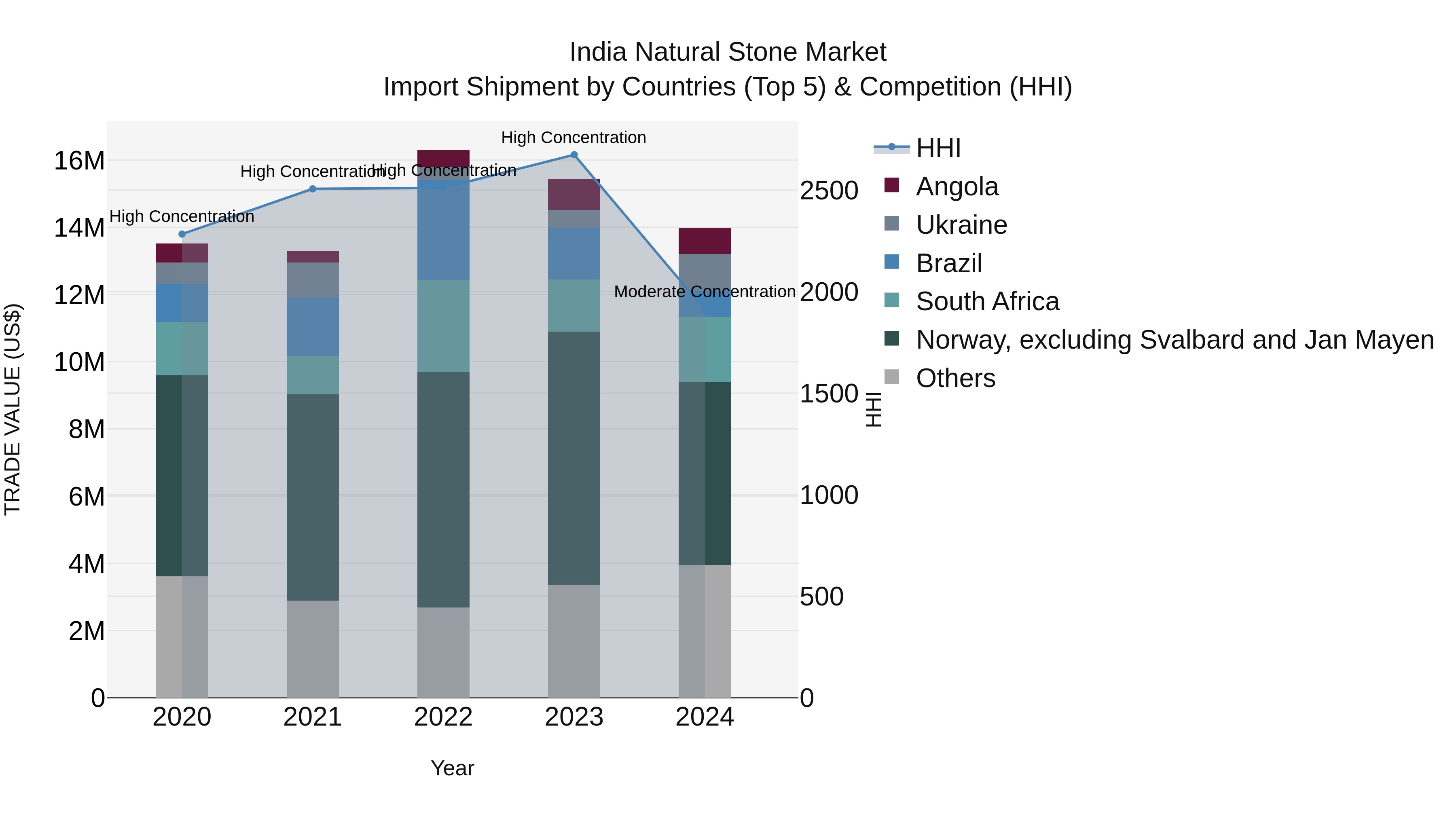
India`s natural stone import shipments in 2024 saw a shift in concentration levels from high to moderate, indicating a more diversified import market. The top countries exporting to India included Norway, South Africa, Ukraine, Brazil, and Angola. Despite a slight decrease in growth rate from 2023 to 2024, the compound annual growth rate (CAGR) over the period 2020-2024 remained positive at 0.84%. This data suggests a stable demand for natural stone imports in India, with a growing interest from a variety of source countries.
India Natural Stone Market Growth Rate
According to 6Wresearch internal database and industry insights, the India Natural Stone Market is projected to grow at a compound annual growth rate (CAGR) of 7.1% during the forecast period (2026–2032).
Topics Covered in the India Natural Stone Market Report
The India Natural Stone Market report thoroughly covers the market by type, application, and construction type. The report provides a detailed analysis of ongoing market trends, opportunities/high-growth areas, and market drivers that will help stakeholders align strategies based on current and future market dynamics.
Russia Smartphone Market Highlights
| Report Name | India Natural Stone Market |
| Forecast Period | 2026–2032 |
| CAGR | 7.1% |
| Growing Sector | Granite and Wall Cladding |
India Natural Stone Market Synopsis
India natural stone market is set to experience growth in the coming years, propelled by the increase in demand from the construction industry, infrastructure, and real estate industries. The export demand for India natural stone is also booming, making the nation a production hub. The industry is expecting massive export potential in the coming few years, especially to countries such as the USA, UAE, Netherlands, United Kingdom, and Israel, which will cause a substantial boost in production and distribution.
Evaluation of Growth Drivers in India Natural Stone Market
Below are some prominent drivers and their influence on the market dynamics:
| Drivers | Primary Segments Affected | Why It Matters |
| Luxury Real Estate Growth | By Type (Marble) | High-income homeowners prefer marble for premium aesthetics and property value appreciation. |
| Infrastructure Pipeline | By Application (Flooring) | Large-scale public projects like new airports require high-durability natural stone. |
| Advanced Processing | By Construction Type (New Construction) | CNC and automated machinery lower costs and allow for complex architectural designs. |
| Sustainability Focus | By Type (Limestone/Granite) | Natural stone has a lower carbon footprint compared to synthetic materials like porcelain. |
| Export Competitiveness | By Type (Granite) | India’s status as a top granite exporter drives domestic production and technological upgrades. |
According to 6Wresearch, the India Natural Stone market size is projected to grow at a CAGR of 7.1% during 2026-2032. Being a substantial part of India’s export economy, the natural stone market has several growth drivers. The country has abundant natural resources and is one of the biggest producers of dimensional stone. Granite, which is found abundantly in the states of Tamil Nadu, Karnataka, and Andhra Pradesh and marble, of which Rajasthan has rich reserves, are among the top exports from India. Moreover, the substantial export demand is due to the competitive pricing, durability, and natural beauty of India-sourced natural stones.
Furthermore, the India natural stone market gets a boost from the government’s focus on infrastructure and housing as is apparent from schemes like Smart Cities Mission, Bharatmala, PMAY, etc. India’s recent focus on infrastructure development such as the construction of highways, Smart City projects, and airports is also driving the demand for high-quality natural stones. The global market is showing a clear shift towards natural and sustainable building materials.
Evaluation of Restraints in the India Natural Stone Market
Below are some prominent restraints and their influence on the market dynamics:
| Restraints | Primary Segments Affected | What This Means |
| High Logistics Cost | By Type (Marble/Granite) | The heavy weight of stone makes transportation from quarries to urban centers expensive. |
| Environmental Norms | By Construction Type (New Construction) | Stringent environmental regulations on quarrying can lead to temporary mining bans and supply gaps. |
| Synthetic Competition | By Application (Flooring) | Top-notch ceramic and vitrified tiles offer easier-to-install substitute. |
| Skilled Labor Shortage | By Application (Wall Cladding) | Complicated stone cladding and memorial arts require specialized craftsmen who are in short supply. |
| Price Volatility | By Type (Others/Exotic Stones) | Constant fluctuations in energy prices for processing affect the final cost of premium natural stones. |
India Natural Stone Market Challenges
Irrespective of growth in the India Natural Stone Industry, the lack of a standardized grading system often causes confusion for buyers regarding quality and durability. Apart from this, the industry is highly fragmented with many unorganized small-scale players who struggle to invest in sustainable mining technologies. In general, regulatory hurdles such as the periodic revision of GST rates and municipal-level mining leases also lead to price uncertainty and project delays in certain regions.
India Natural Stone Market Trends
There are various emerging trends shaping the India Natural Stone Market growth:
- Booming Export - Huge export demand, especially from countries like the USA, United Kingdom, and UAE, paving the way for India’s economic growth.
- More Spending Power - India is experiencing rising disposable incomes leading to urban middle and upper middle class are investing in real estate, which is boosting growth in the India natural stone market.
- Key Applications - While granite and marble are still the dominant India natural stones in demand, sandstone too is witnessing an upward trend because of its longevity. Natural stones are used extensively in flooring and wall cladding, in both residential and commercial construction.
- Sustainable Building Materials - Construction companies and consumers are making the shift towards eco-friendly and sustainable building materials like marble, granite, and sandstone.
Investment Opportunities in the India Natural Stone Market
The India natural stone market will witness tremendous growth in the coming years, propelled by the increase in demand from various industries, mainly infrastructure and real estate, making it highly lucrative for investment opportunities.
- Tapping into Export - Strong presence of India natural stones in the export sector because of affordability, high-quality and aesthetic appeal, this is one of the top investment opportunity available.
- Value-Addition - Manufacturers working in value addition such as architectural elements and customized finishes to natural stones will see growth, especially in urban segments. There is a huge market for natural stones used for ornamental purposes in high-end construction projects and businesses catering to this demand will do well.
- Infrastructure Projects - The strength of India natural stones makes them perfect for government infrastructure projects such as the building of bridges, dams, and river walls.
- Interior Decoration -Urbanization has created more avenues for natural stone usage such as landscaping, gardens, and interior decoration.
Government Regulations in the India Natural Stone Market
The India natural stone market is regulated at the state level, with state-level regulations the norm. The Minor Minerals Concession Rules are governed by the state governments which look after granting mining leases, and mining operations. Further, these initiatives have boosted the India Natural Stone market revenues. The Granite Conservation and Development Rules of 1999 are aimed at the responsible exploitation of natural granite resources of the nation and its conservation.
The state governments will grant environmental clearances for all granite mining operations within its perimeter. Emphasis is placed on sustainable practices that do not harm the environment. Furthermore, The India Bureau of Standards (BIS) also has standard practices established for natural stone production, including water transmission, permeability, abrasion resistance, polish, and surface softening of end products.
Future Insights of the India Natural Stone Market
India natural stone industry is expected to showcase substantial growth in the coming years, fueled by a shift in preference for sustainable building materials in the real estate and infrastructure development industries. The demand for custom-cut natural stones and unique finishes will grow for high-end construction, while granite and marble will continue to enjoy formidable presence. The future will also see consumers looking for eco-friendly certified natural stones propelling natural stone manufacturers to add sustainability certification to their products, including eco-labels.
Top 5 Leading Players in the India Natural Stone Market
Below is a list of prominent companies operating in the India Natural Stone Market:
1. RK Marble
| Company Name | RK Marble |
|---|---|
| Established Year | 1989 |
| Headquarters | Udaipur, Rajasthan |
| Official Website | Click Here |
A global leader in the marble industry, famously known for its high-volume production and ownership of significant quarries. The company is a pioneer in bringing international marble varieties to India while maintaining a strong domestic presence.
2. ARO Granite Industries Ltd.
| Company Name | ARO Granite Industries Ltd. |
|---|---|
| Established Year | 1988 |
| Headquarters | Hosur, Tamil Nadu |
| Official Website | Click Here |
One of India's largest exporters of granite tiles and slabs. The company operates state-of-the-art processing plants and caters primarily to the international market with premium quality finishes.
3. Pokarna Limited
| Company Name | Pokarna Limited |
|---|---|
| Established Year | 1991 |
| Headquarters | Secunderabad, Telangana |
| Official Website | Click Here |
A major player in the granite segment, known for its wide range of colors and finishes. They also have a significant presence in the engineered stone market through their subsidiary, Pokarna Engineered Stone Limited.
4. Stonex India Pvt. Ltd.
| Company Name | Stonex India Pvt. Ltd. |
|---|---|
| Established Year | 2001 |
| Headquarters | New Delhi |
| Official Website | - |
A premium brand specializing in luxury marble and exotic stones. They are known for their curated collections and high-end retail galleries that target the luxury residential and hospitality segments.
5. Mumal Marbles Pvt. Ltd.
| Company Name | Mumal Marbles Pvt. Ltd. |
|---|---|
| Established Year | 1988 |
| Headquarters | Udaipur, Rajasthan |
| Official Website | Click Here |
A vertically integrated company involved in the mining, processing, and export of green marble and other natural stones, maintaining a strong foothold in the international supply chain.
Market Segmentation Analysis
The report offers a comprehensive study of the following market segments and their leading categories:
Marble Category to Dominate the Market- By Type
According to Dhaval, Research Manager, 6Wresearch, the marble category is likely to register huge growth in future. These stones are essential in the construction activities across the country. The growth of marble stone is also driven by rapid urbanization as well as rising population in India. Moreover, rising government initiatives towards the infrastructure and housing along with smart city projects will further boost the growth in the future years.
Flooring to Dominate the Market- By Application
The flooring type constitutes majority of the India Natural Stone market share as the country has abundant natural resources and is one of the biggest producers of dimensional stone. Moreover, increase in demand from various industries, mainly infrastructure and real estate will further spur the market growth in future.
Key Attractiveness of the Report
- 10 Years of Market Numbers
- Historical Data Starting from 2022 to 2025
- Base Year: 2025
- Forecast Data until 2032
- Key Performance Indicators Impacting the Market
- Major Upcoming Developments and Projects
Key Highlights of the Report:
- India Natural Stone Market Outlook
- Market Size of India Natural Stone Market, 2025
- Forecast of India Natural Stone Market, 2032
- Historical Data and Forecast of India Natural Stone Revenues & Volume for the Period 2022-2032
- India Natural Stone Market Trend Evolution
- India Natural Stone Market Drivers and Challenges
- India Natural Stone Price Trends
- India Natural Stone Porter's Five Forces
- India Natural Stone Industry Life Cycle
- Historical Data and Forecast of India Natural Stone Market Revenues & Volume By Type for the Period 2022-2032
- Historical Data and Forecast of India Natural Stone Market Revenues & Volume By Marble for the Period 2022-2032
- Historical Data and Forecast of India Natural Stone Market Revenues & Volume By Granite for the Period 2022-2032
- Historical Data and Forecast of India Natural Stone Market Revenues & Volume By Limestone for the Period 2022-2032
- Historical Data and Forecast of India Natural Stone Market Revenues & Volume By Others for the Period 2022-2032
- Historical Data and Forecast of India Natural Stone Market Revenues & Volume By Application for the Period 2022-2032
- Historical Data and Forecast of India Natural Stone Market Revenues & Volume By Flooring for the Period 2022-2032
- Historical Data and Forecast of India Natural Stone Market Revenues & Volume By Memorial Arts for the Period 2022-2032
- Historical Data and Forecast of India Natural Stone Market Revenues & Volume By Wall Cladding for the Period 2022-2032
- Historical Data and Forecast of India Natural Stone Market Revenues & Volume By Others for the Period 2022-2032
- Historical Data and Forecast of India Natural Stone Market Revenues & Volume By Construction Type for the Period 2022-2032
- Historical Data and Forecast of India Natural Stone Market Revenues & Volume By New Construction for the Period 2022-2032
- Historical Data and Forecast of India Natural Stone Market Revenues & Volume By Renovation for the Period 2022-2032
- India Natural Stone Import Export Trade Statistics
- Market Opportunity Assessment, By Type
- Market Opportunity Assessment, By Application
- Market Opportunity Assessment, By Construction Type
- India Natural Stone Top Companies Market Share
- India Natural Stone Competitive Benchmarking, By Technical and Operational Parameters
- India Natural Stone Company Profiles
- India Natural Stone Key Strategic Recommendations
Markets Covered
The report offers a comprehensive study of the subsequent market segments
By Type
- Marble
- Granite
- Limestone
- Others
By Application
- Flooring
- Memorial Arts
- Wall Cladding
- Others
By Construction Type
- New Construction
- Renovation
India Natural Stone Market (2026-2032): FAQs
India Natural Stone Market is projected to grow at a CAGR of 7.1% during the forecast period 2026–2032.
The huge demand for India natural stones in domestic and international markets because of their cost-effectiveness and aesthetic appeal will propel growth in the coming years.
An unskilled workforce may be the biggest challenge that India natural stone manufacturers face.
Rajasthan is the largest producer, contributing the highest volume of marble, sandstone, and granite to the domestic and international markets.
6Wresearch actively monitors the India Natural Stone Market and publishes its comprehensive annual report, highlighting emerging trends, growth drivers, revenue analysis, and forecast outlook. Our insights help businesses to make data-backed strategic decisions with ongoing market dynamics. Our analysts track relevent industries related to the India Natural Stone Market, allowing our clients with actionable intelligence and reliable forecasts tailored to emerging regional needs.
Yes, we provide customisation as per your requirements. To learn more, feel free to contact us on sales@6wresearch.com
| 1 Executive Summary |
| 2 Introduction |
| 2.1 Key Highlights of the Report |
| 2.2 Report Description |
| 2.3 Market Scope & Segmentation |
| 2.4 Research Methodology |
| 2.5 Assumptions |
| 3 India Natural Stone Market Overview |
| 3.1 India Country Macro Economic Indicators |
| 3.2 India Natural Stone Market Revenues & Volume, 2022 & 2032F |
| 3.3 India Natural Stone Market - Industry Life Cycle |
| 3.4 India Natural Stone Market - Porter's Five Forces |
| 3.5 India Natural Stone Market Revenues & Volume Share, By Type, 2022 & 2032F |
| 3.6 India Natural Stone Market Revenues & Volume Share, By Application, 2022 & 2032F |
| 3.7 India Natural Stone Market Revenues & Volume Share, By Construction Type, 2022 & 2032F |
| 4 India Natural Stone Market Dynamics |
| 4.1 Impact Analysis |
| 4.2 Market Drivers |
| 4.2.1 Growing demand for natural stone in construction projects due to its durability and aesthetic appeal |
| 4.2.2 Increasing investments in infrastructure development projects in India |
| 4.2.3 Rising preference for sustainable and environmentally friendly building materials |
| 4.3 Market Restraints |
| 4.3.1 Fluctuations in raw material prices impacting production costs |
| 4.3.2 Regulatory challenges related to quarrying and mining activities |
| 4.3.3 Competition from alternative materials like engineered stone and ceramics |
| 5 India Natural Stone Market Trends |
| 6 India Natural Stone Market, By Types |
| 6.1 India Natural Stone Market, By Type |
| 6.1.1 Overview and Analysis |
| 6.1.2 India Natural Stone Market Revenues & Volume, By Type, 2022-2032F |
| 6.1.3 India Natural Stone Market Revenues & Volume, By Marble, 2022-2032F |
| 6.1.4 India Natural Stone Market Revenues & Volume, By Granite, 2022-2032F |
| 6.1.5 India Natural Stone Market Revenues & Volume, By Limestone, 2022-2032F |
| 6.1.6 India Natural Stone Market Revenues & Volume, By Others, 2022-2032F |
| 6.2 India Natural Stone Market, By Application |
| 6.2.1 Overview and Analysis |
| 6.2.2 India Natural Stone Market Revenues & Volume, By Flooring, 2022-2032F |
| 6.2.3 India Natural Stone Market Revenues & Volume, By Memorial Arts, 2022-2032F |
| 6.2.4 India Natural Stone Market Revenues & Volume, By Wall Cladding, 2022-2032F |
| 6.2.5 India Natural Stone Market Revenues & Volume, By Others, 2022-2032F |
| 6.3 India Natural Stone Market, By Construction Type |
| 6.3.1 Overview and Analysis |
| 6.3.2 India Natural Stone Market Revenues & Volume, By New Construction, 2022-2032F |
| 6.3.3 India Natural Stone Market Revenues & Volume, By Renovation, 2022-2032F |
| 7 India Natural Stone Market Import-Export Trade Statistics |
| 7.1 India Natural Stone Market Export to Major Countries |
| 7.2 India Natural Stone Market Imports from Major Countries |
| 8 India Natural Stone Market Key Performance Indicators |
| 8.1 Number of new construction projects utilizing natural stone |
| 8.2 Adoption rate of sustainable practices in the natural stone industry |
| 8.3 Number of infrastructure projects incorporating natural stone in their designs |
| 8.4 Technology adoption rate in natural stone extraction and processing |
| 8.5 Customer satisfaction levels with the quality and durability of natural stone products |
| 9 India Natural Stone Market - Opportunity Assessment |
| 9.1 India Natural Stone Market Opportunity Assessment, By Type, 2022 & 2032F |
| 9.2 India Natural Stone Market Opportunity Assessment, By Application, 2022 & 2032F |
| 9.3 India Natural Stone Market Opportunity Assessment, By Construction Type, 2022 & 2032F |
| 10 India Natural Stone Market - Competitive Landscape |
| 10.1 India Natural Stone Market Revenue Share, By Companies, 2025 |
| 10.2 India Natural Stone Market Competitive Benchmarking, By Operating and Technical Parameters |
| 11 Company Profiles |
| 12 Recommendations |
| 13 Disclaimer |
Export potential assessment - trade Analytics for 2030
Export potential enables firms to identify high-growth global markets with greater confidence by combining advanced trade intelligence with a structured quantitative methodology. The framework analyzes emerging demand trends and country-level import patterns while integrating macroeconomic and trade datasets such as GDP and population forecasts, bilateral import–export flows, tariff structures, elasticity differentials between developed and developing economies, geographic distance, and import demand projections. Using weighted trade values from 2020–2024 as the base period to project country-to-country export potential for 2030, these inputs are operationalized through calculated drivers such as gravity model parameters, tariff impact factors, and projected GDP per-capita growth. Through an analysis of hidden potentials, demand hotspots, and market conditions that are most favorable to success, this method enables firms to focus on target countries, maximize returns, and global expansion with data, backed by accuracy.
By factoring in the projected importer demand gap that is currently unmet and could be potential opportunity, it identifies the potential for the Exporter (Country) among 190 countries, against the general trade analysis, which identifies the biggest importer or exporter.
To discover high-growth global markets and optimize your business strategy:
Click Here
Pricing
- Single User License$ 1,995
- Department License$ 2,400
- Site License$ 3,120
- Global License$ 3,795

Search
Thought Leadership and Analyst Meet





Our Clients








Latest Reports
- United Kingdom (UK) Long-term Care Insurance Market (2026-2032) | Growth, Share, Consumer Insights, Drivers, Opportunities, Competition, Pricing Analysis, Segments, Restraints, Companies, Competitive, Value, Outlook, Size, Demand, Analysis, Challenges, Strategic Insights, Investment Trends, Revenue, Trends, Supply, Forecast
- United Kingdom (UK) Long Term Care Market (2026-2032) | Companies, Outlook, Analysis, Trends, Value, Revenue, Segmentation, Share, Forecast, Competitive Landscape, Growth, Size & Forecast
- Iraq Insulation and Waterproofing Market (2026-2032) | Outlook, Drivers, Growth, Size, Share, Industry, Revenue, Trends, Demand, Competitive, Strategic Insights, Opportunities, Segments, Companies, Challenges, Strategy, Consumer Insights, Analysis, Investment Trends, Value, Segmentation, Forecast, Restraints
- India Switchgear Market Outlook (2026 - 2032) | Size, Share, Trends, Growth, Revenue, Forecast, Analysis, Value, Outlook
- Pakistan Contraceptive Implants Market (2025-2031) | Demand, Growth, Size, Share, Industry, Pricing Analysis, Competitive, Strategic Insights, Strategy, Consumer Insights, Analysis, Investment Trends, Opportunities, Revenue, Segments, Value, Segmentation, Supply, Forecast, Restraints, Outlook, Competition, Drivers, Trends, Companies, Challenges
- Sri Lanka Packaging Market (2026-2032) | Outlook, Competition, Drivers, Trends, Demand, Pricing Analysis, Competitive, Strategic Insights, Companies, Challenges, Strategy, Consumer Insights, Analysis, Investment Trends, Opportunities, Growth, Size, Share, Industry, Revenue, Segments, Value, Segmentation, Supply, Forecast, Restraints
- India Kids Watches Market (2026-2032) | Strategy, Consumer Insights, Analysis, Investment Trends, Opportunities, Growth, Size, Share, Industry, Revenue, Segments, Value, Segmentation, Supply, Forecast, Restraints, Outlook, Competition, Drivers, Trends, Demand, Pricing Analysis, Competitive, Strategic Insights, Companies, Challenges
- Saudi Arabia Core Assurance Service Market (2025-2031) | Strategy, Consumer Insights, Analysis, Investment Trends, Opportunities, Growth, Size, Share, Industry, Revenue, Segments, Value, Segmentation, Supply, Forecast, Restraints, Outlook, Competition, Drivers, Trends, Demand, Pricing Analysis, Competitive, Strategic Insights, Companies, Challenges
- Romania Uninterruptible Power Supply (UPS) Market (2026-2032) | Industry, Analysis, Revenue, Size, Forecast, Outlook, Value, Trends, Share, Growth & Companies
- Saudi Arabia Car Window Tinting Film, Paint Protection Film (PPF), and Ceramic Coating Market (2025-2031) | Strategy, Consumer Insights, Analysis, Investment Trends, Opportunities, Growth, Size, Share, Industry, Revenue, Segments, Value, Segmentation, Supply, Forecast, Restraints, Outlook, Competition, Drivers, Trends, Demand, Pricing Analysis, Competitive, Strategic Insights, Companies, Challenges
Industry Events and Analyst Meet

India EV Show 2026

EV tech India Expo 2026

Auto Tech Asia 2026

Battery Tech India 2026

Smart Production Solutions Guangzhou 2026
Whitepaper
- Middle East & Africa Commercial Security Market Click here to view more.
- Middle East & Africa Fire Safety Systems & Equipment Market Click here to view more.
- GCC Drone Market Click here to view more.
- Middle East Lighting Fixture Market Click here to view more.
- GCC Physical & Perimeter Security Market Click here to view more.
6WResearch In News
- Doha a strategic location for EV manufacturing hub: IPA Qatar
- Demand for luxury TVs surging in the GCC, says Samsung
- Empowering Growth: The Thriving Journey of Bangladesh’s Cable Industry
- Demand for luxury TVs surging in the GCC, says Samsung
- Video call with a traditional healer? Once unthinkable, it’s now common in South Africa
- Intelligent Buildings To Smooth GCC’s Path To Net Zero


