India Whey Protein Market (2026-2032) | Outlook, Value, Size, Forecast, Revenue, Industry, Companies, Trends, Analysis, Growth & Share
Market Forecast By Type (Whey Protein Isolates, Whey Protein Concentrates, Whey Protein Hydrolysates), By Application (Nutritional Supplements, Personal Care, Food & Beverages, Animal Feed & Pet Food) And Competitive Landscape
| Product Code: ETC187896 | Publication Date: Aug 2023 | Updated Date: Feb 2026 | Product Type: Market Research Report | |
| Publisher: 6Wresearch | Author: Ravi Bhandari | No. of Pages: 60 | No. of Figures: 40 | No. of Tables: 7 |
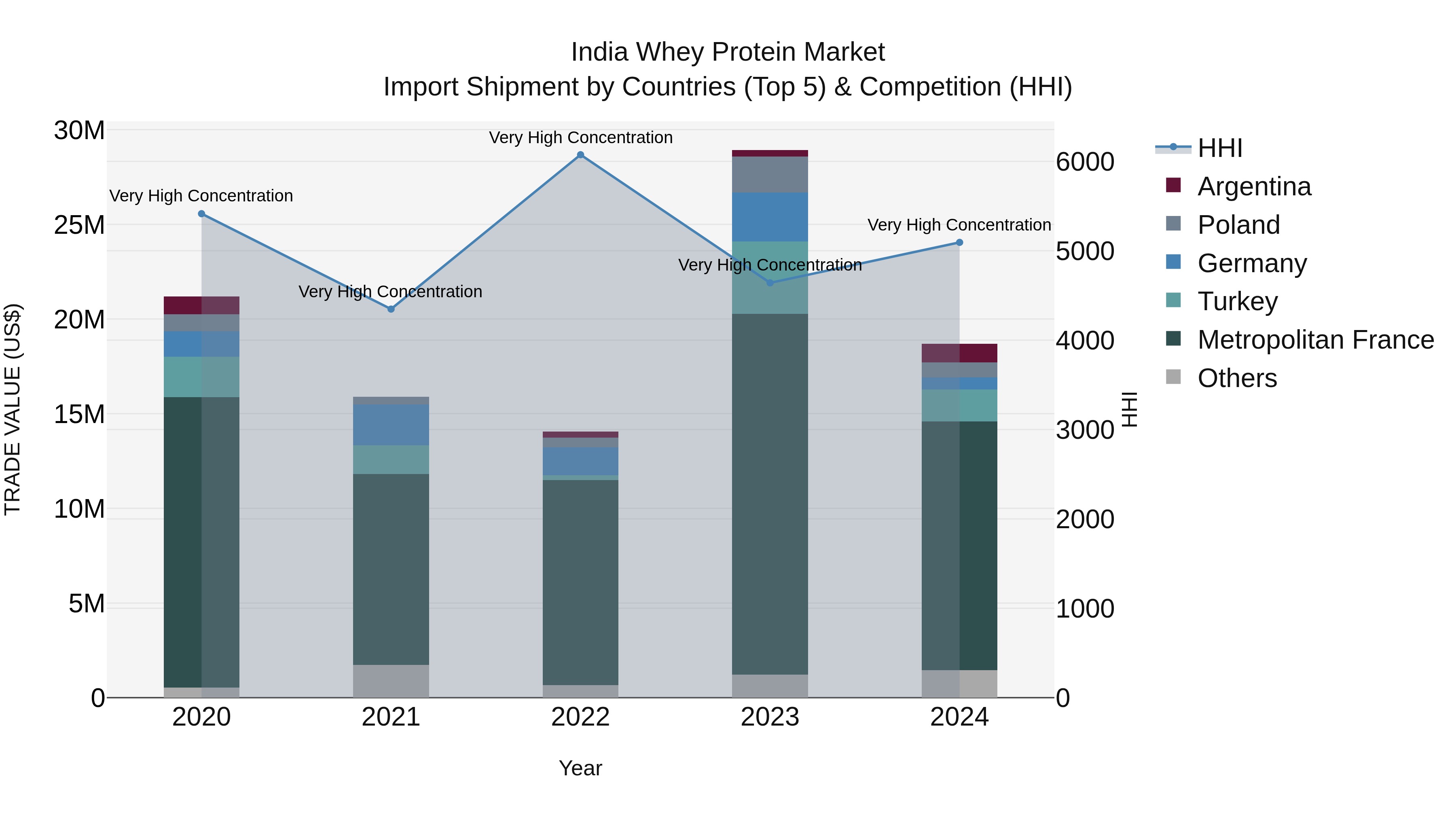
India Whey Protein Market Top 5 Importing Countries and Market Competition (HHI) Analysis
India whey protein import market in 2024 saw significant contributions from top exporting countries including Metropolitan France, Turkey, Argentina, Poland, and Germany. Despite a high concentration level indicated by the Herfindahl-Hirschman Index (HHI), the market experienced a negative Compound Annual Growth Rate (CAGR) of -3.1% from 2020 to 2024. The growth rate for the year 2023-24 further declined by -35.37%, reflecting a challenging landscape for whey protein imports in India. Market players should closely monitor these trends and adapt their strategies accordingly.
India Whey Protein Market Growth Rate
According to 6Wresearch internal database and industry insights, the India Whey Protein Market is projected to grow at a compound annual growth rate (CAGR) of 11.2% during the forecast period (2026-2032).
Five-Year Growth Trajectory of the India Whey Protein Market with Core Drivers
Below mentioned is the evaluation of year-wise growth rate along with key growth drivers:
| Year | Est. Annual Growth (%) | Growth Drivers |
| 2021 | 5.8% | Rising consumer awareness about fitness and protein-rich diets |
| 2022 | 6.9% | Expansion of sports nutrition and health supplement brands |
| 2023 | 8% | Growth in functional food and fortified beverage consumption |
| 2024 | 9.3% | Increasing e-commerce penetration for nutrition products |
| 2025 | 10.2% | Rising demand from clinical nutrition and preventive healthcare segments |
Topics Covered in the India Whey Protein Market Report
The India Whey Protein Market report thoroughly covers the market by type and application. The report provides an unbiased and detailed analysis of current market trends, high-growth opportunities, and key demand drivers, helping stakeholders align strategies with evolving consumer health preferences. The study evaluates dairy industry expansion, functional food innovation, sports nutrition demand, and regulatory developments influencing the adoption of whey protein across food processing, healthcare nutrition, and nutraceutical sectors in India.
India Whey Protein Market Highlights
| Report Name | India Whey Protein Market |
| Forecast Period | 2026–2032 |
| CAGR | 11.2% |
| Growing Sector | Sports & Lifestyle Nutrition Products |
India Whey Protein Market Synopsis
India Whey Protein Market is anticipated to record notable growth due to increasing health awareness, rising fitness participation, and growing demand for high-protein functional foods. The domestic production is being bolstered by the enhanced whey processing capabilities and the expansion of the organized dairy sector. Furthermore, market expansion is being bolstered by the growing demand from manufacturers of infant formula, functional foods, and clinical nutrition. The adoption of preventive healthcare and performance nutrition is being further accelerated in urban and semi-urban markets by the rapid expansion of e-commerce platforms and the increasing consumer preference for these services.
Evaluation of Growth Drivers in the India Whey Protein Market
Below mentioned are some prominent drivers and their influence on the market dynamics:
| Drivers | Primary Segments Affected | Why it Matters (Evidence) |
| Rising Fitness Culture | Isolate & Concentrate; Nutrition Products | Increasing gym participation and active lifestyles are driving demand for protein supplements. |
| Expansion of Functional Food Industry | Concentrate; Food & Beverages | Food manufacturers incorporate protein ingredients to enhance nutritional value and support product innovation. |
| Growth in Clinical Nutrition | Hydrolysates; Pharmaceuticals | Easily digestible proteins are widely used to meet medical and therapeutic nutritional requirements. |
| E-commerce Expansion | All Types; Nutrition Products | Online platforms improve product availability and accessibility across the country. |
| Government Nutrition Initiatives | All Segments; Food & Healthcare | Public health programs promoting protein intake are supporting market growth and consumer adoption. |
India Whey Protein Market is expected to grow at the CAGR of 11.2% during the forecast period of 2026-2032. Increasing health awareness, rising participation in fitness activities, and growing consumption of dietary supplements are driving market growth. Additional support comes from government nutrition programs, growing clinical nutrition demand, and rapid expansion of organized dairy processing. The increasing use of whey protein in functional foods, along with strong growth in online retail and premium nutrition products, is further strengthening long-term market expansion.
Evaluation of Restraints in the India Whey Protein Market
Below mentioned are some major restraints and their influence on the market dynamics:
| Restraints | Primary Segments Affected | What This Means (Evidence) |
| High Product Cost | Isolate & Hydrolysates; Retail | Premium pricing limits affordability and restricts mass-market adoption. |
| Import Dependency | All Types; Manufacturers | Heavy reliance on imports exposes the market to supply disruptions, currency risks, and higher input costs. |
| Low Awareness in Rural Areas | All Segments; Others | Limited nutrition knowledge slows product adoption beyond major urban markets. |
| Quality Concerns and Adulteration | Nutrition Products; Retail | Product authenticity issues reduce consumer trust and negatively affect brand perception. |
| Stringent Regulatory Requirements | Regulated Products; Manufacturers | Compliance with stricter standards increases operational costs and creates entry barriers for smaller players. |
India Whey Protein Industry Challenges
India Whey Protein Industry has been witnessing impressive growth and development. However, it still faces challenges, including high product prices, reliance on import of raw materials, and issues related to quality standardization, among others. Apart from the above, to some extent, low awareness in rural markets, price sensitivity of consumers, and the existence of counterfeit or adulterated products can also be mentioned as factors which have a negative impact on the trustworthiness of the market. Manufacturers are exposed to the risk of regulatory compliance as well as being required to use sophisticated processing technologies that raise both capital expenditure and operational complexities, thereby affecting overall profitability and scalability.
India Whey Protein Market Trends
Some emerging trends in the landscape of the India Whey Protein Market Growth are:
- Shift Toward Premium Whey Isolates and Hydrolysates: Nowadays, customers are moving to high, purity protein products that ensure superior absorption and bring performance benefits.
- Expansion of Ready to Drink Protein Beverages: Protein manufacturers are producing easy, to, use protein shakes which can be taken anywhere. Through these products, the use of whey protein is no longer limited to the traditional powders.
- Growth of Plant and Whey Blended Formulations: With hybrid protein products, companies can improve the nutritional quality and also make the products more affordable.
- Demand from Clinical and Elderly Nutrition: Healthcare professionals are increasingly recommending whey protein to support recovery, manage malnutrition, and address age-related muscle loss among elderly patients.
Investment Opportunities in the India Whey Protein Market
Some prominent investment opportunities in the India Whey Protein Market include:
- Domestic Whey Processing Plants – Establishing advanced filtration and drying facilities can reduce import dependence. Producing locally helps to lower costs and make supplies more dependable.
- Functional Food Product Development: Investing in whey-fortified snacks, dairy products, and beverages can expand application areas and align with the growing demand for protein-enriched mainstream food categories.
- Clinical and Medical Nutrition Manufacturing: Whey-based products formulated for hospital use and therapeutic nutrition are expected to witness strong and sustained demand.
- Sports Nutrition Brand Expansion: Developing premium product lines based on whey isolate and hydrolysate can effectively target the growing fitness and active lifestyle population.
Top 5 Leading Players in the India Whey Protein Market
Some leading players operating in the India Whey Protein Market include:
1. Glanbia plc
| Company Name | Glanbia plc |
|---|---|
| Established Year | 1997 |
| Headquarters | Kilkenny, Ireland |
| Official Website | Click Here |
Glanbia is a leading global supplier of whey protein and sports nutrition ingredients, supporting performance nutrition, functional foods, and clinical nutrition markets in India.
2. Arla Foods Ingredients Group
| Company Name | Arla Foods Ingredients Group |
|---|---|
| Established Year | 2000 |
| Headquarters | Aarhus, Denmark |
| Official Website | Click Here |
Arla provides high-quality whey protein solutions widely used in infant nutrition, medical foods, and performance nutrition applications across India.
3. Fonterra Co-operative Group
| Company Name | Fonterra Co-operative Group |
|---|---|
| Established Year | 2001 |
| Headquarters | Auckland, New Zealand |
| Official Website | Click Here |
Fonterra supplies premium dairy proteins and whey ingredients supporting food processing, beverage, and nutrition product manufacturers operating in India.
4. Kerry Group plc
| Company Name | Kerry Group plc |
|---|---|
| Established Year | 1972 |
| Headquarters | Tralee, Ireland |
| Official Website | Click Here |
Kerry develops customized whey protein systems and functional nutrition solutions tailored for food, beverage, and nutraceutical industries.
5. Lactalis Group
| Company Name | Lactalis Group |
|---|---|
| Established Year | 1933 |
| Headquarters | Laval, France |
| Official Website | Click Here |
Lactalis offers a wide range of dairy-based protein products and ingredients supporting functional food and nutrition manufacturers across global markets.
Government Regulations Introduced in the India Whey Protein Market
According to the India’s Government data, several programs are facilitating the expansion of protein, based nutrition products. Therefore, the Food Safety and Standards Authority of India (FSSAI) is issuing stringent quality, labeling, and safety regulations for nutraceuticals and protein supplements to safeguard consumer health and ensure product authenticity and standardization. Moreover, the Poshan Abhiyaan and the National Nutrition Mission are two of the government, driven programs aimed at encouraging protein consumption, especially among the vulnerable sections of the society. The government is also granting funds to the dairy sector for infrastructure improvement through the National Programme for Dairy Development, which in turn enhance the utilization of in the market.
Future Insights of the India Whey Protein Market
The India Whey Protein Market's forecast remains positive with a gradual rise in health awareness, a surge in preventive nutrition adoption, and an increasing number of applications in both the food and healthcare sectors. The growth of the sports nutrition, clinical nutrition, and functional food sectors is expected to drive sustained long-term demand for whey protein and related nutritional ingredients. In addition, domestic processing investments, product innovations, and digital sales will make whey protein more accessible and affordable. Nutrition initiatives by the government and the expansion of the organized dairy sector will also help strengthen the whey protein ecosystem in the country further.
Market Segmentation Analysis
The report offers a comprehensive study of the subsequent market segments and their leading categories.
Whey Protein Concentrate to Dominate the Market – By Type
According to Mohit, Senior Research Analyst, 6Wresearch, the Whey Protein Concentrate category holds the largest market segment in the India Whey Protein Market Share. This dominance is primarily due to its cheapness and extensive use in the production of food, beverages, and nutrition products. Whey concentrate provides a well, balanced protein content at a price that is reachable for everyone, thus it can be used for mass, market functional foods and supplements.
Key Attractiveness of the Report
- 10 Years of Market Numbers.
- Historical Data Starting from 2022 to 2025.
- Base Year: 2025.
- Forecast Data until 2032.
- Key Performance Indicators Impacting the Market.
- Major Upcoming Developments and Projects.
Key Highlights of the Report:
- India Whey Protein Market Outlook
- Market Size of India Whey Protein Market, 2025
- Forecast of India Whey Protein Market, 2032
- Historical Data and Forecast of India Whey Protein Revenues & Volume for the Period 2022- 2032F
- India Whey Protein Market Trend Evolution
- India Whey Protein Market Drivers and Challenges
- India Whey Protein Price Trends
- India Whey Protein Porter's Five Forces
- India Whey Protein Industry Life Cycle
- Historical Data and Forecast of India Whey Protein Market Revenues & Volume By Type for the Period 2022- 2032F
- Historical Data and Forecast of India Whey Protein Market Revenues & Volume By Whey Protein Concentrate for the Period 2022- 2032F
- Historical Data and Forecast of India Whey Protein Market Revenues & Volume By Whey Protein Isolate for the Period 2022- 2032F
- Historical Data and Forecast of India Whey Protein Market Revenues & Volume By Whey Protein Hydrolysates for the Period 2022- 2032F
- Historical Data and Forecast of India Whey Protein Market Revenues & Volume By Application for the Period 2022- 2032F
- Historical Data and Forecast of India Whey Protein Market Revenues & Volume By Food and Beverages for the Period 2022- 2032F
- Historical Data and Forecast of India Whey Protein Market Revenues & Volume By Nutrition Products and Pharmaceuticals for the Period 2022- 2032F
- Historical Data and Forecast of India Whey Protein Market Revenues & Volume By Feed Application for the Period 2022- 2032F
- Historical Data and Forecast of India Whey Protein Market Revenues & Volume By Others for the Period 2022- 2032F
- India Whey Protein Import Export Trade Statistics
- Market Opportunity Assessment By Type
- Market Opportunity Assessment By Application
- India Whey Protein Top Companies Market Share
- India Whey Protein Competitive Benchmarking By Technical and Operational Parameters
- India Whey Protein Company Profiles
- India Whey Protein Key Strategic Recommendations
Market Covered
The report offers a comprehensive study of the subsequent market segments:
By Type
- Whey Protein Concentrate
- Whey Protein Isolate
- Whey Protein Hydrolysates
By Application
- Food and Beverages
- Nutrition Products and Pharmaceuticals
- Feed Application
- Others
India Whey Protein Market (2026-2032): FAQs
The India Whey Protein Market is projected to grow at a CAGR of 11.2% during the forecast period 2026-2032.
Some of the main challenges are comprise of expensive products, reliance on imports, quality issues, regulatory compliance, and lack of awareness in the rural markets.
Among the potentials are the expansion of domestic processing, innovation in functional foods, manufacturing of clinical nutrition products, and the rise of digital distribution.
The primary demand is coming from sports and fitness consumers, clinical and elderly nutrition segments, and the growing population seeking preventive health and wellness products.
6Wresearch actively monitors the India Whey Protein Market and publishes its comprehensive annual report, highlighting emerging trends, growth drivers, revenue analysis, and forecast outlook. Our insights help businesses to make data-backed strategic decisions with ongoing market dynamics. Our analysts track relevent industries related to the India Whey Protein Market, allowing our clients with actionable intelligence and reliable forecasts tailored to emerging regional needs.
Yes, we provide customisation as per your requirements. To learn more, feel free to contact us on sales@6wresearch.com
| 1 Executive Summary |
| 2 Introduction |
| 2.1 Key Highlights of the Report |
| 2.2 Report Description |
| 2.3 Market Scope & Segmentation |
| 2.4 Research Methodology |
| 2.5 Assumptions |
| 3 India Whey Protein Market Overview |
| 3.1 India Country Macro Economic Indicators |
| 3.2 India Whey Protein Market Revenues & Volume, 2022 & 2032F |
| 3.3 India Whey Protein Market - Industry Life Cycle |
| 3.4 India Whey Protein Market - Porter's Five Forces |
| 3.5 India Whey Protein Market Revenues & Volume Share, By Type, 2022 & 2032F |
| 3.6 India Whey Protein Market Revenues & Volume Share, By Application, 2022 & 2032F |
| 4 India Whey Protein Market Dynamics |
| 4.1 Impact Analysis |
| 4.2 Market Drivers |
| 4.2.1 Increasing awareness about health and fitness among the Indian population |
| 4.2.2 Rising disposable income leading to higher spending on health supplements |
| 4.2.3 Growing trend of adopting a healthy lifestyle and fitness routines |
| 4.3 Market Restraints |
| 4.3.1 High cost of whey protein products compared to other protein supplements |
| 4.3.2 Lack of availability of authentic and quality whey protein products in the market |
| 4.3.3 Limited awareness about the benefits of whey protein among the general population |
| 5 India Whey Protein Market Trends |
| 6 India Whey Protein Market, By Types |
| 6.1 India Whey Protein Market, By Type |
| 6.1.1 Overview and Analysis |
| 6.1.2 India Whey Protein Market Revenues & Volume, By Type, 2022 & 2032F |
| 6.1.3 India Whey Protein Market Revenues & Volume, By Whey Protein Isolates, 2022 & 2032F |
| 6.1.4 India Whey Protein Market Revenues & Volume, By Whey Protein Concentrates, 2022 & 2032F |
| 6.1.5 India Whey Protein Market Revenues & Volume, By Whey Protein Hydrolysates, 2022 & 2032F |
| 6.2 India Whey Protein Market, By Application |
| 6.2.1 Overview and Analysis |
| 6.2.2 India Whey Protein Market Revenues & Volume, By Nutritional Supplements, 2022 & 2032F |
| 6.2.3 India Whey Protein Market Revenues & Volume, By Personal Care, 2022 & 2032F |
| 6.2.4 India Whey Protein Market Revenues & Volume, By Food & Beverages, 2022 & 2032F |
| 6.2.5 India Whey Protein Market Revenues & Volume, By Animal Feed & Pet Food, 2022 & 2032F |
| 7 India Whey Protein Market Import-Export Trade Statistics |
| 7.1 India Whey Protein Market Export to Major Countries |
| 7.2 India Whey Protein Market Imports from Major Countries |
| 8 India Whey Protein Market Key Performance Indicators |
| 8.1 Number of gyms and fitness centers offering or promoting whey protein products |
| 8.2 Percentage increase in online searches for whey protein products in India |
| 8.3 Growth in the number of health and fitness influencers endorsing whey protein brands |
| 9 India Whey Protein Market - Opportunity Assessment |
| 9.1 India Whey Protein Market Opportunity Assessment, By Type, 2022 & 2032F |
| 9.2 India Whey Protein Market Opportunity Assessment, By Application, 2022 & 2032F |
| 10 India Whey Protein Market - Competitive Landscape |
| 10.1 India Whey Protein Market Revenue Share, By Companies, 2025 |
| 10.2 India Whey Protein Market Competitive Benchmarking, By Operating and Technical Parameters |
| 11 Company Profiles |
| 12 Recommendations |
| 13 Disclaimer |
Export potential assessment - trade Analytics for 2030
Export potential enables firms to identify high-growth global markets with greater confidence by combining advanced trade intelligence with a structured quantitative methodology. The framework analyzes emerging demand trends and country-level import patterns while integrating macroeconomic and trade datasets such as GDP and population forecasts, bilateral import–export flows, tariff structures, elasticity differentials between developed and developing economies, geographic distance, and import demand projections. Using weighted trade values from 2020–2024 as the base period to project country-to-country export potential for 2030, these inputs are operationalized through calculated drivers such as gravity model parameters, tariff impact factors, and projected GDP per-capita growth. Through an analysis of hidden potentials, demand hotspots, and market conditions that are most favorable to success, this method enables firms to focus on target countries, maximize returns, and global expansion with data, backed by accuracy.
By factoring in the projected importer demand gap that is currently unmet and could be potential opportunity, it identifies the potential for the Exporter (Country) among 190 countries, against the general trade analysis, which identifies the biggest importer or exporter.
To discover high-growth global markets and optimize your business strategy:
Click Here
Pricing
- Single User License$ 1,995
- Department License$ 2,400
- Site License$ 3,120
- Global License$ 3,795

Search
Thought Leadership and Analyst Meet





Our Clients








Related Reports
- India Switchgear Market Outlook (2026 - 2032) | Size, Share, Trends, Growth, Revenue, Forecast, Analysis, Value, Outlook
- Pakistan Contraceptive Implants Market (2025-2031) | Demand, Growth, Size, Share, Industry, Pricing Analysis, Competitive, Strategic Insights, Strategy, Consumer Insights, Analysis, Investment Trends, Opportunities, Revenue, Segments, Value, Segmentation, Supply, Forecast, Restraints, Outlook, Competition, Drivers, Trends, Companies, Challenges
- Sri Lanka Packaging Market (2026-2032) | Outlook, Competition, Drivers, Trends, Demand, Pricing Analysis, Competitive, Strategic Insights, Companies, Challenges, Strategy, Consumer Insights, Analysis, Investment Trends, Opportunities, Growth, Size, Share, Industry, Revenue, Segments, Value, Segmentation, Supply, Forecast, Restraints
- India Kids Watches Market (2026-2032) | Strategy, Consumer Insights, Analysis, Investment Trends, Opportunities, Growth, Size, Share, Industry, Revenue, Segments, Value, Segmentation, Supply, Forecast, Restraints, Outlook, Competition, Drivers, Trends, Demand, Pricing Analysis, Competitive, Strategic Insights, Companies, Challenges
- Saudi Arabia Core Assurance Service Market (2025-2031) | Strategy, Consumer Insights, Analysis, Investment Trends, Opportunities, Growth, Size, Share, Industry, Revenue, Segments, Value, Segmentation, Supply, Forecast, Restraints, Outlook, Competition, Drivers, Trends, Demand, Pricing Analysis, Competitive, Strategic Insights, Companies, Challenges
- Romania Uninterruptible Power Supply (UPS) Market (2026-2032) | Industry, Analysis, Revenue, Size, Forecast, Outlook, Value, Trends, Share, Growth & Companies
- Saudi Arabia Car Window Tinting Film, Paint Protection Film (PPF), and Ceramic Coating Market (2025-2031) | Strategy, Consumer Insights, Analysis, Investment Trends, Opportunities, Growth, Size, Share, Industry, Revenue, Segments, Value, Segmentation, Supply, Forecast, Restraints, Outlook, Competition, Drivers, Trends, Demand, Pricing Analysis, Competitive, Strategic Insights, Companies, Challenges
- South Africa Stationery Market (2025-2031) | Share, Size, Industry, Value, Growth, Revenue, Analysis, Trends, Segmentation & Outlook
- Afghanistan Rocking Chairs And Adirondack Chairs Market (2026-2032) | Size & Revenue, Competitive Landscape, Share, Segmentation, Industry, Value, Outlook, Analysis, Trends, Growth, Forecast, Companies
- Afghanistan Apparel Market (2026-2032) | Growth, Outlook, Industry, Segmentation, Forecast, Size, Companies, Trends, Value, Share, Analysis & Revenue
Industry Events and Analyst Meet

India EV Show 2026

EV tech India Expo 2026

Auto Tech Asia 2026

Battery Tech India 2026

Smart Production Solutions Guangzhou 2026
Whitepaper
- Middle East & Africa Commercial Security Market Click here to view more.
- Middle East & Africa Fire Safety Systems & Equipment Market Click here to view more.
- GCC Drone Market Click here to view more.
- Middle East Lighting Fixture Market Click here to view more.
- GCC Physical & Perimeter Security Market Click here to view more.
6WResearch In News
- Doha a strategic location for EV manufacturing hub: IPA Qatar
- Demand for luxury TVs surging in the GCC, says Samsung
- Empowering Growth: The Thriving Journey of Bangladesh’s Cable Industry
- Demand for luxury TVs surging in the GCC, says Samsung
- Video call with a traditional healer? Once unthinkable, it’s now common in South Africa
- Intelligent Buildings To Smooth GCC’s Path To Net Zero


