Indonesia Dehydrated Food Market | Value, Share, COVID-19 IMPACT, Revenue, Size, Industry, Companies, Forecast, Growth, Analysis & Trends
Market Forecast By Type (Spray-dried, Freeze-dried, Vacuum-dried, Drum-dried, Others), By Product (Dried Processed Food, Dried Fruit & Vegetable, Dried Dairy, Dried Meat & Seafood, Others), By Distribution Channel (Hypermarket/Supermarket, Convenience Stores, Online Retailing, Others) And Competitive Landscape
| Product Code: ETC175787 | Publication Date: Jul 2023 | Updated Date: Jan 2026 | Product Type: Market Research Report | |
| Publisher: 6Wresearch | Author: Ravi Bhandari | No. of Pages: 70 | No. of Figures: 35 | No. of Tables: 5 |
Indonesia Dehydrated Food Market: Import Trend Analysis
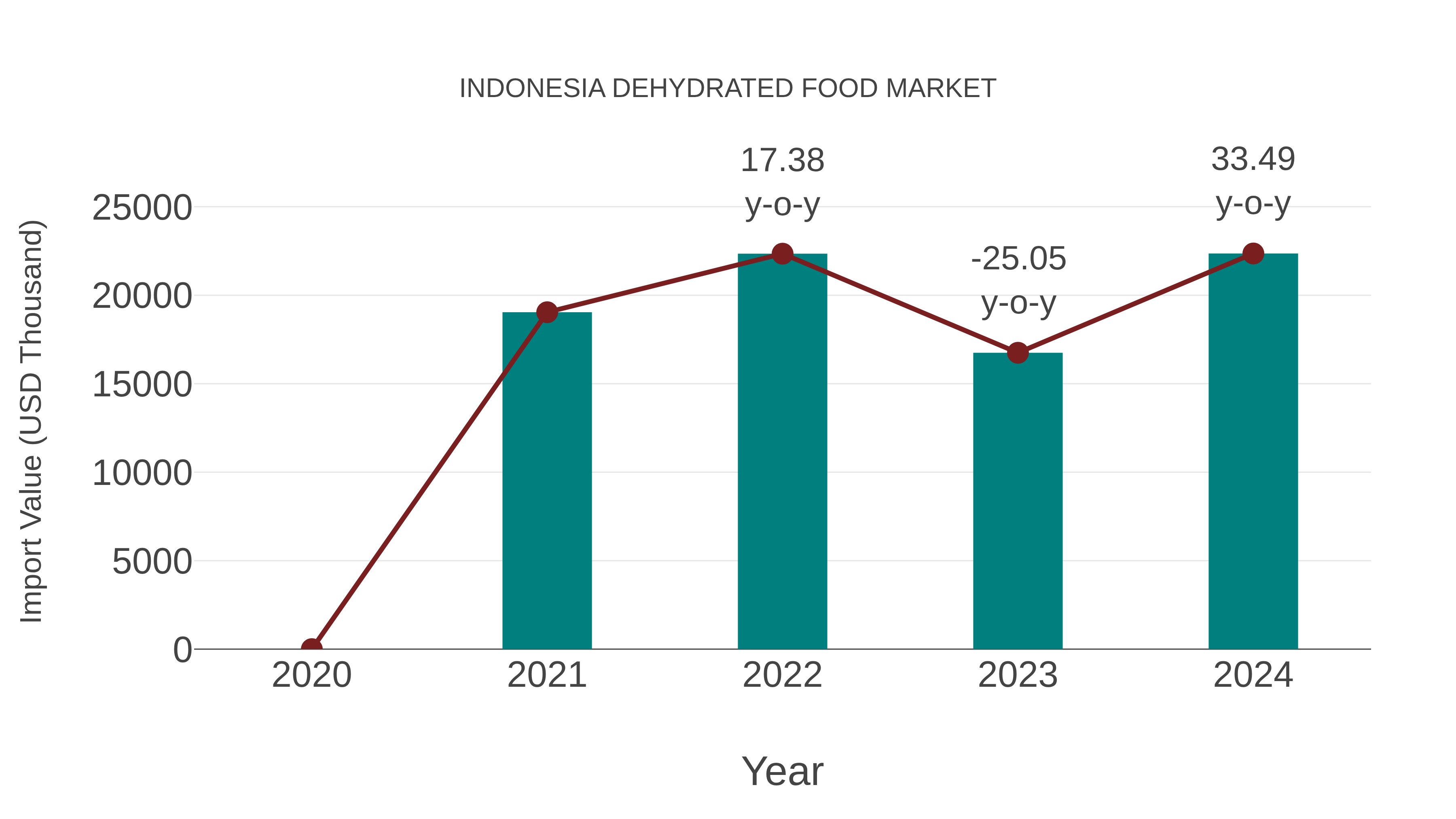
In the Indonesia dehydrated food market, the import trend showed significant growth from 2023 to 2024, with a growth rate of 33.49%. The compound annual growth rate (CAGR) for imports from 2020 to 2024 stood at 5.5%. This surge in import momentum can be attributed to shifting consumer preferences towards convenient and longer shelf-life food products, indicating a notable demand shift in the market.
Dehydrated Food Market: Indonesia vs Top 5 Major Economies in 2027 (Asia)
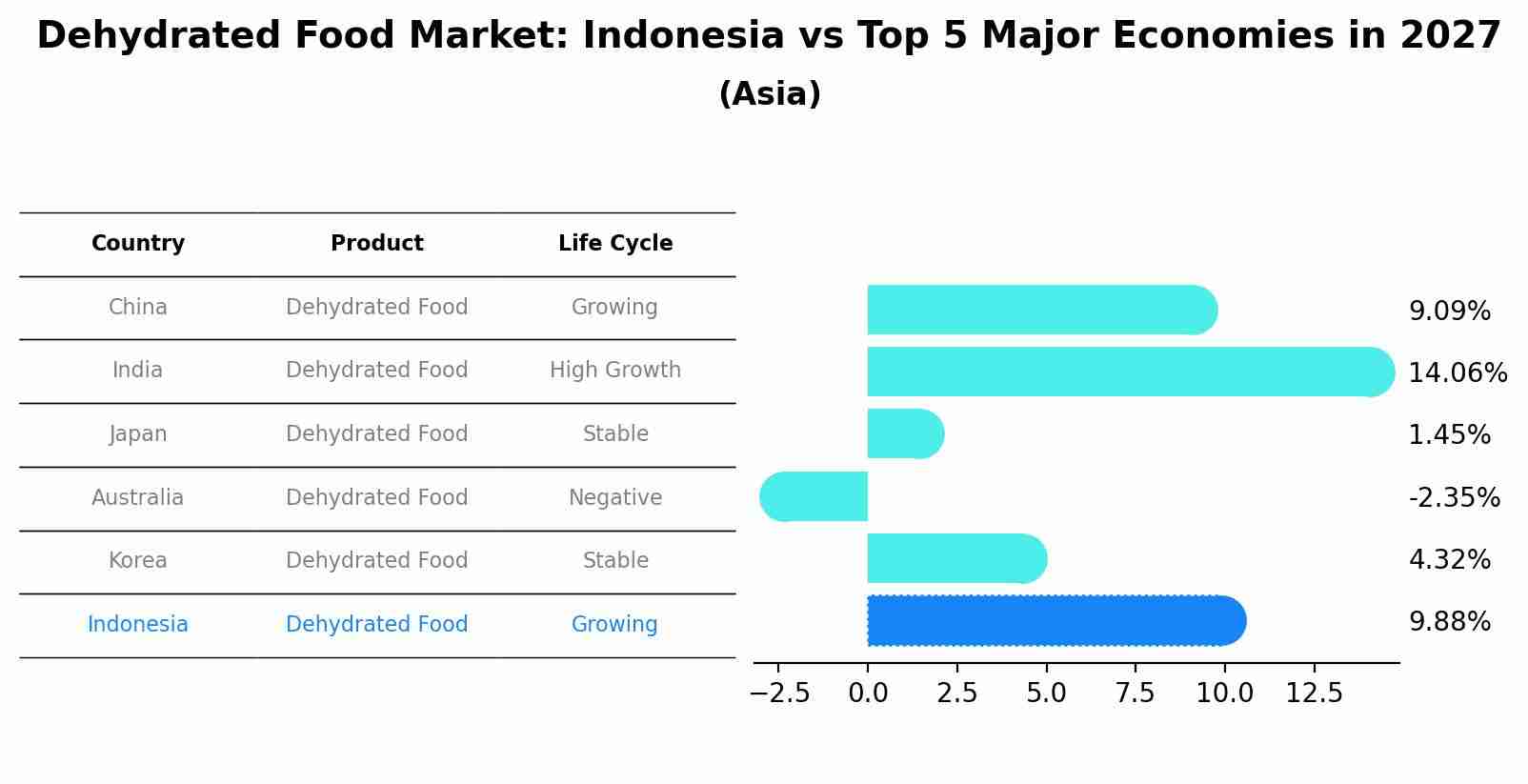
Indonesia's Dehydrated Food market is anticipated to experience a growing growth rate of 9.88% by 2027, reflecting trends observed in the largest economy China, followed by India, Japan, Australia and South Korea.
Indonesia Dehydrated Food Market Synopsis
Dehydrated food is a type of food that has had most, or all, of its moisture removed. This process helps to preserve the shelf life and nutritional value of food products and allows them to be stored for longer periods. Dehydrated foods are becoming increasingly popular in Indonesia as they provide convenience and variety for consumers. In addition, these foods are often used as ingredients in preparation meals due to their ability to retain flavor even after dehydration. The Indonesia dehydrated food market is driven by the increasing demand for ready-to-eat processed foods among busy working professionals who lack the time or inclination to cook from scratch.
Market Trends
The rising trend towards health consciousness among Indonesia consumers has been driving the growth of the dehydrated food market in Indonesia over recent years. Consumers prefer dehydrated snacks over regular unhealthy snacks such as chips because they contain fewer calories and higher nutrient content than traditional snacks do. Additionally, an increase in disposable incomes coupled with changing lifestyles have resulted in increased sales of ready-to-eat processed foods such as frozen dinners which include various types of dehydrated ingredients like vegetables and proteins. This product innovation within this segment has further helped drive growth within this sector overall.
Market Drivers
The main driver behind growing popularity and acceptance of dehydrated fruits & vegetables into their diet is health awareness among Indonesias which encourages healthier snacking options through consumption without sacrificing taste preference. Moreover , expanding retail distribution networks across remote areas via modern trade formats like supermarkets , hypermarkets etc., has also contributed significantly towards gaining traction throughout rural parts of Indonesia where access was limited before modern outlets opened up providing more convenient access points making it easier for customers to purchase these products directly off shelves rather than having them shipped elsewhere. Finally , increasing consumer expenditure on F&B items including packaged foods & beverage categories owing too rising disposable income levels also serve as one major factor leading up toward strong performance seen within this particular category?s segmentation space inside country borders during 2020 year period.
COVID-19 Impact on the Market
The global pandemic has negatively affected the Indonesia dehydrated food market. As a result of the spread of coronavirus, lockdowns have been imposed in many parts of Indonesia, leading to reduced demand for processed and packaged foods such as dehydrated products due to falling incomes and enhanced hygiene requirements. The rising production costs associated with increased sanitation measures has further hampered industry growth. However, there is an increasing demand for ready-to-eat meals that can last longer periods since people are avoiding going out shopping or visiting restaurants. This trend may help revive the sales of dehydrated food items in Indonesia over time.
Challenges of the Market
One major challenge facing the Indonesia dehydrated food market is high competition from both local players as well as international brands offering similar products at more competitive prices. Additionally, limited distribution channels continue to be a constraint on market expansion as most retailers prefer working with larger manufacturers who have established supply networks within their regions or countries. Furthermore, with changing consumer preferences towards organic products and health awareness about additives used during processing further hinders potential growth opportunities within this sector.
Industry Key Players
Some key players in the Indonesia dehydrated food market include PT Global Internusa Agroindo (Indofood), PT Central Proteinaprima Tbk (CP Prima) , PT Indessa Grahasakti (Indoguna), PT Dua Kelinci Sukanda Djaya (Dua Kelinci), and Gano Excel Indonesia Tbk. These companies are actively involved in producing various types of freeze dried fruits & vegetables, soups & sauces flakes/powders including onion powder garlic powder among others catering to different consumers? tastes & needs across various price points
Key Highlights of the Report:
- Indonesia Dehydrated Food Market Outlook
- Market Size of Indonesia Dehydrated Food Market, 2023
- Forecast of Indonesia Dehydrated Food Market, 2030
- Historical Data and Forecast of Indonesia Dehydrated Food Revenues & Volume for the Period 2020-2030
- Indonesia Dehydrated Food Market Trend Evolution
- Indonesia Dehydrated Food Market Drivers and Challenges
- Indonesia Dehydrated Food Price Trends
- Indonesia Dehydrated Food Porter's Five Forces
- Indonesia Dehydrated Food Industry Life Cycle
- Historical Data and Forecast of Indonesia Dehydrated Food Market Revenues & Volume By Type for the Period 2020-2030
- Historical Data and Forecast of Indonesia Dehydrated Food Market Revenues & Volume By Spray-dried for the Period 2020-2030
- Historical Data and Forecast of Indonesia Dehydrated Food Market Revenues & Volume By Freeze-dried for the Period 2020-2030
- Historical Data and Forecast of Indonesia Dehydrated Food Market Revenues & Volume By Vacuum-dried for the Period 2020-2030
- Historical Data and Forecast of Indonesia Dehydrated Food Market Revenues & Volume By Drum-dried for the Period 2020-2030
- Historical Data and Forecast of Indonesia Dehydrated Food Market Revenues & Volume By Others for the Period 2020-2030
- Historical Data and Forecast of Indonesia Dehydrated Food Market Revenues & Volume By Product for the Period 2020-2030
- Historical Data and Forecast of Indonesia Dehydrated Food Market Revenues & Volume By Dried Processed Food for the Period 2020-2030
- Historical Data and Forecast of Indonesia Dehydrated Food Market Revenues & Volume By Dried Fruit & Vegetable for the Period 2020-2030
- Historical Data and Forecast of Indonesia Dehydrated Food Market Revenues & Volume By Dried Dairy for the Period 2020-2030
- Historical Data and Forecast of Indonesia Dehydrated Food Market Revenues & Volume By Dried Meat & Seafood for the Period 2020-2030
- Historical Data and Forecast of Indonesia Dehydrated Food Market Revenues & Volume By Others for the Period 2020-2030
- Historical Data and Forecast of Indonesia Dehydrated Food Market Revenues & Volume By Distribution Channel for the Period 2020-2030
- Historical Data and Forecast of Indonesia Dehydrated Food Market Revenues & Volume By Hypermarket/Supermarket for the Period 2020-2030
- Historical Data and Forecast of Indonesia Dehydrated Food Market Revenues & Volume By Convenience Stores for the Period 2020-2030
- Historical Data and Forecast of Indonesia Dehydrated Food Market Revenues & Volume By Online Retailing for the Period 2020-2030
- Historical Data and Forecast of Indonesia Dehydrated Food Market Revenues & Volume By Others for the Period 2020-2030
- Indonesia Dehydrated Food Import Export Trade Statistics
- Market Opportunity Assessment By Type
- Market Opportunity Assessment By Product
- Market Opportunity Assessment By Distribution Channel
- Indonesia Dehydrated Food Top Companies Market Share
- Indonesia Dehydrated Food Competitive Benchmarking By Technical and Operational Parameters
- Indonesia Dehydrated Food Company Profiles
- Indonesia Dehydrated Food Key Strategic Recommendations
Frequently Asked Questions About the Market Study (FAQs):
6Wresearch actively monitors the Indonesia Dehydrated Food Market and publishes its comprehensive annual report, highlighting emerging trends, growth drivers, revenue analysis, and forecast outlook. Our insights help businesses to make data-backed strategic decisions with ongoing market dynamics. Our analysts track relevent industries related to the Indonesia Dehydrated Food Market, allowing our clients with actionable intelligence and reliable forecasts tailored to emerging regional needs.
Yes, we provide customisation as per your requirements. To learn more, feel free to contact us on sales@6wresearch.com
1 Executive Summary |
2 Introduction |
2.1 Key Highlights of the Report |
2.2 Report Description |
2.3 Market Scope & Segmentation |
2.4 Research Methodology |
2.5 Assumptions |
3 Indonesia Dehydrated Food Market Overview |
3.1 Indonesia Country Macro Economic Indicators |
3.2 Indonesia Dehydrated Food Market Revenues & Volume, 2020 & 2030F |
3.3 Indonesia Dehydrated Food Market - Industry Life Cycle |
3.4 Indonesia Dehydrated Food Market - Porter's Five Forces |
3.5 Indonesia Dehydrated Food Market Revenues & Volume Share, By Type, 2020 & 2030F |
3.6 Indonesia Dehydrated Food Market Revenues & Volume Share, By Product, 2020 & 2030F |
3.7 Indonesia Dehydrated Food Market Revenues & Volume Share, By Distribution Channel, 2020 & 2030F |
4 Indonesia Dehydrated Food Market Dynamics |
4.1 Impact Analysis |
4.2 Market Drivers |
4.2.1 Increasing demand for convenient and ready-to-eat food products |
4.2.2 Growing awareness about the benefits of dehydrated food in terms of nutrition and shelf life |
4.2.3 Rising disposable income leading to higher spending on premium food products |
4.3 Market Restraints |
4.3.1 Concerns regarding the quality and freshness of dehydrated food products |
4.3.2 Price sensitivity among price-conscious consumers impacting purchasing decisions |
5 Indonesia Dehydrated Food Market Trends |
6 Indonesia Dehydrated Food Market, By Types |
6.1 Indonesia Dehydrated Food Market, By Type |
6.1.1 Overview and Analysis |
6.1.2 Indonesia Dehydrated Food Market Revenues & Volume, By Type, 2020-2030F |
6.1.3 Indonesia Dehydrated Food Market Revenues & Volume, By Spray-dried, 2020-2030F |
6.1.4 Indonesia Dehydrated Food Market Revenues & Volume, By Freeze-dried, 2020-2030F |
6.1.5 Indonesia Dehydrated Food Market Revenues & Volume, By Vacuum-dried, 2020-2030F |
6.1.6 Indonesia Dehydrated Food Market Revenues & Volume, By Drum-dried, 2020-2030F |
6.1.7 Indonesia Dehydrated Food Market Revenues & Volume, By Others, 2020-2030F |
6.2 Indonesia Dehydrated Food Market, By Product |
6.2.1 Overview and Analysis |
6.2.2 Indonesia Dehydrated Food Market Revenues & Volume, By Dried Processed Food, 2020-2030F |
6.2.3 Indonesia Dehydrated Food Market Revenues & Volume, By Dried Fruit & Vegetable, 2020-2030F |
6.2.4 Indonesia Dehydrated Food Market Revenues & Volume, By Dried Dairy, 2020-2030F |
6.2.5 Indonesia Dehydrated Food Market Revenues & Volume, By Dried Meat & Seafood, 2020-2030F |
6.2.6 Indonesia Dehydrated Food Market Revenues & Volume, By Others, 2020-2030F |
6.3 Indonesia Dehydrated Food Market, By Distribution Channel |
6.3.1 Overview and Analysis |
6.3.2 Indonesia Dehydrated Food Market Revenues & Volume, By Hypermarket/Supermarket, 2020-2030F |
6.3.3 Indonesia Dehydrated Food Market Revenues & Volume, By Convenience Stores, 2020-2030F |
6.3.4 Indonesia Dehydrated Food Market Revenues & Volume, By Online Retailing, 2020-2030F |
6.3.5 Indonesia Dehydrated Food Market Revenues & Volume, By Others, 2020-2030F |
7 Indonesia Dehydrated Food Market Import-Export Trade Statistics |
7.1 Indonesia Dehydrated Food Market Export to Major Countries |
7.2 Indonesia Dehydrated Food Market Imports from Major Countries |
8 Indonesia Dehydrated Food Market Key Performance Indicators |
8.1 Consumer awareness and perception of dehydrated food products |
8.2 Adoption rate of dehydrated food products in comparison to traditional food items |
8.3 Percentage of repeat purchases indicating customer satisfaction |
8.4 Number of new product launches and innovations in the dehydrated food market |
8.5 Growth in distribution channels for dehydrated food products |
9 Indonesia Dehydrated Food Market - Opportunity Assessment |
9.1 Indonesia Dehydrated Food Market Opportunity Assessment, By Type, 2020 & 2030F |
9.2 Indonesia Dehydrated Food Market Opportunity Assessment, By Product, 2020 & 2030F |
9.3 Indonesia Dehydrated Food Market Opportunity Assessment, By Distribution Channel, 2020 & 2030F |
10 Indonesia Dehydrated Food Market - Competitive Landscape |
10.1 Indonesia Dehydrated Food Market Revenue Share, By Companies, 2023 |
10.2 Indonesia Dehydrated Food Market Competitive Benchmarking, By Operating and Technical Parameters |
11 Company Profiles |
12 Recommendations |
13 Disclaimer |
Export potential assessment - trade Analytics for 2030
Export potential enables firms to identify high-growth global markets with greater confidence by combining advanced trade intelligence with a structured quantitative methodology. The framework analyzes emerging demand trends and country-level import patterns while integrating macroeconomic and trade datasets such as GDP and population forecasts, bilateral import–export flows, tariff structures, elasticity differentials between developed and developing economies, geographic distance, and import demand projections. Using weighted trade values from 2020–2024 as the base period to project country-to-country export potential for 2030, these inputs are operationalized through calculated drivers such as gravity model parameters, tariff impact factors, and projected GDP per-capita growth. Through an analysis of hidden potentials, demand hotspots, and market conditions that are most favorable to success, this method enables firms to focus on target countries, maximize returns, and global expansion with data, backed by accuracy.
By factoring in the projected importer demand gap that is currently unmet and could be potential opportunity, it identifies the potential for the Exporter (Country) among 190 countries, against the general trade analysis, which identifies the biggest importer or exporter.
To discover high-growth global markets and optimize your business strategy:
Click Here
Pricing
- Single User License$ 1,995
- Department License$ 2,400
- Site License$ 3,120
- Global License$ 3,795

Search
Thought Leadership and Analyst Meet





Our Clients








Related Reports
- India Switchgear Market Outlook (2026 - 2032) | Size, Share, Trends, Growth, Revenue, Forecast, Analysis, Value, Outlook
- Pakistan Contraceptive Implants Market (2025-2031) | Demand, Growth, Size, Share, Industry, Pricing Analysis, Competitive, Strategic Insights, Strategy, Consumer Insights, Analysis, Investment Trends, Opportunities, Revenue, Segments, Value, Segmentation, Supply, Forecast, Restraints, Outlook, Competition, Drivers, Trends, Companies, Challenges
- Sri Lanka Packaging Market (2026-2032) | Outlook, Competition, Drivers, Trends, Demand, Pricing Analysis, Competitive, Strategic Insights, Companies, Challenges, Strategy, Consumer Insights, Analysis, Investment Trends, Opportunities, Growth, Size, Share, Industry, Revenue, Segments, Value, Segmentation, Supply, Forecast, Restraints
- India Kids Watches Market (2026-2032) | Strategy, Consumer Insights, Analysis, Investment Trends, Opportunities, Growth, Size, Share, Industry, Revenue, Segments, Value, Segmentation, Supply, Forecast, Restraints, Outlook, Competition, Drivers, Trends, Demand, Pricing Analysis, Competitive, Strategic Insights, Companies, Challenges
- Saudi Arabia Core Assurance Service Market (2025-2031) | Strategy, Consumer Insights, Analysis, Investment Trends, Opportunities, Growth, Size, Share, Industry, Revenue, Segments, Value, Segmentation, Supply, Forecast, Restraints, Outlook, Competition, Drivers, Trends, Demand, Pricing Analysis, Competitive, Strategic Insights, Companies, Challenges
- Romania Uninterruptible Power Supply (UPS) Market (2026-2032) | Industry, Analysis, Revenue, Size, Forecast, Outlook, Value, Trends, Share, Growth & Companies
- Saudi Arabia Car Window Tinting Film, Paint Protection Film (PPF), and Ceramic Coating Market (2025-2031) | Strategy, Consumer Insights, Analysis, Investment Trends, Opportunities, Growth, Size, Share, Industry, Revenue, Segments, Value, Segmentation, Supply, Forecast, Restraints, Outlook, Competition, Drivers, Trends, Demand, Pricing Analysis, Competitive, Strategic Insights, Companies, Challenges
- South Africa Stationery Market (2025-2031) | Share, Size, Industry, Value, Growth, Revenue, Analysis, Trends, Segmentation & Outlook
- Afghanistan Rocking Chairs And Adirondack Chairs Market (2026-2032) | Size & Revenue, Competitive Landscape, Share, Segmentation, Industry, Value, Outlook, Analysis, Trends, Growth, Forecast, Companies
- Afghanistan Apparel Market (2026-2032) | Growth, Outlook, Industry, Segmentation, Forecast, Size, Companies, Trends, Value, Share, Analysis & Revenue
Industry Events and Analyst Meet

India EV Show 2026

EV tech India Expo 2026

Auto Tech Asia 2026

Battery Tech India 2026

Smart Production Solutions Guangzhou 2026
Whitepaper
- Middle East & Africa Commercial Security Market Click here to view more.
- Middle East & Africa Fire Safety Systems & Equipment Market Click here to view more.
- GCC Drone Market Click here to view more.
- Middle East Lighting Fixture Market Click here to view more.
- GCC Physical & Perimeter Security Market Click here to view more.
6WResearch In News
- Doha a strategic location for EV manufacturing hub: IPA Qatar
- Demand for luxury TVs surging in the GCC, says Samsung
- Empowering Growth: The Thriving Journey of Bangladesh’s Cable Industry
- Demand for luxury TVs surging in the GCC, says Samsung
- Video call with a traditional healer? Once unthinkable, it’s now common in South Africa
- Intelligent Buildings To Smooth GCC’s Path To Net Zero


