Indonesia Hydrochloric Acid Market (2026-2032) | Outlook, Growth, Trends, Revenue, Share, Industry, Forecast, Value, Size, Analysis & Companies
Market Forecast By End-user Industry (Food and Beverage, Steel, Oil and Gas, Chemical, Textile, Other End-user Industries (Leather, Rubber, etc.)) And Competitive Landscape
| Product Code: ETC191740 | Publication Date: Jul 2023 | Updated Date: Mar 2026 | Product Type: Market Research Report | |
| Publisher: 6Wresearch | Author: Ravi Bhandari | No. of Pages: 60 | No. of Figures: 40 | No. of Tables: 7 |
Indonesia Hydrochloric Acid Market: Import Trend Analysis
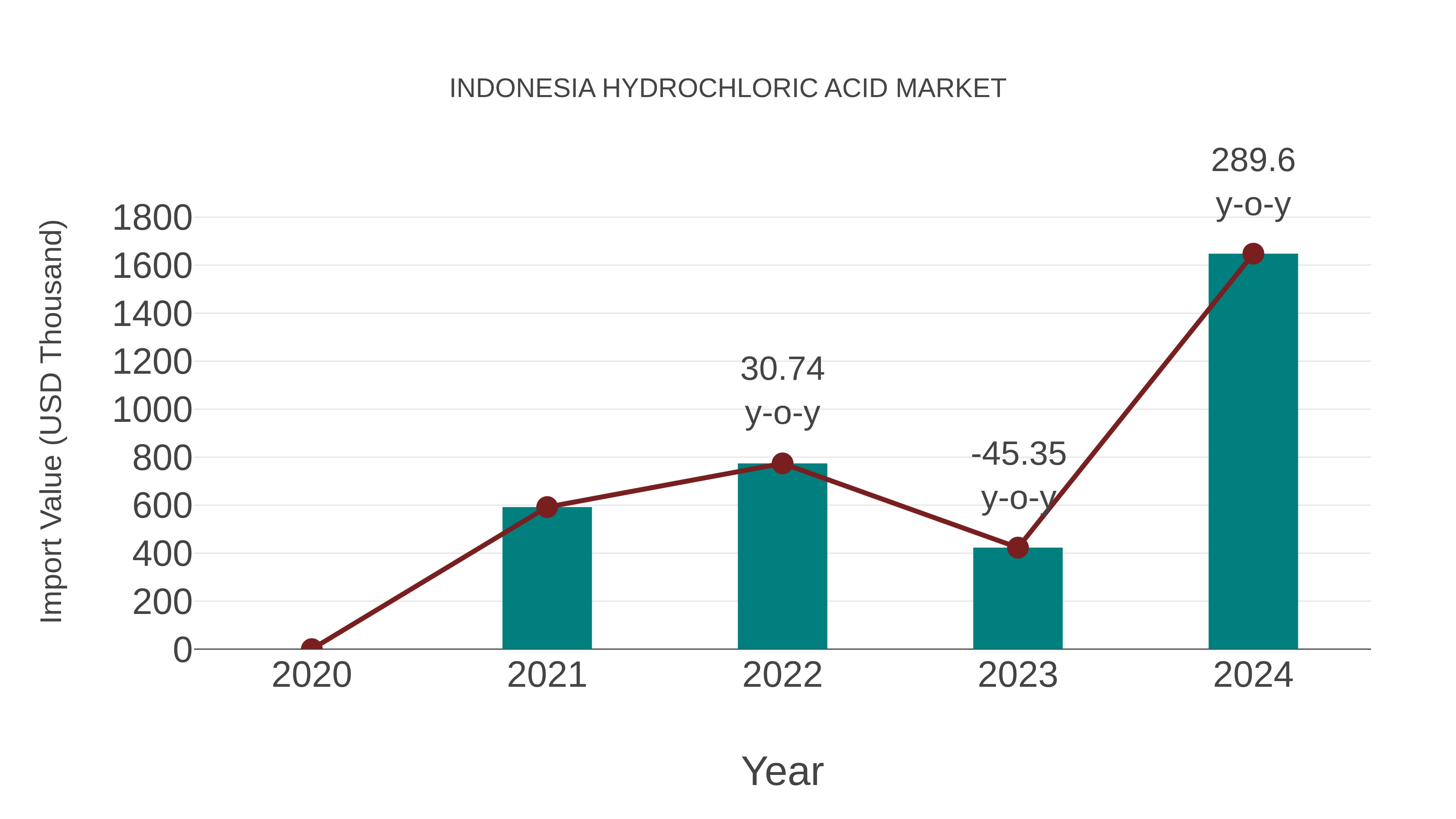
Indonesia hydrochloric acid market witnessed a significant import trend from 2023 to 2024, with a growth rate of 289.6%. The compound annual growth rate (CAGR) for imports during the period 2020-2024 stood at 40.67%. This surge in imports can be attributed to a notable shift in demand dynamics within the market, reflecting changing industry needs or supply chain adjustments.
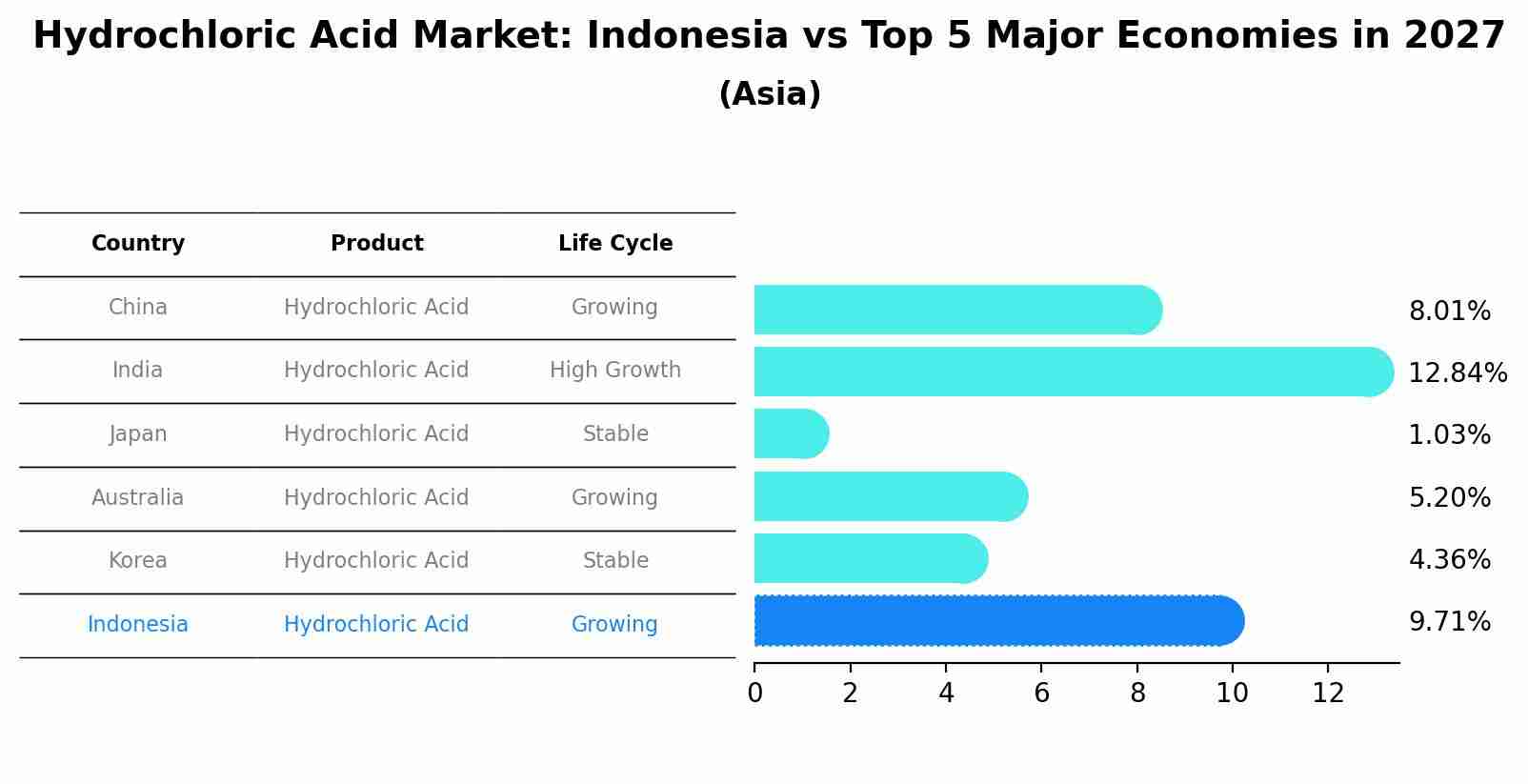
Hydrochloric Acid Market: Indonesia vs Top 5 Major Economies in 2027 (Asia)
In the Asia region, the Hydrochloric Acid market in Indonesia is projected to expand at a growing growth rate of 9.71% by 2027. The largest economy is China, followed by India, Japan, Australia and South Korea.
Indonesia Hydrochloric Acid Market Growth Rate
According to 6Wresearch internal database and industry insights, the Indonesia Hydrochloric Acid Market is projected to grow at a compound annual growth rate (CAGR) of 6% during the forecast period from 2026 to 2032.
Topics Covered in the Indonesia Hydrochloric Acid Market Report
The Indonesia Hydrochloric Acid Market report thoroughly covers the market by end-user industry and application, providing an unbiased and detailed analysis of ongoing market trends, opportunities, challenges, and market drivers, helping stakeholders align their strategies with current and future market dynamics.
Indonesia Hydrochloric Acid Market Highlights
| Report Name | Indonesia Hydrochloric Acid Market |
| Forecast period | 2026-2032 |
| CAGR | 6% |
| Growing Sector | Hydrochloric Acid |
Indonesia Hydrochloric Acid Market Synopsis
The Indonesia Hydrochloric Acid Market is growing steadily owing to multiple industries, including chemical, oil, gas, steel, food and beverage, are increasing their demand for hydrochloric acid. Hydrochloric acid serves multiple purposes, which include steel pickling, cleaning and water treatment and food production as an acidulant. The market is being driven by two factors, which are the pharmaceutical industry demand for high-purity hydrochloric acid and the growth of industrial operations. The upcoming market opportunities are being improved by technological advancements that optimize both production and distribution processes.
Evaluation of Growth Drivers in the Indonesia Hydrochloric Acid Market
Below mentioned are some prominent drivers and their impact on the market dynamics:
| Drivers | Primary Segments Affected | Why It Matters (Evidence) |
| Growing Demand from the Chemical Industry | Chemical | The chemical industry is a major consumer of hydrochloric acid for processes such as pH regulation and chloride compound production. |
| Increasing Use in Steel Manufacturing | Steel | Hydrochloric acid is vital in the steel industry for pickling and cleaning processes, which are expanding due to rising steel demand. |
| Food and Beverage Industry Expansion | Food and Beverage | Hydrochloric acid is uesd worldwide in food production for acidulant purposes, and the rising food and beverage sector in Indonesia is expanding its demand. |
| Oil & Gas Industry Growth | Oil & Gas | Hydrochloric acid serves as a common chemical in oilfield operations which include well stimulation and drilling activities that support the increasing requirements of the oil and gas sector. |
| Technological Advancements in Production | Chemical, Pharmaceutical | The development of production technologies enables the creation of environmentally sustainable hydrochloric acid production processes which operate at greater efficiency. |
The Indonesia Hydrochloric Acid Market Size is projected to grow at a CAGR of 6% from 2026 to 2032. The Indonesia Hydrochloric Acid Market is expanding as the chemical, oil, gas, steel, food and beverage industries need more hydrochloric acid products. The production of hydrochloric acid has become more efficient and cheaper due to technological innovations. The market is expanding as the product is being used in new fields which include pharmaceuticals. The market is growing owing to these factors which help businesses adapt to changing needs while improving their prospects for using hydrochloric acid across multiple industries.
Evaluation of Restraints in the Indonesia Hydrochloric Acid Market
Below mentioned are some major restraints and their influence on the market dynamics:
| Restraints | Primary Segments Affected | What This Means (Evidence) |
| Price Volatility of Raw Materials | Chemical, Oil and Gas | The fluctuation in the price of raw materials, such as chlorine, can affect the cost of hydrochloric acid production. |
| Environmental Concerns | Chemical, Steel | Hydrochloric acid production and its disposal can have environmental impacts, leading to stricter regulations and higher costs. |
| Regulatory Compliance | All Product Segments | Adherence to a legal framework for processing and the distribution of acid may require more operational expenses for manufacturers. |
| Competition from Alternatives | Chemical, Steel | The employment of alternative acids such as sulfuric acid may result in the growth prospects of the hydrochloric acid market being curtailed for certain applications. |
| Health and Safety Concerns | All Product Segments | Hydrochloric acid should be handled with care, as its wide application in industries presents a health hazard that could affect the choice for its adoption. |
Indonesia Hydrochloric Acid Market Challenges
The Indonesia Hydrochloric Acid Industry faces three main challenges which include raw material price volatility, environmental issues and strict regulatory requirements. The implementation of alternative chemicals together with health and safety concerns will create barriers that limit market expansion. The company needs to keep developing new production methods to solve its existing problems. The production facilities need to implement safety and environmental standards in order to reduce operational hazards. The market will resolve its existing issues through these improvements which will enable it to expand while satisfying the changing requirements of various industries.
Indonesia Hydrochloric Acid Market Trends
Here are some major trends changing the Indonesia Hydrochloric Acid Market Growth dynamics:
- Growing Demand from Emerging Industries: The growth of industries like pharmaceuticals and textiles is driving demand for specialized hydrochloric acid formulations, especially high-purity acid for manufacturing.
- Sustainability Efforts in Production: Environmental concerns are pushing companies to adopt sustainable practices, such as green chemistry and waste reduction, in hydrochloric acid production.
- Technological Advancements in Manufacturing: Advances in hydrochloric acid production methods are resulting in lower costs and more efficient processes, providing advantages for both manufacturers and consumers.
Investment Opportunities in the Indonesia Hydrochloric Acid Market
The Indonesia Hydrochloric Acid Market presents several investment opportunities, including:
- Research and Development in High-Purity Hydrochloric Acid: The research and development work for high-purity hydrochloric acid needs R&D funding to create high-purity hydrochloric acid which will meet increasing demands from pharmaceutical and food industries.
- Sustainability Initiatives: The adoption of sustainable production methods together with waste reduction technologies gives companies who invest in these areas a business advantage.
- E-Commerce Platforms for Distribution: Expanding the availability of hydrochloric acid through online platforms can tap into new markets and facilitate easier access for smaller industries.
Top 5 Leading Players in the Indonesia Hydrochloric Acid Market
Below is the list of prominent companies leading the Indonesia Hydrochloric Acid Market Share:
PT. AkzoNobel Indonesia
| Company Name | PT. AkzoNobel Indonesia |
| Established Year | 1970 |
| Headquarters | Jakarta, Indonesia |
| Official Website | Click Here |
AkzoNobel Indonesia is a leading producer of chemicals, including hydrochloric acid, catering to a wide range of industries such as chemicals, oil and gas, and food processing.
Indo Acid Industry
| Company Name | Indo Acid Industry |
| Established Year | 1995 |
| Headquarters | Surabaya, Indonesia |
| Official Website | - |
Indo Acid Industry specializes in the production of hydrochloric acid for various industrial applications, including steel pickling and chemical manufacturing.
PT. TAT Chemical Industry
| Company Name | PT. TAT Chemical Industry |
| Established Year | 1986 |
| Headquarters | Jakarta, Indonesia |
| Official Website | - |
TAT Chemical Industry is a major player in the hydrochloric acid market in Indonesia, offering products for industries like oil and gas, textile, and steel.
Linde Group
| Company Name | Linde Group |
| Established Year | 1900 |
| Headquarters | Munich, Germany (Indonesia operations) |
| Official Website | Click Here |
Linde Group provides industrial gases, including hydrochloric acid, to diverse sectors such as chemical production, healthcare, and food processing.
PT. Kalimantan Chemical Industries
| Company Name | PT. Kalimantan Chemical Industries |
| Established Year | 2001 |
| Headquarters | Kalimantan, Indonesia |
| Official Website | - |
PT. Kalimantan Chemical Industries specializes in producing hydrochloric acid and other specialty chemicals for industrial applications, including the oil and gas sector.
Government Regulations Introduced in the Indonesia Hydrochloric Acid Market
According to Indonesian government data, the Ministry of Industry has established multiple regulations which mandate hydrochloric acid production to follow both environmental standards and safety regulations. These regulations establish procedures that allow producers to operate their facilities while maintaining environmental sustainability and safety standards. Stringent safety protocols for hydrochloric acid handling and transportation are enforced by the Ministry of Energy and Mineral Resources (ESDM) to mitigate accidents and contamination. Government initiatives support industrial development while prioritizing public health and environmental preservation.
Future Insights of the Indonesia Hydrochloric Acid Market
The Indonesia Hydrochloric Acid Market shows positive market prospects as industrial sectors such as food processing, chemical production and steel manufacturing experience growth. The market experiences constant growth as customers’ demands specialized products which include high-purity hydrochloric acid for use in pharmaceuticals and textiles. The current trend toward sustainability combined with technological advancements in production methods will create better business opportunities for the future. The market will continue to expand due to these factors which enable it to meet changing demands of the industry throughout upcoming years.
Market Segmentation Analysis
The report offers a comprehensive study of the following market segments and their leading categories:
By End-user Industry- Food and Beverage to Dominate the Market
According to Ritika Kalra, Senior Research Analyst, 6Wresearch, Food and Beverage Industry is expected to dominate the market due to rising demand for hydrochloric acid as an acidulant in food processing. This industry is seeing significant growth as consumer demand for processed foods increases.
Key Attractiveness of the Report
- 10 Years of Market Numbers
- Historical Data Starting from 2022 to 2025
- Base Year: 2025
- Forecast Data until 2032
- Key Performance Indicators Impacting the Market
- Major Upcoming Developments and Projects
Key Highlights of the Report:
- Indonesia Hydrochloric Acid Market Outlook
- Market Size of Indonesia Hydrochloric Acid Market, 2025
- Forecast of Indonesia Hydrochloric Acid Market, 2032
- Historical Data and Forecast of Indonesia Hydrochloric Acid Revenues & Volume for the Period 2022-2032F
- Indonesia Hydrochloric Acid Market Trend Evolution
- Indonesia Hydrochloric Acid Market Drivers and Challenges
- Indonesia Hydrochloric Acid Price Trends
- Indonesia Hydrochloric Acid Porter's Five Forces
- Indonesia Hydrochloric Acid Industry Life Cycle
- Historical Data and Forecast of Indonesia Hydrochloric Acid Market Revenues & Volume By End-user Industry for the Period 2022-2032F
- Historical Data and Forecast of Indonesia Hydrochloric Acid Market Revenues & Volume By Food and Beverage for the Period 2022-2032F
- Historical Data and Forecast of Indonesia Hydrochloric Acid Market Revenues & Volume By Steel for the Period 2022-2032F
- Historical Data and Forecast of Indonesia Hydrochloric Acid Market Revenues & Volume By Oil and Gas for the Period 2022-2032F
- Historical Data and Forecast of Indonesia Hydrochloric Acid Market Revenues & Volume By Chemical for the Period 2022-2032F
- Historical Data and Forecast of Indonesia Hydrochloric Acid Market Revenues & Volume By Textile for the Period 2022-2032F
- Historical Data and Forecast of Indonesia Hydrochloric Acid Market Revenues & Volume By Other End-user Industries (Leather, Rubber, etc.) for the Period 2022-2032F
- Indonesia Hydrochloric Acid Import Export Trade Statistics
- Market Opportunity Assessment By End-user Industry
- Indonesia Hydrochloric Acid Top Companies Market Share
- Indonesia Hydrochloric Acid Competitive Benchmarking By Technical and Operational Parameters
- Indonesia Hydrochloric Acid Company Profiles
- Indonesia Hydrochloric Acid Key Strategic Recommendations
Market Covered
The report offers a comprehensive study of the subsequent market segments:
By End-user Industry:
- Food and Beverage
- Steel
- Oil and Gas
- Chemical
- Textile
- Other End-user Industries (Leather,
Indonesia Hydrochloric Acid Market (2026-2032): FAQs
The Indonesia Hydrochloric Acid Market is projected to grow at a CAGR of 6% between 2026–2032.
The food and beverage industry is expected to dominate due to its growing demand for hydrochloric acid as an acidulant in food production
Sustainability initiatives, high-purity hydrochloric acid, and e-commerce platforms for distribution represent the main areas of growth potential.
Regulations introduced by the Ministry of Industry ensure environmentally safe production and handling of hydrochloric acid, which helps promote market growth.
6Wresearch actively monitors the Indonesia Hydrochloric Acid Market and publishes its comprehensive annual report, highlighting emerging trends, growth drivers, revenue analysis, and forecast outlook. Our insights help businesses to make data-backed strategic decisions with ongoing market dynamics. Our analysts track relevent industries related to the Indonesia Hydrochloric Acid Market, allowing our clients with actionable intelligence and reliable forecasts tailored to emerging regional needs.
Yes, we provide customisation as per your requirements. To learn more, feel free to contact us on sales@6wresearch.com
1 Executive Summary |
2 Introduction |
2.1 Key Highlights of the Report |
2.2 Report Description |
2.3 Market Scope & Segmentation |
2.4 Research Methodology |
2.5 Assumptions |
3 Indonesia Hydrochloric Acid Market Overview |
3.1 Indonesia Country Macro Economic Indicators |
3.2 Indonesia Hydrochloric Acid Market Revenues & Volume, 2022 & 2032F |
3.3 Indonesia Hydrochloric Acid Market - Industry Life Cycle |
3.4 Indonesia Hydrochloric Acid Market - Porter's Five Forces |
3.5 Indonesia Hydrochloric Acid Market Revenues & Volume Share, By End-user Industry, 2022 & 2032F |
4 Indonesia Hydrochloric Acid Market Dynamics |
4.1 Impact Analysis |
4.2 Market Drivers |
4.2.1 Increasing demand from the chemical industry for the production of various chemicals |
4.2.2 Growth in the food processing industry leading to higher demand for hydrochloric acid as a food additive |
4.2.3 Rising adoption in the pharmaceutical industry for drug manufacturing |
4.3 Market Restraints |
4.3.1 Fluctuating prices of raw materials impacting production costs |
4.3.2 Stringent government regulations on the handling and disposal of hydrochloric acid waste |
5 Indonesia Hydrochloric Acid Market Trends |
6 Indonesia Hydrochloric Acid Market, By Types |
6.1 Indonesia Hydrochloric Acid Market, By End-user Industry |
6.1.1 Overview and Analysis |
6.1.2 Indonesia Hydrochloric Acid Market Revenues & Volume, By End-user Industry, 2022-2032F |
6.1.3 Indonesia Hydrochloric Acid Market Revenues & Volume, By Food and Beverage, 2022-2032F |
6.1.4 Indonesia Hydrochloric Acid Market Revenues & Volume, By Steel, 2022-2032F |
6.1.5 Indonesia Hydrochloric Acid Market Revenues & Volume, By Oil and Gas, 2022-2032F |
6.1.6 Indonesia Hydrochloric Acid Market Revenues & Volume, By Chemical, 2022-2032F |
6.1.7 Indonesia Hydrochloric Acid Market Revenues & Volume, By Textile, 2022-2032F |
6.1.8 Indonesia Hydrochloric Acid Market Revenues & Volume, By Other End-user Industries (Leather, Rubber, etc.), 2022-2032F |
7 Indonesia Hydrochloric Acid Market Import-Export Trade Statistics |
7.1 Indonesia Hydrochloric Acid Market Export to Major Countries |
7.2 Indonesia Hydrochloric Acid Market Imports from Major Countries |
8 Indonesia Hydrochloric Acid Market Key Performance Indicators |
8.1 Number of new applications in different industries for hydrochloric acid |
8.2 Investment in research and development for the production of hydrochloric acid |
8.3 Percentage of companies adopting eco-friendly practices in the production and disposal of hydrochloric acid |
9 Indonesia Hydrochloric Acid Market - Opportunity Assessment |
9.1 Indonesia Hydrochloric Acid Market Opportunity Assessment, By End-user Industry, 2022 & 2032F |
10 Indonesia Hydrochloric Acid Market - Competitive Landscape |
10.1 Indonesia Hydrochloric Acid Market Revenue Share, By Companies, 2025 |
10.2 Indonesia Hydrochloric Acid Market Competitive Benchmarking, By Operating and Technical Parameters |
11 Company Profiles |
12 Recommendations |
13 Disclaimer |
Export potential assessment - trade Analytics for 2030
Export potential enables firms to identify high-growth global markets with greater confidence by combining advanced trade intelligence with a structured quantitative methodology. The framework analyzes emerging demand trends and country-level import patterns while integrating macroeconomic and trade datasets such as GDP and population forecasts, bilateral import–export flows, tariff structures, elasticity differentials between developed and developing economies, geographic distance, and import demand projections. Using weighted trade values from 2020–2024 as the base period to project country-to-country export potential for 2030, these inputs are operationalized through calculated drivers such as gravity model parameters, tariff impact factors, and projected GDP per-capita growth. Through an analysis of hidden potentials, demand hotspots, and market conditions that are most favorable to success, this method enables firms to focus on target countries, maximize returns, and global expansion with data, backed by accuracy.
By factoring in the projected importer demand gap that is currently unmet and could be potential opportunity, it identifies the potential for the Exporter (Country) among 190 countries, against the general trade analysis, which identifies the biggest importer or exporter.
To discover high-growth global markets and optimize your business strategy:
Click Here
Pricing
- Single User License$ 1,995
- Department License$ 2,400
- Site License$ 3,120
- Global License$ 3,795

Search
Thought Leadership and Analyst Meet





Our Clients








Latest Reports
- United Kingdom (UK) Long-term Care Insurance Market (2026-2032) | Growth, Share, Consumer Insights, Drivers, Opportunities, Competition, Pricing Analysis, Segments, Restraints, Companies, Competitive, Value, Outlook, Size, Demand, Analysis, Challenges, Strategic Insights, Investment Trends, Revenue, Trends, Supply, Forecast
- United Kingdom (UK) Long Term Care Market (2026-2032) | Companies, Outlook, Analysis, Trends, Value, Revenue, Segmentation, Share, Forecast, Competitive Landscape, Growth, Size & Forecast
- Iraq Insulation and Waterproofing Market (2026-2032) | Outlook, Drivers, Growth, Size, Share, Industry, Revenue, Trends, Demand, Competitive, Strategic Insights, Opportunities, Segments, Companies, Challenges, Strategy, Consumer Insights, Analysis, Investment Trends, Value, Segmentation, Forecast, Restraints
- India Switchgear Market Outlook (2026 - 2032) | Size, Share, Trends, Growth, Revenue, Forecast, Analysis, Value, Outlook
- Pakistan Contraceptive Implants Market (2025-2031) | Demand, Growth, Size, Share, Industry, Pricing Analysis, Competitive, Strategic Insights, Strategy, Consumer Insights, Analysis, Investment Trends, Opportunities, Revenue, Segments, Value, Segmentation, Supply, Forecast, Restraints, Outlook, Competition, Drivers, Trends, Companies, Challenges
- Sri Lanka Packaging Market (2026-2032) | Outlook, Competition, Drivers, Trends, Demand, Pricing Analysis, Competitive, Strategic Insights, Companies, Challenges, Strategy, Consumer Insights, Analysis, Investment Trends, Opportunities, Growth, Size, Share, Industry, Revenue, Segments, Value, Segmentation, Supply, Forecast, Restraints
- India Kids Watches Market (2026-2032) | Strategy, Consumer Insights, Analysis, Investment Trends, Opportunities, Growth, Size, Share, Industry, Revenue, Segments, Value, Segmentation, Supply, Forecast, Restraints, Outlook, Competition, Drivers, Trends, Demand, Pricing Analysis, Competitive, Strategic Insights, Companies, Challenges
- Saudi Arabia Core Assurance Service Market (2025-2031) | Strategy, Consumer Insights, Analysis, Investment Trends, Opportunities, Growth, Size, Share, Industry, Revenue, Segments, Value, Segmentation, Supply, Forecast, Restraints, Outlook, Competition, Drivers, Trends, Demand, Pricing Analysis, Competitive, Strategic Insights, Companies, Challenges
- Romania Uninterruptible Power Supply (UPS) Market (2026-2032) | Industry, Analysis, Revenue, Size, Forecast, Outlook, Value, Trends, Share, Growth & Companies
- Saudi Arabia Car Window Tinting Film, Paint Protection Film (PPF), and Ceramic Coating Market (2025-2031) | Strategy, Consumer Insights, Analysis, Investment Trends, Opportunities, Growth, Size, Share, Industry, Revenue, Segments, Value, Segmentation, Supply, Forecast, Restraints, Outlook, Competition, Drivers, Trends, Demand, Pricing Analysis, Competitive, Strategic Insights, Companies, Challenges
Industry Events and Analyst Meet

India EV Show 2026

EV tech India Expo 2026

Auto Tech Asia 2026

Battery Tech India 2026

Smart Production Solutions Guangzhou 2026
Whitepaper
- Middle East & Africa Commercial Security Market Click here to view more.
- Middle East & Africa Fire Safety Systems & Equipment Market Click here to view more.
- GCC Drone Market Click here to view more.
- Middle East Lighting Fixture Market Click here to view more.
- GCC Physical & Perimeter Security Market Click here to view more.
6WResearch In News
- Doha a strategic location for EV manufacturing hub: IPA Qatar
- Demand for luxury TVs surging in the GCC, says Samsung
- Empowering Growth: The Thriving Journey of Bangladesh’s Cable Industry
- Demand for luxury TVs surging in the GCC, says Samsung
- Video call with a traditional healer? Once unthinkable, it’s now common in South Africa
- Intelligent Buildings To Smooth GCC’s Path To Net Zero


