Indonesia Infant Formula Market (2026-2032) | Companies, Growth, Competitive Landscape, Trends, Size & Revenue, Forecast, Outlook, Share, Industry, Segmentation, Analysis, Value
Market Forecast By Type (Infant Milk, Follow on Milk, Specialty Baby Milk, Growing-up Milk), By Ingredient (Carbohydrate, Fat, Protein, Minerals, Vitamins, Others), By Distribution Channel (Online, Offline) And Competitive Landscape
| Product Code: ETC7567228 | Publication Date: Sep 2024 | Updated Date: Feb 2026 | Product Type: Market Research Report | |
| Publisher: 6Wresearch | Author: Summon Dutta | No. of Pages: 75 | No. of Figures: 35 | No. of Tables: 20 |
Indonesia Infant Formula Market: Import Trend Analysis
In the Indonesia infant formula market, the import trend experienced a significant decline from 2023 to 2024, with a growth rate of -39.22%. The compound annual growth rate (CAGR) for imports between 2020 and 2024 stood at -31.85%. This sharp downturn in import momentum could be attributed to shifting demand patterns or changes in trade policies impacting market stability.
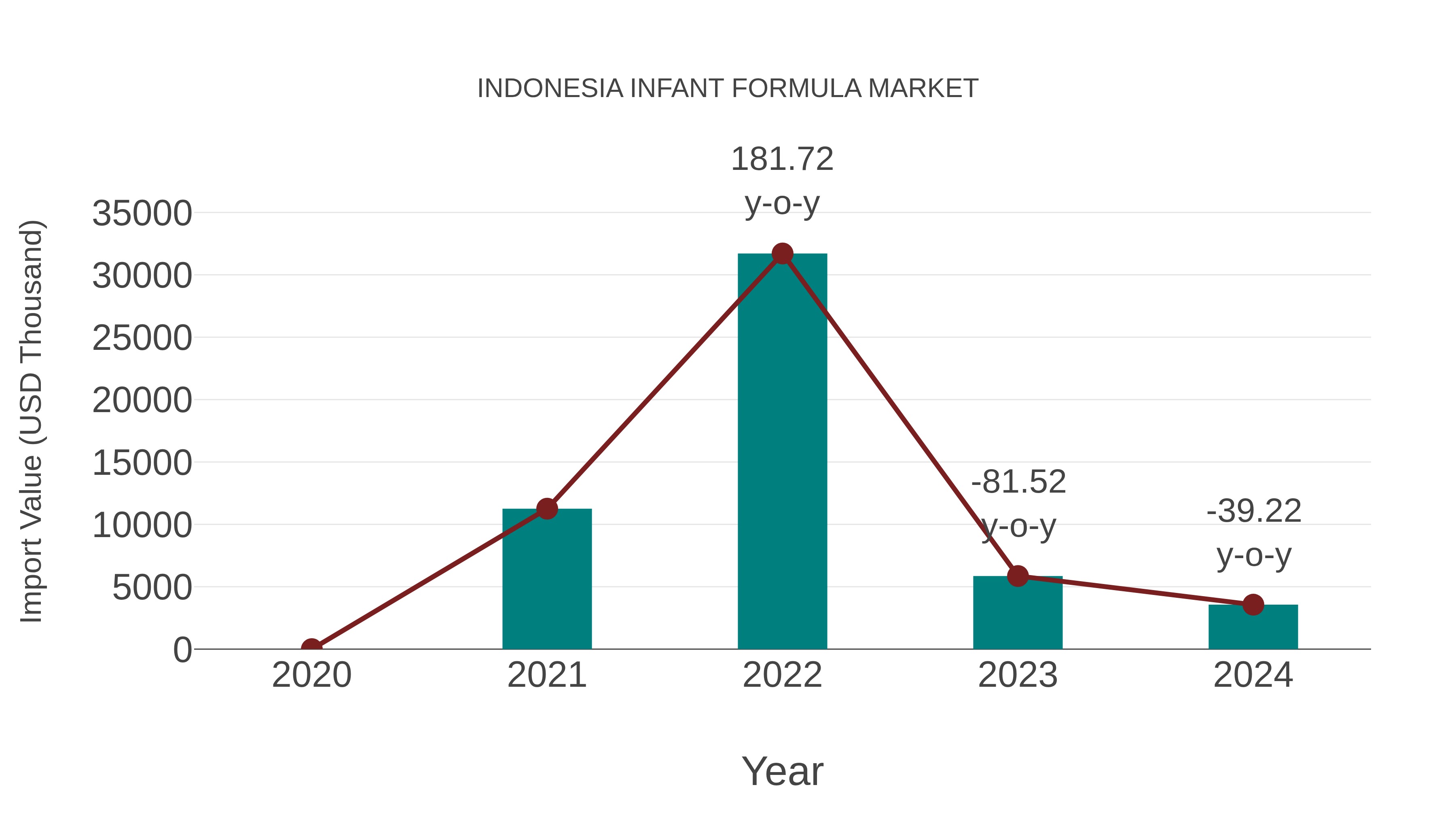
Indonesia Infant Formula Market Growth Rate
According to 6Wresearch internal database and industry insights, the Indonesia Infant Formula Market is projected to grow at a compound annual growth rate (CAGR) of 7.1% during the forecast period (2026–2032).
Topics Covered in the Indonesia Infant Formula Market Report
The Indonesia Infant Formula Market report thoroughly covers the market by type, ingredient, and distribution channel. The report provides an unbiased and detailed assessment of emerging trends, high-growth opportunities, and key demand drivers. It helps stakeholders align strategies with evolving consumer preferences, regulatory norms, and product innovation trends shaping the infant nutrition landscape in Indonesia.
Indonesia Infant Formula Market Highlights
| Report Name | Indonesia Infant Formula Market |
| Forecast Period | 2026–2032 |
| CAGR | 7.10% |
| Growing Sector | Specialty Baby Milk |
Indonesia Infant Formula Market Synopsis
Indonesia Infant Formula Market is anticipated to witness strong growth driven by rising birth rates, increasing disposable income, and growing awareness of balanced infant nutrition. More parents are choosing fortified and specialty formulas due to changes in people living and easier access to healthcare. Also, more stores, faster adoption of online shopping, and government-supported programs for child nutrition are all also helping to keep demand for infant and growing-up milk products strong in cities and suburbs.
Evaluation of Growth Drivers in the Indonesia Infant Formula Market
Below mentioned are some prominent drivers and their influence on the market dynamics:
| Drivers | Primary Segments Affected | Why It Matters (Evidence) |
| Rising Working Female Population | Infant & Follow-on Milk | Growing preference for convenient, safe, and reliable infant nutrition solutions |
| Increasing Nutrition Awareness | Specialty Baby Milk | Awareness programs highlight the importance of fortified and functional nutrition |
| Retail Expansion | All Types; Offline | Wider presence of supermarkets and pharmacies improves product accessibility |
| E-commerce Growth | All Types; Online | Digital platforms expand brand reach and enable repeat and subscription purchases |
| Government Nutrition Focus | Growing-up Milk | Public initiatives stress early childhood development and balanced nutrition intake |
Indonesia Infant Formula Market is expected to grow at a CAGR of 7.1% during the forecast period of 2026-2032. Growth is driven by premiumization in baby food, rising adoption of specialty formulas, and expanded distribution channels. In addition, the increasing popularity of fortified milk products is a result of the increased health consciousness of parents and government nutrition programs. This is particularly evident in metropolitan and developing regions of Indonesia.
Evaluation of Restraints in the Indonesia Infant Formula Market
Below mentioned are some major restraints and their influence on the market dynamics:
| Restraints | Primary Segments Affected | What This Means (Evidence) |
| High Product Prices | Specialty Baby Milk | Premium pricing limits affordability for low-income families |
| Strict Marketing Regulations | All Types | Promotion restrictions affect brand visibility and consumer outreach |
| Breastfeeding Promotion | Infant Milk | Government policies prioritize breastfeeding awareness over formula use |
| Supply Chain Dependence | Ingredients | Imported raw materials increase cost volatility |
| Rural Accessibility Issues | Offline Channels | Limited cold-chain and retail penetration in remote areas |
Indonesia Infant Formula Industry Challenges
Despite steady growth, the Indonesia Infant Formula Industry faces challenges such as regulatory compliance complexity, price sensitivity among consumers, and intense competition from international brands. Moreover, not enough knowledge in the countryside areas, reliance on imported materials, and limiting infant milk promotion also cause operational difficulties. Addressing affordability, distribution reach, and localized product innovation remains critical for long-term market expansion.
Indonesia Infant Formula Market Trends
Below are some key trends in the Indonesia Infant Formula Market Growth are:
- Premium and organic infant formulas: They are increasingly chosen by parents due to their perceived health benefits, which helps companies differentiate their products and increase margins.
- Demand for Specialty Nutrition Products: There is a growing demand for lactose-free and allergy-friendly infant formulas.
- E-commerce Growth: Online shopping is becoming an essential distribution channel for infant formula.
- Fortification with Functional Ingredients: DHA, probiotics, and vitamins are being fortified in infant formulas. This increases the benefits of infant formulas for cognitive development and immunity.
- Product Innovation to Meet Local Dietary Requirements: Brands are innovating products to meet local dietary requirements which increases consumer acceptance and trust.
Investment Opportunities in the Indonesia Infant Formula Market
Some prominent investment opportunities in the Indonesia Infant Formula Market include:
- Specialty Formula Manufacturing Facilities – Setting up localized production units reduces import dependency and costs and improves supply stability.
- E-commerce and Direct-to-Consumer Platforms – Investing in e-commerce platforms improves reach and data-driven marketing.
- Ingredient Sourcing and Processing – Developing local ingredient sourcing improves cost competitiveness and supports regulatory compliance.
- Fortified Nutrition R&D — Investing in innovation enhances premium product quality and aligns with evolving nutritional preferences.
Top 5 Leading Players in the Indonesia Infant Formula Market
Some leading players operating in the Indonesia Infant Formula Market include:
1. Nestle S.A.
| Company Name | Nestle S.A. |
| Established Year | 1866 |
| Headquarters | Vevey, Switzerland |
| Official Website | Click Here |
Nestlé offers a wide range of infant and growing-up milk products in Indonesia, focusing on fortified nutrition, quality assurance, and localized formulations to meet diverse consumer needs.
2. Danone S.A.
| Company Name | Danone S.A. |
| Established Year | 1919 |
| Headquarters | Paris, France |
| Official Website | Click Here |
Danone provides premium and specialty infant formula products, emphasizing early-life nutrition research and strong retail partnerships across Indonesia.
3. Abbott Laboratories
| Company Name | Abbott Laboratories |
| Established Year | 1888 |
| Headquarters | Illinois, USA |
| Official Website | Click Here |
Abbott delivers science-based infant nutrition solutions, including specialty formulas, supported by clinical research and healthcare collaborations.
4. FrieslandCampina
| Company Name | FrieslandCampina |
| Established Year | 1871 |
| Headquarters | Amersfoort, Netherlands |
| Official Website | Click Here |
FrieslandCampina supplies high-quality dairy-based infant formulas, leveraging strong milk sourcing and nutrition expertise.
5. Mead Johnson Nutrition
| Company Name | Mead Johnson Nutrition |
| Established Year | 1905 |
| Headquarters | Chicago, USA |
| Official Website | Click Here |
Mead Johnson focuses on advanced infant nutrition products designed to support cognitive and physical development.
Government Regulations Introduced in the Indonesia Infant Formula Market
According to the Indonesia’s Government data, several initiatives exist to promote child nutrition and food safety. The Ministry of Health promotes balanced nutrition through the National Nutrition Improvement Program, while BPOM strictly enforces labeling and quality standards for infant formula. In addition, the encouragement of development in the local dairy industry and public-private partnerships in nutrition education programs is also improving the quality and accessibility of products, as well as boosting consumer confidence in the country.
Future Outlook of the Indonesia Infant Formula Market
The future outlook for the Indonesia Infant Formula Market is positive due to rising income levels, premiumization of infant nutrition, and investment in innovation. E-commerce growth, development of specialty nutrition products, and government initiatives for child health programs are expected to drive growth. Local manufacturing and ingredient sourcing will further enhance market competitiveness and sustainability. Additionally, increasing urbanization and greater awareness of early-life nutrition are likely to support sustained demand across both metropolitan and emerging regions.
Market Segmentation Analysis
The report offers a comprehensive study of the subsequent market segments and their leading categories.
Infant Milk to Dominate the Market – By Type
According to Mohit, Senior Research Analyst, 6Wresearch, Infant Milk holds the largest market segment in the Indonesia Infant Formula Market Share due to its essential role in early-stage infant nutrition. High birth rates, high recommendations from doctors, and the availability of fortified formulations are also the factors that continue to drive the demand.
Carbohydrate to Dominate the Market – By Ingredient
Carbohydrates remain the leading ingredient segment due to their role as a primary energy source. Lactose-based formulations are widely preferred for supporting healthy growth and digestion.
Key Attractiveness of the Report
- 10 Years of Market Numbers.
- Historical Data Starting from 2022 to 2025.
- Base Year: 2025.
- Forecast Data until 2032.
- Key Performance Indicators Impacting the Market.
- Major Upcoming Developments and Projects.
Key Highlights of the Report:
- Indonesia Infant Formula Market Outlook
- Market Size of Indonesia Infant Formula Market, 2025
- Forecast of Indonesia Infant Formula Market, 2032
- Historical Data and Forecast of Indonesia Infant Formula Revenues & Volume for the Period 2022- 2032F
- Indonesia Infant Formula Market Trend Evolution
- Indonesia Infant Formula Market Drivers and Challenges
- Indonesia Infant Formula Price Trends
- Indonesia Infant Formula Porter's Five Forces
- Indonesia Infant Formula Industry Life Cycle
- Historical Data and Forecast of Indonesia Infant Formula Market Revenues & Volume By Type for the Period 2022- 2032F
- Historical Data and Forecast of Indonesia Infant Formula Market Revenues & Volume By Infant Milk for the Period 2022- 2032F
- Historical Data and Forecast of Indonesia Infant Formula Market Revenues & Volume By Follow on Milk for the Period 2022- 2032F
- Historical Data and Forecast of Indonesia Infant Formula Market Revenues & Volume By Specialty Baby Milk for the Period 2022- 2032F
- Historical Data and Forecast of Indonesia Infant Formula Market Revenues & Volume By Growing-up Milk for the Period 2022- 2032F
- Historical Data and Forecast of Indonesia Infant Formula Market Revenues & Volume By Ingredient for the Period 2022- 2032F
- Historical Data and Forecast of Indonesia Infant Formula Market Revenues & Volume By Carbohydrate for the Period 2022- 2032F
- Historical Data and Forecast of Indonesia Infant Formula Market Revenues & Volume By Fat for the Period 2022- 2032F
- Historical Data and Forecast of Indonesia Infant Formula Market Revenues & Volume By Protein for the Period 2022- 2032F
- Historical Data and Forecast of Indonesia Infant Formula Market Revenues & Volume By Minerals for the Period 2022- 2032F
- Historical Data and Forecast of Indonesia Infant Formula Market Revenues & Volume By Vitamins for the Period 2022- 2032F
- Historical Data and Forecast of Indonesia Infant Formula Market Revenues & Volume By Others for the Period 2022- 2032F
- Historical Data and Forecast of Indonesia Infant Formula Market Revenues & Volume By Distribution Channel for the Period 2022- 2032F
- Historical Data and Forecast of Indonesia Infant Formula Market Revenues & Volume By Online for the Period 2022- 2032F
- Historical Data and Forecast of Indonesia Infant Formula Market Revenues & Volume By Offline for the Period 2022- 2032F
- Indonesia Infant Formula Import Export Trade Statistics
- Market Opportunity Assessment By Type
- Market Opportunity Assessment By Ingredient
- Market Opportunity Assessment By Distribution Channel
- Indonesia Infant Formula Top Companies Market Share
- Indonesia Infant Formula Competitive Benchmarking By Technical and Operational Parameters
- Indonesia Infant Formula Company Profiles
- Indonesia Infant Formula Key Strategic Recommendations
Market Covered
The report offers a comprehensive study of the subsequent market segments:
By Type
- Infant Milk
- Follow-on Milk
- Specialty Baby Milk
- Growing-up Milk
By Ingredient
- Carbohydrate
- Fat
- Protein
- Minerals
- Vitamins
- Others
By Distribution Channel
- Online
- Offline
Indonesia Infant Formula Market (2026-2032): FAQs
The Indonesia Infant Formula Market is projected to grow at a CAGR of 7.1% during the forecast period.
Key trends include premiumization, specialty nutrition adoption, online sales growth, and fortified ingredient innovation.
Rising awareness of infant allergies, digestive issues, and immunity support is driving specialty formula demand.
Offline channels dominate due to strong pharmacy networks and consumer trust.
6Wresearch actively monitors the Indonesia Infant Formula Market and publishes its comprehensive annual report, highlighting emerging trends, growth drivers, revenue analysis, and forecast outlook. Our insights help businesses to make data-backed strategic decisions with ongoing market dynamics. Our analysts track relevent industries related to the Indonesia Infant Formula Market, allowing our clients with actionable intelligence and reliable forecasts tailored to emerging regional needs.
Yes, we provide customisation as per your requirements. To learn more, feel free to contact us on sales@6wresearch.com
| 1 Executive Summary |
| 2 Introduction |
| 2.1 Key Highlights of the Report |
| 2.2 Report Description |
| 2.3 Market Scope & Segmentation |
| 2.4 Research Methodology |
| 2.5 Assumptions |
| 3 Indonesia Infant Formula Market Overview |
| 3.1 Indonesia Country Macro Economic Indicators |
| 3.2 Indonesia Infant Formula Market Revenues & Volume, 2022 & 2032F |
| 3.3 Indonesia Infant Formula Market - Industry Life Cycle |
| 3.4 Indonesia Infant Formula Market - Porter's Five Forces |
| 3.5 Indonesia Infant Formula Market Revenues & Volume Share, By Type, 2022 & 2032F |
| 3.6 Indonesia Infant Formula Market Revenues & Volume Share, By Ingredient, 2022 & 2032F |
| 3.7 Indonesia Infant Formula Market Revenues & Volume Share, By Distribution Channel, 2022 & 2032F |
| 4 Indonesia Infant Formula Market Dynamics |
| 4.1 Impact Analysis |
| 4.2 Market Drivers |
| 4.2.1 Increasing urbanization and a rise in the number of working mothers leading to higher demand for convenience products like infant formula. |
| 4.2.2 Growing awareness about the importance of proper nutrition for infants and the benefits of using infant formula. |
| 4.2.3 Rising disposable income levels enabling more parents to afford premium infant formula products. |
| 4.3 Market Restraints |
| 4.3.1 Concerns regarding the quality and safety of infant formula products leading to regulatory scrutiny and consumer skepticism. |
| 4.3.2 Cultural and societal norms promoting breastfeeding over formula feeding, impacting the adoption of infant formula products. |
| 5 Indonesia Infant Formula Market Trends |
| 6 Indonesia Infant Formula Market, By Types |
| 6.1 Indonesia Infant Formula Market, By Type |
| 6.1.1 Overview and Analysis |
| 6.1.2 Indonesia Infant Formula Market Revenues & Volume, By Type, 2022 & 2032F |
| 6.1.3 Indonesia Infant Formula Market Revenues & Volume, By Infant Milk, 2022 & 2032F |
| 6.1.4 Indonesia Infant Formula Market Revenues & Volume, By Follow on Milk, 2022 & 2032F |
| 6.1.5 Indonesia Infant Formula Market Revenues & Volume, By Specialty Baby Milk, 2022 & 2032F |
| 6.1.6 Indonesia Infant Formula Market Revenues & Volume, By Growing-up Milk, 2022 & 2032F |
| 6.2 Indonesia Infant Formula Market, By Ingredient |
| 6.2.1 Overview and Analysis |
| 6.2.2 Indonesia Infant Formula Market Revenues & Volume, By Carbohydrate, 2022 & 2032F |
| 6.2.3 Indonesia Infant Formula Market Revenues & Volume, By Fat, 2022 & 2032F |
| 6.2.4 Indonesia Infant Formula Market Revenues & Volume, By Protein, 2022 & 2032F |
| 6.2.5 Indonesia Infant Formula Market Revenues & Volume, By Minerals, 2022 & 2032F |
| 6.2.6 Indonesia Infant Formula Market Revenues & Volume, By Vitamins, 2022 & 2032F |
| 6.2.7 Indonesia Infant Formula Market Revenues & Volume, By Others, 2022 & 2032F |
| 6.3 Indonesia Infant Formula Market, By Distribution Channel |
| 6.3.1 Overview and Analysis |
| 6.3.2 Indonesia Infant Formula Market Revenues & Volume, By Online, 2022 & 2032F |
| 6.3.3 Indonesia Infant Formula Market Revenues & Volume, By Offline, 2022 & 2032F |
| 7 Indonesia Infant Formula Market Import-Export Trade Statistics |
| 7.1 Indonesia Infant Formula Market Export to Major Countries |
| 7.2 Indonesia Infant Formula Market Imports from Major Countries |
| 8 Indonesia Infant Formula Market Key Performance Indicators |
| 8.1 Percentage of pediatricians recommending infant formula as part of a balanced diet. |
| 8.2 Number of new product launches and innovations in the infant formula market. |
| 8.3 Growth in online sales of infant formula products. |
| 9 Indonesia Infant Formula Market - Opportunity Assessment |
| 9.1 Indonesia Infant Formula Market Opportunity Assessment, By Type, 2022 & 2032F |
| 9.2 Indonesia Infant Formula Market Opportunity Assessment, By Ingredient, 2022 & 2032F |
| 9.3 Indonesia Infant Formula Market Opportunity Assessment, By Distribution Channel, 2022 & 2032F |
| 10 Indonesia Infant Formula Market - Competitive Landscape |
| 10.1 Indonesia Infant Formula Market Revenue Share, By Companies, 2025 |
| 10.2 Indonesia Infant Formula Market Competitive Benchmarking, By Operating and Technical Parameters |
| 11 Company Profiles |
| 12 Recommendations |
| 13 Disclaimer |
Export potential assessment - trade Analytics for 2030
Export potential enables firms to identify high-growth global markets with greater confidence by combining advanced trade intelligence with a structured quantitative methodology. The framework analyzes emerging demand trends and country-level import patterns while integrating macroeconomic and trade datasets such as GDP and population forecasts, bilateral import–export flows, tariff structures, elasticity differentials between developed and developing economies, geographic distance, and import demand projections. Using weighted trade values from 2020–2024 as the base period to project country-to-country export potential for 2030, these inputs are operationalized through calculated drivers such as gravity model parameters, tariff impact factors, and projected GDP per-capita growth. Through an analysis of hidden potentials, demand hotspots, and market conditions that are most favorable to success, this method enables firms to focus on target countries, maximize returns, and global expansion with data, backed by accuracy.
By factoring in the projected importer demand gap that is currently unmet and could be potential opportunity, it identifies the potential for the Exporter (Country) among 190 countries, against the general trade analysis, which identifies the biggest importer or exporter.
To discover high-growth global markets and optimize your business strategy:
Click Here
Pricing
- Single User License$ 1,995
- Department License$ 2,400
- Site License$ 3,120
- Global License$ 3,795

Search
Thought Leadership and Analyst Meet





Our Clients








Related Reports
- Sri Lanka Packaging Market (2026-2032) | Outlook, Competition, Drivers, Trends, Demand, Pricing Analysis, Competitive, Strategic Insights, Companies, Challenges, Strategy, Consumer Insights, Analysis, Investment Trends, Opportunities, Growth, Size, Share, Industry, Revenue, Segments, Value, Segmentation, Supply, Forecast, Restraints
- India Kids Watches Market (2026-2032) | Strategy, Consumer Insights, Analysis, Investment Trends, Opportunities, Growth, Size, Share, Industry, Revenue, Segments, Value, Segmentation, Supply, Forecast, Restraints, Outlook, Competition, Drivers, Trends, Demand, Pricing Analysis, Competitive, Strategic Insights, Companies, Challenges
- Saudi Arabia Core Assurance Service Market (2025-2031) | Strategy, Consumer Insights, Analysis, Investment Trends, Opportunities, Growth, Size, Share, Industry, Revenue, Segments, Value, Segmentation, Supply, Forecast, Restraints, Outlook, Competition, Drivers, Trends, Demand, Pricing Analysis, Competitive, Strategic Insights, Companies, Challenges
- Romania Uninterruptible Power Supply (UPS) Market (2026-2032) | Industry, Analysis, Revenue, Size, Forecast, Outlook, Value, Trends, Share, Growth & Companies
- Saudi Arabia Car Window Tinting Film, Paint Protection Film (PPF), and Ceramic Coating Market (2025-2031) | Strategy, Consumer Insights, Analysis, Investment Trends, Opportunities, Growth, Size, Share, Industry, Revenue, Segments, Value, Segmentation, Supply, Forecast, Restraints, Outlook, Competition, Drivers, Trends, Demand, Pricing Analysis, Competitive, Strategic Insights, Companies, Challenges
- South Africa Stationery Market (2025-2031) | Share, Size, Industry, Value, Growth, Revenue, Analysis, Trends, Segmentation & Outlook
- Afghanistan Rocking Chairs And Adirondack Chairs Market (2026-2032) | Size & Revenue, Competitive Landscape, Share, Segmentation, Industry, Value, Outlook, Analysis, Trends, Growth, Forecast, Companies
- Afghanistan Apparel Market (2026-2032) | Growth, Outlook, Industry, Segmentation, Forecast, Size, Companies, Trends, Value, Share, Analysis & Revenue
- Canada Oil and Gas Market (2026-2032) | Share, Segmentation, Value, Industry, Trends, Forecast, Analysis, Size & Revenue, Growth, Competitive Landscape, Outlook, Companies
- Germany Breakfast Food Market (2026-2032) | Industry, Share, Growth, Size, Companies, Value, Analysis, Revenue, Trends, Forecast & Outlook
Industry Events and Analyst Meet

Smart Production Solutions Guangzhou 2026

Stationery & Paper Expo Saudi Arabia 2026

Kids & Toys Expo Saudi Arabia 2026

Gifts & Homeware Expo Saudi Arabia 2026

Smart Home Expo 2026
Whitepaper
- Middle East & Africa Commercial Security Market Click here to view more.
- Middle East & Africa Fire Safety Systems & Equipment Market Click here to view more.
- GCC Drone Market Click here to view more.
- Middle East Lighting Fixture Market Click here to view more.
- GCC Physical & Perimeter Security Market Click here to view more.
6WResearch In News
- Doha a strategic location for EV manufacturing hub: IPA Qatar
- Demand for luxury TVs surging in the GCC, says Samsung
- Empowering Growth: The Thriving Journey of Bangladesh’s Cable Industry
- Demand for luxury TVs surging in the GCC, says Samsung
- Video call with a traditional healer? Once unthinkable, it’s now common in South Africa
- Intelligent Buildings To Smooth GCC’s Path To Net Zero


