Indonesia Office Equipment Market (2026-2032) | Industry, Growth, Forecast, Revenue, Analysis, Outlook, Companies, Trends, Size, Share & Value
Market Forecast By Type (Photocopiers, Printers and Scanners, Fax Machines, Coin and Currency Counting Devices), By Distribution Channel (Online, Offline) And Competitive Landscape
| Product Code: ETC037188 | Publication Date: Jul 2023 | Updated Date: Jun 2026 | Product Type: Report | |
| Publisher: 6Wresearch | Author: Ravi Bhandari | No. of Pages: 70 | No. of Figures: 35 | No. of Tables: 5 |
Indonesia Office Equipment Market Summary
The indonesia office equipment market was estimated at USD 297 Million in 2025 and is projected to reach USD 397 Million by 2032, growing at a CAGR of 5.1% from 2026 to 2032.
Indonesia Office Equipment Market Growth Rate Analysis (2021-2032)
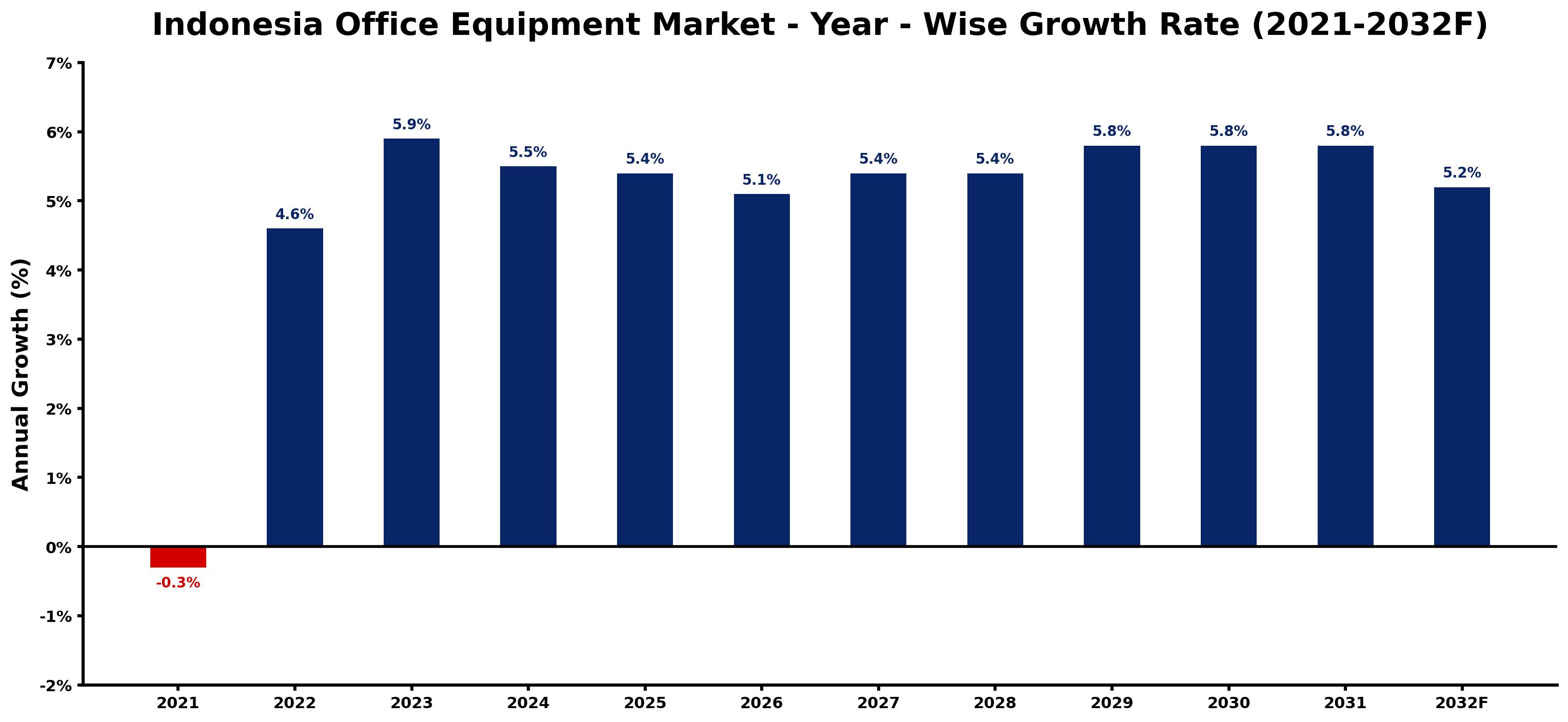
The Indonesia office equipment market is witnessing a notable upward trend, rebounding from a slight decline of -0.3% in 2021. This resurgence is largely fueled by a 4.6% growth in 2022, followed by an impressive 5.9% in 2023. Key factors driving this expansion include increased consumer demand and significant investments in digitalization and infrastructure upgrades. Expectations for sustained growth are strong, with forecasts suggesting growth rates of around 5.5% to 5.8% through to 2031. The shift towards hybrid work models and the rise of the tech sector are also contributing to this dynamic landscape, positioning Indonesia for continued development in office equipment solutions in the coming years.
Indonesia Office Equipment Market Year-wise Growth Rate and Key Drivers
This graph highlights how the Indonesia Office Equipment Market has steadily grown over the past five years, supported by major growth factors.
The table below presents the year wise growth rates along with the key drivers influencing the market
| Year | Growth Rate | Major Drivers |
| 2021 | -0.3% | Economic uncertainty stemming from the pandemic led to decreased corporate investment in new office equipment. |
| 2022 | 4.6% | Corporate budgets reflected a shift towards remote work solutions and digital integration. |
| 2023 | 5.9% | Increased digital transformation efforts led to enhanced demand for office automation equipment. |
| 2024 | 5.5% | Sustainability trends pushed companies towards eco-friendly office equipment and solutions. |
| 2025 | 5.4% | With urbanization accelerating, office space expansions influenced equipment procurement decisions. |
| 2026 | 5.1% | Emergence of co-working spaces brought about diverse requirements for multi-functional office gear. |
| 2027 | 5.4% | Competitive pressures compelled businesses to invest in advanced tech for operational efficiency. |
| 2028 | 5.4% | Supply chain disruptions highlighted the need for resilient inventory management systems. |
| 2029 | 5.8% | Technological innovations in printing and imaging equipment captured significant market attention. |
| 2030 | 5.8% | E-commerce growth spurred demand for efficient logistics and office management solutions. |
| 2031 | 5.8% | Corporate restructuring post-recession emphasized the importance of flexible office layouts. |
| 2032 | 5.2% | Cultural shifts towards hybrid work models drove demand for adaptable office setups. |
Note - Market size estimations and growth projections presented in this report are based on 6Wresearch's advanced forecasting approach, validated with industry datasets as of June 2026.
Indonesia Office Equipment Market Synopsis
The Indonesia Office Equipment Market is projected to reach 5.1% and witness significant growth during the forecast period (2026-2032). As one of the fastest-growing economies in Southeast Asia, Indonesia presents a fertile ground for office equipment suppliers. The market dynamics are shaped by various factors, including increasing foreign investments, the rise of small-medium enterprises (SMEs), and the growing trend of remote work culture. These elements collectively indicate a robust demand for both conventional and advanced office automation solutions, such as printers, photocopiers, and scanners.
Indonesia Office Equipment Market Growth Drivers
The growth of the Indonesia Office Equipment Market is underpinned by several key drivers. Firstly, the influx of foreign investments has spurred local enterprises to modernize their operations and enhance productivity through the acquisition of modern office equipment. This trend is evident in both urban centers and emerging regions.
- Increasing digitalization across various industries promotes the need for advanced office equipment capable of supporting tech-driven environments.
- The rise of remote working culture necessitates the adoption of high-quality printing and communication tools to facilitate home office setups.
- Government incentives, such as tax exemptions on specific business machines, boost purchase rates among SMEs, driving demand significantly.
- Technological advancements lead to the development of products tailored for the local market, enhancing usability and affordability.
- Higher awareness about the benefits of automation solutions encourages local businesses to invest in modern office equipment for improved operational efficiency.
Indonesia Office Equipment Market Trends and Opportunities
The Indonesia Office Equipment Market is witnessing notable trends that present opportunities for growth. The increasing integration of smart technologies in office equipment provides avenues for suppliers to innovate and cater to changing consumer preferences.
- The shift towards cloud-based solutions is making multifunction printers and copiers more appealing, as they streamline workflows and enhance collaboration.
- Growing awareness of sustainability is prompting businesses to seek eco-friendly office solutions, presenting manufacturers with opportunities to redefine their offerings.
- Local firms are increasingly leaning towards integrated systems that encompass both hardware and software solutions, indicating a shift in purchasing behavior.
- The demand for value-added services, such as maintenance and support packages, is on the rise, indicating that suppliers can enhance customer loyalty and revenue streams.
- Urbanization is driving the growth of flexible office spaces, which often require adaptable office equipment suited to dynamic work environments.
Indonesia Office Equipment Market Challenges and Restraints
Despite the positive outlook, the Indonesia Office Equipment Market faces several challenges and restraints that could impede growth. A significant barrier is the lack of awareness regarding the latest technological advancements among some local businesses, particularly in rural areas.
- Adequate technical expertise is scarce in certain regions, making it difficult for businesses to adopt advanced office solutions effectively.
- The cost sensitivity in rural markets limits the proliferation of high-end office equipment, as budget constraints dictate purchasing decisions.
- Supply chain disruptions can affect product availability, causing delays that impact the ability of businesses to operate efficiently.
- Competition among suppliers for market share may lead to price wars, affecting profit margins and overall market stability.
- Regulatory hurdles in importing certain office equipment can delay market entry for foreign vendors, inhibiting potential growth opportunities.
Indonesia Office Equipment Market Government Investment and Initiatives
The Indonesian government plays a proactive role in fostering the growth of the office equipment sector through various investments and initiatives. Public spending on infrastructure development and modernization projects creates a favorable landscape for the office equipment market.
- Government policies encourage the adoption of advanced technologies in both public and private sectors, enhancing demand for modern office solutions.
- Investment incentives for businesses that adopt digital tools and equipment are designed to stimulate regional economic activity and growth.
- Ongoing training programs aimed at enhancing technical expertise in local workforces further support the uptake of sophisticated office technologies.
- Environmental policies also encourage businesses to invest in sustainable office equipment, aligning with national goals for sustainable development.
- Public-private partnerships are promoted to drive innovation in office automation, ensuring local businesses can access the latest technologies and solutions.
Indonesia Office Equipment Market Latest Developments (May 2025 - June 2026)
In the period from May 2025 to June 2026, the Indonesia Office Equipment Market is experiencing significant developments amid changing market dynamics. The focus on sustainability is increasingly influencing product development strategies, as companies seek to offer eco-friendly office solutions.
- Collaboration between technology providers and local businesses has intensified, enhancing the design and functionality of office equipment tailored for the Indonesian market.
- Emerging trends in hybrid work environments are prompting suppliers to innovate and offer more versatile equipment that can adapt to diverse working conditions.
- Government-backed initiatives aimed at fostering digital transformation are providing the necessary support for companies to upgrade their office environments.
- Increased involvement of traditional office equipment suppliers in the digital services space indicates a trend towards comprehensive service offerings for end-users.
- Efforts to enhance supply chain resilience are becoming a focal point for businesses, ensuring seamless delivery of office equipment despite ongoing global disruptions.
Indonesia Office Equipment Market - Key Attractiveness of the Report
- 10 Years of Market Numbers
- Historical Data Starting from 2022 to 2025
- Base Year: 2025
- Forecast Data until 2032
- Key Performance Indicators Impacting the Market
- Major Upcoming Developments and Projects
Key Highlights of the Report:
- Indonesia Office Equipment Market Outlook
- Market Size of Indonesia Office Equipment Market, 2025
- Forecast of Indonesia Office Equipment Market, 2032F
- Historical Data and Forecast of Indonesia Office Equipment Revenues & Volume for the Period 2022-2032F
- Indonesia Office Equipment Market Trend Evolution
- Indonesia Office Equipment Market Drivers and Challenges
- Indonesia Office Equipment Price Trends
- Indonesia Office Equipment Porter's Five Forces
- Indonesia Office Equipment Industry Life Cycle
- Historical Data and Forecast of Indonesia Office Equipment Market Revenues & Volume By Type for the Period 2022-2032F
- Historical Data and Forecast of Indonesia Office Equipment Market Revenues & Volume By Photocopiers for the Period 2022-2032F
- Historical Data and Forecast of Indonesia Office Equipment Market Revenues & Volume By Printers and Scanners for the Period 2022-2032F
- Historical Data and Forecast of Indonesia Office Equipment Market Revenues & Volume By Fax Machines for the Period 2022-2032F
- Historical Data and Forecast of Indonesia Office Equipment Market Revenues & Volume By Coin and Currency Counting Devices for the Period 2022-2032F
- Historical Data and Forecast of Indonesia Office Equipment Market Revenues & Volume By Distribution Channel for the Period 2022-2032F
- Historical Data and Forecast of Indonesia Office Equipment Market Revenues & Volume By Online for the Period 2022-2032F
- Historical Data and Forecast of Indonesia Office Equipment Market Revenues & Volume By Offline for the Period 2022-2032F
- Indonesia Office Equipment Import Export Trade Statistics
- Market Opportunity Assessment By Type
- Market Opportunity Assessment By Distribution Channel
- Indonesia Office Equipment Top Companies Market Share
- Indonesia Office Equipment Competitive Benchmarking By Technical and Operational Parameters
- Indonesia Office Equipment Company Profiles
- Indonesia Office Equipment Key Strategic Recommendations
Frequently Asked Questions About the Market Study (FAQs):
Key growth factors include rising foreign investments, increased adoption of remote work practices, and the government incentives aimed at enhancing local business productivity.
Technological advancements are leading to the development of more efficient and user-friendly office equipment, promoting greater adoption among businesses striving for operational efficiency.
The primary challenges include lack of technical expertise in certain regions, cost sensitivity among local businesses, and supply chain disruptions affecting product availability.
The government supports the market through policies that promote investment in digital technologies and infrastructure, as well as initiatives aimed at enhancing local workforce skills in technology usage.
6Wresearch actively monitors the Indonesia Office Equipment Market and publishes its comprehensive annual report, highlighting emerging trends, growth drivers, revenue analysis, and forecast outlook. Our insights help businesses to make data-backed strategic decisions with ongoing market dynamics. Our analysts track relevent industries related to the Indonesia Office Equipment Market, allowing our clients with actionable intelligence and reliable forecasts tailored to emerging regional needs.
Yes, we provide customisation as per your requirements. To learn more, feel free to contact us on sales@6wresearch.com
1 Executive Summary |
2 Introduction |
2.1 Key Highlights of the Report |
2.2 Report Description |
2.3 Market Scope & Segmentation |
2.4 Research Methodology |
2.5 Assumptions |
3 Indonesia Office Equipment Market Overview |
3.1 Indonesia Country Macro Economic Indicators |
3.2 Indonesia Office Equipment Market Revenues & Volume, 2022 & 2032F |
3.3 Indonesia Office Equipment Market - Industry Life Cycle |
3.4 Indonesia Office Equipment Market - Porter's Five Forces |
3.5 Indonesia Office Equipment Market Revenues & Volume Share, By Type, 2022 & 2032F |
3.6 Indonesia Office Equipment Market Revenues & Volume Share, By Distribution Channel, 2022 & 2032F |
4 Indonesia Office Equipment Market Dynamics |
4.1 Impact Analysis |
4.2 Market Drivers |
4.3 Market Restraints |
5 Indonesia Office Equipment Market Trends |
6 Indonesia Office Equipment Market, By Types |
6.1 Indonesia Office Equipment Market, By Type |
6.1.1 Overview and Analysis |
6.1.2 Indonesia Office Equipment Market Revenues & Volume, By Type, 2022-2032F |
6.1.3 Indonesia Office Equipment Market Revenues & Volume, By Photocopiers, 2022-2032F |
6.1.4 Indonesia Office Equipment Market Revenues & Volume, By Printers and Scanners, 2022-2032F |
6.1.5 Indonesia Office Equipment Market Revenues & Volume, By Fax Machines, 2022-2032F |
6.1.6 Indonesia Office Equipment Market Revenues & Volume, By Coin and Currency Counting Devices, 2022-2032F |
6.2 Indonesia Office Equipment Market, By Distribution Channel |
6.2.1 Overview and Analysis |
6.2.2 Indonesia Office Equipment Market Revenues & Volume, By Online, 2022-2032F |
6.2.3 Indonesia Office Equipment Market Revenues & Volume, By Offline, 2022-2032F |
7 Indonesia Office Equipment Market Import-Export Trade Statistics |
7.1 Indonesia Office Equipment Market Export to Major Countries |
7.2 Indonesia Office Equipment Market Imports from Major Countries |
8 Indonesia Office Equipment Market Key Performance Indicators |
9 Indonesia Office Equipment Market - Opportunity Assessment |
9.1 Indonesia Office Equipment Market Opportunity Assessment, By Type, 2022 & 2032F |
9.2 Indonesia Office Equipment Market Opportunity Assessment, By Distribution Channel, 2022 & 2032F |
10 Indonesia Office Equipment Market - Competitive Landscape |
10.1 Indonesia Office Equipment Market Revenue Share, By Companies, 2025 |
10.2 Indonesia Office Equipment Market Competitive Benchmarking, By Operating and Technical Parameters |
11 Company Profiles |
12 Recommendations |
13 Disclaimer |
Global Go To Market Strategy - 2030
Export potential enables firms to identify high-growth global markets with greater confidence by combining advanced trade intelligence with a structured quantitative methodology. The framework analyzes emerging demand trends and country-level import patterns while integrating macroeconomic and trade datasets such as GDP and population forecasts, bilateral import–export flows, tariff structures, elasticity differentials between developed and developing economies, geographic distance, and import demand projections. Using weighted trade values from 2020–2024 as the base period to project country-to-country export potential for 2030, these inputs are operationalized through calculated drivers such as gravity model parameters, tariff impact factors, and projected GDP per-capita growth. Through an analysis of hidden potentials, demand hotspots, and market conditions that are most favorable to success, this method enables firms to focus on target countries, maximize returns, and global expansion with data, backed by accuracy.
By factoring in the projected importer demand gap that is currently unmet and could be potential opportunity, it identifies the potential for the Exporter (Country) among 190 countries, against the general trade analysis, which identifies the biggest importer or exporter.
To discover high-growth global markets and optimize your business strategy:
Click Here
Pricing
- Single User License$ 1,995
- Department License$ 2,400
- Site License$ 3,120
- Global License$ 3,795

Leadership Perspectives from Industry Events
Search
Thought Leadership and Analyst Meet





Our Clients








6WResearch In News
- India Air Conditioner Market Set for Strong Rebound in 2026 After Weather-Led Correction and GST-Driven Recovery: 6Wresearch
- ADAS in India: How Automatic Emergency Braking, Blind Spot Detection & Driver Monitoring are Transforming Road Safety
- Doha a strategic location for EV manufacturing hub: IPA Qatar
- Demand for luxury TVs surging in the GCC, says Samsung
- Empowering Growth: The Thriving Journey of Bangladesh’s Cable Industry
- Demand for luxury TVs surging in the GCC, says Samsung
Latest Reports
- Poland Fire Protection Systems Market (2026-2032)
- Cape Verde Portable Hand-Thrown Extinguisher Market (2026-2032)
- Canada Portable Hand-Thrown Extinguisher Market (2026-2032)
- Cameroon Portable Hand-Thrown Extinguisher Market (2026-2032)
- Burundi Portable Hand-Thrown Extinguisher Market (2026-2032)
- Burkina Faso Portable Hand-Thrown Extinguisher Market (2026-2032)
- Bulgaria Portable Hand-Thrown Extinguisher Market (2026-2032)
- Brunei Portable Hand-Thrown Extinguisher Market (2026-2032)
- Botswana Portable Hand-Thrown Extinguisher Market (2026-2032)
- Bosnia and Herzegovina Portable Hand-Thrown Extinguisher Market (2026-2032)
Industry Events and Analyst Meet

HIMTEX 2026

India Refining Summit 2026

India EV Show 2026

EV tech India Expo 2026

Auto Tech Asia 2026
Whitepaper
- Middle East & Africa Commercial Security Market Click here to view more.
- Middle East & Africa Fire Safety Systems & Equipment Market Click here to view more.
- GCC Drone Market Click here to view more.
- Middle East Lighting Fixture Market Click here to view more.
- GCC Physical & Perimeter Security Market Click here to view more.


