Japan Organic Cosmetics Market (2025-2031) | Share, Segmentation, Competitive Landscape, Trends, Value, Size & Revenue, Growth, Forecast, Companies, Analysis, Industry
Market Forecast By Product Type (Skin Care, Hair Care, Make Up, Fragrances, Toiletries, Others), By Distribution Channel (Departmental Stores, Franchise Outlet, Beauty Specialist Salon, Direct Sales, Chemist/Pharmacies, Internet, Others) And Competitive Landscape
| Product Code: ETC7744434 | Publication Date: Sep 2024 | Updated Date: Nov 2025 | Product Type: Market Research Report | |
| Publisher: 6Wresearch | Author: Shubham Padhi | No. of Pages: 75 | No. of Figures: 35 | No. of Tables: 20 |
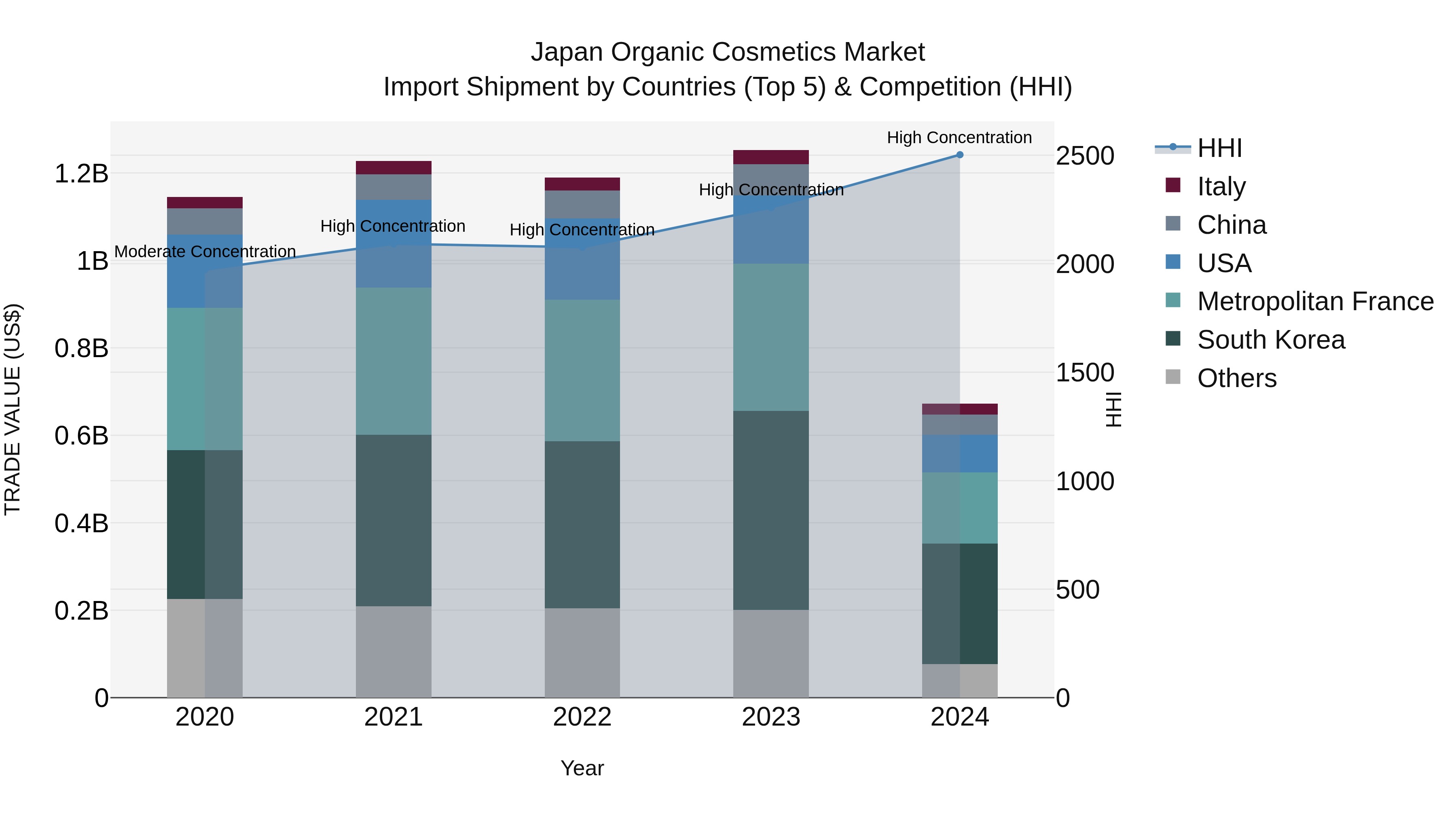
Japan Organic Cosmetics Market Import Shipment by Countries (Top 5) & Competition (HHI)
Despite a negative CAGR and a significant decline in growth rate in 2024, Japan continues to show a strong demand for organic cosmetics imports. The top exporting countries to Japan, including South Korea, Metropolitan France, USA, China, and Italy, highlight the diverse range of products available in the market. The high Herfindahl-Hirschman Index (HHI) indicates a concentrated market, suggesting potential challenges for new entrants. However, with Japan's growing interest in sustainable and natural beauty products, there is an opportunity for organic cosmetics exporters to tap into this market and cater to the evolving consumer preferences.
Japan Organic Cosmetics Market Growth Rate
According to 6Wresearch internal database and industry insights, the Japan Organic Cosmetics Market is anticipated to rise at a compound annual growth rate (CAGR) of 4.9% during the forecast period 2025‑2031.
Five‑Year Growth Trajectory of the Japan Organic Cosmetics Market with Core Drivers
Below is the evaluation of year‑wise growth rate along with key growth drivers:
| Year | Est. Annual Growth (%) | Growth Drivers |
| 2020 | 2 | Rising consumer awareness about natural ingredients and greater demand for safe formulations. |
| 2021 | 2.8 | Expansion of online beauty retail and increased visibility of organic brands via digital media. |
| 2022 | 3.6 | Shift toward clean‑beauty formulations and more stringent ingredient transparency. |
| 2023 | 4.5 | Growth in premium organic skincare segments and broadening into hair care and make‑up. |
| 2024 | 4.8 | Stronger retail channel penetration, eco‑friendly packaging uptake and increased male grooming interest |
Japan Organic Cosmetics Market highlights
| Report Name | Japan Organic Cosmetics Market |
| Forecast period | 2025-2031 |
| CAGR | 4.9% |
| Growing Sector | Skin Care |
Topics Covered in the Japan Organic Cosmetics Market Report
Japan Organic Cosmetics Market report thoroughly covers the market by product type, and distribution channels. The report provides an unbiased and detailed analysis of ongoing market trends, opportunities/high growth areas, and market drivers, which would help stakeholders to devise and align their market strategies according to the current and future market dynamics.
Japan Organic Cosmetics Market Synopsis
The Japan Organic Cosmetics Market is experiencing consistent growth driven by rising demand across skin care, hair care, make‑up, fragrances and toiletries. Consumer preference for ethically produced, naturally‑derived formulations and expanding distribution channels are fueling the market. Advances in ingredient technology and retail infrastructure further support expansion.
Evaluation of Growth Drivers in the Japan Organic Cosmetics Market
Below are some major growth factors and their impacts on the market dynamics:
| Drivers | Primary Segments Affected | Why it matters |
| Rising Consumer Awareness | By Product Type (Skin Care) | Consumers now have more information about synthetic chemicals and are looking for organic solutions. |
| E‑commerce & Digital Influence | By Distribution Channel (Internet) | Online some consumers can access, read reviews, and conveniently purchase organic beauty products. |
| Sustainability & Ethical Consumption | By Product Type (Hair Care, Make‑Up) | The demand for cruelty free, vegan, and environmentally friendly packaging continues to enhance organic brand's appeal. |
| Premiumisation and Male Grooming | By Product Type (Others) | New potential growth segments such as male grooming and premium organic lines are presenting new opportunities. |
The Japan Organic Cosmetics Market anticipated to witness substantial growth, with an estimated CAGR of 4.9% from 2025 to 2031. Factors driving the Japan organic cosmetics market include increased consumer awareness of the impact of synthetic chemicals, increased interest in sustainable, environmentally friendly beauty products, and the recent shift to clean beauty. Social media influencers and beauty bloggers are largely responsible for buzzing demand for organic and natural cosmetics. The growth of e-commerce has provided consumers far wider access to organic cosmetics, facilitating Japan Organic Cosmetics Market Growth.
Evaluation of Restraints in the Japan Organic Cosmetics Market
Below are some major restraints and their influence on the market dynamics:
| Restraints | Primary Segments Affected | What this means |
| Higher Cost of Organic Products | By Product Type | Expensive natural ingredients and lengthy certifications drive up product pricing, making it unattainable for some consumers. |
| Limited Definition & Certification | By Distribution Channel | Consumer uncertainty about "organic" messaging and lengthy certification processes create an unreliable trust in companies and entry of new products. |
| Market Saturation in Urban Areas | By Distribution Channel | Significant competition from established brands in target cities means growth only occurs if the product is significantly differentiated. |
| Distribution & Supply Chain Complexity | By Product Type | Sourcing certified organic, sustainable raw ingredients and ensuring production consistency can be an operational challenge |
Japan Organic Cosmetics Market Challenges
There are various challenges to Japan Organic Cosmetics Market Growth. The higher costs of organic products may deter uptake from consumers with a heightened price sensitivity. The lack of a single standard for the term "organic" creates uncertainty and may prevent new entrants due to the lengthy certification process. Complex supply chains regarding natural ingredients and distribution channels in less serviced areas of the country are also impediments.
Japan Organic Cosmetics Market Trends
The following are notable trends within the Japan Organic Cosmetics Market:
- Blending of Traditional Japanese Ingredients with Modern Skincare Science: Brands are combining botanicals including rice bran, camellia, and green tea with advanced technology to be appealing to consumers focused on both heritage and innovation.
- Category Growth in Customized & Male Focused Organic Grooming Products: Customized formulations and hair and body grooming products specifically for men are emerging as growth categories.
- More Retail Channel Availability Across More than Just Urban Markets: Urban markets are strong, but brands are actively pursuing regional retail channels, salons, and niche channels to build distribution of organic cosmetics.
Investment Opportunities in the Japan Organic Cosmetics Industry
The following are a compilation of competitive opportunities in the Japan Organic Cosmetics Industry:
- Eco Friendly, Refillable & Minimalist Packaging Options: Sustainability credentials can provide premium differentiation and appeal to an eco-conscious user group.
- Tailored Formulations for Men and Niche Segments: There are new growth opportunities in introducing organic grooming products for men, specific age segments, or specialized needs.
- Deeper penetration into Secondary Cities and Salon Channels: Beyond the main metropolitan markets, organizational channels can provide deeper penetration in regional markets and through beauty specialist salons.
Top 5 Leading Players in the Japan Organic Cosmetics Market
There are some top companies dominating the Japan Organic Cosmetics Market Share, including:
1. Shiseido Company, Limited
| Company Name | Shiseido Company, Limited |
| Established Year | 1872 |
| Headquarters | Tokyo, Japan |
| Official Website | Click Here |
This company offers a wide range of skin care, make‑up, hair care and fragrance lines, and is expanding its organic and sustainable range.
2. KOSÉ Corporation
| Company Name | KOSÉ Corporation |
| Established Year | 1946 |
| Headquarters | Tokyo, Japan |
| Official Website | Click Here |
Known for its premium beauty brands and increasing presence in organic cosmetic solutions and skincare innovation.
3. FANCL Corporation
| Company Name | FANCL Corporation |
| Established Year | 1980 |
| Headquarters | Yokohama, Japan |
| Official Website | Click Here |
Focuses on additive‑free and naturally‑derived formulations, making it a strong contender in the organic cosmetics segment.
4. Weleda AG
| Company Name | Weleda AG |
| Established Year | 1921 |
| Headquarters |
Arlesheim, Switzerland (operates in Japan) |
| Official Website | - |
Offers certified organic skincare and personal care products in Japan, appealing to eco‑conscious consumers.
5. L’Occitane International S.A.
| Company Name | L’Occitane International S.A. |
| Established Year | 1976 |
| Headquarters |
Manosque, France (strong Japan presence) |
| Official Website | - |
Combines natural ingredients with luxury, and is expanding its organic and sustainable range specifically in Japan.
Government Regulations Introduced in the Japan Organic Cosmetics Market
According to Japanese Government Data, the regulatory framework revolves around the safety, ingredient transparency, and production standards for cosmetics. The Ministry of Health, Labour and Welfare is responsible for cosmetic products as part of the Pharmaceutical and Medical Devices law which includes prohibited substances and performance standards.
The Japan Natural & Organic Cosmetics Association has its own guidelines and certification systems in place to provide credibility to claims of organic and natural cosmetic products. These regulatory surrogates not only provide trust for consumers but is also a growing and supportive environment for the organic cosmetics industry moving forward.
Future Insights of the Japan Organic Cosmetics Market
The future of the Japan Organic Cosmetics Market is promising, with continued demographic shifts, health consciousness and an increasingly urban population contributing an ongoing demand. As the younger generations continue to embrace sustainability and conscientious consumption, more brands will increasingly move towards organic and clean label products. Technological advancements in ingredient innovation and manufacturing processes will provide grower and brands added performance benefits of organic, along with a growing e commerce market and a direct-to-consumer options for consumers will help to stimulate growth and provide more options, including specialty niche products targeting male consumers.
Market Segmentation Analysis
The report offers a comprehensive study of the following market segments and their leading categories:
By Product Type- Skin care to Dominate the Market
According to Sachin, Senior Research Analyst, 6Wresearch, In the Japan Organic Cosmetics Market, the skin care segment dominates due to the increasing consumer demand for products focused on health and wellness. Japanese consumers are becoming more conscious of the ingredients in their beauty products, leading to a preference for organic, chemical-free skincare items.
By Distribution Channels- Internet to Dominate the Market
In terms of distribution channels, the Internet is the fastest-growing segment, especially among younger, tech-savvy consumers who prefer the convenience of shopping from home. Online platforms provide access to a wide variety of organic products, including niche or hard-to-find brands, making it the dominant channel for growth.
Key Attractiveness of the Report
- 10 Years of Market Numbers
- Historical Data Starting from 2021 to 2024
- Base Year: 2024
- Forecast Data until 2031
- Key Performance Indicators Impacting the Market
- Major Upcoming Developments and Projects
Key Highlights of the Report:
- Japan Organic Cosmetics Market Outlook
- Market Size of Japan Organic Cosmetics Market, 2024
- Forecast of Japan Organic Cosmetics Market, 2031
- Historical Data and Forecast of Japan Organic Cosmetics Revenues & Volume for the Period 2021- 2031
- Japan Organic Cosmetics Market Trend Evolution
- Japan Organic Cosmetics Market Drivers and Challenges
- Japan Organic Cosmetics Price Trends
- Japan Organic Cosmetics Porter's Five Forces
- Japan Organic Cosmetics Industry Life Cycle
- Historical Data and Forecast of Japan Organic Cosmetics Market Revenues & Volume By Product Type for the Period 2021- 2031
- Historical Data and Forecast of Japan Organic Cosmetics Market Revenues & Volume By Skin Care for the Period 2021- 2031
- Historical Data and Forecast of Japan Organic Cosmetics Market Revenues & Volume By Hair Care for the Period 2021- 2031
- Historical Data and Forecast of Japan Organic Cosmetics Market Revenues & Volume By Make Up for the Period 2021- 2031
- Historical Data and Forecast of Japan Organic Cosmetics Market Revenues & Volume By Fragrances for the Period 2021- 2031
- Historical Data and Forecast of Japan Organic Cosmetics Market Revenues & Volume By Toiletries for the Period 2021- 2031
- Historical Data and Forecast of Japan Organic Cosmetics Market Revenues & Volume By Others for the Period 2021- 2031
- Historical Data and Forecast of Japan Organic Cosmetics Market Revenues & Volume By Distribution Channel for the Period 2021- 2031
- Historical Data and Forecast of Japan Organic Cosmetics Market Revenues & Volume By Departmental Stores for the Period 2021- 2031
- Historical Data and Forecast of Japan Organic Cosmetics Market Revenues & Volume By Franchise Outlet for the Period 2021- 2031
- Historical Data and Forecast of Japan Organic Cosmetics Market Revenues & Volume By Beauty Specialist Salon for the Period 2021- 2031
- Historical Data and Forecast of Japan Organic Cosmetics Market Revenues & Volume By Direct Sales for the Period 2021- 2031
- Historical Data and Forecast of Japan Organic Cosmetics Market Revenues & Volume By Chemist/Pharmacies for the Period 2021- 2031
- Historical Data and Forecast of Japan Organic Cosmetics Market Revenues & Volume By Internet for the Period 2021- 2031
- Historical Data and Forecast of Japan Organic Cosmetics Market Revenues & Volume By Others for the Period 2021- 2031
- Japan Organic Cosmetics Import Export Trade Statistics
- Market Opportunity Assessment By Product Type
- Market Opportunity Assessment By Distribution Channel
- Japan Organic Cosmetics Top Companies Market Share
- Japan Organic Cosmetics Competitive Benchmarking By Technical and Operational Parameters
- Japan Organic Cosmetics Company Profiles
- Japan Organic Cosmetics Key Strategic Recommendations
Market Covered
The report offers a comprehensive study of the subsequent market segments:
By Product Type
- Skin Care
- Hair Care
- Make Up
- Fragrances
- Toiletries
- Others
By Distribution Channel
- Departmental Stores
- Franchise Outlet
- Beauty Specialist Salon
- Direct Sales
- Chemist/Pharmacies
- Internet
- Others
Japan Organic Cosmetics Market (2025-2031): FAQ's
Key drivers include increasing consumer awareness of harmful synthetic chemicals rising influence of social media, and expanding online retail channels.
What key challenges does the Japan Organic Cosmetics Market face?
Japan Organic Cosmetics Market expected to witness growth, registering a CAGR of 4.9% between 2025-2031.
The skincare segment holds the largest share within the organic cosmetics category in Japan.
6Wresearch actively monitors the Japan Organic Cosmetics Market and publishes its comprehensive annual report, highlighting emerging trends, growth drivers, revenue analysis, and forecast outlook. Our insights help businesses to make data-backed strategic decisions with ongoing market dynamics. Our analysts track relevent industries related to the Japan Organic Cosmetics Market, allowing our clients with actionable intelligence and reliable forecasts tailored to emerging regional needs.
Yes, we provide customisation as per your requirements. To learn more, feel free to contact us on sales@6wresearch.com
| 1 Executive Summary |
| 2 Introduction |
| 2.1 Key Highlights of the Report |
| 2.2 Report Description |
| 2.3 Market Scope & Segmentation |
| 2.4 Research Methodology |
| 2.5 Assumptions |
| 3 Japan Organic Cosmetics Market Overview |
| 3.1 Japan Country Macro Economic Indicators |
| 3.2 Japan Organic Cosmetics Market Revenues & Volume, 2021 & 2031F |
| 3.3 Japan Organic Cosmetics Market - Industry Life Cycle |
| 3.4 Japan Organic Cosmetics Market - Porter's Five Forces |
| 3.5 Japan Organic Cosmetics Market Revenues & Volume Share, By Product Type, 2021 & 2031F |
| 3.6 Japan Organic Cosmetics Market Revenues & Volume Share, By Distribution Channel, 2021 & 2031F |
| 4 Japan Organic Cosmetics Market Dynamics |
| 4.1 Impact Analysis |
| 4.2 Market Drivers |
| 4.2.1 Increasing consumer awareness about the benefits of organic products |
| 4.2.2 Growing concerns about the use of chemicals in cosmetics |
| 4.2.3 Rising disposable income leading to higher spending on premium products |
| 4.3 Market Restraints |
| 4.3.1 Higher pricing compared to conventional cosmetics |
| 4.3.2 Limited availability of organic cosmetics in certain regions |
| 4.3.3 Lack of strict regulations around labeling and certification of organic products |
| 5 Japan Organic Cosmetics Market Trends |
| 6 Japan Organic Cosmetics Market, By Types |
| 6.1 Japan Organic Cosmetics Market, By Product Type |
| 6.1.1 Overview and Analysis |
| 6.1.2 Japan Organic Cosmetics Market Revenues & Volume, By Product Type, 2021- 2031F |
| 6.1.3 Japan Organic Cosmetics Market Revenues & Volume, By Skin Care, 2021- 2031F |
| 6.1.4 Japan Organic Cosmetics Market Revenues & Volume, By Hair Care, 2021- 2031F |
| 6.1.5 Japan Organic Cosmetics Market Revenues & Volume, By Make Up, 2021- 2031F |
| 6.1.6 Japan Organic Cosmetics Market Revenues & Volume, By Fragrances, 2021- 2031F |
| 6.1.7 Japan Organic Cosmetics Market Revenues & Volume, By Toiletries, 2021- 2031F |
| 6.1.8 Japan Organic Cosmetics Market Revenues & Volume, By Others, 2021- 2031F |
| 6.2 Japan Organic Cosmetics Market, By Distribution Channel |
| 6.2.1 Overview and Analysis |
| 6.2.2 Japan Organic Cosmetics Market Revenues & Volume, By Departmental Stores, 2021- 2031F |
| 6.2.3 Japan Organic Cosmetics Market Revenues & Volume, By Franchise Outlet, 2021- 2031F |
| 6.2.4 Japan Organic Cosmetics Market Revenues & Volume, By Beauty Specialist Salon, 2021- 2031F |
| 6.2.5 Japan Organic Cosmetics Market Revenues & Volume, By Direct Sales, 2021- 2031F |
| 6.2.6 Japan Organic Cosmetics Market Revenues & Volume, By Chemist/Pharmacies, 2021- 2031F |
| 6.2.7 Japan Organic Cosmetics Market Revenues & Volume, By Internet, 2021- 2031F |
| 7 Japan Organic Cosmetics Market Import-Export Trade Statistics |
| 7.1 Japan Organic Cosmetics Market Export to Major Countries |
| 7.2 Japan Organic Cosmetics Market Imports from Major Countries |
| 8 Japan Organic Cosmetics Market Key Performance Indicators |
| 8.1 Number of new organic cosmetics product launches in the market |
| 8.2 Growth in the number of organic cosmetics retail outlets |
| 8.3 Increase in online searches and social media mentions related to organic cosmetics in Japan |
| 8.4 Percentage of consumers opting for organic cosmetics over conventional ones |
| 8.5 Adoption rate of sustainable packaging practices by organic cosmetics brands in Japan |
| 9 Japan Organic Cosmetics Market - Opportunity Assessment |
| 9.1 Japan Organic Cosmetics Market Opportunity Assessment, By Product Type, 2021 & 2031F |
| 9.2 Japan Organic Cosmetics Market Opportunity Assessment, By Distribution Channel, 2021 & 2031F |
| 10 Japan Organic Cosmetics Market - Competitive Landscape |
| 10.1 Japan Organic Cosmetics Market Revenue Share, By Companies, 2024 |
| 10.2 Japan Organic Cosmetics Market Competitive Benchmarking, By Operating and Technical Parameters |
| 11 Company Profiles |
| 12 Recommendations |
| 13 Disclaimer |
Export potential assessment - trade Analytics for 2030
Export potential enables firms to identify high-growth global markets with greater confidence by combining advanced trade intelligence with a structured quantitative methodology. The framework analyzes emerging demand trends and country-level import patterns while integrating macroeconomic and trade datasets such as GDP and population forecasts, bilateral import–export flows, tariff structures, elasticity differentials between developed and developing economies, geographic distance, and import demand projections. Using weighted trade values from 2020–2024 as the base period to project country-to-country export potential for 2030, these inputs are operationalized through calculated drivers such as gravity model parameters, tariff impact factors, and projected GDP per-capita growth. Through an analysis of hidden potentials, demand hotspots, and market conditions that are most favorable to success, this method enables firms to focus on target countries, maximize returns, and global expansion with data, backed by accuracy.
By factoring in the projected importer demand gap that is currently unmet and could be potential opportunity, it identifies the potential for the Exporter (Country) among 190 countries, against the general trade analysis, which identifies the biggest importer or exporter.
To discover high-growth global markets and optimize your business strategy:
Click Here
Pricing
- Single User License$ 1,995
- Department License$ 2,400
- Site License$ 3,120
- Global License$ 3,795

Search
Thought Leadership and Analyst Meet





Our Clients








Related Reports
- India Switchgear Market Outlook (2026 - 2032) | Size, Share, Trends, Growth, Revenue, Forecast, Analysis, Value, Outlook
- Pakistan Contraceptive Implants Market (2025-2031) | Demand, Growth, Size, Share, Industry, Pricing Analysis, Competitive, Strategic Insights, Strategy, Consumer Insights, Analysis, Investment Trends, Opportunities, Revenue, Segments, Value, Segmentation, Supply, Forecast, Restraints, Outlook, Competition, Drivers, Trends, Companies, Challenges
- Sri Lanka Packaging Market (2026-2032) | Outlook, Competition, Drivers, Trends, Demand, Pricing Analysis, Competitive, Strategic Insights, Companies, Challenges, Strategy, Consumer Insights, Analysis, Investment Trends, Opportunities, Growth, Size, Share, Industry, Revenue, Segments, Value, Segmentation, Supply, Forecast, Restraints
- India Kids Watches Market (2026-2032) | Strategy, Consumer Insights, Analysis, Investment Trends, Opportunities, Growth, Size, Share, Industry, Revenue, Segments, Value, Segmentation, Supply, Forecast, Restraints, Outlook, Competition, Drivers, Trends, Demand, Pricing Analysis, Competitive, Strategic Insights, Companies, Challenges
- Saudi Arabia Core Assurance Service Market (2025-2031) | Strategy, Consumer Insights, Analysis, Investment Trends, Opportunities, Growth, Size, Share, Industry, Revenue, Segments, Value, Segmentation, Supply, Forecast, Restraints, Outlook, Competition, Drivers, Trends, Demand, Pricing Analysis, Competitive, Strategic Insights, Companies, Challenges
- Romania Uninterruptible Power Supply (UPS) Market (2026-2032) | Industry, Analysis, Revenue, Size, Forecast, Outlook, Value, Trends, Share, Growth & Companies
- Saudi Arabia Car Window Tinting Film, Paint Protection Film (PPF), and Ceramic Coating Market (2025-2031) | Strategy, Consumer Insights, Analysis, Investment Trends, Opportunities, Growth, Size, Share, Industry, Revenue, Segments, Value, Segmentation, Supply, Forecast, Restraints, Outlook, Competition, Drivers, Trends, Demand, Pricing Analysis, Competitive, Strategic Insights, Companies, Challenges
- South Africa Stationery Market (2025-2031) | Share, Size, Industry, Value, Growth, Revenue, Analysis, Trends, Segmentation & Outlook
- Afghanistan Rocking Chairs And Adirondack Chairs Market (2026-2032) | Size & Revenue, Competitive Landscape, Share, Segmentation, Industry, Value, Outlook, Analysis, Trends, Growth, Forecast, Companies
- Afghanistan Apparel Market (2026-2032) | Growth, Outlook, Industry, Segmentation, Forecast, Size, Companies, Trends, Value, Share, Analysis & Revenue
Industry Events and Analyst Meet

India EV Show 2026

EV tech India Expo 2026

Auto Tech Asia 2026

Battery Tech India 2026

Smart Production Solutions Guangzhou 2026
Whitepaper
- Middle East & Africa Commercial Security Market Click here to view more.
- Middle East & Africa Fire Safety Systems & Equipment Market Click here to view more.
- GCC Drone Market Click here to view more.
- Middle East Lighting Fixture Market Click here to view more.
- GCC Physical & Perimeter Security Market Click here to view more.
6WResearch In News
- Doha a strategic location for EV manufacturing hub: IPA Qatar
- Demand for luxury TVs surging in the GCC, says Samsung
- Empowering Growth: The Thriving Journey of Bangladesh’s Cable Industry
- Demand for luxury TVs surging in the GCC, says Samsung
- Video call with a traditional healer? Once unthinkable, it’s now common in South Africa
- Intelligent Buildings To Smooth GCC’s Path To Net Zero


