Japan Transformer Market (2025-2031) | Growth, Revenue, Value, Industry, Analysis, Companies, Trends, Outlook, Share, Forecast & Size
Market Forecast By Core (Closed, Shell, Berry), By Product (Power transformer, Distribution transformer, Instrument transformer, Others), By Winding (Two-winding, Auto-transformer), By Application (Residential & Commercial, Utility, Industrial), By Cooling (Dry type, Oil Immersed), By Phase (Single phase, 3 - phase), By Rating (10 MVA, 11 MVA to 60 MVA, 61 MVA to 600 MVA, > 600 MVA) And Competitive Landscape
| Product Code: ETC014262 | Publication Date: Oct 2020 | Updated Date: Oct 2025 | Product Type: Report | |
| Publisher: 6Wresearch | Author: Ravi Bhandari | No. of Pages: 70 | No. of Figures: 35 | No. of Tables: 5 |
Japan Transformer Market Growth Rate
According to 6Wresearch internal database and Industry insights, the Japan Transformer Market is projected to grow at a compound annual growth rate (CAGR) of 5.80% during the forecast period (2025-2031).
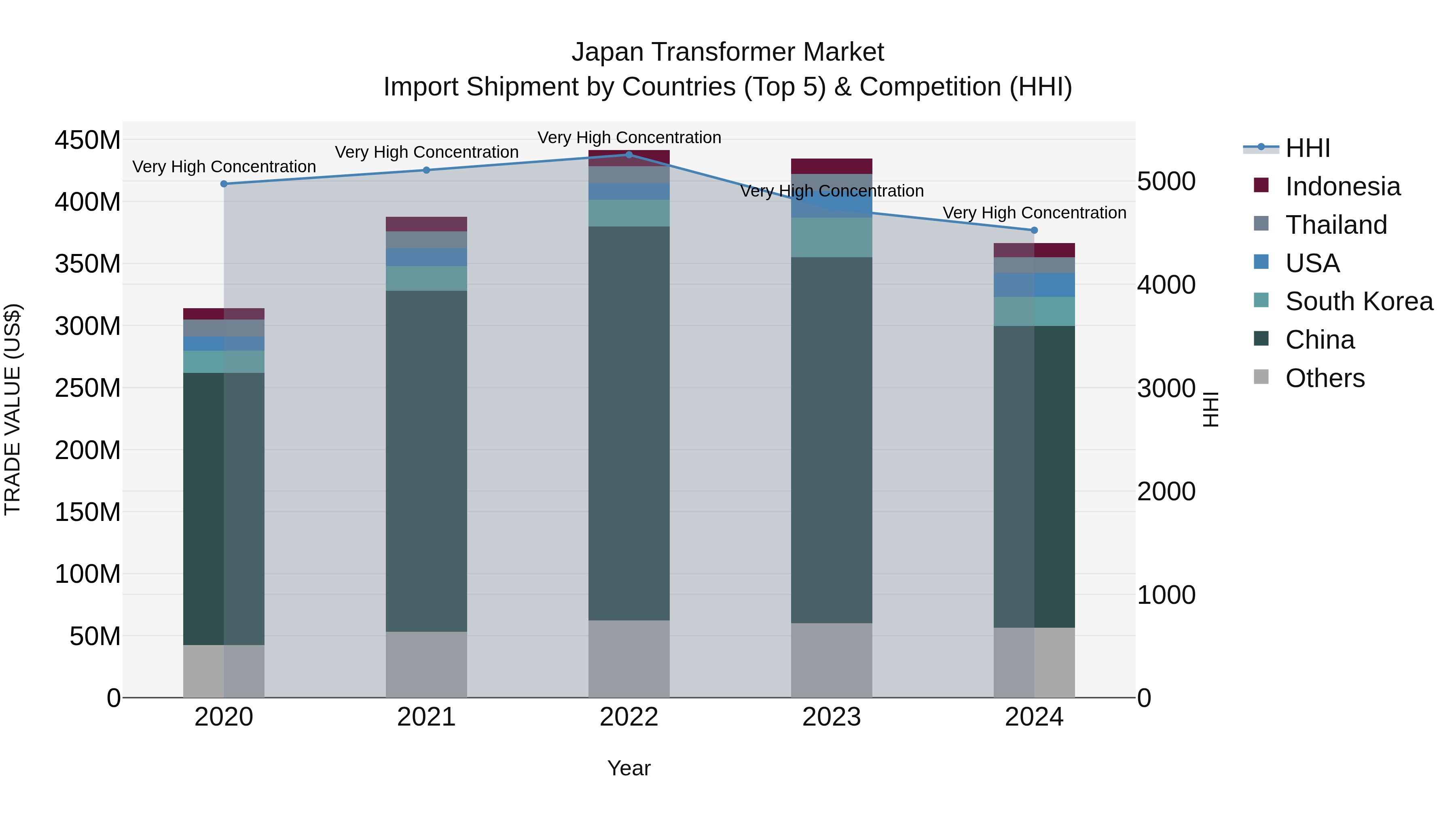
Japan Transformer Market Import Shipment by Countries (Top 5) & Competition (HHI)
In 2024, Japan's transformer import market continues to be dominated by major players such as China, South Korea, USA, Thailand, and Vietnam. Despite a high Herfindahl-Hirschman Index (HHI) indicating market concentration, the industry has shown steady growth with a compound annual growth rate (CAGR) of 3.94% from 2020 to 2024. However, there was a notable decline in growth rate from 2023 to 2024 at -15.7%. This data suggests a challenging year for transformer import shipments in Japan, potentially influenced by various economic factors impacting trade dynamics.
Japan Transformer Market Highlights
| Report Name | Japan Transformer Market |
| Forecast period | 2025-2031 |
| CAGR | 5.80% |
| Growing Sector | Utility & Renewable |
Topics Covered in the Japan Transformer Market Report
The Japan Transformer Market report thoroughly covers the Market by core, product, winding, application, cooling, phase, rating, and regions. The Market report provides an unbiased and detailed analysis of ongoing Market trends, opportunities/high growth areas, and Market drivers, which would help stakeholders devise and align their strategies according to the current and future Market dynamics, with emphasis on Market Growth, Industry Size, Share, and Revenue.
Japan Transformer Market Synopsis
The Japan Transformer Market has been experiencing a massive growth over the years, driven by various growth drivers, including increasing investments in renewable energy integration and urban infrastructure renewal. Japan’s energy landscape has shifted massively, with the government is focusing on renewable energy projects such as offshore wind, solar, and geothermal, leading to an increased adoption of transformers. Additionally, the country’s aging grid infrastructure is upgrading to improve resilience against natural disasters like earthquakes and tsunamis, this acts as a major growth catalyst for the market expansion.
Evaluation of Growth Drivers in the Japan Transformer Market
Below mentioned are some prominent drivers and their influence to the market dynamics:
| Driver | Primary Segments Affected | Why it matters (evidence) |
| Renewable Integration | Power & Distribution; Utility | Offshore wind projects in Hokkaido and solar in Kyushu demand step-up transformers for grid interconnection. |
| Urban Infrastructure Renewal | Distribution & Dry-Type; Residential & Commercial | Replacement of existing transformers in Tokyo, Osaka, and Yokohama to make sure safety and efficiency. |
| Industrial Growth in High-Tech Sectors | Power Transformers; Industrial | Stable power demand is increasing due to a rapid expansion of robotics, automotive, and electronics industries. |
| Energy Efficiency Mandates | Smart & Oil-Immersed; Utility | Government regulations push adoption of low-loss, eco-friendly transformers. |
| Disaster Resilience Programs | Oil-Immersed & Compact; Utility & Residential | Earthquake- and flood-resistant transformers being deployed to improve grid resilience. |
Japan Transformer Market is projected to grow steadily, recording a CAGR of 5.80% during the forecast period 2025-2031. The major growth drivers include renewable energy expansion and energy efficiency mandates, which are bolstering the market share. Additionally, urban modernization projects are collectively boosting transformer installation. Also, there is a massive opportunity for the adoption of advanced transformers, with the rising electricity demand from smart cities, data centers, and railway networks in the country. Japan’s expertise in precision engineering and digital innovation is accelerating the adoption of smart, eco-friendly, and compact transformers.
Evaluation of Restraints in the Japan Transformer Market
Below mentioned are some major restraints and their influence to the market dynamics:
| Restraint | Primary Segments Affected | What this means (evidence) |
| High Cost of Smart Transformers | Utility & Industrial | Adoption rate is limited, as advanced IoT-enabled transformers are expensive. |
| Land Scarcity in Urban Areas | Distribution Transformers; Residential & Commercial | New substation installation is hampered due to limited space in dense cities. |
| Import Reliance for Certain Materials | Power & Specialty Transformers | Dependence on imported CRGO steel increases production costs. |
| Aging Workforce | Smart Grid Deployments | Skilled labor shortage impacts the installation and maintenance of smart transformers. |
| Stringent Approval Processes | Utility Projects | Lengthy approval cycles for grid upgrades delay deployment. |
Japan Transformer Market Challenges
Despite the growth outlook, the market consists of several major obstacles that need to be encountered. These challenges are balancing renewable energy integration with grid stability and high costs of eco-friendly and digital transformers. limited land availability for urban substations is another major challenge for the transformer’s adoption. Furthermore, Japan’s susceptibility to natural disasters mandates disaster-proof transformer designs, which raises manufacturing costs.
Japan Transformer Market Trends
Several prominent trends reshaping the Japan Transformer Market Growth include:
- Offshore Wind-Specific Transformers: Growing demand from Hokkaido and coastal projects
- Smart & Digital Transformers: Widespread adoption of IoT-enabled monitoring in urban grids
- Eco-Friendly Transformers: Increasing use of natural ester oil and recyclable materials
- Compact Transformers: High demand in subways, rail networks, and urban real estate
Investment Opportunities in the Japan Transformer Industry
Some major investment opportunities in the market are:
- Local Partnerships: Collaborations for assembling and testing transformers to reduce costs
- Renewable Energy Transformers: Offshore wind, solar, and geothermal transformers present high potential
- Retrofit Opportunities: Modernizing old transformer fleets with energy-efficient and monitoring-ready units
- Resilient Designs: Earthquake-resistant and flood-proof transformers tailored for Japan’s geography
Top 5 Leading Players in the Japan Transformer Market
Leading players contributing to Japan Transformer Market Share are: -
1. Toshiba Energy Systems & Solutions
| Company Name | Toshiba Energy Systems & Solutions |
| Establishment Year | 1875 |
| Headquarter | Tokyo, Japan |
| Official Website | Click here |
Supplies advanced power transformers with smart monitoring features and disaster-resistant designs.
2. Hitachi Energy (formerly Hitachi ABB Power Grids)
| Company Name | Hitachi Energy (formerly Hitachi ABB Power Grids) |
| Establishment Year | 1910 |
| Headquarter | Tokyo, Japan |
| Official Website | Click here |
Provides digital substations and eco-friendly transformers tailored for renewable integration and urban projects.
3. Mitsubishi Electric Corporation
| Company Name | Mitsubishi Electric Corporation |
| Establishment Year | 1921 |
| Headquarter | Tokyo, Japan |
| Official Website | Click here |
Manufactures high-capacity transformers for power utilities and industrial parks, with emphasis on efficiency.
4. Siemens Energy AG
| Company Name | Siemens Energy AG |
| Establishment Year | 2020 |
| Headquarter | Munich, Germany |
| Official Website | Click here |
Supplies smart and high-voltage transformers for grid modernization and industrial applications in Japan.
5. GE Grid Solutions
| Company Name | GE Grid Solutions |
| Establishment Year | 1892 |
| Headquarter | Paris, France & Atlanta, USA |
| Official Website | Click here |
Provides grid-scale transformers integrated with predictive monitoring platforms for Japanese utilities.
Government Regulations Introduced in the Japan Transformer Market
According to Japanese government data, several policies & programmes are there to increase transformer demand. Such as, the Strategic Energy Plan, which targets higher renewable penetration, which increases the demand for renewable interconnection transformers. Additionally, under the Smart Community Initiatives in Tokyo and other cities, digital substations adoption with IoT-enabled monitoring has been increasing. Moreover, the government’s disaster resilience programs fund transformer upgrades designed to withstand earthquakes, floods, and tsunamis.
Future Insights of the Japan Transformer Market
Japan Transformer Market Share is estimated to secure double digit growth in the coming years. This is owing to renewable projects, especially offshore wind and solar and disaster resilience programs that will drive replacement of aging transformers with compact, safe, and eco-friendly units. Additionally, the transformer installations will surge, with the growing demand from high-tech industries, including robotics and automotive. The market will also benefit from the country’s focus on smart cities, leading to high adoption of IoT-enabled and monitoring-ready transformers.
Market Segmentation Analysis
The report offers a comprehensive study of the following market segments and their leading categories.
Shell Core to Dominate the Market - By Core
According to Shivank Sharma, Senior Research Analyst, 6Wresearch, Shell core transformers are expected to dominate Japan’s Market due to their ability to handle large loads and their mechanical strength. They are especially important for urban substations in Tokyo and Osaka, where high-voltage stability is critical.
Power transformers to Dominate the Market - By Product
Power transformers will dominate the Market as Japan continues to expand renewable integration and support industrial growth. The rise of offshore wind projects, as well as large industrial complexes in regions like Aichi and Kanagawa, require high-capacity power transformers.
Two-winding transformers to Dominate the Market - By Winding
Two-winding transformers will dominate in Japan as they offer reliability and safety in urban environments. These transformers are favored in renewable projects and residential grids, where redundancy and stable performance are prioritized.
The Utility sector to Dominate the Market - By Application
The Utility sector dominates the Japan Transformer Market, as national utilities focus on upgrading grid infrastructure and integrating renewable energy. Industrial applications, especially robotics, electronics, and automotive manufacturing, also demand a large share of transformers.
Key attractiveness of the report
- 10 Years Market Numbers.
- Historical Data Starting from 2021 to 2024.
- Base Year: 2024.
- Forecast Data until 2031.
- Key Performance Indicators Impacting the Market.
- Major Upcoming Developments and Projects.
Key Highlights of the Report:
- Japan Transformer Market Outlook
- Market Size of Japan Transformer Market, 2024
- Forecast of Japan Transformer Market, 2031
- Historical Data and Forecast of Japan Transformer Revenues & Volume for the Period 2021 - 2031
- Japan Transformer Market Trend Evolution
- Japan Transformer Market Drivers and Challenges
- Japan Transformer Price Trends
- Japan Transformer Porter’s Five Forces
- Japan Transformer Industry Life Cycle
- Historical Data and Forecast of Japan Transformer Market Revenues & Volume By Core for the Period 2021 - 2031
- Historical Data and Forecast of Japan Transformer Market Revenues & Volume By Closed for the Period 2021 - 2031
- Historical Data and Forecast of Japan Transformer Market Revenues & Volume By Shell for the Period 2021 - 2031
- Historical Data and Forecast of Japan Transformer Market Revenues & Volume By Berry for the Period 2021 - 2031
- Historical Data and Forecast of Japan Transformer Market Revenues & Volume By Product for the Period 2021 - 2031
- Historical Data and Forecast of Japan Transformer Market Revenues & Volume By Power transformer for the Period 2021 - 2031
- Historical Data and Forecast of Japan Transformer Market Revenues & Volume By Distribution transformer for the Period 2021 - 2031
- Historical Data and Forecast of Japan Transformer Market Revenues & Volume By Instrument transformer for the Period 2021 - 2031
- Historical Data and Forecast of Japan Transformer Market Revenues & Volume By Others for the Period 2021 - 2031
- Historical Data and Forecast of Japan Transformer Market Revenues & Volume By Winding for the Period 2021 - 2031
- Historical Data and Forecast of Japan Transformer Market Revenues & Volume By Two-winding for the Period 2021 - 2031
- Historical Data and Forecast of Japan Transformer Market Revenues & Volume By Auto-transformer for the Period 2021 - 2031
- Historical Data and Forecast of Japan Transformer Market Revenues & Volume By Application for the Period 2021 - 2031
- Historical Data and Forecast of Japan Transformer Market Revenues & Volume By Residential & Commercial for the Period 2021 - 2031
- Historical Data and Forecast of Japan Transformer Market Revenues & Volume By Utility for the Period 2021 - 2031
- Historical Data and Forecast of Japan Transformer Market Revenues & Volume By Industrial for the Period 2021 - 2031
- Historical Data and Forecast of Japan Transformer Market Revenues & Volume By Cooling for the Period 2021 - 2031
- Historical Data and Forecast of Japan Transformer Market Revenues & Volume By Dry type for the Period 2021 - 2031
- Historical Data and Forecast of Japan Transformer Market Revenues & Volume By Oil Immersed for the Period 2021 - 2031
- Historical Data and Forecast of Japan Transformer Market Revenues & Volume By Insulation for the Period 2021 - 2031
- Historical Data and Forecast of Japan Transformer Market Revenues & Volume By Gas for the Period 2021 - 2031
- Historical Data and Forecast of Japan Transformer Market Revenues & Volume By Oil for the Period 2021 - 2031
- Historical Data and Forecast of Japan Transformer Market Revenues & Volume By Solid for the Period 2021 - 2031
- Historical Data and Forecast of Japan Transformer Market Revenues & Volume By Air for the Period 2021 - 2031
- Historical Data and Forecast of Japan Transformer Market Revenues & Volume By Others for the Period 2021 - 2031
- Historical Data and Forecast of Japan Transformer Market Revenues & Volume By Phase for the Period 2021 - 2031
- Historical Data and Forecast of Japan Transformer Market Revenues & Volume By Single phase for the Period 2021 - 2031
- Historical Data and Forecast of Japan Transformer Market Revenues & Volume By 3 - phase for the Period 2021 - 2031
- Historical Data and Forecast of Japan Transformer Market Revenues & Volume By Rating for the Period 2021 - 2031
- Historical Data and Forecast of Japan Transformer Market Revenues & Volume By ? 10 MVA for the Period 2021 - 2031
- Historical Data and Forecast of Japan Transformer Market Revenues & Volume By 11 MVA to 60 MVA for the Period 2021 - 2031
- Historical Data and Forecast of Japan Transformer Market Revenues & Volume By 61 MVA to 600 MVA for the Period 2021 - 2031
- Historical Data and Forecast of Japan Transformer Market Revenues & Volume By > 600 MVA for the Period 2021 - 2031
- Japan Transformer Import Export Trade Statistics
- Market Opportunity Assessment By Core
- Market Opportunity Assessment By Product
- Market Opportunity Assessment By Winding
- Market Opportunity Assessment By Application
- Market Opportunity Assessment By Cooling
- Market Opportunity Assessment By Insulation
- Market Opportunity Assessment By Phase
- Market Opportunity Assessment By Rating
- Japan Transformer Top Companies Market Share
- Japan Transformer Competitive Benchmarking By Technical and Operational Parameters
- Japan Transformer Company Profiles
- Japan Transformer Key Strategic Recommendation
Market Covered
The report offers a comprehensive study of the subsequent Market segments:
By Core
- Closed
- Shell
- Berry
By Product
- Power Transformer
- Distribution Transformer
- Instrument Transformer
- Others
By Winding
- Two-Winding
- Auto-Transformer
By Application
- Residential & Commercial
- Utility
- Industrial
By Cooling
- Dry Type
- Oil Immersed
By Phase
- Single Phase
- 3-Phase
By Rating
- 10 MVA
- 11 MVA to 60 MVA
- 61 MVA to 600 MVA
- 600 MVA
Japan Transformer Market (2025-2031): FAQs
Japan Transformer Market is projected to grow at a CAGR of approximately 5.80% during the forecast period.
Policies include the Strategic Energy Plan, Energy Conservation Act, and Smart Community Initiatives.
Dry-type transformers are expected to dominate due to their safety and suitability for earthquake-prone and urban environments.
Opportunities exist in resilient transformer designs, renewable interconnection transformers, and modernization of aging urban fleets.
The Utility sector and industrial hubs (robotics, automotive, electronics) are the major contributors to transformer demand.
6Wresearch actively monitors the Japan Transformer Market and publishes its comprehensive annual report, highlighting emerging trends, growth drivers, revenue analysis, and forecast outlook. Our insights help businesses to make data-backed strategic decisions with ongoing market dynamics. Our analysts track relevent industries related to the Japan Transformer Market, allowing our clients with actionable intelligence and reliable forecasts tailored to emerging regional needs.
Yes, we provide customisation as per your requirements. To learn more, feel free to contact us on sales@6wresearch.com
| 1 Executive Summary |
| 2 Introduction |
| 2.1 Key Highlights of the Report |
| 2.2 Report Description |
| 2.3 Market Scope & Segmentation |
| 2.4 Research Methodology |
| 2.5 Assumptions |
| 3 Japan Transformer Market Overview |
| 3.1 Japan Country Macro Economic Indicators |
| 3.2 Japan Transformer Market Revenues & Volume, 2021 & 2031F |
| 3.3 Japan Transformer Market - Industry Life Cycle |
| 3.4 Japan Transformer Market - Porter's Five Forces |
| 3.5 Japan Transformer Market Revenues & Volume Share, By Core, 2021 & 2031F |
| 3.6 Japan Transformer Market Revenues & Volume Share, By Product, 2021 & 2031F |
| 3.7 Japan Transformer Market Revenues & Volume Share, By Winding, 2021 & 2031F |
| 3.8 Japan Transformer Market Revenues & Volume Share, By Application, 2021 & 2031F |
| 3.9 Japan Transformer Market Revenues & Volume Share, By Cooling, 2021 & 2031F |
| 3.10 Japan Transformer Market Revenues & Volume Share, By Insulation, 2021 & 2031F |
| 3.11 Japan Transformer Market Revenues & Volume Share, By Phase, 2021 & 2031F |
| 4 Japan Transformer Market Dynamics |
| 4.1 Impact Analysis |
| 4.2 Market Drivers |
| 4.2.1 Increasing demand for electricity in Japan |
| 4.2.2 Growing emphasis on renewable energy sources |
| 4.2.3 Technological advancements in transformer design and efficiency |
| 4.3 Market Restraints |
| 4.3.1 Regulatory challenges in the energy sector |
| 4.3.2 Economic downturn impacting infrastructure spending |
| 5 Japan Transformer Market Trends |
| 6 Japan Transformer Market, By Types |
| 6.1 Japan Transformer Market, By Core |
| 6.1.1 Overview and Analysis |
| 6.1.2 Japan Transformer Market Revenues & Volume, By Core, 2021 - 2031F |
| 6.1.3 Japan Transformer Market Revenues & Volume, By Closed, 2021 - 2031F |
| 6.1.4 Japan Transformer Market Revenues & Volume, By Shell, 2021 - 2031F |
| 6.1.5 Japan Transformer Market Revenues & Volume, By Berry, 2021 - 2031F |
| 6.2 Japan Transformer Market, By Product |
| 6.2.1 Overview and Analysis |
| 6.2.2 Japan Transformer Market Revenues & Volume, By Power transformer, 2021 - 2031F |
| 6.2.3 Japan Transformer Market Revenues & Volume, By Distribution transformer, 2021 - 2031F |
| 6.2.4 Japan Transformer Market Revenues & Volume, By Instrument transformer, 2021 - 2031F |
| 6.2.5 Japan Transformer Market Revenues & Volume, By Others, 2021 - 2031F |
| 6.3 Japan Transformer Market, By Winding |
| 6.3.1 Overview and Analysis |
| 6.3.2 Japan Transformer Market Revenues & Volume, By Two-winding, 2021 - 2031F |
| 6.3.3 Japan Transformer Market Revenues & Volume, By Auto-transformer, 2021 - 2031F |
| 6.4 Japan Transformer Market, By Application |
| 6.4.1 Overview and Analysis |
| 6.4.2 Japan Transformer Market Revenues & Volume, By Residential & Commercial, 2021 - 2031F |
| 6.4.3 Japan Transformer Market Revenues & Volume, By Utility, 2021 - 2031F |
| 6.4.4 Japan Transformer Market Revenues & Volume, By Industrial, 2021 - 2031F |
| 6.5 Japan Transformer Market, By Cooling |
| 6.5.1 Overview and Analysis |
| 6.5.2 Japan Transformer Market Revenues & Volume, By Dry type, 2021 - 2031F |
| 6.5.3 Japan Transformer Market Revenues & Volume, By Oil Immersed, 2021 - 2031F |
| 6.6 Japan Transformer Market, By Insulation |
| 6.6.1 Overview and Analysis |
| 6.6.2 Japan Transformer Market Revenues & Volume, By Gas, 2021 - 2031F |
| 6.6.3 Japan Transformer Market Revenues & Volume, By Oil, 2021 - 2031F |
| 6.6.4 Japan Transformer Market Revenues & Volume, By Solid, 2021 - 2031F |
| 6.6.5 Japan Transformer Market Revenues & Volume, By Air, 2021 - 2031F |
| 6.6.6 Japan Transformer Market Revenues & Volume, By Others, 2021 - 2031F |
| 6.7 Japan Transformer Market, By Phase |
| 6.7.1 Overview and Analysis |
| 6.7.2 Japan Transformer Market Revenues & Volume, By Single phase, 2021 - 2031F |
| 6.7.3 Japan Transformer Market Revenues & Volume, By 3 - phase, 2021 - 2031F |
| 6.8 Japan Transformer Market, By Rating |
| 6.8.1 Overview and Analysis |
| 6.8.2 Japan Transformer Market Revenues & Volume, By ? 10 MVA, 2021 - 2031F |
| 6.8.3 Japan Transformer Market Revenues & Volume, By 11 MVA to 60 MVA, 2021 - 2031F |
| 6.8.4 Japan Transformer Market Revenues & Volume, By > 600 MVA, 2021 - 2031F |
| 6.8.5 Japan Transformer Market Revenues & Volume, By > 600 MVA, 2021 - 2031F |
| 7 Japan Transformer Market Import-Export Trade Statistics |
| 7.1 Japan Transformer Market Export to Major Countries |
| 7.2 Japan Transformer Market Imports from Major Countries |
| 8 Japan Transformer Market Key Performance Indicators |
| 8.1 Average age of transformers in operation |
| 8.2 Percentage of transformer failures |
| 8.3 Investment in smart grid technologies |
| 9 Japan Transformer Market - Opportunity Assessment |
| 9.1 Japan Transformer Market Opportunity Assessment, By Core, 2021 & 2031F |
| 9.2 Japan Transformer Market Opportunity Assessment, By Product, 2021 & 2031F |
| 9.3 Japan Transformer Market Opportunity Assessment, By Winding, 2021 & 2031F |
| 9.4 Japan Transformer Market Opportunity Assessment, By Application, 2021 & 2031F |
| 9.5 Japan Transformer Market Opportunity Assessment, By Cooling, 2021 & 2031F |
| 9.6 Japan Transformer Market Opportunity Assessment, By Insulation, 2021 & 2031F |
| 9.7 Japan Transformer Market Opportunity Assessment, By Phase, 2021 & 2031F |
| 9.7 Japan Transformer Market Opportunity Assessment, By Rating, 2021 & 2031F |
| 10 Japan Transformer Market - Competitive Landscape |
| 10.1 Japan Transformer Market Revenue Share, By Companies, 2024 |
| 10.2 Japan Transformer Market Competitive Benchmarking, By Operating and Technical Parameters |
| 11 Company Profiles |
| 12 Recommendations |
| 13 Disclaimer |
Export potential assessment - trade Analytics for 2030
Export potential enables firms to identify high-growth global markets with greater confidence by combining advanced trade intelligence with a structured quantitative methodology. The framework analyzes emerging demand trends and country-level import patterns while integrating macroeconomic and trade datasets such as GDP and population forecasts, bilateral import–export flows, tariff structures, elasticity differentials between developed and developing economies, geographic distance, and import demand projections. Using weighted trade values from 2020–2024 as the base period to project country-to-country export potential for 2030, these inputs are operationalized through calculated drivers such as gravity model parameters, tariff impact factors, and projected GDP per-capita growth. Through an analysis of hidden potentials, demand hotspots, and market conditions that are most favorable to success, this method enables firms to focus on target countries, maximize returns, and global expansion with data, backed by accuracy.
By factoring in the projected importer demand gap that is currently unmet and could be potential opportunity, it identifies the potential for the Exporter (Country) among 190 countries, against the general trade analysis, which identifies the biggest importer or exporter.
To discover high-growth global markets and optimize your business strategy:
Click Here
Pricing
- Single User License$ 1,995
- Department License$ 2,400
- Site License$ 3,120
- Global License$ 3,795

Search
Thought Leadership and Analyst Meet





Our Clients








Related Reports
- Iraq Insulation and Waterproofing Market (2026-2032) | Outlook, Drivers, Growth, Size, Share, Industry, Revenue, Trends, Demand, Competitive, Strategic Insights, Opportunities, Segments, Companies, Challenges, Strategy, Consumer Insights, Analysis, Investment Trends, Value, Segmentation, Forecast, Restraints
- India Switchgear Market Outlook (2026 - 2032) | Size, Share, Trends, Growth, Revenue, Forecast, Analysis, Value, Outlook
- Pakistan Contraceptive Implants Market (2025-2031) | Demand, Growth, Size, Share, Industry, Pricing Analysis, Competitive, Strategic Insights, Strategy, Consumer Insights, Analysis, Investment Trends, Opportunities, Revenue, Segments, Value, Segmentation, Supply, Forecast, Restraints, Outlook, Competition, Drivers, Trends, Companies, Challenges
- Sri Lanka Packaging Market (2026-2032) | Outlook, Competition, Drivers, Trends, Demand, Pricing Analysis, Competitive, Strategic Insights, Companies, Challenges, Strategy, Consumer Insights, Analysis, Investment Trends, Opportunities, Growth, Size, Share, Industry, Revenue, Segments, Value, Segmentation, Supply, Forecast, Restraints
- India Kids Watches Market (2026-2032) | Strategy, Consumer Insights, Analysis, Investment Trends, Opportunities, Growth, Size, Share, Industry, Revenue, Segments, Value, Segmentation, Supply, Forecast, Restraints, Outlook, Competition, Drivers, Trends, Demand, Pricing Analysis, Competitive, Strategic Insights, Companies, Challenges
- Saudi Arabia Core Assurance Service Market (2025-2031) | Strategy, Consumer Insights, Analysis, Investment Trends, Opportunities, Growth, Size, Share, Industry, Revenue, Segments, Value, Segmentation, Supply, Forecast, Restraints, Outlook, Competition, Drivers, Trends, Demand, Pricing Analysis, Competitive, Strategic Insights, Companies, Challenges
- Romania Uninterruptible Power Supply (UPS) Market (2026-2032) | Industry, Analysis, Revenue, Size, Forecast, Outlook, Value, Trends, Share, Growth & Companies
- Saudi Arabia Car Window Tinting Film, Paint Protection Film (PPF), and Ceramic Coating Market (2025-2031) | Strategy, Consumer Insights, Analysis, Investment Trends, Opportunities, Growth, Size, Share, Industry, Revenue, Segments, Value, Segmentation, Supply, Forecast, Restraints, Outlook, Competition, Drivers, Trends, Demand, Pricing Analysis, Competitive, Strategic Insights, Companies, Challenges
- South Africa Stationery Market (2025-2031) | Share, Size, Industry, Value, Growth, Revenue, Analysis, Trends, Segmentation & Outlook
- Afghanistan Rocking Chairs And Adirondack Chairs Market (2026-2032) | Size & Revenue, Competitive Landscape, Share, Segmentation, Industry, Value, Outlook, Analysis, Trends, Growth, Forecast, Companies
Industry Events and Analyst Meet

India EV Show 2026

EV tech India Expo 2026

Auto Tech Asia 2026

Battery Tech India 2026

Smart Production Solutions Guangzhou 2026
Whitepaper
- Middle East & Africa Commercial Security Market Click here to view more.
- Middle East & Africa Fire Safety Systems & Equipment Market Click here to view more.
- GCC Drone Market Click here to view more.
- Middle East Lighting Fixture Market Click here to view more.
- GCC Physical & Perimeter Security Market Click here to view more.
6WResearch In News
- Doha a strategic location for EV manufacturing hub: IPA Qatar
- Demand for luxury TVs surging in the GCC, says Samsung
- Empowering Growth: The Thriving Journey of Bangladesh’s Cable Industry
- Demand for luxury TVs surging in the GCC, says Samsung
- Video call with a traditional healer? Once unthinkable, it’s now common in South Africa
- Intelligent Buildings To Smooth GCC’s Path To Net Zero


