Kazakhstan Transformer Market (2026-2032) | Analysis, Outlook, Industry, Value, Trends, Share, Revenue, Forecast, Growth, Size & Companies
Market Forecast By Core (Closed, Shell, Berry), By Product (Power transformer, Distribution transformer, Instrument transformer, Others), By Winding (Two-winding, Auto-transformer), By Application (Residential & Commercial, Utility, Industrial), By Cooling (Dry type, Oil Immersed), By Phase (Single phase, 3 - phase), By Rating (10 MVA, 11 MVA to 60 MVA, 61 MVA to 600 MVA, > 600 MVA) And Competitive Landscape
| Product Code: ETC014298 | Publication Date: Oct 2020 | Updated Date: Mar 2026 | Product Type: Report | |
| Publisher: 6Wresearch | Author: Ravi Bhandari | No. of Pages: 70 | No. of Figures: 35 | No. of Tables: 5 |
Kazakhstan Transformer Market: Import Trend Analysis
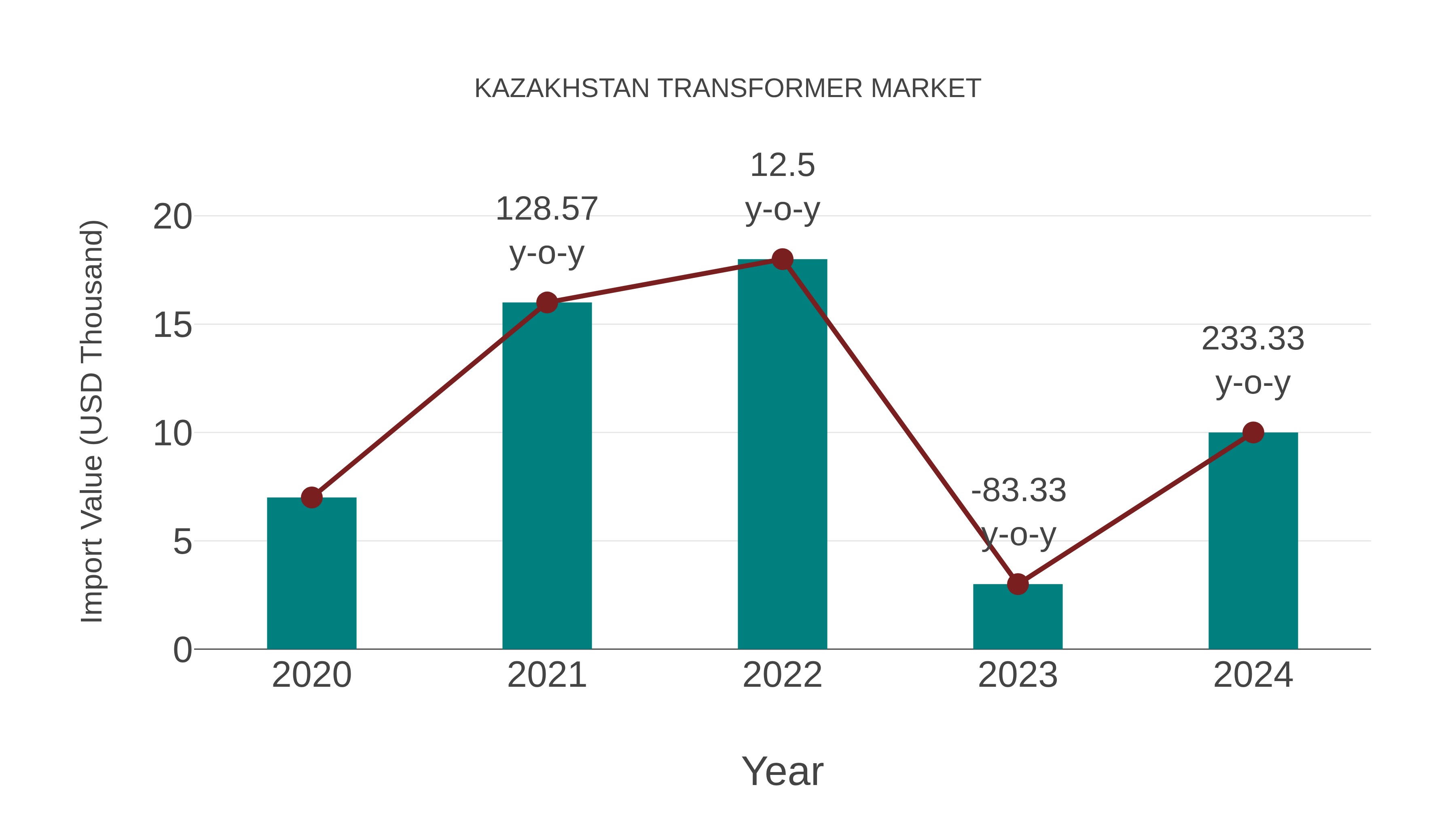
In the Kazakhstan transformer market, import trends witnessed significant growth from 2023 to 2024, with a notable 233.33% increase. The compound annual growth rate (CAGR) for imports from 2020 to 2024 stood at 9.33%. This surge in imports could be attributed to a shift in demand dynamics or favorable trade policies during the period, indicating potential market stability.
Kazakhstan Transformer Market Growth Rate
According to 6Wresearch internal database and Industry insights, the Kazakhstan Transformer Market is projected to grow at a compound annual growth rate (CAGR) of 7.80% during the forecast period (2025-2031).
Kazakhstan Transformer Market Highlights
| Report Name | Kazakhstan Transformer Market |
| Forecast Period | 2025-2031 |
| CAGR | 7.80% |
| Growing Sector | Industrial |
Topics Covered in the Kazakhstan Transformer Market Report
The Kazakhstan Transformer Market report thoroughly covers the Market by core, product, winding, application, cooling, phase, rating, and regions. The Market report provides an unbiased and detailed analysis of ongoing Market trends, opportunities/high growth areas, and Market drivers, which would help stakeholders devise and align their strategies according to the current and future Market dynamics, with emphasis on Market Growth, Industry Size, Share, and Revenue outlook.
Kazakhstan Transformer Market Synopsis
The Kazakhstan Transformer Market growth has been proliferated due to several factors. Such as expand on the back of large-scale grid reinforcement and interconnection projects with neighbouring countries. Additionally, industrial broadening, including mining, metals, oil & gas processing sectors is another major factor for boosting the transformer’s demand in the country. The demand for high-efficiency transformers across distribution and transmission levels has been increasing, with the increasing private investments in substations.
Evaluation of Growth Drivers in the Kazakhstan Transformer Market
Below mentioned are some prominent drivers and their influence to the market dynamics:
| Driver | Primary Segments Affected | Why it matters (evidence) |
| Transmission Backbone Upgrades | Power & Auto-transformers; Utility | To drive higher reliability and capacity, the demand for KEGOC’s multi-year substation and line modernization drives procurement of medium-to-large MVA units, has increased. |
| Industrial Expansion in Mining & Metals | Power & Distribution; Industrial | For energy-intensive processes, the demand for step-up/step-down transformers is increasing for new copper, uranium, and ferroalloy projects. |
| Cross-Border Power Trade | Power Transformers; Utility | Interties with Russia, China, and Central Asian states necessitate grid-stable, high-MVA transformers for export/import balancing. |
| Renewable Energy Zones | Distribution & Instrument; Utility & Residential/Commercial | Solar/wind integration and flexible substations increase deployment of smart distribution transformers and monitoring devices. |
| Urban Load Growth & Electrified Services | Distribution & Instrument; Residential & Commercial | The demand for medium-voltage distribution transformer has been increasing across the country due to urbanization and public service electrification (metro, hospitals, data centers). |
Kazakhstan Transformer Market is projected to grow steadily, recording a CAGR of 7.80% during the forecast period 2025-2031. Kazakhstan’s transformer market growth has been boosting over the years, driven by the rising expansion of grid and ongoing investments by the transmission operator and utilities to strengthen power grid. Additionally, there are various sectors, like mining, and oil & gas sector, proliferating the demand for transformers. Furthermore, the growing urban population has been proliferating the adoption of reliable and efficient transformers in the country.
Evaluation of Restraints in the Kazakhstan Transformer Market
Below mentioned are some major restraints and their influence to the market dynamics:
| Restraint | Primary Segments Affected | What this means (evidence) |
| Volatile Input Costs | All Types; Utility & Industrial | Global fluctuations in steel/copper raise CAPEX and pressure margins for OEMs and EPCs. |
| Procurement & Approval Timelines | Utility Projects | Public tender cycles and phased funding can extend delivery schedules, delaying installations. |
| Harsh Climatic Conditions | Oil-Immersed & Outdoor Units | Extreme temperature swings demand ruggedized designs, raising lifecycle costs and specification complexity. |
| Skilled Workforce Gap in Digitalization | Smart/IoT-Enabled Units | There has seen a major delay in smart grid adoption due to lack of local experts for advanced monitoring/diagnostics. |
| Import Reliance on Specialty Components | High-MVA & Instrument | Lead times for cores, bushings, and OLTCs may constrain rapid scaling and retrofit programs. |
Kazakhstan Transformer Market Challenges
Despite the major growth drivers of the Kazakhstan Transformer industry, there are numerous challenges in the market that could affect its growth. These challenges are aligning product specs with severe climatic requirements and accelerating workforce training for condition monitoring, IEC/IEEE standards, and digital twins. Additionally, the Kazakhstan Transformer Market growth is hampered due to synchronizing renewable build-out with substation readiness.
Kazakhstan Transformer Market Trends
Several prominent trends reshaping the market growth include:
- Digitalized Asset Management: Utilities and industrials increasingly specify sensors, online DGA, and SCADA-ready transformers to reduce outages and optimize O&M.
- High-Efficiency Core Materials: Uptake of low-loss core laminations to meet energy-efficiency targets and reduce total cost of ownership.
- Modular Substations: Skid-mounted transformer packages supporting fast-track mining and remote industrial expansions.
- Local Assembly & Testing: Gradual shift toward local assembly partnerships to improve lead times and tailor specs for regional needs.
Investment Opportunities in the Kazakhstan Transformer Industry
Some major investment opportunities in the market are:
- Local JV Manufacturing: Partnerships for core assembly, tank fabrication, and testing to improve availability and drive down costs.
- Renewable Interconnection Transformers: Purpose-built units for solar/wind parks with reactive power support and grid code compliance.
- Leasing & OPEX Models: Transformer-as-a-Service offerings for mining camps and temporary grid nodes to reduce upfront CAPEX.
- R&D for Extreme Climates: Designs optimized for temperature variance, dust/sand ingress protection, and remote diagnostics.
Top 5 Leading Players in the Kazakhstan Transformer Market
Leading players contributing to Kazakhstan Transformer Market Share are: -
1. Alageum Electric (Kentau Transformer Plant – KTP)
| Company Name | Alageum Electric (Kentau Transformer Plant – KTP) |
| Established Year | 1948 |
| Headquarters | Kentau, Kazakhstan |
| Official Website | Click Here |
Leading domestic manufacturer offering power and distribution transformers tailored to local grid codes and climatic conditions.
2. Siemens Energy AG
| Company Name | Siemens Energy AG |
| Established Year | 2020 |
| Headquarters | Munich, Germany (Global); regional operations in CIS |
| Official Website | Click Here |
o Supplies high-voltage power transformers and digital monitoring suites for KEGOC substations and industrial load centers.
3. ABB Ltd.
| Company Name | ABB Ltd. |
| Established Year | 1988 |
| Headquarters | Zurich, Switzerland |
| Official Website | Click Here |
Provides energy-efficient distribution and instrument transformers with advanced protection and automation and urban infrastructure.
4. Hyosung Heavy Industries
| Company Name | Hyosung Heavy Industries |
| Established Year | 1962 |
| Headquarters | Seoul, South Korea |
| Official Website | Click Here |
Delivers large MVA power transformers and shunt reactors for long-distance transmission and interconnection projects.
5. GE Grid Solutions
| Company Name | GE Grid Solutions |
| Established Year | 1892 |
| Headquarters | Paris, France & Atlanta, USA (Grid Solutions) |
| Official Website | Click Here |
Offers grid-scale power and instrument transformers with asset performance management platforms for condition-based maintenance in Utility networks.
Government Regulations Introduced in the Kazakhstan Transformer Market
According to Kazakh government data, the market is reshaped by the introduction of several rules specifically governing the compliance of transmission organisations with legal, technical, and safety requirements. These include procedures for inspections, documentation and staffing, availability of dispatch control and balancing arrangements, and technical grounding in grid codes. Deadline-phased implementation has been typical, giving industry players time to adapt.
Future Insights of the Kazakhstan Transformer Market
Kazakhstan’s Transformer Market Share will increase in the coming years, influenced by various factors. For instances, upgradation in utility transmission and the expansion of mining/metals processing. Also, the renewable integration corridors are rising in the market, acting as another major future trend. Manufacturers that combine high-efficiency designs and climate-resilient engineering is likely to secure a major growth opportunity. The distribution and instrument transformers installations are increasing underpinned by rapid urbanization and industrialization.
Market Segmentation Analysis
The report offers a comprehensive study of the following market segments and their leading categories.
By Core – Shell Core to Dominate the Market
Shell core transformers are expected to dominate due to their suitability for high-voltage, heavy-duty applications common in Kazakhstan’s transmission backbones and mining districts. Their mechanical robustness and reduced leakage flux make them preferred choices for substations requiring high reliability and compact footprints.
By Product – Distribution Transformers to Dominate the Market
According to Shivank Verma, Senior Research Analyst, 6Wresearch, Distribution transformers will lead the Market on account of widespread MV expansion for industrial clusters, new residential townships, and renewable evacuation nodes. Their scalability and lower installation costs support rapid grid densification across regions beyond Almaty and Astana.
By Winding – Auto-Transformers to Dominate the Market
Auto-transformers are set to dominate given Kazakhstan’s emphasis on high-voltage interconnections and long-distance power flows. Their material efficiency and lower impedance are advantageous for step-up/step-down duties in transmission corridors and interties.
By Application – Industrial Sector to Dominate the Market
The Industrial segment will dominate the Market, driven by energy-intensive mining, refining, and metallurgy operations. Stable voltage profiles and high MVA capacities are critical to process uptime, making utility-grade transformer specs common in industrial estates.
By Cooling – Oil Immersed Transformers to Dominate the Market
Oil immersed units will remain dominant owing to their superior heat dissipation and suitability for outdoor, high-load environments common in mining sites and transmission substations. Their proven lifecycle performance reduces LCOE for both Utility and Industrial operators.
By Phase – 3-Phase Transformers to Dominate the Market
3-phase transformers will dominate due to their central role in bulk power transmission and large industrial loads. Their efficiency, balance, and compatibility with high-capacity switchgear align with KEGOC’s network standards.
By Rating – 11 MVA to 60 MVA Segment to Dominate the Market
The 11 MVA to 60 MVA band will lead as it fits the needs of regional substations, renewable pooling stations, and industrial feeders. This range balances cost and capacity, enabling agile expansion without overcapitalization.
Key attractiveness of the report
- 10 Years Market Numbers.
- Historical Data Starting from 2021 to 2024.
- Base Year: 2024.
- Forecast Data until 2031.
- Key Performance Indicators Impacting the Market.
- Major Upcoming Developments and Projects.
Key Highlights of the Report:
- Kazakhstan Transformer Market Outlook
- Market Size of Kazakhstan Transformer Market
- Forecast of Kazakhstan Transformer Market, 2032
- Historical Data and Forecast of Kazakhstan Transformer Revenues & Volume for the Period 2022 - 2032F
- Kazakhstan Transformer Market Trend Evolution
- Kazakhstan Transformer Market Drivers and Challenges
- Kazakhstan Transformer Price Trends
- Kazakhstan Transformer Porter's Five Forces
- Kazakhstan Transformer Industry Life Cycle
- Historical Data and Forecast of Kazakhstan Transformer Market Revenues & Volume By Core for the Period 2022 - 2032F
- Historical Data and Forecast of Kazakhstan Transformer Market Revenues & Volume By Closed for the Period 2022 - 2032F
- Historical Data and Forecast of Kazakhstan Transformer Market Revenues & Volume By Shell for the Period 2022 - 2032F
- Historical Data and Forecast of Kazakhstan Transformer Market Revenues & Volume By Berry for the Period 2022 - 2032F
- Historical Data and Forecast of Kazakhstan Transformer Market Revenues & Volume By Product for the Period 2022 - 2032F
- Historical Data and Forecast of Kazakhstan Transformer Market Revenues & Volume By Power transformer for the Period 2022 - 2032F
- Historical Data and Forecast of Kazakhstan Transformer Market Revenues & Volume By Distribution transformer for the Period 2022 - 2032F
- Historical Data and Forecast of Kazakhstan Transformer Market Revenues & Volume By Instrument transformer for the Period 2022 - 2032F
- Historical Data and Forecast of Kazakhstan Transformer Market Revenues & Volume By Others for the Period 2022 - 2032F
- Historical Data and Forecast of Kazakhstan Transformer Market Revenues & Volume By Winding for the Period 2022 - 2032F
- Historical Data and Forecast of Kazakhstan Transformer Market Revenues & Volume By Two-winding for the Period 2022 - 2032F
- Historical Data and Forecast of Kazakhstan Transformer Market Revenues & Volume By Auto-transformer for the Period 2022 - 2032F
- Historical Data and Forecast of Kazakhstan Transformer Market Revenues & Volume By Application for the Period 2022 - 2032F
- Historical Data and Forecast of Kazakhstan Transformer Market Revenues & Volume By Residential & Commercial for the Period 2022 - 2032F
- Historical Data and Forecast of Kazakhstan Transformer Market Revenues & Volume By Utility for the Period 2022 - 2032F
- Historical Data and Forecast of Kazakhstan Transformer Market Revenues & Volume By Industrial for the Period 2022 - 2032F
- Historical Data and Forecast of Kazakhstan Transformer Market Revenues & Volume By Cooling for the Period 2022 - 2032F
- Historical Data and Forecast of Kazakhstan Transformer Market Revenues & Volume By Dry type for the Period 2022 - 2032F
- Historical Data and Forecast of Kazakhstan Transformer Market Revenues & Volume By Oil Immersed for the Period 2022 - 2032F
- Historical Data and Forecast of Kazakhstan Transformer Market Revenues & Volume By Insulation for the Period 2022 - 2032F
- Historical Data and Forecast of Kazakhstan Transformer Market Revenues & Volume By Gas for the Period 2022 - 2032F
- Historical Data and Forecast of Kazakhstan Transformer Market Revenues & Volume By Oil for the Period 2022 - 2032F
- Historical Data and Forecast of Kazakhstan Transformer Market Revenues & Volume By Solid for the Period 2022 - 2032F
- Historical Data and Forecast of Kazakhstan Transformer Market Revenues & Volume By Air for the Period 2022 - 2032F
- Historical Data and Forecast of Kazakhstan Transformer Market Revenues & Volume By Others for the Period 2022 - 2032F
- Historical Data and Forecast of Kazakhstan Transformer Market Revenues & Volume By Phase for the Period 2022 - 2032F
- Historical Data and Forecast of Kazakhstan Transformer Market Revenues & Volume By Single phase for the Period 2022 - 2032F
- Historical Data and Forecast of Kazakhstan Transformer Market Revenues & Volume By 3 - phase for the Period 2022 - 2032F
- Historical Data and Forecast of Kazakhstan Transformer Market Revenues & Volume By Rating for the Period 2022 - 2032F
- Historical Data and Forecast of Kazakhstan Transformer Market Revenues & Volume By ? 10 MVA for the Period 2022 - 2032F
- Historical Data and Forecast of Kazakhstan Transformer Market Revenues & Volume By 11 MVA to 60 MVA for the Period 2022 - 2032F
- Historical Data and Forecast of Kazakhstan Transformer Market Revenues & Volume By 61 MVA to 600 MVA for the Period 2022 - 2032F
- Historical Data and Forecast of Kazakhstan Transformer Market Revenues & Volume By > 600 MVA for the Period 2022 - 2032F
- Kazakhstan Transformer Import Export Trade Statistics
- Market Opportunity Assessment By Core
- Market Opportunity Assessment By Product
- Market Opportunity Assessment By Winding
- Market Opportunity Assessment By Application
- Market Opportunity Assessment By Cooling
- Market Opportunity Assessment By Insulation
- Market Opportunity Assessment By Phase
- Market Opportunity Assessment By Rating
- Kazakhstan Transformer Top Companies Market Share
- Kazakhstan Transformer Competitive Benchmarking By Technical and Operational Parameters
- Kazakhstan Transformer Company Profiles
- Kazakhstan Transformer Key Strategic Recommendations
Market Scope and Segmentation
The report provides a detailed analysis of the following market segments:
By Core
- Closed
- Shell
- Berry
By Product
- Power Transformer
- Distribution Transformer
- Instrument Transformer
- Others
By Winding
- Two-Winding
- Auto-Transformer
By Application
- Residential & Commercial
- Utility
- Industrial
By Cooling
- Dry Type
- Oil Immersed
By Phase
- Single Phase
- 3 – Phase
By Rating
- 10 MVA
- 11 MVA To 60 MVA
- 61 MVA To 600 MVA
- > 600 MVA
Kazakhstan Transformer Market (2026-2032): FAQs
Kazakhstan Transformer Market is projected to grow at a CAGR of approximately 7.80% during the forecast period.
Opportunities include local JV manufacturing, renewable interconnection transformers, and climate-optimized digital monitoring solutions aligned with Kazakhstan’s grid upgrades.
Siemens Energy AG, ABB Ltd., and Hyosung Heavy Industries are some major leading players of the market.
Challenges include product specs with severe climatic requirements and synchronizing renewable build-out with substation readiness.
6Wresearch actively monitors the Kazakhstan Transformer Market and publishes its comprehensive annual report, highlighting emerging trends, growth drivers, revenue analysis, and forecast outlook. Our insights help businesses to make data-backed strategic decisions with ongoing market dynamics. Our analysts track relevent industries related to the Kazakhstan Transformer Market, allowing our clients with actionable intelligence and reliable forecasts tailored to emerging regional needs.
Yes, we provide customisation as per your requirements. To learn more, feel free to contact us on sales@6wresearch.com
| 1 Executive Summary |
| 2 Introduction |
| 2.1 Key Highlights of the Report |
| 2.2 Report Description |
| 2.3 Market Scope & Segmentation |
| 2.4 Research Methodology |
| 2.5 Assumptions |
| 3 Kazakhstan Transformer Market Overview |
| 3.1 Kazakhstan Country Macro Economic Indicators |
| 3.2 Kazakhstan Transformer Market Revenues & Volume, 2022 & 2032F |
| 3.3 Kazakhstan Transformer Market - Industry Life Cycle |
| 3.4 Kazakhstan Transformer Market - Porter's Five Forces |
| 3.5 Kazakhstan Transformer Market Revenues & Volume Share, By Core, 2022 & 2032F |
| 3.6 Kazakhstan Transformer Market Revenues & Volume Share, By Product, 2022 & 2032F |
| 3.7 Kazakhstan Transformer Market Revenues & Volume Share, By Winding, 2022 & 2032F |
| 3.8 Kazakhstan Transformer Market Revenues & Volume Share, By Application, 2022 & 2032F |
| 3.9 Kazakhstan Transformer Market Revenues & Volume Share, By Cooling, 2022 & 2032F |
| 3.10 Kazakhstan Transformer Market Revenues & Volume Share, By Insulation, 2022 & 2032F |
| 3.11 Kazakhstan Transformer Market Revenues & Volume Share, By Phase, 2022 & 2032F |
| 4 Kazakhstan Transformer Market Dynamics |
| 4.1 Impact Analysis |
| 4.2 Market Drivers |
| 4.3 Market Restraints |
| 5 Kazakhstan Transformer Market Trends |
| 6 Kazakhstan Transformer Market, By Types |
| 6.1 Kazakhstan Transformer Market, By Core |
| 6.1.1 Overview and Analysis |
| 6.1.2 Kazakhstan Transformer Market Revenues & Volume, By Core, 2022-2032F |
| 6.1.3 Kazakhstan Transformer Market Revenues & Volume, By Closed, 2022-2032F |
| 6.1.4 Kazakhstan Transformer Market Revenues & Volume, By Shell, 2022-2032F |
| 6.1.5 Kazakhstan Transformer Market Revenues & Volume, By Berry, 2022-2032F |
| 6.2 Kazakhstan Transformer Market, By Product |
| 6.2.1 Overview and Analysis |
| 6.2.2 Kazakhstan Transformer Market Revenues & Volume, By Power transformer, 2022-2032F |
| 6.2.3 Kazakhstan Transformer Market Revenues & Volume, By Distribution transformer, 2022-2032F |
| 6.2.4 Kazakhstan Transformer Market Revenues & Volume, By Instrument transformer, 2022-2032F |
| 6.2.5 Kazakhstan Transformer Market Revenues & Volume, By Others, 2022-2032F |
| 6.3 Kazakhstan Transformer Market, By Winding |
| 6.3.1 Overview and Analysis |
| 6.3.2 Kazakhstan Transformer Market Revenues & Volume, By Two-winding, 2022-2032F |
| 6.3.3 Kazakhstan Transformer Market Revenues & Volume, By Auto-transformer, 2022-2032F |
| 6.4 Kazakhstan Transformer Market, By Application |
| 6.4.1 Overview and Analysis |
| 6.4.2 Kazakhstan Transformer Market Revenues & Volume, By Residential & Commercial, 2022-2032F |
| 6.4.3 Kazakhstan Transformer Market Revenues & Volume, By Utility, 2022-2032F |
| 6.4.4 Kazakhstan Transformer Market Revenues & Volume, By Industrial, 2022-2032F |
| 6.5 Kazakhstan Transformer Market, By Cooling |
| 6.5.1 Overview and Analysis |
| 6.5.2 Kazakhstan Transformer Market Revenues & Volume, By Dry type, 2022-2032F |
| 6.5.3 Kazakhstan Transformer Market Revenues & Volume, By Oil Immersed, 2022-2032F |
| 6.6 Kazakhstan Transformer Market, By Insulation |
| 6.6.1 Overview and Analysis |
| 6.6.2 Kazakhstan Transformer Market Revenues & Volume, By Gas, 2022-2032F |
| 6.6.3 Kazakhstan Transformer Market Revenues & Volume, By Oil, 2022-2032F |
| 6.6.4 Kazakhstan Transformer Market Revenues & Volume, By Solid, 2022-2032F |
| 6.6.5 Kazakhstan Transformer Market Revenues & Volume, By Air, 2022-2032F |
| 6.6.6 Kazakhstan Transformer Market Revenues & Volume, By Others, 2022-2032F |
| 6.7 Kazakhstan Transformer Market, By Phase |
| 6.7.1 Overview and Analysis |
| 6.7.2 Kazakhstan Transformer Market Revenues & Volume, By Single phase, 2022-2032F |
| 6.7.3 Kazakhstan Transformer Market Revenues & Volume, By 3 - phase, 2022-2032F |
| 6.8 Kazakhstan Transformer Market, By Rating |
| 6.8.1 Overview and Analysis |
| 6.8.2 Kazakhstan Transformer Market Revenues & Volume, By ? 10 MVA, 2022-2032F |
| 6.8.3 Kazakhstan Transformer Market Revenues & Volume, By 11 MVA to 60 MVA, 2022-2032F |
| 6.8.4 Kazakhstan Transformer Market Revenues & Volume, By > 600 MVA, 2022-2032F |
| 6.8.5 Kazakhstan Transformer Market Revenues & Volume, By > 600 MVA, 2022-2032F |
| 7 Kazakhstan Transformer Market Import-Export Trade Statistics |
| 7.1 Kazakhstan Transformer Market Export to Major Countries |
| 7.2 Kazakhstan Transformer Market Imports from Major Countries |
| 8 Kazakhstan Transformer Market Key Performance Indicators |
| 9 Kazakhstan Transformer Market - Opportunity Assessment |
| 9.1 Kazakhstan Transformer Market Opportunity Assessment, By Core, 2022 & 2032F |
| 9.2 Kazakhstan Transformer Market Opportunity Assessment, By Product, 2022 & 2032F |
| 9.3 Kazakhstan Transformer Market Opportunity Assessment, By Winding, 2022 & 2032F |
| 9.4 Kazakhstan Transformer Market Opportunity Assessment, By Application, 2022 & 2032F |
| 9.5 Kazakhstan Transformer Market Opportunity Assessment, By Cooling, 2022 & 2032F |
| 9.6 Kazakhstan Transformer Market Opportunity Assessment, By Insulation, 2022 & 2032F |
| 9.7 Kazakhstan Transformer Market Opportunity Assessment, By Phase, 2022 & 2032F |
| 9.7 Kazakhstan Transformer Market Opportunity Assessment, By Rating, 2022 & 2032F |
| 10 Kazakhstan Transformer Market - Competitive Landscape |
| 10.1 Kazakhstan Transformer Market Revenue Share, By Companies, 2025 |
| 10.2 Kazakhstan Transformer Market Competitive Benchmarking, By Operating and Technical Parameters |
| 11 Company Profiles |
| 12 Recommendations |
| 13 Disclaimer |
Export potential assessment - trade Analytics for 2030
Export potential enables firms to identify high-growth global markets with greater confidence by combining advanced trade intelligence with a structured quantitative methodology. The framework analyzes emerging demand trends and country-level import patterns while integrating macroeconomic and trade datasets such as GDP and population forecasts, bilateral import–export flows, tariff structures, elasticity differentials between developed and developing economies, geographic distance, and import demand projections. Using weighted trade values from 2020–2024 as the base period to project country-to-country export potential for 2030, these inputs are operationalized through calculated drivers such as gravity model parameters, tariff impact factors, and projected GDP per-capita growth. Through an analysis of hidden potentials, demand hotspots, and market conditions that are most favorable to success, this method enables firms to focus on target countries, maximize returns, and global expansion with data, backed by accuracy.
By factoring in the projected importer demand gap that is currently unmet and could be potential opportunity, it identifies the potential for the Exporter (Country) among 190 countries, against the general trade analysis, which identifies the biggest importer or exporter.
To discover high-growth global markets and optimize your business strategy:
Click Here
Pricing
- Single User License$ 1,995
- Department License$ 2,400
- Site License$ 3,120
- Global License$ 3,795

Search
Thought Leadership and Analyst Meet





Our Clients








Latest Reports
- United Kingdom (UK) Long-term Care Insurance Market (2026-2032) | Growth, Share, Consumer Insights, Drivers, Opportunities, Competition, Pricing Analysis, Segments, Restraints, Companies, Competitive, Value, Outlook, Size, Demand, Analysis, Challenges, Strategic Insights, Investment Trends, Revenue, Trends, Supply, Forecast
- United Kingdom (UK) Long Term Care Market (2026-2032) | Companies, Outlook, Analysis, Trends, Value, Revenue, Segmentation, Share, Forecast, Competitive Landscape, Growth, Size & Forecast
- Iraq Insulation and Waterproofing Market (2026-2032) | Outlook, Drivers, Growth, Size, Share, Industry, Revenue, Trends, Demand, Competitive, Strategic Insights, Opportunities, Segments, Companies, Challenges, Strategy, Consumer Insights, Analysis, Investment Trends, Value, Segmentation, Forecast, Restraints
- India Switchgear Market Outlook (2026 - 2032) | Size, Share, Trends, Growth, Revenue, Forecast, Analysis, Value, Outlook
- Pakistan Contraceptive Implants Market (2025-2031) | Demand, Growth, Size, Share, Industry, Pricing Analysis, Competitive, Strategic Insights, Strategy, Consumer Insights, Analysis, Investment Trends, Opportunities, Revenue, Segments, Value, Segmentation, Supply, Forecast, Restraints, Outlook, Competition, Drivers, Trends, Companies, Challenges
- Sri Lanka Packaging Market (2026-2032) | Outlook, Competition, Drivers, Trends, Demand, Pricing Analysis, Competitive, Strategic Insights, Companies, Challenges, Strategy, Consumer Insights, Analysis, Investment Trends, Opportunities, Growth, Size, Share, Industry, Revenue, Segments, Value, Segmentation, Supply, Forecast, Restraints
- India Kids Watches Market (2026-2032) | Strategy, Consumer Insights, Analysis, Investment Trends, Opportunities, Growth, Size, Share, Industry, Revenue, Segments, Value, Segmentation, Supply, Forecast, Restraints, Outlook, Competition, Drivers, Trends, Demand, Pricing Analysis, Competitive, Strategic Insights, Companies, Challenges
- Saudi Arabia Core Assurance Service Market (2025-2031) | Strategy, Consumer Insights, Analysis, Investment Trends, Opportunities, Growth, Size, Share, Industry, Revenue, Segments, Value, Segmentation, Supply, Forecast, Restraints, Outlook, Competition, Drivers, Trends, Demand, Pricing Analysis, Competitive, Strategic Insights, Companies, Challenges
- Romania Uninterruptible Power Supply (UPS) Market (2026-2032) | Industry, Analysis, Revenue, Size, Forecast, Outlook, Value, Trends, Share, Growth & Companies
- Saudi Arabia Car Window Tinting Film, Paint Protection Film (PPF), and Ceramic Coating Market (2025-2031) | Strategy, Consumer Insights, Analysis, Investment Trends, Opportunities, Growth, Size, Share, Industry, Revenue, Segments, Value, Segmentation, Supply, Forecast, Restraints, Outlook, Competition, Drivers, Trends, Demand, Pricing Analysis, Competitive, Strategic Insights, Companies, Challenges
Industry Events and Analyst Meet

India EV Show 2026

EV tech India Expo 2026

Auto Tech Asia 2026

Battery Tech India 2026

Smart Production Solutions Guangzhou 2026
Whitepaper
- Middle East & Africa Commercial Security Market Click here to view more.
- Middle East & Africa Fire Safety Systems & Equipment Market Click here to view more.
- GCC Drone Market Click here to view more.
- Middle East Lighting Fixture Market Click here to view more.
- GCC Physical & Perimeter Security Market Click here to view more.
6WResearch In News
- Doha a strategic location for EV manufacturing hub: IPA Qatar
- Demand for luxury TVs surging in the GCC, says Samsung
- Empowering Growth: The Thriving Journey of Bangladesh’s Cable Industry
- Demand for luxury TVs surging in the GCC, says Samsung
- Video call with a traditional healer? Once unthinkable, it’s now common in South Africa
- Intelligent Buildings To Smooth GCC’s Path To Net Zero


