Latin America 3D Printing Market Size, Share & Growth Rate
The Latin America 3D Printing Market was estimated at USD 931 Million in 2025 and is projected to reach USD 1360 Million by 2032, growing at a CAGR of 5.6% from 2026 to 2032. This positive trajectory can largely be attributed to the increasing integration of artificial intelligence across various industrial sectors in the region, significantly enhancing technological capabilities. As businesses evolve towards advanced manufacturing techniques, the demand for 3D printing solutions continues to escalate, particularly within healthcare and education, propelling robust market growth.
Latin America 3D Printing Market Year-wise Growth Rate and Key Drivers
This graph highlights how the Latin America 3D Printing Market has steadily grown over the years, supported by major growth factors.
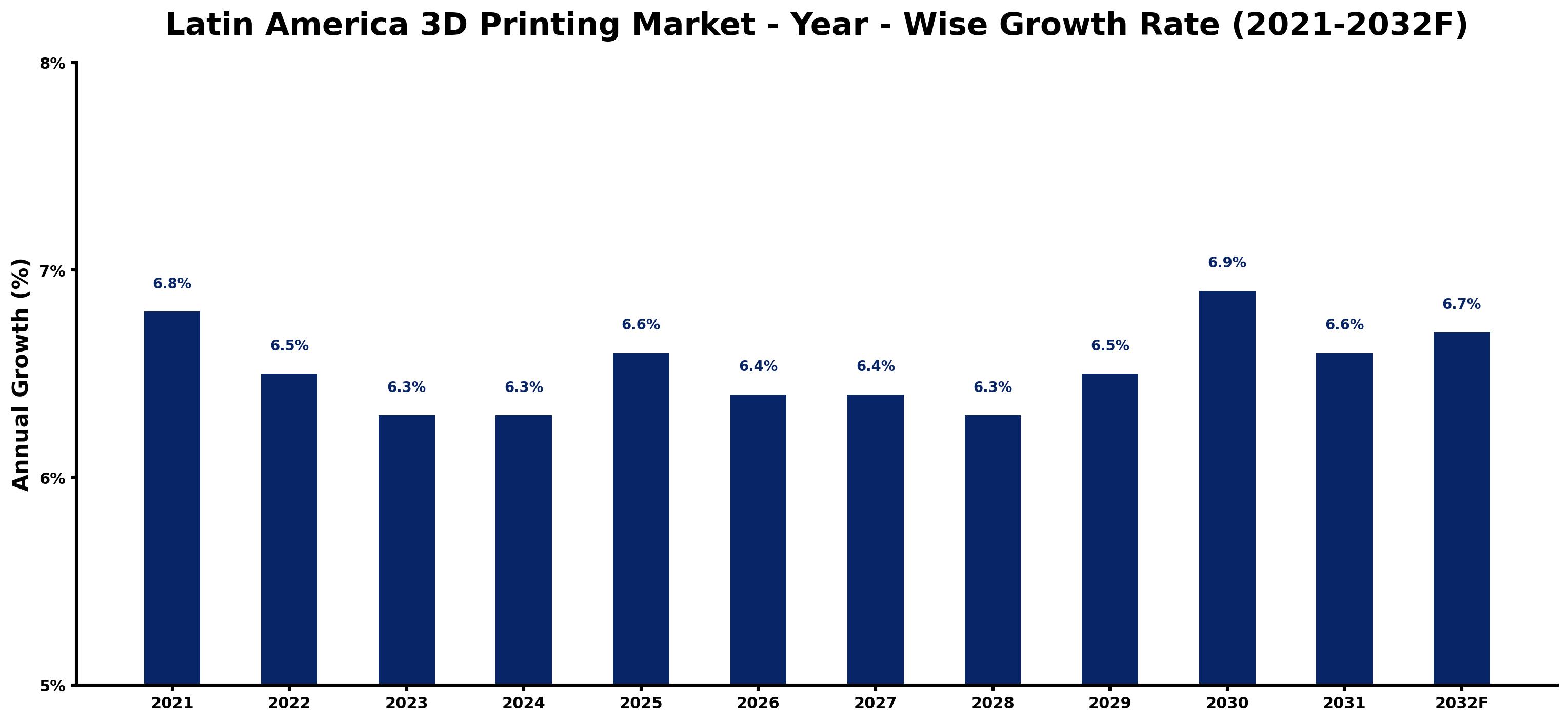
The table below presents the year‑wise growth rates along with the key drivers influencing the market
| Year | Growth Rate | Major Drivers |
| 2021 | 6.8% | Rapid growth in telecom and data center sectors |
| 2022 | 6.5% | Increasing industrial infrastructure investments |
| 2023 | 6.3% | Increasing industrial automation investments |
| 2024 | 6.3% | Increasing industrial infrastructure investments |
| 2025 | 6.6% | Increasing industrial automation investments |
| 2026 | 6.4% | Expansion of manufacturing activities |
| 2027 | 6.4% | Expansion of commercial construction activities |
| 2028 | 6.3% | Government infrastructure modernization initiatives |
| 2029 | 6.5% | Increasing adoption of advanced technologies |
| 2030 | 6.9% | Rapid growth in telecom and data center sectors |
| 2031 | 6.6% | Expansion of manufacturing activities |
| 2032 | 6.7% | Expansion of transportation and logistics networks |
Note - Market size estimations and growth projections presented in this report are based on 6Wresearch’s advanced forecasting approach, validated with industry datasets as of June 2026.
Latin America 3D Printing Market Synopsis
In recent years, the Latin America 3D printing market has navigated challenges posed by the COVID-19 pandemic, which initially stunted growth due to disruptions in industrial activity. However, as industries rebound and adapt to new technological landscapes, the market is poised for significant expansion driven by advancements in AI and digital services.
The growing awareness of 3D printing's benefits, particularly in sectors like healthcare where customized solutions are increasingly sought after, is reshaping market dynamics. Coupled with the rise of digital education and innovative manufacturing processes, the outlook for the Latin America 3D printing market is brighter than ever.
Latin America 3D Printing Market Key Takeaways
- The market is experiencing a notable shift towards technology-driven practices, with 3D printing becoming integral to modern manufacturing.
- The healthcare sector's adoption of 3D printing is anticipated to spur growth, with personalized solutions gaining traction.
- Investments in education and digital services are creating new opportunities for the integration of 3D printing technology.
- AI advancements across various sectors are facilitating deeper penetration of 3D printing applications.
- Government initiatives aimed at fostering technological growth are expected to bolster market expansion.
Evaluation of Restraints in Latin America 3D Printing Market
Despite the promising growth prospects, several restraints are holding back the Latin America 3D printing market. Challenges such as varying levels of technological adoption across countries in the region can create disparities in growth. Additionally, limited access to funding for smaller enterprises and the high initial investment costs associated with advanced 3D printing technologies can hinder widespread adoption. Moreover, the lingering effects of economic instability in certain countries may impede consistent market growth.
Latin America 3D Printing Market Trends
Current trends indicate a strong shift towards sustainable manufacturing practices, with many industries exploring eco-friendly materials for 3D printing. Moreover, the convergence of 3D printing technology with artificial intelligence is redefining manufacturing efficiency and product customization. Additionally, the rise of personalized consumer products is influencing the retail landscape, with bespoke manufacturing processes becoming more commonplace. As industries continue to adapt, the integration of smart technologies in 3D printing is expected to drive innovation and efficiency.
Latin America 3D Printing Market Opportunities
The Latin America 3D printing market presents several lucrative opportunities for growth and investment. The healthcare sector's increasing need for customized medical devices, prosthetics, and anatomical models is a significant driver. Furthermore, advancements in educational frameworks that utilize 3D printing technology for hands-on learning are expanding market horizons. Retail sectors are also tapping into the potential of on-demand production capabilities, catering to shifting consumer preferences. With a focus on AI-driven solutions, numerous avenues for innovation are emerging, making this market ripe for exploration.
Government Initiatives in the Latin America 3D Printing Market
Government bodies across Latin America are increasingly recognizing the strategic importance of 3D printing technology. Initiatives aimed at promoting research and development are being introduced, alongside funding programs to support startups and SMEs in adopting advanced manufacturing techniques. Policies that encourage collaboration between educational institutions and industry players are also fostering an environment conducive to innovation. Furthermore, public spending on infrastructure development is expected to facilitate smoother adoption and integration of 3D printing across various sectors.
Future Insights of the Latin America 3D Printing Market
Looking towards the future, the Latin America 3D printing market is anticipated to continue evolving rapidly. The period from 2026 to 2032 is expected to see heightened investments in advanced manufacturing technologies, driven by the need for efficiency and customization. As education systems increasingly embrace digital learning methods, the demand for 3D printing in educational settings will likely grow. Additionally, the ongoing advancements in artificial intelligence will further enhance the capabilities and applications of 3D printing technology, solidifying its place in the industrial landscape of Latin America.
Latin America 3D Printing Market Latest Developments (May 2025 - June 2026)
Recent developments within the Latin America 3D printing market reflect a strategic pivot towards more sustainable and innovative manufacturing practices. Industries are beginning to explore alternative materials that reduce environmental impact while enhancing product performance. Furthermore, initiatives aimed at upskilling the workforce in advanced 3D printing technologies are gaining traction, preparing a new generation for a technology-driven job market. The convergence of sectors, including healthcare, education, and retail, is leading to collaborative projects that leverage 3D printing's capabilities for tailored solutions, indicating a forward-thinking approach to market challenges.
Latin America 3D Printing Market - Key Attractiveness of the Report
- 10 Years of Market Numbers
- Historical Data Starting from 2022 to 2025
- Base Year: 2025
- Forecast Data until 2032
- Key Performance Indicators Impacting the Market
- Major Upcoming Developments and Projects
Key Highlights of the Report:
- Latin America 3D Printing Market Overview
- Latin America 3D Printing Market Outlook
- Latin America 3D Printing Market Forecast
- Historical Data of Latin America 3D Printing Market Revenues & Volume for the Period 2022-2032F
- Latin America 3D Printing Market Size and Latin America 3D Printing Market Forecast of Revenues & Volume, Until 2032F
- Historical Data of Latin America 3D Printing Market Revenues & Volume, by Technology, for the Period 2022-2032F
- Market Size & Forecast of Latin America 3D Printing Market Revenues & Volume, by Technology, Until 2032F
- Historical Data of Latin America 3D Printing Market Revenues & Volume, by Sector, for the Period 2022-2032F
- Market Size & Forecast of Latin America 3D Printing Market Revenues & Volume, by Sector, Until 2032F
- Historical Data of Latin America 3D Printing Market Revenues, by Countries, for the Period 2022-2032F
- Market Size & Forecast of Latin America 3D Printing Market Revenues, by Countries, Until 2032F
- Historical Data of Mexico 3D Printing Market Revenues, for the Period 2022-2032F
- Market Size & Forecast of Mexico 3D Printing Market Revenues, Until 2032F
- Historical Data of Argentina 3D Printing Market Revenues, for the Period 2022-2032F
- Market Size & Forecast of Argentina 3D Printing Market Revenues, Until 2032F
- Historical Data of Brazil 3D Printing Market Revenues, for the Period 2022-2032F
- Market Size & Forecast of Brazil 3D Printing Market Revenues, Until 2032F
- Historical Data of Rest of Latin America 3D Printing Market Revenues, for the Period 2022-2032F
- Market Size & Forecast of Rest of Latin America 3D Printing Market Revenues, Until 2032F
- Market Drivers and Restraints
- Latin America 3D Printing Market Trends and Industry Life Cycle
- Porter’s Five Force Analysis
- Market Opportunity Assessment
- Latin America 3D Printing Market Share, By Players
- Latin America 3D Printing Market Share, By Countries
- Latin America 3D Printing Market Overview on Competitive Benchmarking
- Company Profiles
- Key Strategic Recommendations
Markets Covered
The Latin America 3D Printing Market report provides a detailed analysis of the following market segments:
- By Technology:
- Fused Deposition Modelling (FDM)
- Selective Laser Sintering (SLS)
- Binder Jetting
- Stereolithography (SLA)
- Other Technologies
- By Sector:
- Architecture
- Medical
- Automotive
- Construction
- Education & Research
- Consumer Products
- Others
- By Countries:
- Mexico
- Argentina
- Brazil
- Rest of Latin America






































