Latin America PVC Market Size, Share & Growth Rate
The Latin America PVC Market was estimated at USD 215 Million in 2025 and is projected to reach USD 284 Million by 2032, growing at a CAGR of 4.1% from 2026 to 2032. This growth is primarily driven by the expansion of the automotive sector, which increasingly utilizes PVC for its lightweight, durable, and cost-effective properties. Furthermore, the ongoing urbanization and increased infrastructure projects across countries like Brazil and Mexico are boosting demand, reinforcing PVC's position as a preferred material over traditional options.
Latin America PVC Market Year-wise Growth Rate and Key Drivers
This graph highlights how the Latin America PVC Market has steadily grown over the years, supported by major growth factors.
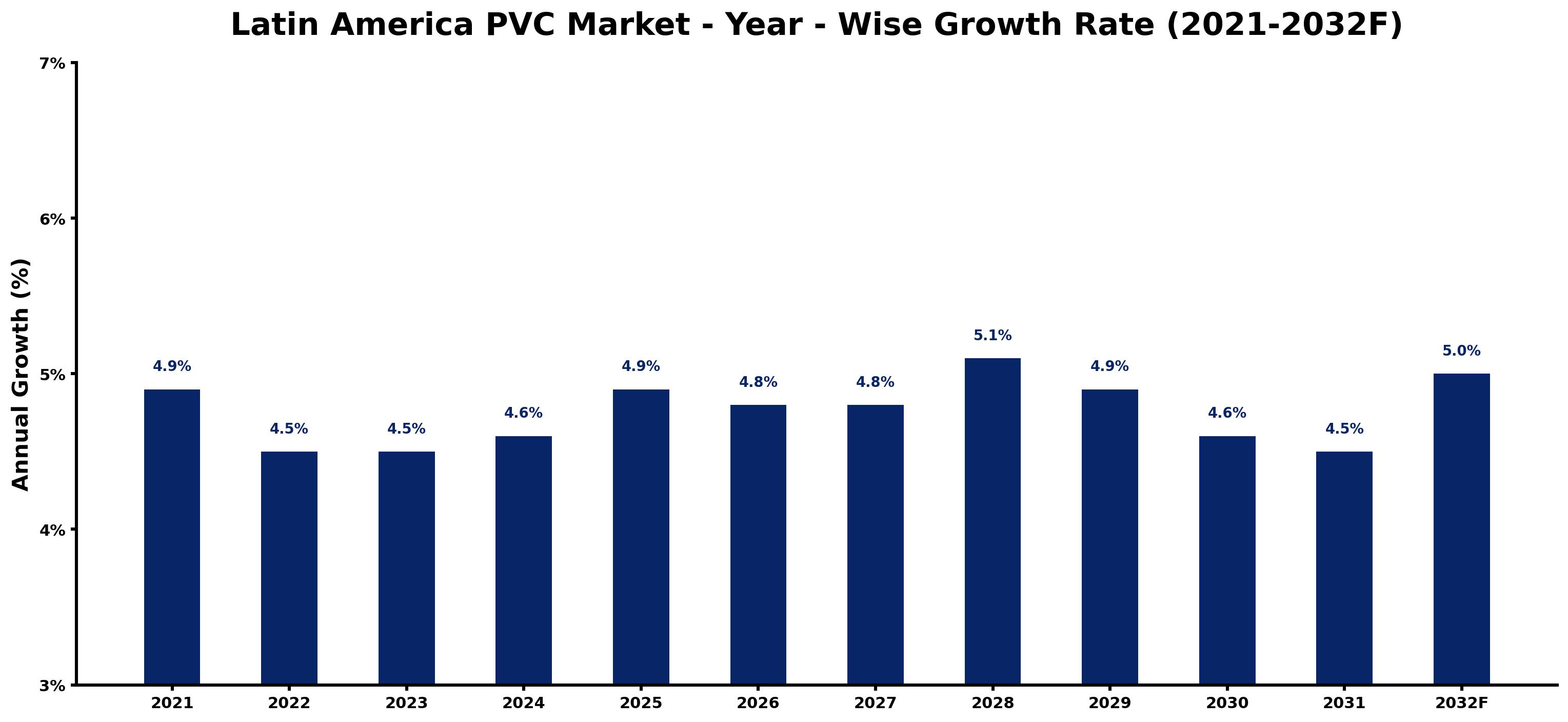
The table below presents the year‑wise growth rates along with the key drivers influencing the market
| Year | Growth Rate | Major Drivers |
| 2021 | 4.9% | Increasing industrial infrastructure investments |
| 2022 | 4.5% | Increasing adoption of advanced technologies |
| 2023 | 4.5% | Growing urbanization and commercial development |
| 2024 | 4.6% | Government infrastructure modernization initiatives |
| 2025 | 4.9% | Increasing industrial infrastructure investments |
| 2026 | 4.8% | Government infrastructure modernization initiatives |
| 2027 | 4.8% | Expansion of transportation and logistics networks |
| 2028 | 5.1% | Expansion of commercial construction activities |
| 2029 | 4.9% | Rapid growth in telecom and data center sectors |
| 2030 | 4.6% | Growing renewable energy integration projects |
| 2031 | 4.5% | Growing urbanization and commercial development |
| 2032 | 5.0% | Increasing adoption of advanced technologies |
Note - Market size estimations and growth projections presented in this report are based on 6Wresearch's advanced forecasting approach, validated with industry datasets as of June 2026.
Latin America PVC Market Synopsis
Despite a temporary slowdown caused by the COVID-19 pandemic, the Latin America PVC market is showing signs of resilience and is set for a rebound. As the region's economies recover, demand for PVC in construction, automotive, and consumer goods is expected to rise significantly, reflecting broader trends in population growth and economic development.
The current trajectory indicates a strengthening market presence, particularly in key countries such as Chile and Colombia. With rigid PVC dominating the segment due to its versatility in consumer applications, the market is transitioning towards advanced formulations and additives that enhance performance and sustainability.
Latin America PVC Market Key Takeaways
- The Latin America PVC market is driven by expanding sectors such as automotive and construction.
- Rigid PVC continues to lead in market share due to its application in consumer goods.
- Key regional markets include Brazil, Argentina, and Mexico, each contributing significantly to growth.
- The demand for PVC additives is rising in tandem with the overall market growth.
- Population growth and economic development are pivotal to market expansion.
Evaluation of Restraints in Latin America PVC Market
While the Latin America PVC market exhibits strong potential, certain restraints could impede growth. Fluctuating raw material prices pose a significant challenge, impacting overall production costs and pricing strategies. Furthermore, environmental regulations aimed at reducing plastic use may limit market opportunities, pushing manufacturers to seek sustainable alternatives. Consequently, companies must navigate these restrictions while adapting to a shifting regulatory landscape.
Latin America PVC Market Trends
The market is witnessing several key trends that are reshaping demand. A notable shift towards sustainability is prompting manufacturers to invest in eco-friendly additives and production processes. The adoption of innovative technologies for PVC recycling is also gaining momentum, responding to environmental concerns. Additionally, the automotive sector is increasingly integrating smart materials, prompting advancements in PVC formulations that enhance performance and durability.
Latin America PVC Market Opportunities
Growth opportunities are particularly pronounced in the construction sector, fueled by urbanization and infrastructure development initiatives. Expanding economies are driving demand for building materials, with PVC's favorable characteristics making it an attractive choice. Additionally, investment in research and development for new applications—especially in electronics and sustainable products—promises to create fresh market avenues for stakeholders in the coming years.
Government Initiatives in the Latin America PVC Market
Governments across Latin America are increasingly recognizing the value of the PVC market as a vital contributor to economic development. Various initiatives aimed at boosting infrastructure investments, such as public-private partnerships in construction projects, are anticipated to stimulate demand for PVC products. Moreover, regulatory frameworks supporting innovation and sustainability in materials technology are likely to enhance market growth, encouraging manufacturers to adopt more responsible practices.
Future Insights of the Latin America PVC Market
Looking ahead to 2026-2032, the Latin America PVC market is poised for robust growth. As industries recover from the pandemic's impacts, the renewed focus on sustainable solutions will shape market dynamics. The acceleration of infrastructure projects and automotive innovations will further entrench PVC as a staple material. Stakeholders can anticipate a landscape characterized by evolving technologies and heightened competition, demanding agility and strategic foresight.
Latin America PVC Market Latest Developments (May 2025 - June 2026)
Recent industry developments indicate a strong emphasis on sustainability initiatives, with multiple manufacturers enhancing their portfolios through eco-friendly PVC products. Additionally, partnerships aimed at advancing recycling technologies are becoming more commonplace, reflecting a shift towards a circular economy. As the market landscape evolves, companies are keenly investing in research to develop innovative applications for PVC that align with consumer preferences for environmentally responsible solutions.
Latin America PVC Market - Key Attractiveness of the Report
- 10 Years of Market Numbers
- Historical Data Starting from 2022 to 2025
- Base Year: 2025
- Forecast Data until 2032
- Key Performance Indicators Impacting the Market
- Major Upcoming Developments and Projects






































