Netherlands Electric Vehicle Market Top 5 Importing Countries and Market Competition (HHI) Analysis
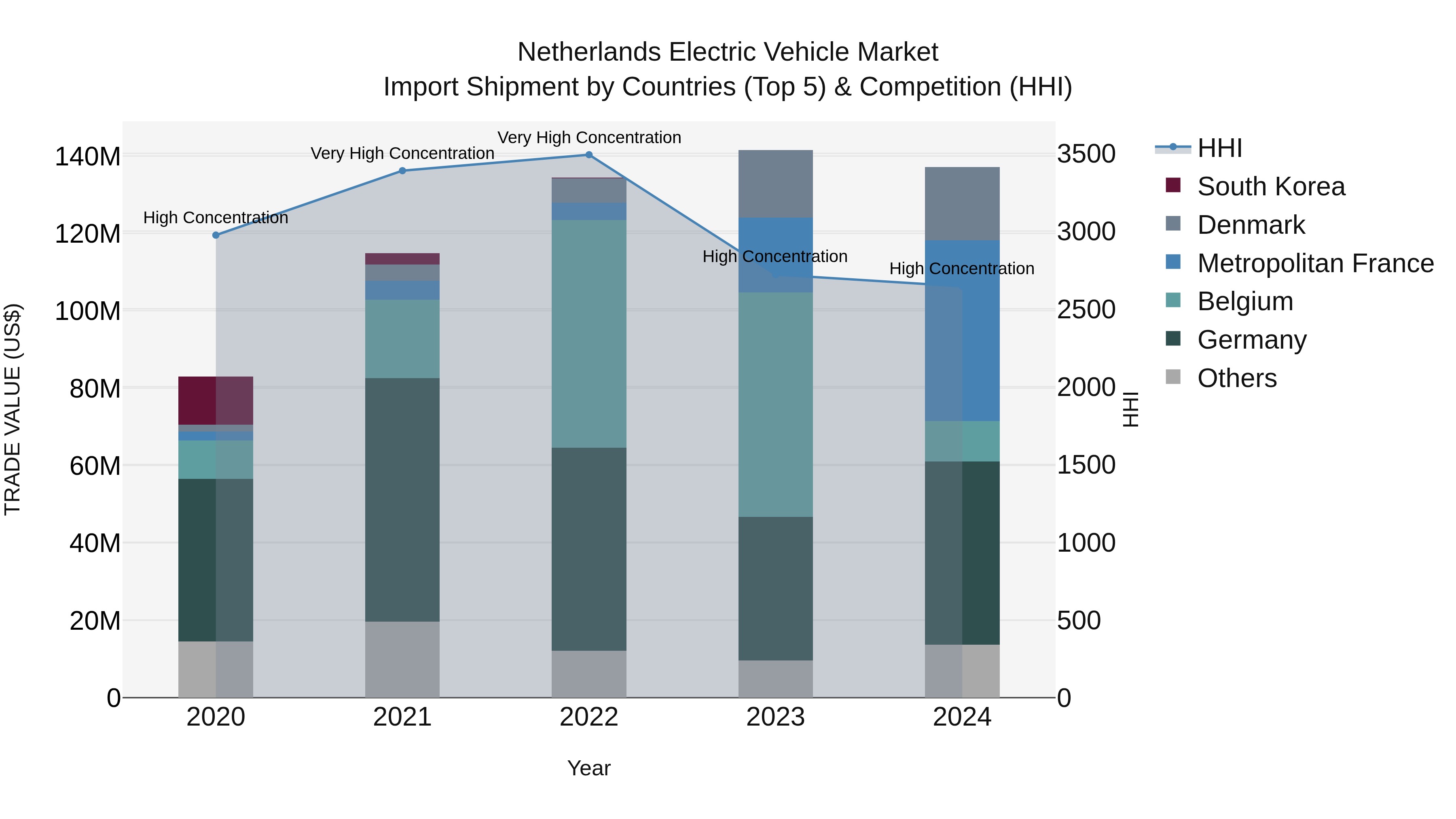
In 2024, the Netherlands saw a significant influx of electric vehicle import shipments, with top exporters including Germany, Metropolitan France, Denmark, Belgium, and Sweden. Despite a slight decline in growth rate from 2023 to 2024, the compound annual growth rate (CAGR) from 2020-24 remained robust at 13.36%. The Herfindahl-Hirschman Index (HHI) indicated high market concentration in 2024, suggesting a competitive landscape dominated by key players in the electric vehicle import market. The continued interest and investments in electric vehicles underscore a promising future for sustainable transportation in the Netherlands.
Netherlands Electric Vehicle Market Growth Rate
According to 6Wresearch internal database and industry insights, The Netherlands Electric Vehicle Market is projected to grow at a compound annual growth rate (CAGR) of 21.9% during the forecast period (2025–2031).
Netherlands Electric Vehicle Market Highlights
| Report Name | Netherlands Electric Vehicle Market |
| Forecast Period | 2025-2031 |
| CAGR | 21.9% |
| Growing Sector | Passenger Vehicles & Public Transport |
Topics Covered in the Netherlands Electric Vehicle Market Report
The Netherlands Electric Vehicle Market report thoroughly covers the market by propulsion (BEV, PHEV, FCEV), vehicle drive type (FWD, RWD, AWD), and vehicle top speed (<125 mph, >125 mph). The market report provides an unbiased and detailed analysis of ongoing market trends, opportunities/high growth areas, and market drivers, which would help stakeholders to devise and align their market strategies according to the current and future market dynamics.
Netherlands Electric Vehicle Market Synopsis
Netherlands Electric Vehicle Market is anticipated to attain major growth due to the country’s potent sustainability agenda, constructive tax policies, and worldwide charging infrastructure development. EVs are highly spreading in both passenger and public transport fleets specifically which consists of battery electric vehicles (BEV), plug-in hybrid vehicles (PHEV), and fuel-cell electric vehicles (FCEV). The government’s is majorly accelerating EV deployment in the Netherlands through concentrating on decreasing reliability on fossil fuels, coupled with consumer choice for eco-friendly transport and Europe-wide emission standards.
Evaluation of Growth Drivers in the Netherlands Electric Vehicle Market
Below mentioned are some prominent drivers and their influence on the market dynamics:
| Driver | Primary Segments Affected | Why it matters (evidence) |
| Zero-Emission Mandates | BEV; Passenger Vehicles, Public Transport | National targets for banning new ICE vehicle sales by 2030 profiler BEV deployment in both private and public segments. |
| Tax Incentives & Subsidies | BEV/PHEV; Residential & Commercial Users | Budget-friendliness of EVs is improving through favourable purchase subsidies, decreased registration tax, and less road taxes. |
| Expanding Charging Infrastructure | BEV; <125 mph & >125 mph | Range anxiety and encourage daily commutes is removing via dense charging chains across urban centres and highways. |
| Corporate Fleet Electrification | BEV/PHEV; Commercial Fleets | To align with ESG and emission compliance goals dutch logistics and ride-hailing companies are increasingly electrifying fleets. |
| EU Emission Regulations | All propulsion types; Passenger & Industrial Vehicles | Strict European Union regulations on CO₂ emissions reinforce quick deployment of low-emission vehicles. |
The Netherlands Electric Vehicle Market size is predicted to grow at the CAGR of 21.9% during the forecast period of 2025–2031. The market growth is strongly accelerated by the country’s leadership in renewable energy transition and proactive EV deployment strategies, making it one of the most appealing EV markets in Europe. Netherlands is shifting toward electrification of transport is making use of it developed infrastructure, innovation system and consumer knowledge.
Evaluation of Restraints in the Netherlands Electric Vehicle Market
Below mentioned are some major restraints and their influence to the market dynamics:
| Restraint | Primary Segments Affected | What this means (evidence) |
| High Purchase Costs | BEV/FCEV; Passenger Cars | Initial EV prices persist to increase than ICE vehicles, lowering mass deployment in lower-income groups in spite of subsidies. |
| Grid Load Challenges | BEV/PHEV; Residential Charging | Increasing EV adoption puts stress on local electricity grids, needing upgrades and smart load administration. |
| Limited Hydrogen Infrastructure | FCEV; Public Transport & Heavy Vehicles | FCEV adoption is insufficient due to scarce refuelling stations, delaying its large-scale deployment. |
| Battery Supply Dependency | All propulsion types | Heavy dependency on imported lithium-ion batteries makes supply threats and increases attainment prices. |
| Parking & Charging Limitations in Urban Areas | BEV; <125 mph | Dense city populations face constraints in installing private chargers, impacting EV adoption in apartments and rentals. |
Netherlands Electric Vehicle Market Challenges
Despite government support, the Netherlands Electric Vehicle Market encounter challenges consisting of increasing upfront EV costs, insufficient hydrogen fuelling infrastructure, and strain on the national electricity grid due to increasing charging demand. Insufficient charging access for residents of high-density housing also obstructs deployment, while reliability on global battery supply chains makes the sector vulnerable to disruptions.
Netherlands Electric Vehicle Market Trends
Several prominent trends reshaping the market growth include:
- Vehicle-to-Grid (V2G) Technology: To even out local electricity grids increasing deployment of EVs as energy storage systems.
- Smart Charging Systems: Increasing requirement for IoT-enabled chargers with remote monitoring, payment, and scheduling features.
- Rise of Shared E-Mobility: Decreasing emissions with increasing use of EVs in car-sharing and ride-hailing platforms.
- Hydrogen Mobility Initiatives: Early pilot programs for FCEVs in buses and trucks To expand clean transport solutions.
Investment Opportunities in the Netherlands Electric Vehicle Industry
Some prominent investment opportunities in the market include:
- EV Battery Recycling Facilities – To decrease reliability on imported materials and encourage sustainability launch recycling plants.
- Charging-as-a-Service (CaaS) – Give bundled charging infrastructure and service solutions for residential, commercial, and highway chains.
- Corporate Fleet Solutions – Provide tailored EV leasing and charging packages for logistics and ride-hailing companies.
- Hydrogen Mobility Pilots – To harness the potential of FCEVs in logistics and public transport allocate money in hydrogen refuelling stations.
Top 5 Leading Players in the Netherlands Electric Vehicle Market
Some leading players operating in the Netherlands Electric Vehicle Market consist of:
1. Tesla Inc.
| Company Name | Tesla Inc. |
| Established Year | 2003 |
| Headquarters | Austin, Texas, USA |
| Official Website | Click Here |
Tesla dominates the market with a solid presence of its BEV lineup and supercharging infrastructure across the Netherlands.
2. BYD Auto Co., Ltd.
| Company Name | BYD Auto Co., Ltd. |
| Established Year | 1995 |
| Headquarters | Shenzhen, China |
| Official Website | Click Here |
BYD imparts a major role in electrifying Dutch public transport and private markets by providing electric buses and passenger EVs.
3. Volkswagen AG
| Company Name | Volkswagen AG |
| Established Year | 1937 |
| Headquarters | Wolfsburg, Germany |
| Official Website | Click Here |
Volkswagen is a leading provider of BEVs and PHEVs in the Netherlands, providing economical models under its ID series.
4. Stellantis N.V.
| Company Name | Stellantis N.V. |
| Established Year | 2021 |
| Headquarters | Amsterdam, Netherlands |
| Official Website | Click Here |
Stellantis utilises its headquarters in the Netherlands to provide BEVs and PHEVs across brands like Peugeot, Opel, and Fiat.
5. Hyundai Motor Company
| Company Name | Hyundai Motor Company |
| Established Year | 1967 |
| Headquarters | Seoul, South Korea |
| Official Website | Click Here |
Hyundai has launched itself as a famous EV brand in the Netherlands with models such as the Kona Electric and Ioniq 5, integrating efficiency and budget-friendliness.
Government Regulations Introduced in the Netherlands Electric Vehicle Market
According to Netherland’s government data, numerous initiatives have been established to propel EV deployment. For instance, the government provides purchase subsidies for electric cars under the SEPP program, reduced vehicle registration taxes, and lower road taxes for EVs. The Netherlands also directed that all new company cars should be emission-free by 2026. Additionally, municipalities have been incentivized to extend public charging stations, while national policies meet with the EU Green Deal which has the objective of for carbon neutrality by 2050.
Future Insights of the Netherlands Electric Vehicle Market
The Netherlands Electric Vehicle Market Growth is anticipated to increase majorly in the upcoming years. This growth is encouraged by government-led zero-emission targets, solid charging infrastructure coverage, and increased consumer knowledge about sustainability. The extension of EV leasing programs, allocation of money in hydrogen transport, and innovations in vehicle-to-grid technologies will further solidify the Netherlands as one of Europe’s leaders in EV deployment.
Market Segmentation Analysis
BEV to Dominate the Market– By Propulsion
According to Shubhamdeep, Senior Research Analyst at 6Wresearch, the Battery Electric Vehicle (BEV) segment dominates the market. This dominance is accelerated by the government’s zero-emission policies, consumer incentives, and the availability of a broad variety of BEV models appropriate for urban and intercity travel.
FWD to Dominate the Market– By Vehicle Drive Type
The Front-Wheel Drive (FWD) category holds the largest Netherlands Electric Vehicle Market Share, as most mass-market EVs in the Netherlands are crafted with FWD layouts.
<125 mph to Dominate the Market– By Vehicle Top Speed
The Below 125 mph category leads the Netherlands Electric Vehicle Industry. Most consumer EVs are improved for efficiency and everyday commuting rather than high-speed performance, meeting with the country’s dense urban structure and short-distance travel needs.
Key Attractiveness of the Report
- 10 Years of Market Numbers.
- Historical Data Starting from 2021 to 2024.
- Base Year: 2024.
- Forecast Data until 2031.
- Key Performance Indicators Impacting the Market.
- Major Upcoming Developments and Projects.
Key Highlights of the Report:
- Netherlands Electric Vehicle Market Outlook
- Market Size of Netherlands Electric Vehicle Market, 2024
- Forecast of Netherlands Electric Vehicle Market, 2031
- Historical Data and Forecast of Netherlands Electric Vehicle Revenues & Volume for the Period 2021-2031
- Netherlands Electric Vehicle Market Trend Evolution
- Netherlands Electric Vehicle Market Drivers and Challenges
- Netherlands Electric Vehicle Price Trends
- Netherlands Electric Vehicle Porter's Five Forces
- Netherlands Electric Vehicle Industry Life Cycle
- Historical Data and Forecast of Netherlands Electric Vehicle Market Revenues & Volume By Propulsion for the Period 2021-2031
- Historical Data and Forecast of Netherlands Electric Vehicle Market Revenues & Volume By BEV for the Period 2021-2031
- Historical Data and Forecast of Netherlands Electric Vehicle Market Revenues & Volume By PHEV for the Period 2021-2031
- Historical Data and Forecast of Netherlands Electric Vehicle Market Revenues & Volume By FCEV for the Period 2021-2031
- Historical Data and Forecast of Netherlands Electric Vehicle Market Revenues & Volume By Vehicle Drive Type for the Period 2021-2031
- Historical Data and Forecast of Netherlands Electric Vehicle Market Revenues & Volume By FWD for the Period 2021-2031
- Historical Data and Forecast of Netherlands Electric Vehicle Market Revenues & Volume By RWD for the Period 2021-2031
- Historical Data and Forecast of Netherlands Electric Vehicle Market Revenues & Volume By AWD for the Period 2021-2031
- Historical Data and Forecast of Netherlands Electric Vehicle Market Revenues & Volume By Vehicle Top Speed for the Period 2021-2031
- Historical Data and Forecast of Netherlands Electric Vehicle Market Revenues & Volume By <125 mph for the Period 2021-2031
- Historical Data and Forecast of Netherlands Electric Vehicle Market Revenues & Volume By >125 mph for the Period 2021-2031
- Netherlands Electric Vehicle Import Export Trade Statistics
- Market Opportunity Assessment By Propulsion
- Market Opportunity Assessment By Vehicle Drive Type
- Market Opportunity Assessment By Vehicle Top Speed
- Netherlands Electric Vehicle Top Companies Market Share
- Netherlands Electric Vehicle Competitive Benchmarking By Technical and Operational Parameters
- Netherlands Electric Vehicle Company Profiles
- Netherlands Electric Vehicle Key Strategic Recommendations
Markets Covered
TheNetherlands Electric Vehicle Marketreport provides a detailed analysis of the following market segments:
By Propulsion
- BEV
- PHEV
- FCEV
By Vehicle Drive Type
- FWD
- RWD
- AWD
By Vehicle Top Speed
- <125 Mph
- >125 Mph






































