New Zealand Ready To Drink Tea And Coffee Market (2026-2032) | Forecast, Size & Revenue, Analysis, Competitive Landscape, Segmentation, Growth, Trends, Outlook, Value, Companies, Industry, Share
Market Forecast By Product (RTD Tea, Black, Green, Fruit, RTD Coffee, Cold brew coffee, Iced coffee, Others), By Packaging (Canned, Glass Bottle, PET Bottle, Others), By Price (Premium, Economy) And Competitive Landscape
| Product Code: ETC8569054 | Publication Date: Sep 2024 | Updated Date: Apr 2026 | Product Type: Market Research Report | |
| Publisher: 6Wresearch | Author: Summon Dutta | No. of Pages: 75 | No. of Figures: 35 | No. of Tables: 20 |
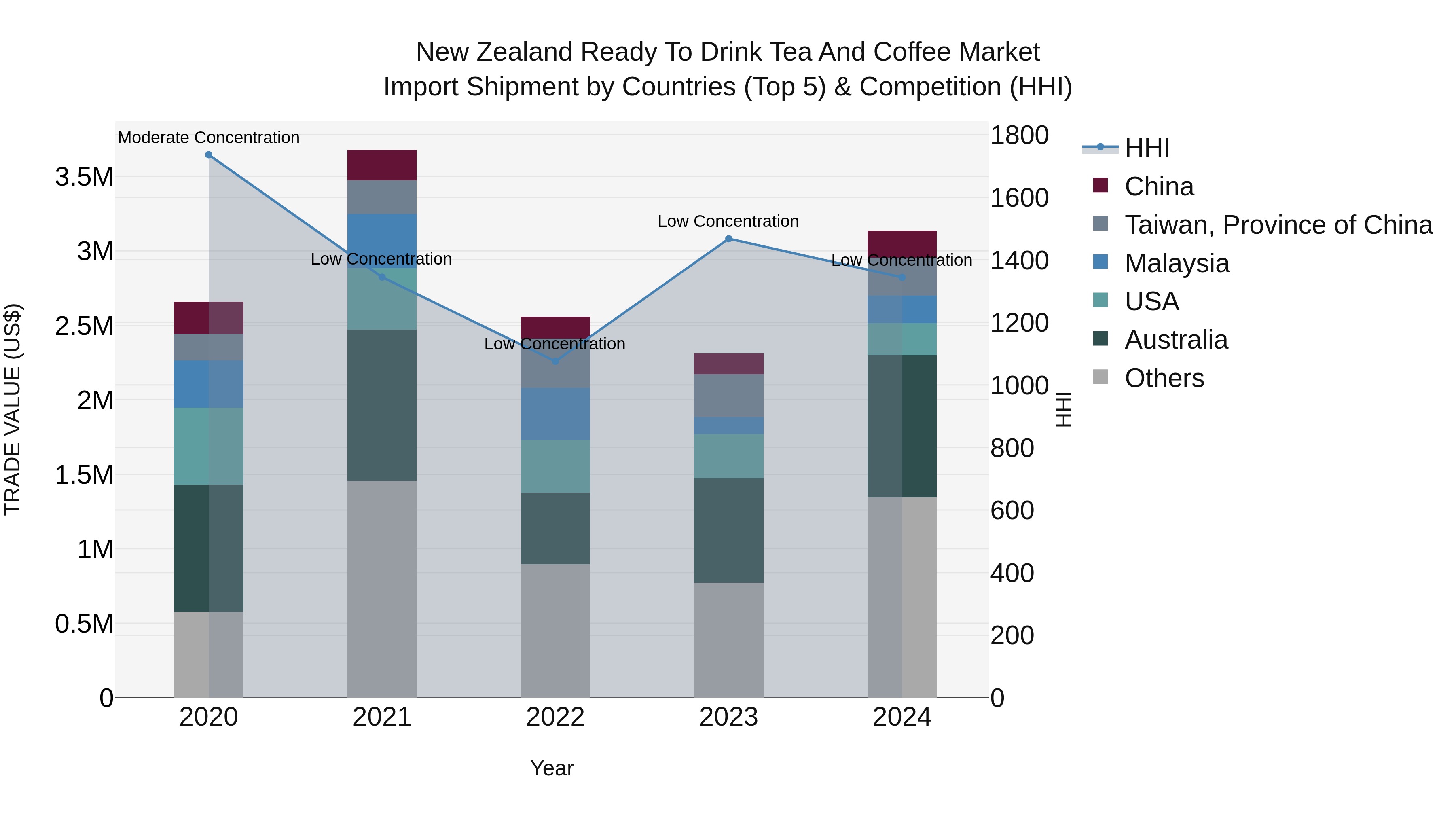
New Zealand Ready to Drink Tea and Coffee Market Top 5 Importing Countries and Market Competition (HHI) Analysis
The ready-to-drink tea and coffee market in New Zealand continues to thrive with import shipments mainly coming from Australia, Taiwan, South Korea, and other key countries. The relatively low concentration level indicates a diverse market landscape. The impressive compound annual growth rate (CAGR) of 4.22% from 2020 to 2024 highlights the increasing popularity of these products among consumers. Moreover, the remarkable growth rate of 35.71% from 2023 to 2024 indicates a significant surge in demand, presenting opportunities for both local and international suppliers to capitalize on this trend.
New Zealand Ready To Drink Tea And Coffee Market Growth Rate
According to 6Wresearch internal database and industry insights, the New Zealand Ready To Drink Tea And Coffee Market is projected to grow at a compound annual growth rate (CAGR) of 7.8% during the forecast period (2026-2032).
Topics Covered in the New Zealand Ready To Drink Tea And Coffee Market Report
The New Zealand Ready To Drink Tea And Coffee Market report thoroughly covers the market by product type and applications. The market report provides an unbiased and detailed analysis of ongoing market trends, opportunities/high growth areas, and market drivers, which help stakeholders devise and align their market strategies according to the current and future market dynamics.
New Zealand Ready To Drink Tea And Coffee Market Highlights
| Report Name | New Zealand Ready To Drink Tea And Coffee Market |
| Forecast period | 2026-2032 |
| CAGR | 7.8% |
| Growing Sector |
RTD Coffee (Cold Brew & Iced Coffee Segment) |
New Zealand Ready To Drink Tea And Coffee Market Synopsis
New Zealand Ready To Drink Tea And Coffee Market is anticipated to witness steady expansion due to changes in consumer lifestyles, increasing demand for convenient beverages, and rising awareness about functional and healthier beverage options. RTD tea and coffee are becoming more sought after beverages compared to other sugary drinks, driven by the rise of health and wellness. Also, the rise in innovation is supporting the market penetration of RTD beverages. The availability of good retail infrastructure and the rising popularity of cold brew coffee are also driving the market.
Evaluation of Growth Drivers in the New Zealand Ready To Drink Tea And Coffee Market
Below mentioned are some prominent drivers and their influence on the market dynamics:
| Drivers | Primary Segments Affected | Why it Matters (Evidence) |
| Increasing Demand for Convenient Beverages | RTD Tea & Coffee; Retail Stores | Busy lifestyles drive demand for ready-to-consume drink options. |
| Health-Conscious Consumer Shift | Green Tea; Premium Segment | Consumers prefer low-sugar and antioxidant-rich beverages. |
| Expansion of Retail & E-commerce Channels | All Segments | Wider availability improves product accessibility nationwide. |
| Innovation in Flavors and Packaging | Fruit Tea; PET Bottles | Unique flavors and eco-friendly packaging attract younger consumers. |
| Growth of Coffee Culture | Cold Brew & Iced Coffee; Cafés | Rising café culture fuels demand for premium RTD coffee products. |
New Zealand Ready To Drink Tea And Coffee Market is expected to grow at the CAGR of 7.8% during the forecast period of 2026-2032. This is attributed to changing consumer behavior in terms of convenience and health aspects of beverages, as well as the popularity of premium coffee culture. Moreover, an increase in modern retail channels and online platforms is providing easy access to products throughout the country. In terms of product formulations, innovations in products such as organic tea, functional drinks, and cold brew coffee are contributing to market growth. In addition, an increase in disposable income is prompting consumers to try ready-to-drink beverages, thus fuelling market growth.
Evaluation of Restraints in the New Zealand Ready To Drink Tea And Coffee Market
Below mentioned are some major restraints and their influence on the market dynamics:
| Restraints | Primary Segments Affected | What This Means (Evidence) |
| High Product Pricing | Premium Segment | Premium RTD beverages limit affordability for price-sensitive consumers. |
| Competition from Fresh Beverages | All Segments | Freshly brewed tea and coffee remain popular alternatives. |
| Environmental Concerns | PET Bottles; Cans | Packaging waste regulations increase compliance costs. |
| Sugar Content Concerns | RTD Tea | Consumers avoid products with high sugar levels. |
| Limited Rural Penetration | All Segments | Distribution challenges restrict market reach in remote areas. |
New Zealand Ready To Drink Tea And Coffee Industry Challenges
The New Zealand Ready To Drink Tea And Coffee Industry has tremendous growth prospects, and the industry is facing a few practical challenges. The first challenge is the focus on the amount of sugar content in the products, which has a direct effect on the end consumer’s buying habits. Another challenge faced by the industry is the sustainability of the products, specifically the recycling of PET bottles, which has become a major issue in the industry. And the competition from the coffee served in cafes, which has been an integral part of the culture in New Zealand. In addition, it is often difficult for manufacturers to manage supply chains and high production costs, especially for premium products.
New Zealand Ready To Drink Tea And Coffee Market Trends
Some emerging trends New Zealand Ready To Drink Tea And Coffee Market Growth are:
- Use of Functional Ingredients: Vitamins, antioxidants, and herbal extracts are being used in RTD beverages. This will increase the appeal of the product to consumers.
- Rise of Cold Brew Coffee: Cold brew coffee is becoming more popular due to the smooth taste and less acidity. This segment is attracting young consumers and premium consumers in urban cities.
- Eco-Friendly Packaging Innovations: Companies are using eco-friendly packaging solutions. This is also in line with the high level of environmental awareness in New Zealand.
- Premiumization of Products: Premiumization is on the rise in the RTD beverage market. There is an increasing demand for high-quality, artisanal RTD beverages.
Investment Opportunities in the New Zealand Ready To Drink Tea And Coffee Market
Some of the best investment opportunities in the New Zealand Ready To Drink Tea And Coffee Market include:
- Premium Product Development – Investing in organic and specialty RTD drinks can help capture the premium segment’s high margins. This is especially important as the trend towards quality rather than quantity continues.
- Sustainable Packaging Solutions – Developing sustainable packaging solutions can create a strong long-term growth opportunity. This can help brands align with environmental policies and consumer demands.
- Expanding into rural markets: Improving the infrastructure for distributing goods in rural areas can create a new way to make money.
- Innovation in Functional Beverages – Developing drinks with functional benefits like immunity boosters can generate more demand. This segment is gaining traction among health-conscious consumers.
Top 5 Leading Players in the New Zealand Ready To Drink Tea And Coffee Market
Some leading players operating in the New Zealand Ready To Drink Tea And Coffee Market include:
1. Coca-Cola Amatil
| Company Name | Coca-Cola Amatil |
|---|---|
| Established Year | 1904 |
| Headquarters | Sydney, Australia |
| Official Website | Click Here |
Coca-Cola Amatil offers a wide range of RTD tea and coffee beverages through strong retail networks. Its focus on product innovation, sustainability initiatives, and premium beverage offerings supports its growing presence in New Zealand’s competitive RTD market.
2. Suntory Beverage & Food Limited
| Company Name | Suntory Beverage & Food Limited |
|---|---|
| Established Year | 2009 |
| Headquarters | Tokyo, Japan |
| Official Website | Click Here |
Suntory provides RTD tea and coffee products with a strong emphasis on quality and taste. The company leverages advanced beverage technology and premium branding strategies to cater to evolving consumer preferences in New Zealand.
3. Nestlé S.A.
| Company Name | Nestlé S.A. |
|---|---|
| Established Year | 1866 |
| Headquarters | Vevey, Switzerland |
| Official Website | Click Here |
Nestlé delivers a diverse portfolio of RTD coffee products, including cold brew and iced coffee. Its global expertise in nutrition and beverages helps strengthen its market position through innovation and trusted brand recognition.
4. Asahi Group Holdings Ltd.
| Company Name | Asahi Group Holdings Ltd. |
|---|---|
| Established Year | 1889 |
| Headquarters | Tokyo, Japan |
| Official Website | Click Here |
Asahi Group offers a variety of ready-to-drink beverages, including tea and coffee. The company focuses on premium product development and sustainable packaging to meet New Zealand’s environmentally conscious consumer demands.
5. Frucor Suntory New Zealand
| Company Name | Frucor Suntory New Zealand |
|---|---|
| Established Year | 1962 |
| Headquarters | Auckland, New Zealand |
| Official Website | Click Here |
Frucor Suntory is a leading beverage company in New Zealand with strong distribution capabilities. It focuses on innovative RTD tea and coffee products tailored to local tastes, supporting its strong foothold in the domestic market.
Government Regulations Introduced in the New Zealand Ready To Drink Tea And Coffee Market
According to New Zealand Government Data, several initiatives are also in place for this particular industry, which ensures the safety and sustainability of consumers. For example, food labeling has been initiated by the government, which ensures transparency about the amount of sugar added to a particular food product, enabling consumers to make better choices. Additionally, legislation such as the Waste Minimisation Act encourages organizations to use green products, thereby ensuring sustainability. The government also promotes local manufacturers in the beverage industry through export promotion schemes, allowing them to compete globally.Furthermore, initiatives encouraging a healthy lifestyle also boost RTD beverages, especially those with less sugar content, thereby providing a boost to the industry and public health.
Future Insights of the New Zealand Ready To Drink Tea And Coffee Market
New Zealand Ready To Drink Tea And Coffee Market Share has been growing continuously and is likely to continue doing so in the future, considering the innovation and changing consumer behavior. Functional, premium, and eco-friendly concepts are likely to influence the market in the future. Further, technological advancements, especially in cold brew coffee, and digital retail are also likely to aid the market growth. As the awareness of healthy living increases, the need for convenient drinks will encourage manufacturers to introduce clean label and organic products in the market, which will continue to drive the market in the future.
Market Segmentation Analysis
The report offers a comprehensive study of the subsequent market segments and their leading categories.
RTD Coffee to Dominate the Market – By Product Type
According to Rahul, Senior Research Analyst, 6Wresearch, the RTD Coffee segment dominates the New Zealand Ready To Drink Tea And Coffee Market. This type of leadership is driven by the popularity and growth rate of cold brew and iced coffee among the youth and working professionals. Café culture and the need for premium coffee are other drivers. In addition, innovation in the product line, such as iced coffee with flavors and less sugar, is also contributing to the popularity of the product. New Zealand Ready To Drink Tea And Coffee Market Growth. The segment is expected to maintain its market position due to the its brand and retail reach.
PET Bottles to Dominate the Market – By Packaging
PET bottle packaging leads the market due to its convenience, portability, and cost-effectiveness. Consumers prefer lightweight and resealable packaging for on-the-go consumption. Additionally, improvements in recyclable PET materials are aligning with sustainability trends.
Premium Segment to Dominate the Market – By Price
The premium segment holds a significant share driven by increasing demand for high-quality and specialty beverages. Consumers are willing to spend more on organic, functional, and uniquely flavored RTD products. This trend reflects changing consumption patterns and rising disposable income levels.
Key Attractiveness of the Report
- 10 Years of Market Numbers.
- Historical Data Starting from 2022 to 2025.
- Base Year: 2025.
- Forecast Data until 2032.
- Key Performance Indicators Impacting the Market.
- Major Upcoming Developments and Projects.
Key Highlights of the Report:
- New Zealand Ready To Drink Tea And Coffee Market Outlook
- Market Size of New Zealand Ready To Drink Tea And Coffee Market, 2025
- Forecast of New Zealand Ready To Drink Tea And Coffee Market, 2032
- Historical Data and Forecast of New Zealand Ready To Drink Tea And Coffee Revenues & Volume for the Period 2022 - 2032
- New Zealand Ready To Drink Tea And Coffee Market Trend Evolution
- New Zealand Ready To Drink Tea And Coffee Market Drivers and Challenges
- New Zealand Ready To Drink Tea And Coffee Price Trends
- New Zealand Ready To Drink Tea And Coffee Porter's Five Forces
- New Zealand Ready To Drink Tea And Coffee Industry Life Cycle
- Historical Data and Forecast of New Zealand Ready To Drink Tea And Coffee Market Revenues & Volume By Product for the Period 2022 - 2032
- Historical Data and Forecast of New Zealand Ready To Drink Tea And Coffee Market Revenues & Volume By RTD Tea for the Period 2022 - 2032
- Historical Data and Forecast of New Zealand Ready To Drink Tea And Coffee Market Revenues & Volume By Black for the Period 2022 - 2032
- Historical Data and Forecast of New Zealand Ready To Drink Tea And Coffee Market Revenues & Volume By Green for the Period 2022 - 2032
- Historical Data and Forecast of New Zealand Ready To Drink Tea And Coffee Market Revenues & Volume By Fruit for the Period 2022 - 2032
- Historical Data and Forecast of New Zealand Ready To Drink Tea And Coffee Market Revenues & Volume By RTD Coffee for the Period 2022 - 2032
- Historical Data and Forecast of New Zealand Ready To Drink Tea And Coffee Market Revenues & Volume By Cold brew coffee for the Period 2022 - 2032
- Historical Data and Forecast of New Zealand Ready To Drink Tea And Coffee Market Revenues & Volume By Iced coffee for the Period 2022 - 2032
- Historical Data and Forecast of New Zealand RTD Tea Ready To Drink Tea And Coffee Market Revenues & Volume By Others for the Period 2022 - 2032
- Historical Data and Forecast of New Zealand Ready To Drink Tea And Coffee Market Revenues & Volume By Packaging for the Period 2022 - 2032
- Historical Data and Forecast of New Zealand Ready To Drink Tea And Coffee Market Revenues & Volume By Canned for the Period 2022 - 2032
- Historical Data and Forecast of New Zealand Ready To Drink Tea And Coffee Market Revenues & Volume By Glass Bottle for the Period 2022 - 2032
- Historical Data and Forecast of New Zealand Ready To Drink Tea And Coffee Market Revenues & Volume By PET Bottle for the Period 2022 - 2032
- Historical Data and Forecast of New Zealand Ready To Drink Tea And Coffee Market Revenues & Volume By Others for the Period 2022 - 2032
- Historical Data and Forecast of New Zealand Ready To Drink Tea And Coffee Market Revenues & Volume By Price for the Period 2022 - 2032
- Historical Data and Forecast of New Zealand Ready To Drink Tea And Coffee Market Revenues & Volume By Premium for the Period 2022 - 2032
- Historical Data and Forecast of New Zealand Ready To Drink Tea And Coffee Market Revenues & Volume By Economy for the Period 2022 - 2032
- New Zealand Ready To Drink Tea And Coffee Import Export Trade Statistics
- Market Opportunity Assessment By Product
- Market Opportunity Assessment By Packaging
- Market Opportunity Assessment By Price
- New Zealand Ready To Drink Tea And Coffee Top Companies Market Share
- New Zealand Ready To Drink Tea And Coffee Competitive Benchmarking By Technical and Operational Parameters
- New Zealand Ready To Drink Tea And Coffee Company Profiles
- New Zealand Ready To Drink Tea And Coffee Key Strategic Recommendations
New Zealand Ready To Drink Tea And Coffee Market (2026-2032): FAQs
The New Zealand Ready To Drink Tea And Coffee Market is projected to grow at a CAGR of 7.8% during the forecast period 2026-2032.
Consumers are being driven by health trends, convenience, and premium products. Consumer preferences are shifting towards low sugar, organic, and functional beverages.
RTD coffee beverages, especially cold brew coffee and iced coffee, are expected to lead the market due to the rise of café culture.
Manufacturers are facing problems such as environmental regulations, high production costs, and competition from fresh beverages.
6Wresearch actively monitors the New Zealand Ready To Drink Tea And Coffee Market and publishes its comprehensive annual report, highlighting emerging trends, growth drivers, revenue analysis, and forecast outlook. Our insights help businesses to make data-backed strategic decisions with ongoing market dynamics. Our analysts track relevent industries related to the New Zealand Ready To Drink Tea And Coffee Market, allowing our clients with actionable intelligence and reliable forecasts tailored to emerging regional needs.
Yes, we provide customisation as per your requirements. To learn more, feel free to contact us on sales@6wresearch.com
1 Executive Summary |
2 Introduction |
2.1 Key Highlights of the Report |
2.2 Report Description |
2.3 Market Scope & Segmentation |
2.4 Research Methodology |
2.5 Assumptions |
3 New Zealand Ready To Drink Tea And Coffee Market Overview |
3.1 New Zealand Country Macro Economic Indicators |
3.2 New Zealand Ready To Drink Tea And Coffee Market Revenues & Volume, 2022 & 2032F |
3.3 New Zealand Ready To Drink Tea And Coffee Market - Industry Life Cycle |
3.4 New Zealand Ready To Drink Tea And Coffee Market - Porter's Five Forces |
3.5 New Zealand Ready To Drink Tea And Coffee Market Revenues & Volume Share, By Product, 2022 & 2032F |
3.6 New Zealand Ready To Drink Tea And Coffee Market Revenues & Volume Share, By Packaging, 2022 & 2032F |
3.7 New Zealand Ready To Drink Tea And Coffee Market Revenues & Volume Share, By Price, 2022 & 2032F |
4 New Zealand Ready To Drink Tea And Coffee Market Dynamics |
4.1 Impact Analysis |
4.2 Market Drivers |
4.2.1 Increasing consumer preference for convenience and on-the-go beverages |
4.2.2 Growing awareness about health benefits associated with tea and coffee consumption |
4.2.3 Innovation and introduction of new flavors and product varieties in the market |
4.3 Market Restraints |
4.3.1 Competition from other beverage categories such as energy drinks and soft drinks |
4.3.2 Fluctuating raw material prices affecting production costs |
4.3.3 Regulatory challenges related to labeling, packaging, and health claims |
5 New Zealand Ready To Drink Tea And Coffee Market Trends |
6 New Zealand Ready To Drink Tea And Coffee Market, By Types |
6.1 New Zealand Ready To Drink Tea And Coffee Market, By Product |
6.1.1 Overview and Analysis |
6.1.2 New Zealand Ready To Drink Tea And Coffee Market Revenues & Volume, By Product, 2022 - 2032F |
6.1.3 New Zealand Ready To Drink Tea And Coffee Market Revenues & Volume, By RTD Tea, 2022 - 2032F |
6.1.4 New Zealand Ready To Drink Tea And Coffee Market Revenues & Volume, By Black, 2022 - 2032F |
6.1.5 New Zealand Ready To Drink Tea And Coffee Market Revenues & Volume, By Green, 2022 - 2032F |
6.1.6 New Zealand Ready To Drink Tea And Coffee Market Revenues & Volume, By Fruit, 2022 - 2032F |
6.1.7 New Zealand Ready To Drink Tea And Coffee Market Revenues & Volume, By RTD Coffee, 2022 - 2032F |
6.1.8 New Zealand Ready To Drink Tea And Coffee Market Revenues & Volume, By Cold brew coffee, 2022 - 2032F |
6.1.9 New Zealand Ready To Drink Tea And Coffee Market Revenues & Volume, By Others, 2022 - 2032F |
6.1.10 New Zealand Ready To Drink Tea And Coffee Market Revenues & Volume, By Others, 2022 - 2032F |
6.2 New Zealand Ready To Drink Tea And Coffee Market, By Packaging |
6.2.1 Overview and Analysis |
6.2.2 New Zealand Ready To Drink Tea And Coffee Market Revenues & Volume, By Canned, 2022 - 2032F |
6.2.3 New Zealand Ready To Drink Tea And Coffee Market Revenues & Volume, By Glass Bottle, 2022 - 2032F |
6.2.4 New Zealand Ready To Drink Tea And Coffee Market Revenues & Volume, By PET Bottle, 2022 - 2032F |
6.2.5 New Zealand Ready To Drink Tea And Coffee Market Revenues & Volume, By Others, 2022 - 2032F |
6.3 New Zealand Ready To Drink Tea And Coffee Market, By Price |
6.3.1 Overview and Analysis |
6.3.2 New Zealand Ready To Drink Tea And Coffee Market Revenues & Volume, By Premium, 2022 - 2032F |
6.3.3 New Zealand Ready To Drink Tea And Coffee Market Revenues & Volume, By Economy, 2022 - 2032F |
7 New Zealand Ready To Drink Tea And Coffee Market Import-Export Trade Statistics |
7.1 New Zealand Ready To Drink Tea And Coffee Market Export to Major Countries |
7.2 New Zealand Ready To Drink Tea And Coffee Market Imports from Major Countries |
8 New Zealand Ready To Drink Tea And Coffee Market Key Performance Indicators |
8.1 Consumer engagement on social media platforms for ready to drink tea and coffee brands |
8.2 Number of new product launches and flavor innovations in the market |
8.3 Growth in distribution channels such as convenience stores, supermarkets, and online retailers |
9 New Zealand Ready To Drink Tea And Coffee Market - Opportunity Assessment |
9.1 New Zealand Ready To Drink Tea And Coffee Market Opportunity Assessment, By Product, 2022 & 2032F |
9.2 New Zealand Ready To Drink Tea And Coffee Market Opportunity Assessment, By Packaging, 2022 & 2032F |
9.3 New Zealand Ready To Drink Tea And Coffee Market Opportunity Assessment, By Price, 2022 & 2032F |
10 New Zealand Ready To Drink Tea And Coffee Market - Competitive Landscape |
10.1 New Zealand Ready To Drink Tea And Coffee Market Revenue Share, By Companies, 2025 |
10.2 New Zealand Ready To Drink Tea And Coffee Market Competitive Benchmarking, By Operating and Technical Parameters |
11 Company Profiles |
12 Recommendations |
13 Disclaimer |
Global Go To Market Strategy - 2030
Export potential enables firms to identify high-growth global markets with greater confidence by combining advanced trade intelligence with a structured quantitative methodology. The framework analyzes emerging demand trends and country-level import patterns while integrating macroeconomic and trade datasets such as GDP and population forecasts, bilateral import–export flows, tariff structures, elasticity differentials between developed and developing economies, geographic distance, and import demand projections. Using weighted trade values from 2020–2024 as the base period to project country-to-country export potential for 2030, these inputs are operationalized through calculated drivers such as gravity model parameters, tariff impact factors, and projected GDP per-capita growth. Through an analysis of hidden potentials, demand hotspots, and market conditions that are most favorable to success, this method enables firms to focus on target countries, maximize returns, and global expansion with data, backed by accuracy.
By factoring in the projected importer demand gap that is currently unmet and could be potential opportunity, it identifies the potential for the Exporter (Country) among 190 countries, against the general trade analysis, which identifies the biggest importer or exporter.
To discover high-growth global markets and optimize your business strategy:
Click Here
Pricing
- Single User License$ 1,995
- Department License$ 2,400
- Site License$ 3,120
- Global License$ 3,795

Leadership Perspectives from Industry Events
Search
Thought Leadership and Analyst Meet





Our Clients








6WResearch In News
- India Air Conditioner Market Set for Strong Rebound in 2026 After Weather-Led Correction and GST-Driven Recovery: 6Wresearch
- ADAS in India: How Automatic Emergency Braking, Blind Spot Detection & Driver Monitoring are Transforming Road Safety
- Doha a strategic location for EV manufacturing hub: IPA Qatar
- Demand for luxury TVs surging in the GCC, says Samsung
- Empowering Growth: The Thriving Journey of Bangladesh’s Cable Industry
- Demand for luxury TVs surging in the GCC, says Samsung
Latest Reports
- Nicaragua RPG Gaming Market (2026-2032)
- New Zealand RPG Gaming Market (2026-2032)
- Netherlands RPG Gaming Market (2026-2032)
- Nauru RPG Gaming Market (2026-2032)
- Namibia RPG Gaming Market (2026-2032)
- Mozambique RPG Gaming Market (2026-2032)
- Montenegro RPG Gaming Market (2026-2032)
- Mongolia RPG Gaming Market (2026-2032)
- Monaco RPG Gaming Market (2026-2032)
- Micronesia RPG Gaming Market (2026-2032)
Industry Events and Analyst Meet

EV India Expo 2026

HIMTEX 2026

India Refining Summit 2026

India EV Show 2026

EV tech India Expo 2026
Whitepaper
- Middle East & Africa Commercial Security Market Click here to view more.
- Middle East & Africa Fire Safety Systems & Equipment Market Click here to view more.
- GCC Drone Market Click here to view more.
- Middle East Lighting Fixture Market Click here to view more.
- GCC Physical & Perimeter Security Market Click here to view more.


