Nigeria Automobile Market (2026-2032) | Segmentation, Growth, Trends, Analysis, Industry, Companies, Size & Revenue, Share, Value, Forecast, Outlook, Competitive Landscape
Market Forecast By Vehicle Type (Passenger Cars, Commercial Vehicles, Two-wheelers, Three-wheelers), By Propulsion (Internal Combustion Engine, Electric Vehicles), By Type (New Vehicles, Used Vehicles) And Competitive Landscape
| Product Code: ETC8618841 | Publication Date: Sep 2024 | Updated Date: Feb 2026 | Product Type: Market Research Report | |
| Publisher: 6Wresearch | Author: Sumit Sagar | No. of Pages: 75 | No. of Figures: 35 | No. of Tables: 20 |
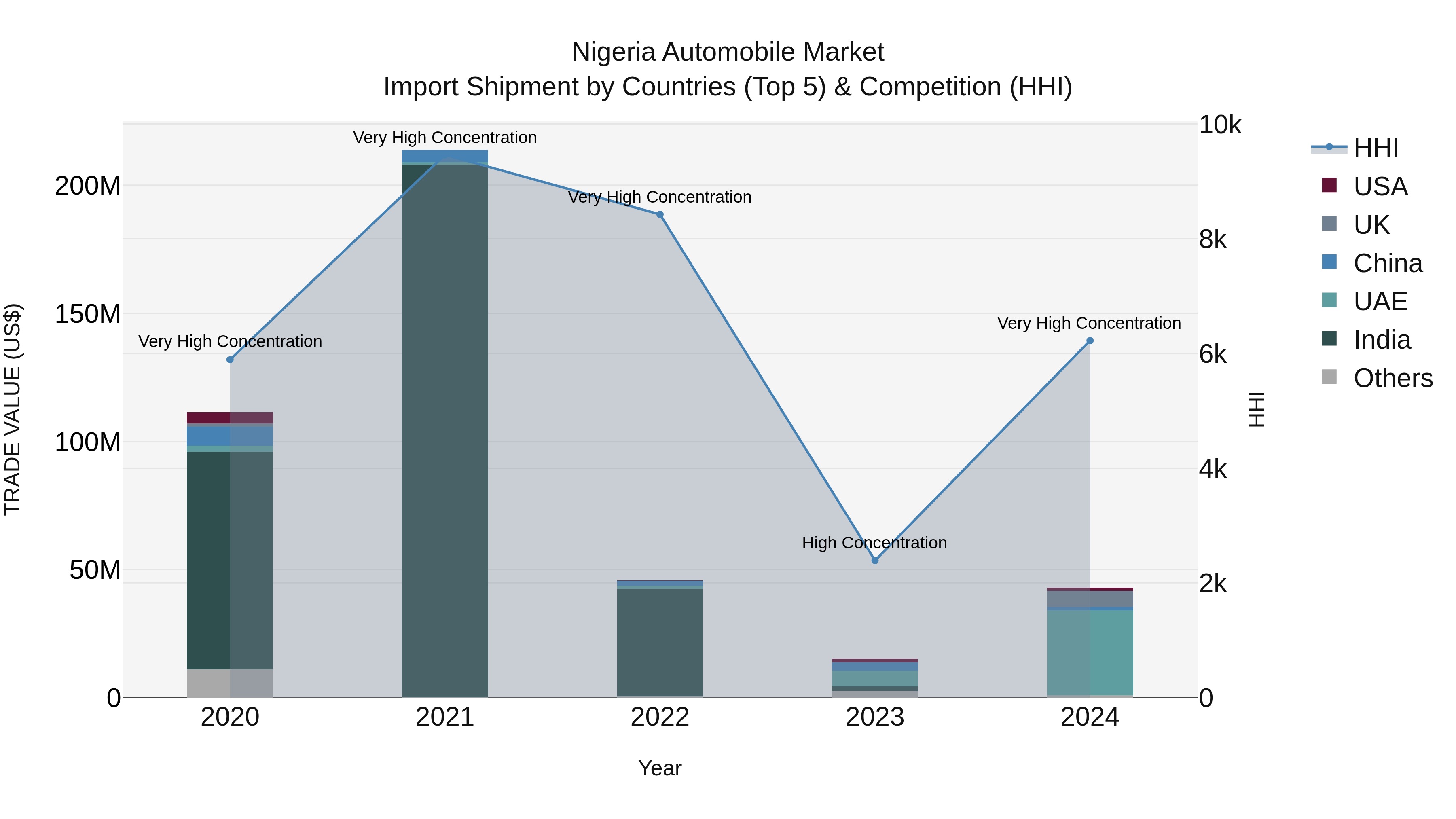
Nigeria Automobile Market Top 5 Importing Countries and Market Competition (HHI) Analysis
The Nigeria automobile import market continues to showcase significant growth and increasing concentration. In 2024, top exporting countries include UAE, UK, USA, China, and Japan. The market saw a drastic increase in concentration from 2023 to 2024. Despite a negative CAGR from 2020-24, the growth rate in 2024 surged by an impressive 183.88%. This indicates a dynamic market with potential opportunities and challenges for both domestic and international players in the automotive industry looking to capitalize on Nigeria`s import market.
Nigeria Automobile Market Growth Rate
According to 6Wresearch internal database and industry insights, the Nigeria Automobile Market is projected to grow at a compound annual growth rate (CAGR) of 6.8% during the forecast period from 2026 to 2032.
Topics Covered in the Nigeria Automobile Market Report
The Nigeria Automobile Market report thoroughly covers the market by vehicle type, propulsion, and type. It provides an unbiased and detailed analysis of ongoing market trends, opportunities, challenges, and market drivers, helping stakeholders align their strategies with current and future market dynamics.
Nigeria Automobile Market Highlights
| Report Name | Nigeria Automobile Market |
| Forecast Period | 2026–2032 |
| CAGR | 6.8% |
| Growing Sector | Automotive & Transportation |
Nigeria Automobile Market Synopsis
Nigeria Automobile Market is anticipated to experience steady growth driven by rapid urban growth, increase in the middle-class demographic, and the demand for different transportation solutions. More ride-hailing services and logistics support and ongoing infrastructure upgrades, are contributing to increased demand for both personal and commercial vehicles. Government initiatives promoting locally assembled vehicles through the National Automotive Industry Development Plan (NAIDP) are creating a domestic manufacturing industry while reducing reliance on imported vehicles. In addition, improved vehicle financing programs and awareness of the need for electric vehicles, along with continued investments into transportation infrastructure, will help in supporting the overall growth of the Nigerian automobile industry. With rising economic activities and expanding trade operations, the Nigeria Automobile Market is expected to expand consistently during the forecast period.
Evaluation of Growth Drivers in the Nigeria Automobile Market
Below mentioned are some prominent drivers and their impact on the Nigeria Automobile Market dynamics:
| Drivers | Primary Segment Affected | Why It Matters (Evidence) |
| Urbanization & Population Growth | Passenger Cars | Increasing urban population is boosting demand for personal mobility solutions. |
| Expansion of Logistics & E-commerce | Commercial Vehicles | Increase of delivery services lead to increased demand for vans and trucks. |
| Government Automotive Policy (NAIDP) | New Vehicles | Encourages local assembly of automobiles through modified import duties and tax incentives. |
| Availability of Vehicle Financing | Passenger Cars, Used Vehicles | Ease of obtaining auto-loans and lease provides affordability options to the consumers. |
| Ride-Hailing Services | Passenger Cars | Apps such as to Bolt and Uber have increased the number of vehicles being used for commercial purposes |
Nigeria Automobile Market is projected to grow at a CAGR of 6.8% from 2026 to 2032. Major growth factors include expansion of local vehicle assembly plants, increasing demand for commercial transport vehicles, and supportive automotive financing schemes. Rising infrastructure development projects and growth in intercity transportation services are also contributing significantly to the Nigeria Automobile Market Growth.
Evaluation of Restraints in the Nigeria Automobile Market
Below mentioned are some major restraints and their influence on the Nigeria Automobile Market dynamics:
| Restraints | Primary Segment Affected | What This Means (Evidence) |
| High Import Dependency | New Vehicles | Heavy reliance on imported vehicles increases prices due to exchange rate volatility. |
| Poor Road Infrastructure | All Segments | The conditions of poorly maintained roads negatively impact the reliability and longevity of vehicle components. |
| Limited EV Charging Infrastructure | Electric Vehicles | Lack of charging stations slows adoption of electric mobility. |
| High Vehicle Maintenance Costs | Passenger & Commercial Vehicles | High costs for the repairs and replacement parts of existing vehicles will adversely affect the ability to acquire new vehicles. |
| Regulatory & Customs Delays | New Vehicles | Long delays at clearance of new vehicle imports will impact supply into the marketplace. |
Nigeria Automobile Market Challenges
Nigeria Automobile Industry has encountered numerous challenges, such as variable international currency values, dependence on foreign automobile imports, and expensive costs of automobile ownership costs. Also, as there are insufficient charging stations for electric vehicles, their adoption rate is limited. In addition, vehicle purchase decisions are impacted by inadequate roadway systems and the continuing rise in gasoline prices. However, local production incentives from government and greater access to financial services will help to address these challenges in the long run. The unavailability of reasonable priced automobile loans and high interest rates may discourage first-time buyers to purchase vehicles.
Emerging Trends in the Nigeria Automobile Market
Trends driving the Nigeria Automobile Market include:
- Rise in Local Vehicle Assembly: International companies such as Toyota and Hyundai are establishing assembly facilities in the country, which promotes local production capabilities and decreases reliance on imports.
- Growth in Used Vehicle Market: More consumers want affordable ways to travel, so there is growing demand for pre-owned vehicles from Europe and North America.
Digital Auto Financing Platforms: Through partnership with fintech companies, auto lenders are streamlining their loan approvals processes, making it easier for people to own the vehicles they need. - Expansion of Ride-Hailing & Mobility Services: Increased use of ride-hailing and other mobility services (use of app-based taxi services) supporting an increase in demand for car purchases for personal use.
- Gradual Introduction of Electric Mobility: Various Pilot EV projects are providing the foundation for future EV development.
Investment Opportunities in the Nigeria Automobile Market
Key investment avenues in the Nigeria Automobile Market are:
- Establishment of Auto Assembly Plants: The establishment of auto assembly plants, in Nigeria, has a number of benefits, including tax incentives through NAIDP.
- Spare Parts Manufacturing: Manufacturing spare parts will result in a decrease of importing auto parts, which will not only reduce reliance on imports but also increase efficiencies within the supply chain.
- EV Charging Infrastructure Development: Constructing EV charging stations in major urban centres present a long-term investment opportunity.
- Automotive Aftermarket Services: The increase in the number of service centres and maintenance facilities will provide an ongoing source of revenue.
Top 5 Leading Players in the Nigeria Automobile Market
Below is the list of prominent companies leading in the Nigeria Automobile Market:
1. Toyota Nigeria Limited
| Company Name | Toyota Nigeria Limited |
|---|---|
| Established Year | 1996 |
| Headquarters | Lagos, Nigeria |
| Official Website | Click Here |
Toyota Nigeria Limited is a leading distributor and assembler of Toyota vehicles in Nigeria, offering a wide range of passenger and commercial vehicles with strong after-sales support.
2. Innoson Vehicle Manufacturing (IVM)
| Company Name | Innoson Vehicle Manufacturing (IVM) |
|---|---|
| Established Year | 2007 |
| Headquarters | Nnewi, Nigeria |
| Official Website | - |
Innoson is Nigeria first indigenous automobile manufacturer producing passenger cars, buses, and trucks locally under government-supported automotive development initiatives.
3. Stallion Motors
| Company Name | Stallion Motors |
|---|---|
| Established Year | 1969 |
| Headquarters | Lagos, Nigeria |
| Official Website | Click Here |
Stallion Motors operates vehicle assembly plants and distributes brands such as Hyundai and Nissan in Nigeria.
4. Coscharis Motors
| Company Name | Coscharis Motors |
|---|---|
| Established Year | 1977 |
| Headquarters | Lagos, Nigeria |
| Official Website | Click Here |
Coscharis Motors is a major automotive distributor offering premium brands including BMW and Ford with strong dealership networks.
5. Peugeot Automobile Nigeria (PAN)
| Company Name | Peugeot Automobile Nigeria (PAN) |
|---|---|
| Established Year | 1972 |
| Headquarters | Kaduna, Nigeria |
| Official Website | - |
PAN is a key vehicle assembler in Nigeria focusing on passenger cars and supporting domestic automotive production.
Government Regulations Introduced in the Nigeria Automobile Market
According to Nigerian government data, various initiatives have been introduced to strengthen the automobile sector. The National Automotive Industry Development Plan (NAIDP) provides tariff adjustments to encourage local assembly and reduce fully built unit imports. The introduction of tax incentives and duty rebates for manufacturers are establishing assembly plants in Nigeria. Moreover, policies promoting Compressed Natural Gas (CNG) vehicle conversion programs and pilot electric vehicle initiatives in Lagos are supporting alternative adoption of the fuel.
Future Insights of the Nigeria Automobile Market
Nigeria Automobile Market Share is anticipated to experience a strong growth supported by expanding domestic vehicle assembly, the growth of infrastructure projects, and digital transformation in auto financing. Growth in commercial transportation, modernization of public transit fleets and gradual implementation of electric vehicle programs are helping to increase the market Growth in smart mobility solutions through increased investment and reduced dependency on imported products by the government will create opportunities for growth in the future. The rising adoption of alternative fuel vehicles, including CNG-powered vehicles, and the integration of digital vehicle tracking and fleet management systems are also expected to shape the long-term development of the Nigeria Automobile Market.
Market Segmentation Analysis
The report offers a comprehensive study of the following market segments and their leading categories:
By Vehicle Type – Passenger Cars to dominate the market
According to Ekta, Senior Research Analyst, 6Wresearch, Passenger Cars are expected to dominate the Nigeria Automobile Market Share due to rising urbanization, expanding middle-class income levels, and increasing participation in ride-hailing services. Growing availability of financing schemes and demand for affordable mobility solutions are further strengthening this segment dominance.
By Propulsion – Internal Combustion Engine (ICE) to dominate the market
Internal Combustion Engine vehicles are dominating the market due to limited EV charging infrastructure and higher affordability compared to electric vehicles. Nigeria existing fuel distribution network supports ICE vehicle usage, making it the preferred propulsion choice.
By Type – Used Vehicles to dominate the market
Used Vehicles are expected to dominate the market as they offer cost-effective transportation options for a large portion of the population. Importation of fairly used vehicles remains strong due to affordability and availability.
Key Attractiveness of the Report
- 10 Years of Market Numbers
- Historical Data Starting from 2022 to 2025
- Base Year: 2025
- Forecast Data until 2032
- Key Performance Indicators Impacting the Market
- Major Upcoming Developments and Projects
Key Highlights of the Report:
- Nigeria Automobile Market Outlook
- Market Size of Nigeria Automobile Market, 2025
- Forecast of Nigeria Automobile Market, 2032
- Historical Data and Forecast of Nigeria Automobile Revenues & Volume for the Period 2022- 2032
- Nigeria Automobile Market Trend Evolution
- Nigeria Automobile Market Drivers and Challenges
- Nigeria Automobile Price Trends
- Nigeria Automobile Porter's Five Forces
- Nigeria Automobile Industry Life Cycle
- Historical Data and Forecast of Nigeria Automobile Market Revenues & Volume By Vehicle Type for the Period 2022- 2032
- Historical Data and Forecast of Nigeria Automobile Market Revenues & Volume By Passenger Cars for the Period 2022- 2032
- Historical Data and Forecast of Nigeria Automobile Market Revenues & Volume By Commercial Vehicles for the Period 2022- 2032
- Historical Data and Forecast of Nigeria Automobile Market Revenues & Volume By Two-wheelers for the Period 2022- 2032
- Historical Data and Forecast of Nigeria Automobile Market Revenues & Volume By Three-wheelers for the Period 2022- 2032
- Historical Data and Forecast of Nigeria Automobile Market Revenues & Volume By Propulsion for the Period 2022- 2032
- Historical Data and Forecast of Nigeria Automobile Market Revenues & Volume By Internal Combustion Engine for the Period 2022- 2032
- Historical Data and Forecast of Nigeria Automobile Market Revenues & Volume By Electric Vehicles for the Period 2022- 2032
- Historical Data and Forecast of Nigeria Automobile Market Revenues & Volume By Type for the Period 2022- 2032
- Historical Data and Forecast of Nigeria Automobile Market Revenues & Volume By New Vehicles for the Period 2022- 2032
- Historical Data and Forecast of Nigeria Automobile Market Revenues & Volume By Used Vehicles for the Period 2022- 2032
- Nigeria Automobile Import Export Trade Statistics
- Market Opportunity Assessment By Vehicle Type
- Market Opportunity Assessment By Propulsion
- Market Opportunity Assessment By Type
- Nigeria Automobile Top Companies Market Share
- Nigeria Automobile Competitive Benchmarking By Technical and Operational Parameters
- Nigeria Automobile Company Profiles
- Nigeria Automobile Key Strategic Recommendations
Market Covered
The report offers a comprehensive study of the following Nigeria Automobile Market segments:
By Vehicle Type
- Passenger Cars
- Commercial Vehicles
- Two-wheelers
- Three-wheelers
By Propulsion
- Internal Combustion Engine
- Electric Vehicles
By Type
- New Vehicles
- Used Vehicles
Nigeria Automobile Market (2026-2032): FAQs
Nigeria Automobile Market is expected to grow at a compound annual growth rate of 6.8% during the forecast period of 2026 to 2032.
Passenger Cars dominate the Market due to rising urbanization, expanding middle-class income levels, and increasing participation in ride-hailing services.
The factors driving the growth includes availability of imported pre-owned vehicles and flexible financing options.
The government initiatives like NAIDP program and pilot electric vehicle initiatives strengthen the automobile sector.
6Wresearch actively monitors the Nigeria Automobile Market and publishes its comprehensive annual report, highlighting emerging trends, growth drivers, revenue analysis, and forecast outlook. Our insights help businesses to make data-backed strategic decisions with ongoing market dynamics. Our analysts track relevent industries related to the Nigeria Automobile Market, allowing our clients with actionable intelligence and reliable forecasts tailored to emerging regional needs.
Yes, we provide customisation as per your requirements. To learn more, feel free to contact us on sales@6wresearch.com
| 1 Executive Summary |
| 2 Introduction |
| 2.1 Key Highlights of the Report |
| 2.2 Report Description |
| 2.3 Market Scope & Segmentation |
| 2.4 Research Methodology |
| 2.5 Assumptions |
| 3 Nigeria Automobile Market Overview |
| 3.1 Nigeria Country Macro Economic Indicators |
| 3.2 Nigeria Automobile Market Revenues & Volume, 2022 & 2032F |
| 3.3 Nigeria Automobile Market - Industry Life Cycle |
| 3.4 Nigeria Automobile Market - Porter's Five Forces |
| 3.5 Nigeria Automobile Market Revenues & Volume Share, By Vehicle Type, 2022 & 2032F |
| 3.6 Nigeria Automobile Market Revenues & Volume Share, By Propulsion, 2022 & 2032F |
| 3.7 Nigeria Automobile Market Revenues & Volume Share, By Type, 2022 & 2032F |
| 4 Nigeria Automobile Market Dynamics |
| 4.1 Impact Analysis |
| 4.2 Market Drivers |
| 4.2.1 Economic growth and rising disposable income leading to increased consumer spending on automobiles. |
| 4.2.2 Government initiatives and policies promoting the automotive industry. |
| 4.2.3 Urbanization and infrastructure development increasing demand for vehicles. |
| 4.2.4 Technological advancements driving innovation in the automobile market. |
| 4.3 Market Restraints |
| 4.3.1 High import tariffs and taxes affecting affordability of vehicles. |
| 4.3.2 Volatility in oil prices impacting consumer purchasing power. |
| 4.3.3 Poor road conditions and lack of proper maintenance affecting vehicle performance and sales. |
| 5 Nigeria Automobile Market Trends |
| 6 Nigeria Automobile Market, By Types |
| 6.1 Nigeria Automobile Market, By Vehicle Type |
| 6.1.1 Overview and Analysis |
| 6.1.2 Nigeria Automobile Market Revenues & Volume, By Vehicle Type, 2022- 2032F |
| 6.1.3 Nigeria Automobile Market Revenues & Volume, By Passenger Cars, 2022- 2032F |
| 6.1.4 Nigeria Automobile Market Revenues & Volume, By Commercial Vehicles, 2022- 2032F |
| 6.1.5 Nigeria Automobile Market Revenues & Volume, By Two-wheelers, 2022- 2032F |
| 6.1.6 Nigeria Automobile Market Revenues & Volume, By Three-wheelers, 2022- 2032F |
| 6.2 Nigeria Automobile Market, By Propulsion |
| 6.2.1 Overview and Analysis |
| 6.2.2 Nigeria Automobile Market Revenues & Volume, By Internal Combustion Engine, 2022- 2032F |
| 6.2.3 Nigeria Automobile Market Revenues & Volume, By Electric Vehicles, 2022- 2032F |
| 6.3 Nigeria Automobile Market, By Type |
| 6.3.1 Overview and Analysis |
| 6.3.2 Nigeria Automobile Market Revenues & Volume, By New Vehicles, 2022- 2032F |
| 6.3.3 Nigeria Automobile Market Revenues & Volume, By Used Vehicles, 2022- 2032F |
| 7 Nigeria Automobile Market Import-Export Trade Statistics |
| 7.1 Nigeria Automobile Market Export to Major Countries |
| 7.2 Nigeria Automobile Market Imports from Major Countries |
| 8 Nigeria Automobile Market Key Performance Indicators |
| 8.1 Average age of vehicles on the road. |
| 8.2 Number of new car registrations. |
| 8.3 Average annual mileage of vehicles. |
| 8.4 Percentage of vehicles using alternative fuels. |
| 8.5 Average vehicle efficiency rating. |
| 9 Nigeria Automobile Market - Opportunity Assessment |
| 9.1 Nigeria Automobile Market Opportunity Assessment, By Vehicle Type, 2022 & 2032F |
| 9.2 Nigeria Automobile Market Opportunity Assessment, By Propulsion, 2022 & 2032F |
| 9.3 Nigeria Automobile Market Opportunity Assessment, By Type, 2022 & 2032F |
| 10 Nigeria Automobile Market - Competitive Landscape |
| 10.1 Nigeria Automobile Market Revenue Share, By Companies, 2025 |
| 10.2 Nigeria Automobile Market Competitive Benchmarking, By Operating and Technical Parameters |
| 11 Company Profiles |
| 12 Recommendations |
| 13 Disclaimer |
Export potential assessment - trade Analytics for 2030
Export potential enables firms to identify high-growth global markets with greater confidence by combining advanced trade intelligence with a structured quantitative methodology. The framework analyzes emerging demand trends and country-level import patterns while integrating macroeconomic and trade datasets such as GDP and population forecasts, bilateral import–export flows, tariff structures, elasticity differentials between developed and developing economies, geographic distance, and import demand projections. Using weighted trade values from 2020–2024 as the base period to project country-to-country export potential for 2030, these inputs are operationalized through calculated drivers such as gravity model parameters, tariff impact factors, and projected GDP per-capita growth. Through an analysis of hidden potentials, demand hotspots, and market conditions that are most favorable to success, this method enables firms to focus on target countries, maximize returns, and global expansion with data, backed by accuracy.
By factoring in the projected importer demand gap that is currently unmet and could be potential opportunity, it identifies the potential for the Exporter (Country) among 190 countries, against the general trade analysis, which identifies the biggest importer or exporter.
To discover high-growth global markets and optimize your business strategy:
Click Here
Pricing
- Single User License$ 1,995
- Department License$ 2,400
- Site License$ 3,120
- Global License$ 3,795

Search
Thought Leadership and Analyst Meet





Our Clients








Related Reports
- India Switchgear Market Outlook (2026 - 2032) | Size, Share, Trends, Growth, Revenue, Forecast, Analysis, Value, Outlook
- Pakistan Contraceptive Implants Market (2025-2031) | Demand, Growth, Size, Share, Industry, Pricing Analysis, Competitive, Strategic Insights, Strategy, Consumer Insights, Analysis, Investment Trends, Opportunities, Revenue, Segments, Value, Segmentation, Supply, Forecast, Restraints, Outlook, Competition, Drivers, Trends, Companies, Challenges
- Sri Lanka Packaging Market (2026-2032) | Outlook, Competition, Drivers, Trends, Demand, Pricing Analysis, Competitive, Strategic Insights, Companies, Challenges, Strategy, Consumer Insights, Analysis, Investment Trends, Opportunities, Growth, Size, Share, Industry, Revenue, Segments, Value, Segmentation, Supply, Forecast, Restraints
- India Kids Watches Market (2026-2032) | Strategy, Consumer Insights, Analysis, Investment Trends, Opportunities, Growth, Size, Share, Industry, Revenue, Segments, Value, Segmentation, Supply, Forecast, Restraints, Outlook, Competition, Drivers, Trends, Demand, Pricing Analysis, Competitive, Strategic Insights, Companies, Challenges
- Saudi Arabia Core Assurance Service Market (2025-2031) | Strategy, Consumer Insights, Analysis, Investment Trends, Opportunities, Growth, Size, Share, Industry, Revenue, Segments, Value, Segmentation, Supply, Forecast, Restraints, Outlook, Competition, Drivers, Trends, Demand, Pricing Analysis, Competitive, Strategic Insights, Companies, Challenges
- Romania Uninterruptible Power Supply (UPS) Market (2026-2032) | Industry, Analysis, Revenue, Size, Forecast, Outlook, Value, Trends, Share, Growth & Companies
- Saudi Arabia Car Window Tinting Film, Paint Protection Film (PPF), and Ceramic Coating Market (2025-2031) | Strategy, Consumer Insights, Analysis, Investment Trends, Opportunities, Growth, Size, Share, Industry, Revenue, Segments, Value, Segmentation, Supply, Forecast, Restraints, Outlook, Competition, Drivers, Trends, Demand, Pricing Analysis, Competitive, Strategic Insights, Companies, Challenges
- South Africa Stationery Market (2025-2031) | Share, Size, Industry, Value, Growth, Revenue, Analysis, Trends, Segmentation & Outlook
- Afghanistan Rocking Chairs And Adirondack Chairs Market (2026-2032) | Size & Revenue, Competitive Landscape, Share, Segmentation, Industry, Value, Outlook, Analysis, Trends, Growth, Forecast, Companies
- Afghanistan Apparel Market (2026-2032) | Growth, Outlook, Industry, Segmentation, Forecast, Size, Companies, Trends, Value, Share, Analysis & Revenue
Industry Events and Analyst Meet

India EV Show 2026

EV tech India Expo 2026

Auto Tech Asia 2026

Battery Tech India 2026

Smart Production Solutions Guangzhou 2026
Whitepaper
- Middle East & Africa Commercial Security Market Click here to view more.
- Middle East & Africa Fire Safety Systems & Equipment Market Click here to view more.
- GCC Drone Market Click here to view more.
- Middle East Lighting Fixture Market Click here to view more.
- GCC Physical & Perimeter Security Market Click here to view more.
6WResearch In News
- Doha a strategic location for EV manufacturing hub: IPA Qatar
- Demand for luxury TVs surging in the GCC, says Samsung
- Empowering Growth: The Thriving Journey of Bangladesh’s Cable Industry
- Demand for luxury TVs surging in the GCC, says Samsung
- Video call with a traditional healer? Once unthinkable, it’s now common in South Africa
- Intelligent Buildings To Smooth GCC’s Path To Net Zero


