Pakistan Calcium carbide Market (2026-2032) | Share, Size, Trends, Analysis, Forecast, Growth, Value, Industry, Companies & Revenue
Market Forecast By Application (Acetylene Gas, Calcium Cyanamide, Reducing and Dehydrating Agent, Desulfurizing and Deoxidizing Agent, Other Applications), By End-user Industry (Chemical, Metallurgy, Food, Other End-user Industries) And Competitive Landscape
| Product Code: ETC106316 | Publication Date: Jun 2021 | Updated Date: Mar 2026 | Product Type: Report | |
| Publisher: 6Wresearch | Author: Ravi Bhandari | No. of Pages: 70 | No. of Figures: 35 | No. of Tables: 5 |
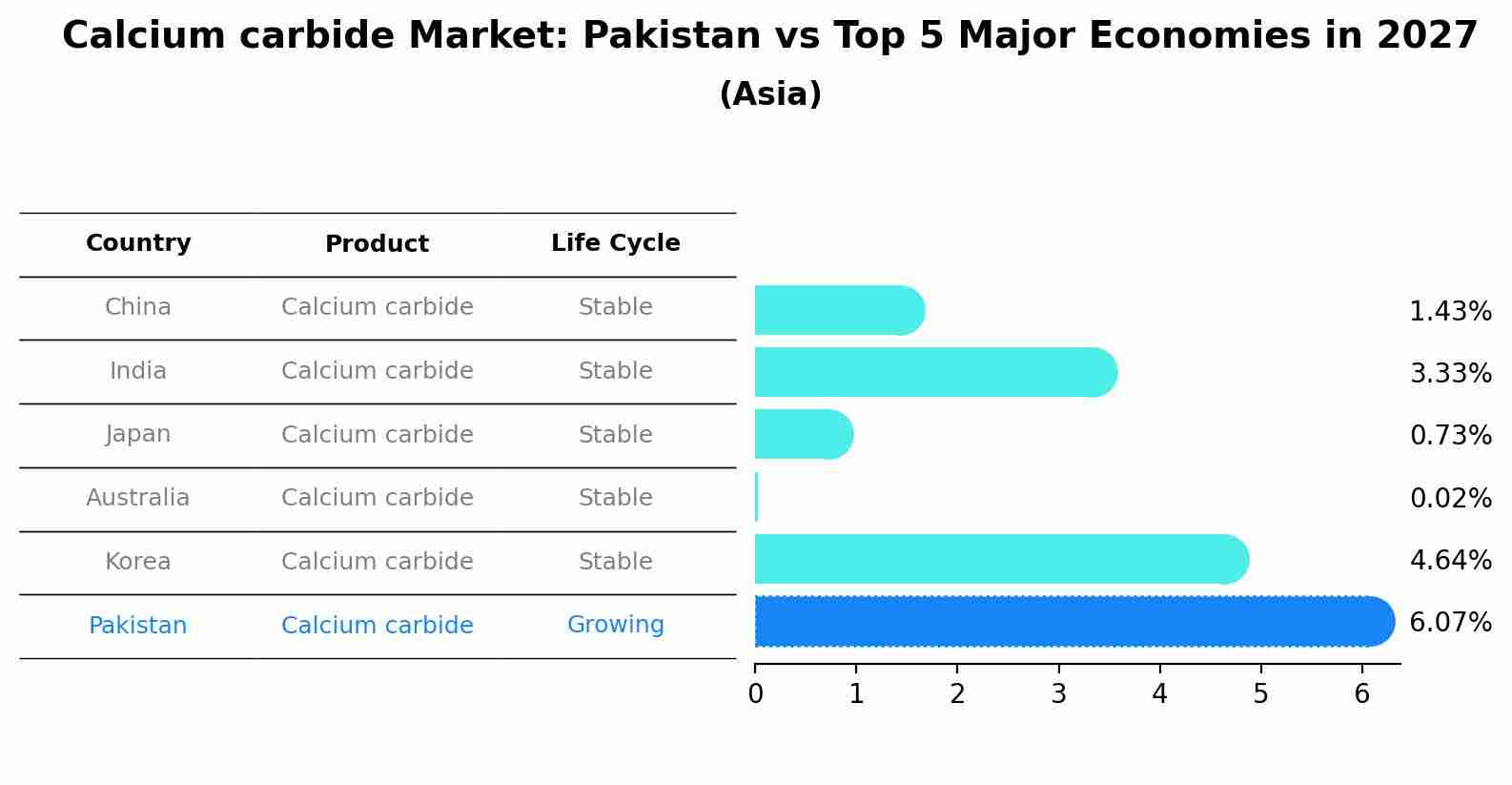
Calcium carbide Market: Pakistan vs Top 5 Major Economies in 2027 (Asia)
Pakistan's Calcium carbide market is anticipated to experience a growing growth rate of 6.07% by 2027, reflecting trends observed in the largest economy China, followed by India, Japan, Australia and South Korea.
Pakistan Calcium Carbide Market Growth Rate
According to 6Wresearch internal database and industry insights, the Pakistan Calcium Carbide Market is projected to grow at a compound annual growth rate (CAGR) of 6.4% during the forecast period (2026–2032).
Topics Covered in the Pakistan Calcium Carbide Market Report
The Pakistan Calcium Carbide Market report thoroughly covers the market by application and end-user industry. The report provides a detailed analysis of ongoing market trends, opportunities/high-growth areas, and market drivers that will help stakeholders align strategies based on current and future market dynamics.
Pakistan Calcium Carbide Market Highlights
| Report Name | Pakistan Calcium Carbide Market |
| Forecast Period | 2026–2032 |
| CAGR | 6.4% |
| Growing Sector |
Chemical Synthesis and Metallurgy |
Pakistan Calcium Carbide Market Synopsis
The Pakistan Calcium Carbide Market is projected to attain enormous expansion in the coming years on the back of a major industrial transition toward self-reliance and import substitution. The market, which has in the past relied on imports from China, is shifting to use products manufactured locally in an attempt to avoid currency fluctuations. Moreover, the growth of the agricultural sector has resulted in an increased demand for calcium cyanamide derivatives, and therefore, calcium carbide is an essential raw material for the development of industrial as well as agro-based economies.
Evaluation of Growth Drivers in Pakistan Calcium Carbide Market
Below are some major drivers and their influence on the market dynamics:
| Drivers | Primary Segments Affected | Why It Matters |
| Import Exchange | By End-user (Chemical) | Local production diminishes reliance on foreign exchange and cuts logistics costs. |
| Development of Steel Sector | By Application (Desulfurizing) | Modernization of steel mills requires higher purity deoxidizing agents. |
| Thriving Infrastructure | By Application (Acetylene Gas) | Improved metal welding and cutting activities in urban development projects. |
| Agrochemical Demand | By Application (Calcium Cyanamide) | Indispensable for producing fertilizers that improve soil health and crop yields. |
| Industrial Zone Incentives | By End-user (All Industries) | Government tax holidays attract large-scale private investments in chemical plants |
Pakistan Calcium Carbide Market is expected to grow at a CAGR of 6.4% during the forecast period of 2026-2032. This steady growth reflects increasing industrial activity, expanding end‑user sectors, and greater demand for calcium carbide in key applications such as acetylene gas production, chemical synthesis, and metal processing. The market expansion is supported by rising infrastructure development, particularly in construction, welding applications, and manufacturing, which together contribute to heightened use of calcium carbide as a foundational industrial material.
Evaluation of Restraints in Pakistan Calcium Carbide Market
Below are some major restraints and their influence on the market dynamics:
| Restraints | Primary Segments Affected | What This Means |
| Energy Crisis | By End-user (Metallurgy) | Frequent power outages affect the continuous operation of electric arc furnaces. |
| Raw Material Volatility | By Application (Acetylene Gas) | Coke and lime prices are volatile. |
| Strict Safety Norms | By Application (Other) | Special arrangements are needed for storage and transportation due to the highly reactive nature of the compound. |
| Environmental Laws | By End-user (Chemical) | Carbon emission concerns related to the use of coal. |
| Alternative Technologies | By Application (Acetylene Gas) | Gradual shift toward plasma cutting and electric welding reduces gas demand. |
Pakistan Calcium Carbide Market Challenges
The Pakistan Calcium Carbide Market is expected to continue its upward momentum during the forecast period. However, the high energy intensity of the production process remains a major barrier for local players, as electricity costs in Pakistan are among the highest in the region. In addition, regulatory discrepancies regarding the handling of hazardous chemicals and municipal safety permits for "carbide-to-acetylene" generators often lead to operational delays. As well, there is limited standardized purity certification across smaller local distributors, which makes some high-end industrial consumers hesitant to switch from established international suppliers.
Pakistan Calcium Carbide Market Trends
The current trends that are affecting the Pakistan Calcium Carbide Market are:
- Move towards Semi-Automated Furnaces: Local players are shifting towards Chinese and European furnace technology, which helps recover heat. This reduces the energy consumption per ton by a large margin.
- Rise of the PVC Value Chain: With the local production of PVC Resins, there has been a growing trend to use carbide-based acetylene as a substitute for petroleum-based ethylene.
Investment Opportunities in the Pakistan Calcium Carbide Market
An analysis of the best investment opportunities in the Pakistan Calcium Carbide Industry is as follows:
- Export-Oriented Units: Leveraging the geographical advantage of Pakistan to export excess calcium carbide to countries like Afghanistan and the Central Asian Republics.
- ertical Integration with Lime Kilns: Investing in the production of lime plants ensures the availability of high-quality raw materials, thereby reducing the overall cost of production.
- Waste-to-Value Plants: Setting up plants that have the capability to process "carbide lime" into cement bricks or construction materials.
Top 5 Leading Players in the Pakistan Calcium Carbide Market
Below is a list of prominent companies leading the Pakistan Calcium Carbide Market:
1. Pak Libya
| Company Name | Pak Libya |
|---|---|
| Established Year | 1992 |
| Headquarters | Karachi, Sindh |
| Official Website | Click Here |
Pak Libya is a key manufacturer of calcium carbide in Pakistan. It serves various industrial applications, including acetylene production and metallurgy.
2. Simec Group
| Company Name | Simec Group |
|---|---|
| Established Year | 1995 |
| Headquarters | Lahore, Punjab |
| Official Website | Click Here |
Simec Group produces calcium carbide primarily for the metallurgy industry. It is recognized for supplying high-quality carbide products used in steel manufacturing and chemical processes.
3. Pakistan Steel Mills Corporation
| Company Name | Pakistan Steel Mills Corporation |
|---|---|
| Established Year | 1973 |
| Headquarters | Karachi, Sindh |
| Official Website | - |
Pakistan Steel Mills is the largest steel manufacturer in the country. It uses calcium carbide extensively in its steel manufacturing process, particularly for desulfurization.
4. Tariq Glass Industries Limited
| Company Name | Tariq Glass Industries Limited |
|---|---|
| Established Year | 1978 |
| Headquarters | Lahore, Punjab |
| Official Website | Click Here |
Tariq Glass is involved in the manufacturing of glass products but also has significant operations involving calcium carbide in the production process, particularly for use as a reducing agent.
5. Ghani ChemWorld Limited (GCWL)
| Company Name | Ghani ChemWorld Limited (GCWL) |
|---|---|
| Established Year | 2024 |
| Headquarters | Lahore, Punjab |
| Official Website | - |
A pioneer in localized production, managing Pakistan’s first large-scale calcium carbide plant in the Hattar Special Economic Zone, aimed at achieving 90% import substitution.
Government Regulations in the Pakistan Calcium Carbide Market
The Government of Pakistan has played a pivotal role through initiatives like the National Chemical Policy, which provides a framework for the safe handling and domestic manufacture of industrial chemicals. Apart from this, the Income Tax Ordinance (Clause 126) is the best example of state-level support, as it provides a tax holiday for 10 years for manufacturing projects set up in Special Economic Zones (SEZs) such as Hattar and Rashakai. Secondly, the Ministry of Commerce has introduced stricter assessment criteria for imported carbide (e.g., VR# 1824/2023) in order to provide fair competition for local producers and prevent the dumping of substandard materials.
Future Insights of the Pakistan Calcium Carbide Market
The Pakistan Calcium Carbide Market is likely to maintain its growth path, and the factors influencing the market are the rising level of industrialization and the increasing number of end-use industries. With the steel industry undergoing a period of modernization, the agricultural sector, and the infrastructure sector, the calcium carbide market is likely to grow significantly. In addition, investments in sustainable production processes and strategic government initiatives are likely to boost the calcium carbide market.
Market Segmentation Analysis
The report offers a comprehensive study of the leading categories in each segment:
By Application – Acetylene Gas to Lead the Market
Acetylene Gas segment is anticipated to lead the market as it remains the primary utility for metal fabrication, oxy-fuel cutting, and chemical synthesis. In Pakistan, the dominance of the ship-breaking industry at Gadani and the extensive network of small-to-medium metal workshops drive a continuous and massive demand for carbide-based acetylene, which is preferred over alternatives for its high-temperature flame and localized availability.
By End-user Industry – Chemical to Lead the Market
According to Rishil, Senior Research Analyst, 6Wresearch, Chemical Industry is expected to dominate the Pakistan Calcium Carbide Market share due to the rising production of PVC and other organic compounds. As Pakistan seeks to reduce its high import bill for plastic resins, integrated chemical complexes are increasingly adopting carbide-to-acetylene routes. This segment is bolstered by the strategic move of players to use calcium carbide as a fundamental building block for downstream value-added chemicals.
Key Attractiveness of the Report
- 10 Years of Market Numbers
- Historical Data Starting from 2022 to 2025
- Base Year: 2025
- Forecast Data until 2032
- Key Performance Indicators Impacting the Market
- Major Upcoming Developments and Projects
Key Highlights of the Report:
- Pakistan Calcium carbide Market Outlook
- Market Size of Pakistan Calcium carbide Market, 2025
- Forecast of Pakistan Calcium carbide Market, 2032
- Historical Data and Forecast of Pakistan Calcium carbide Revenues & Volume for the Period 2022-2032F
- Pakistan Calcium carbide Market Trend Evolution
- Pakistan Calcium carbide Market Drivers and Challenges
- Pakistan Calcium carbide Price Trends
- Pakistan Calcium carbide Porter's Five Forces
- Pakistan Calcium carbide Industry Life Cycle
- Historical Data and Forecast of Pakistan Calcium carbide Market Revenues & Volume By Application for the Period 2022-2032F
- Historical Data and Forecast of Pakistan Calcium carbide Market Revenues & Volume By Acetylene Gas for the Period 2022-2032F
- Historical Data and Forecast of Pakistan Calcium carbide Market Revenues & Volume By Calcium Cyanamide for the Period 2022-2032F
- Historical Data and Forecast of Pakistan Calcium carbide Market Revenues & Volume By Reducing and Dehydrating Agent for the Period 2022-2032F
- Historical Data and Forecast of Pakistan Calcium carbide Market Revenues & Volume By Desulfurizing and Deoxidizing Agent for the Period 2022-2032F
- Historical Data and Forecast of Pakistan Calcium carbide Market Revenues & Volume By Other Applications for the Period 2022-2032F
- Historical Data and Forecast of Pakistan Calcium carbide Market Revenues & Volume By End-user Industry for the Period 2022-2032F
- Historical Data and Forecast of Pakistan Calcium carbide Market Revenues & Volume By Chemical for the Period 2022-2032F
- Historical Data and Forecast of Pakistan Calcium carbide Market Revenues & Volume By Metallurgy for the Period 2022-2032F
- Historical Data and Forecast of Pakistan Calcium carbide Market Revenues & Volume By Food for the Period 2022-2032F
- Historical Data and Forecast of Pakistan Calcium carbide Market Revenues & Volume By Other End-user Industries for the Period 2022-2032F
- Pakistan Calcium carbide Import Export Trade Statistics
- Market Opportunity Assessment By Application
- Market Opportunity Assessment By End-user Industry
- Pakistan Calcium carbide Top Companies Market Share
- Pakistan Calcium carbide Competitive Benchmarking By Technical and Operational Parameters
- Pakistan Calcium carbide Company Profiles
- Pakistan Calcium carbide Key Strategic Recommendations
Market Covered
The report offers a comprehensive study of the following market segments:
By Application
- Acetylene Gas
- Calcium Cyanamide
- Reducing and Dehydrating Agent
- Desulfurizing and Deoxidizing Agent
- Other Applications
By End-user Industry
- Chemical
- Metallurgy
- Food (Controlled Ripening)
- Other End-user Industries
Pakistan Calcium carbide Market (2026-2032): FAQs
Pakistan Calcium Carbide Market is projected to grow at a CAGR of 6.4% during the forecast period 2026-2032.
Key drivers include industrial expansion, the growing need for acetylene gas, and increasing chemical sector demand.
The high production costs, supply chain disruptions, and regulatory hurdles are some of the challenges faced by the calcium carbide market.
The opportunities for the calcium carbide market are the emerging markets, eco-friendly production, and new uses for calcium carbide in the chemical industry.
6Wresearch actively monitors the Pakistan Calcium carbide Market and publishes its comprehensive annual report, highlighting emerging trends, growth drivers, revenue analysis, and forecast outlook. Our insights help businesses to make data-backed strategic decisions with ongoing market dynamics. Our analysts track relevent industries related to the Pakistan Calcium carbide Market, allowing our clients with actionable intelligence and reliable forecasts tailored to emerging regional needs.
Yes, we provide customisation as per your requirements. To learn more, feel free to contact us on sales@6wresearch.com
| 1 Executive Summary |
| 2 Introduction |
| 2.1 Key Highlights of the Report |
| 2.2 Report Description |
| 2.3 Market Scope & Segmentation |
| 2.4 Research Methodology |
| 2.5 Assumptions |
| 3 Pakistan Calcium carbide Market Overview |
| 3.1 Pakistan Country Macro Economic Indicators |
| 3.2 Pakistan Calcium carbide Market Revenues & Volume, 2022 & 2032F |
| 3.3 Pakistan Calcium carbide Market - Industry Life Cycle |
| 3.4 Pakistan Calcium carbide Market - Porter's Five Forces |
| 3.5 Pakistan Calcium carbide Market Revenues & Volume Share, By Form, 2022 & 2032F |
| 3.6 Pakistan Calcium carbide Market Revenues & Volume Share, By End-user Industry, 2022 & 2032F |
| 4 Pakistan Calcium carbide Market Dynamics |
| 4.1 Impact Analysis |
| 4.2 Market Drivers |
| 4.3 Market Restraints |
| 5 Pakistan Calcium carbide Market Trends |
| 6 Pakistan Calcium carbide Market, By Types |
| 6.1 Pakistan Calcium carbide Market, By Application |
| 6.1.1 Overview and Analysis |
| 6.1.2 Pakistan Calcium carbide Market Revenues & Volume, By Application, 2022-2032F |
| 6.1.3 Pakistan Calcium carbide Market Revenues & Volume, By Acetylene Gas, 2022-2032F |
| 6.1.4 Pakistan Calcium carbide Market Revenues & Volume, By Calcium Cyanamide, 2022-2032F |
| 6.1.5 Pakistan Calcium carbide Market Revenues & Volume, By Reducing and Dehydrating Agent, 2022-2032F |
| 6.1.6 Pakistan Calcium carbide Market Revenues & Volume, By Desulfurizing and Deoxidizing Agent, 2022-2032F |
| 6.1.7 Pakistan Calcium carbide Market Revenues & Volume, By Other Applications, 2022-2032F |
| 6.2 Pakistan Calcium carbide Market, By End-user Industry |
| 6.2.1 Overview and Analysis |
| 6.2.2 Pakistan Calcium carbide Market Revenues & Volume, By Chemical, 2022-2032F |
| 6.2.3 Pakistan Calcium carbide Market Revenues & Volume, By Metallurgy, 2022-2032F |
| 6.2.4 Pakistan Calcium carbide Market Revenues & Volume, By Food, 2022-2032F |
| 6.2.5 Pakistan Calcium carbide Market Revenues & Volume, By Other End-user Industries, 2022-2032F |
| 7 Pakistan Calcium carbide Market Import-Export Trade Statistics |
| 7.1 Pakistan Calcium carbide Market Export to Major Countries |
| 7.2 Pakistan Calcium carbide Market Imports from Major Countries |
| 8 Pakistan Calcium carbide Market Key Performance Indicators |
| 9 Pakistan Calcium carbide Market - Opportunity Assessment |
| 9.1 Pakistan Calcium carbide Market Opportunity Assessment, By Application, 2022 & 2032F |
| 9.2 Pakistan Calcium carbide Market Opportunity Assessment, By End-user Industry, 2022 & 2032F |
| 10 Pakistan Calcium carbide Market - Competitive Landscape |
| 10.1 Pakistan Calcium carbide Market Revenue Share, By Companies, 2025 |
| 10.2 Pakistan Calcium carbide Market Competitive Benchmarking, By Operating and Technical Parameters |
| 11 Company Profiles |
| 12 Recommendations |
| 13 Disclaimer |
Export potential assessment - trade Analytics for 2030
Export potential enables firms to identify high-growth global markets with greater confidence by combining advanced trade intelligence with a structured quantitative methodology. The framework analyzes emerging demand trends and country-level import patterns while integrating macroeconomic and trade datasets such as GDP and population forecasts, bilateral import–export flows, tariff structures, elasticity differentials between developed and developing economies, geographic distance, and import demand projections. Using weighted trade values from 2020–2024 as the base period to project country-to-country export potential for 2030, these inputs are operationalized through calculated drivers such as gravity model parameters, tariff impact factors, and projected GDP per-capita growth. Through an analysis of hidden potentials, demand hotspots, and market conditions that are most favorable to success, this method enables firms to focus on target countries, maximize returns, and global expansion with data, backed by accuracy.
By factoring in the projected importer demand gap that is currently unmet and could be potential opportunity, it identifies the potential for the Exporter (Country) among 190 countries, against the general trade analysis, which identifies the biggest importer or exporter.
To discover high-growth global markets and optimize your business strategy:
Click Here
Pricing
- Single User License$ 1,995
- Department License$ 2,400
- Site License$ 3,120
- Global License$ 3,795

Search
Thought Leadership and Analyst Meet





Our Clients








Latest Reports
- France Thermally Conductive Filler Dispersants Market (2026-2032) | Challenges, Restraints, Value, Share, Size, segmentation, Analysis, Trends, Investment Opportunities, Outlook, Pricing, Demand, Forecast, Revenue, Companies, Growth, Drivers, Strategy, Insights, Competition
- Egypt Thermally Conductive Filler Dispersants Market (2026-2032) | Competition, Forecast, Strategy, Value, Insights, Outlook, Investment Opportunities, Pricing, Demand, Share, segmentation, Drivers, Size, Companies, Restraints, Growth, Trends, Revenue, Challenges, Analysis
- Czech Republic Thermally Conductive Filler Dispersants Market (2026-2032) | Forecast, Pricing, Analysis, Drivers, Insights, Size, Demand, Growth, Challenges, segmentation, Competition, Outlook, Trends, Investment Opportunities, Companies, Strategy, Revenue, Share, Value, Restraints
- Colombia Thermally Conductive Filler Dispersants Market (2026-2032) | segmentation, Trends, Share, Drivers, Strategy, Companies, Demand, Insights, Size, Challenges, Value, Competition, Analysis, Growth, Revenue, Restraints, Forecast, Pricing, Outlook, Investment Opportunities
- China Thermally Conductive Filler Dispersants Market (2026-2032) | Restraints, Investment Opportunities, Pricing, Companies, Share, Size, Challenges, Trends, Outlook, Value, Analysis, Competition, Revenue, Drivers, Forecast, Demand, Insights, Growth, Strategy, segmentation
- Chile Thermally Conductive Filler Dispersants Market (2026-2032) | Investment Opportunities, Trends, Value, Restraints, Share, Companies, Forecast, segmentation, Pricing, Challenges, Demand, Size, Analysis, Drivers, Outlook, Growth, Competition, Strategy, Revenue, Insights
- Cambodia Thermally Conductive Filler Dispersants Market (2026-2032) | Analysis, Share, Outlook, Strategy, Pricing, Demand, Size, Growth, segmentation, Insights, Revenue, Forecast, Challenges, Competition, Companies, Investment Opportunities, Trends, Restraints, Value, Drivers
- Brazil Thermally Conductive Filler Dispersants Market (2026-2032) | Restraints, Forecast, Competition, Size, Revenue, Value, Investment Opportunities, Trends, Insights, Outlook, Growth, Analysis, Drivers, segmentation, Pricing, Challenges, Strategy, Share, Companies, Demand
- Bangladesh Thermally Conductive Filler Dispersants Market (2026-2032) | Restraints, Trends, Analysis, Competition, Insights, Forecast, Value, Investment Opportunities, Pricing, Share, Demand, Outlook, Revenue, segmentation, Companies, Drivers, Growth, Size, Challenges, Strategy
- Bahrain Thermally Conductive Filler Dispersants Market (2026-2032) | Trends, Outlook, Pricing, Demand, Value, Competition, Forecast, Growth, segmentation, Revenue, Companies, Analysis, Insights, Size, Drivers, Challenges, Strategy, Investment Opportunities, Share, Restraints
Industry Events and Analyst Meet

HIMTEX 2026

India Refining Summit 2026

India EV Show 2026

EV tech India Expo 2026

Auto Tech Asia 2026
Whitepaper
- Middle East & Africa Commercial Security Market Click here to view more.
- Middle East & Africa Fire Safety Systems & Equipment Market Click here to view more.
- GCC Drone Market Click here to view more.
- Middle East Lighting Fixture Market Click here to view more.
- GCC Physical & Perimeter Security Market Click here to view more.
6WResearch In News
- Doha a strategic location for EV manufacturing hub: IPA Qatar
- Demand for luxury TVs surging in the GCC, says Samsung
- Empowering Growth: The Thriving Journey of Bangladesh’s Cable Industry
- Demand for luxury TVs surging in the GCC, says Samsung
- Video call with a traditional healer? Once unthinkable, it’s now common in South Africa
- Intelligent Buildings To Smooth GCC’s Path To Net Zero


