Pakistan Condom Market (2025-2031) | Industry, Outlook, Forecast, Growth, Value, Revenue, Analysis, Companies, Trends, Size & Share
Market Forecast By Material Type (Latex, Non-Latex), By Product (Male Condoms, Female Condoms), By Distribution Channel (Mass Merchandizers, Drug Stores, e-Commerce) And Competitive Landscape
| Product Code: ETC091436 | Publication Date: Jun 2021 | Updated Date: Feb 2026 | Product Type: Report | |
| Publisher: 6Wresearch | Author: Shubham Padhi | No. of Pages: 59 | No. of Figures: 18 | No. of Tables: 6 |
pakistan condom market
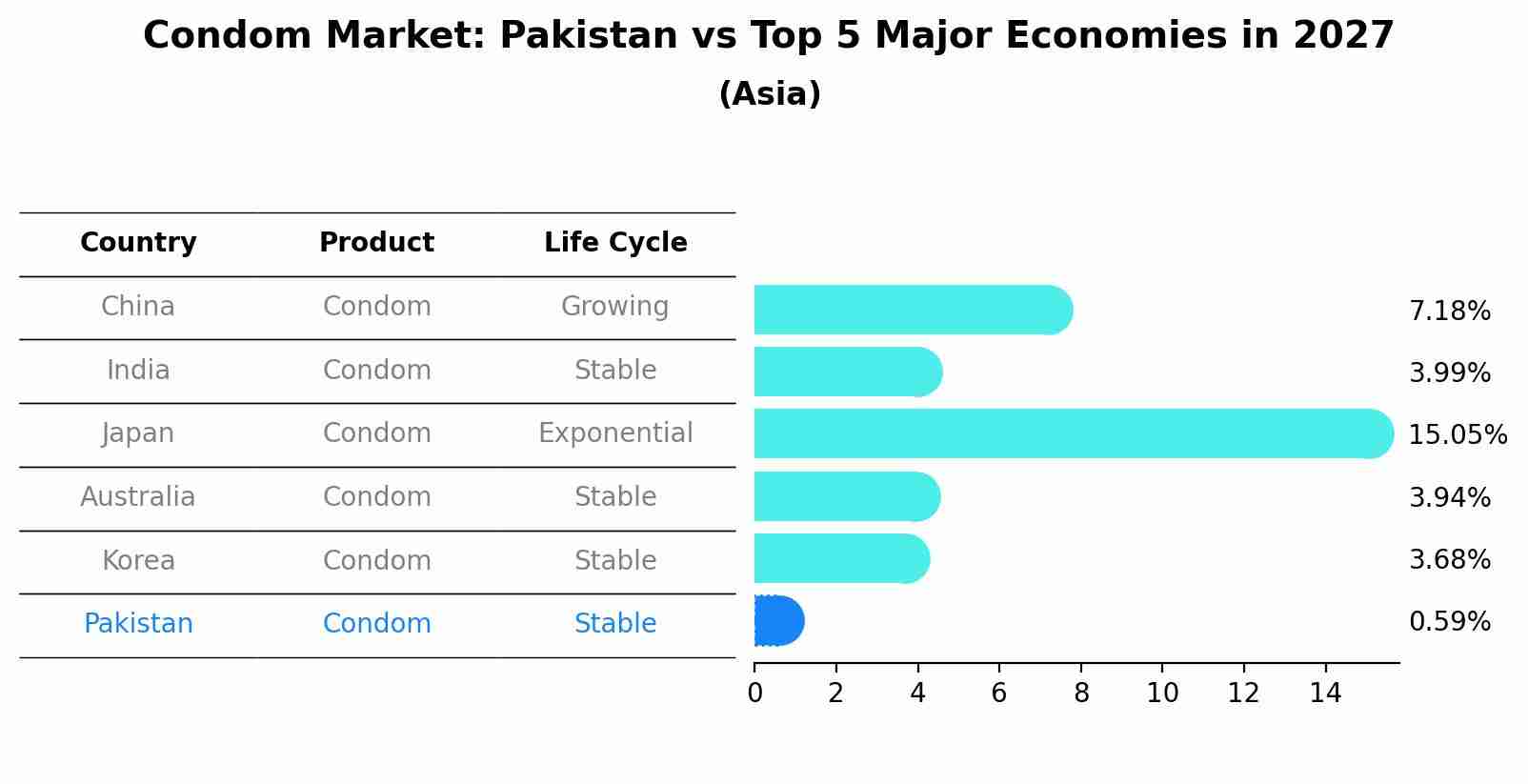
Condom Market: Pakistan vs Top 5 Major Economies in 2027 (Asia)
The Condom market in Pakistan is projected to grow at a stable growth rate of 0.59% by 2027, highlighting the country's increasing focus on advanced technologies within the Asia region, where China holds the dominant position, followed closely by India, Japan, Australia and South Korea, shaping overall regional demand.
Topics Covered in Pakistan Condom Market Report
Pakistan Condom Market Report thoroughly covers the market by material type, product type, and distribution channel. Pakistan Condom Market Outlook report provides an unbiased and detailed analysis of the ongoing Pakistan Condom Market trends, opportunities/high growth areas, and market drivers. This would help stakeholders devise and align their market strategies according to the current and future market dynamics.
Pakistan Condom Market Synopsis
Pakistan Condom Market recorded steady expansion, shaped by gradual improvements in contraceptive behavior, service availability, and last-mile delivery mechanisms. The modern contraceptive user base increased from 2020 to 2024, with rise in the modern contraceptive prevalence rate (mCPR), indicating slow but consistent normalization of condom use within national family planning practices. Demand satisfaction by modern methods has also improved highlighting a growing preference for short-term, accessible solutions such as condoms.
Public-sector distribution played a foundational role, supported by hospitals, Basic Health Units, Maternity and Child Health Centers, and Lady Health Workers enabling household-level awareness and supply. In parallel, private-sector social marketing and franchising models accounted for contraceptive distribution, reinforcing availability in urban and semi-urban markets. Despite high awareness levels among women actual usage remained, underscoring persistent behavioral, gender, and continuity gaps that constrained faster market expansion.
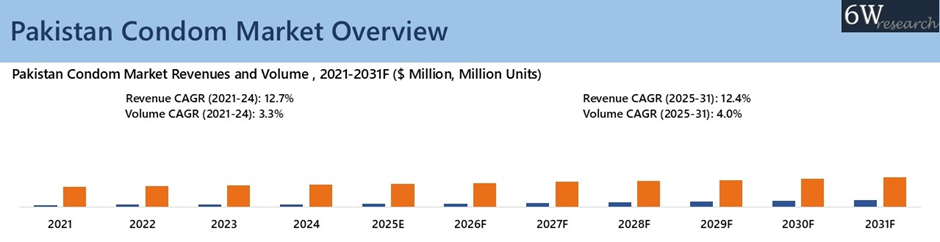
According to 6Wresearch, Pakistan Condom Market revenue size is projected to grow at a CAGR of 12.4% during 2025-2031, supported by continued investment in family planning programs, stable expansion of healthcare infrastructure, and targeted demand-generation initiatives. Government and donor-backed programs, including the UNFPA Pakistan Country Programme and the World Bank supported Punjab Family Planning Programme, are expected to sustain focus on awareness creation, service quality, and uninterrupted supply, particularly in underserved regions.
Gradual reductions in unmet need, alongside increasing demand satisfaction, are likely to translate into higher and more consistent condom uptake. The presence of registered pharmaceutical manufacturers and pharmaceutical exports further supports domestic supply stability and affordability. Additionally, expanding digital health platforms and discreet procurement channels are expected to reduce stigma-related barriers and improve access among younger and urban populations. Overall, the market outlook points toward measured but continuous scaling, with condoms remaining a central, cost-effective solution within Pakistan’s long-term reproductive and preventive healthcare strategy.
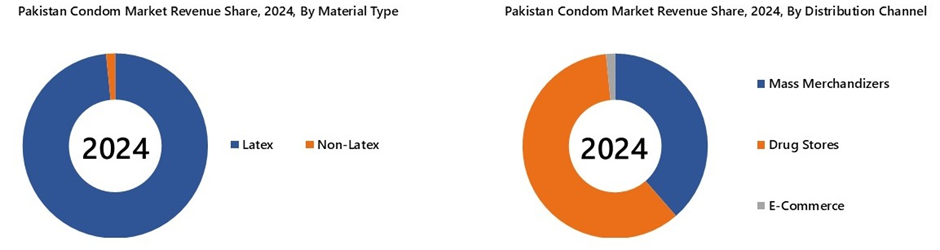
Market Segmentation By Material Type
The latex condoms segment in Pakistan Condom Market is anticipated to exhibit the most rapid growth from 2025 to 2031, driven by a combination of increasing awareness around sexual health, a growing population of sexually active individuals, and a heightened focus on affordable and effective contraceptive solutions. Latex condoms are expected to maintain their position as the leading product category, benefiting from their established reputation for reliability, cost-effectiveness, and widespread availability across retail and pharmacy channels.
Market Segmentation By Product Type
The male condoms segment in Pakistan Condom Market is set for steady growth from 2025 to 2031, driven by awareness of family planning and demand for reliable contraception. Known for preventing pregnancy and STIs, male condoms will remain the market leader. Their widespread availability through pharmacies, retail outlets, and online platforms, along with ongoing public health campaigns, will boost adoption. Affordable, effective, and easily accessible, male condoms will continue to be a preferred contraceptive, supporting sustained market growth.
Market Segmentation By Distribution Channel
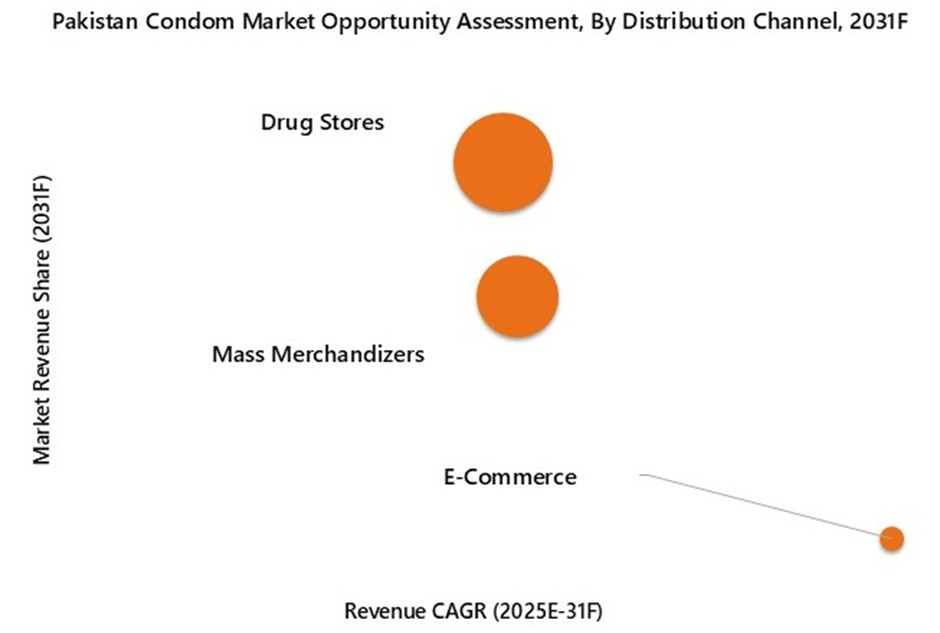
The e-commerce segment in Pakistan Condom Market is expected to experience strong growth from 2025 to 2031, driven by a shift towards online shopping and greater consumer convenience. With growing internet penetration and growth in e-commerce platforms are becoming a preferred channel for purchasing contraceptives. Online retailers offer a wide range of brands and discreet delivery options, enhancing accessibility, especially in remote areas. The segment's expansion will be supported by rising consumer trust in online transactions and targeted marketing campaigns promoting sexual health products.
Key Attractiveness of the Report
- 10 Years Market Numbers.
- Historical Data Starting from 2021 to 2024
- Base Year: 2024
- Forecast Data until 2031
- Key Performance Indicators Impacting the Market.
- Major Upcoming Developments and Projects.
Key Highlights of the Report:
- Pakistan Condom Market Overview
- Pakistan Condom Market Outlook
- Pakistan Condom Market Forecast
- Historical Data and Forecast of Pakistan Condom Market Revenues for the Period 2021-2031F
- Historical Data and Forecast of Pakistan Condom Market Revenues, By Material Type, for the Period 2021-2031F
- Historical Data and Forecast of Pakistan Condom Market Volumes, By Material Type, for the Period 2021-2031F
- Historical Data and Forecast of Pakistan Condom Market Revenues, By Product Type, for the Period 2021-2031F
- Historical Data and Forecast of Pakistan Condom Market Revenues, By Distribution Channel, for the Period 2021-2031F
- Industry Life Cycle
- Porter’s Five Force Analysis
- Pakistan Condom Market Drivers and Restraints
- Market Trends & Evolution
- Market Opportunity Assessment
- Pakistan Condom Market Revenue Ranking, By Top 3 Companies
- Competitive Benchmarking
- Company Profiles
- Key Strategic Recommendations
Market Scope and Segmentation
The report provides a detailed analysis of the following market segments:
By Material Type
- Latex
- Non-Latex
By Product Type
- Male Condoms
- Female Condoms
By Distribution Channel
- Mass Merchandizers
- Drug Stores
- E-Commerce
Pakistan Condom Market (2025-2031): FAQs
Pakistan Condom Market is projected to grow at a CAGR of 12.4% from 2025-2031F.
Expanding Modern Contraceptive User Base and Government-Led Family Planning Policies and Institutional Support are driving the growth of market.
The market faces restraints due to Low Uptake of Modern Contraception Due to Socio-Demographic and Service Access Barriers.
Pakistan Condom Market Report thoroughly covers the market by material type, product type, and distribution channel.
6Wresearch actively monitors the Pakistan Condom Market and publishes its comprehensive annual report, highlighting emerging trends, growth drivers, revenue analysis, and forecast outlook. Our insights help businesses to make data-backed strategic decisions with ongoing market dynamics. Our analysts track relevent industries related to the Pakistan Condom Market, allowing our clients with actionable intelligence and reliable forecasts tailored to emerging regional needs.
Yes, we provide customisation as per your requirements. To learn more, feel free to contact us on sales@6wresearch.com
| 1. Executive Summary |
| 2. Introduction |
| 2.1. Report Description |
| 2.2. Key Highlights of the Report |
| 2.3. Market Scope & Segmentation |
| 2.4. Research Methodology |
| 2.5. Assumptions |
| 3. Pakistan Condom Market Overview |
| 3.1. Pakistan Condom Market Revenues, 2021-2031F |
| 3.2. Pakistan Condom Market Industry Life Cycle |
| 3.3. Pakistan Condom Market Porter's Five Forces |
| 4. Pakistan Condom Market Dynamics |
| 4.1. Impact Analysis |
| 4.2. Market Drivers |
| 4.3. Market Restraints |
| 5. Pakistan Condom Market Trends |
| 6. Pakistan Condom Market Overview, By Material Type |
| 6.1 Pakistan Condom Market Revenues and Revenue Share, By Material Type, 2024 & 2031F |
| 6.1.1 Pakistan Condom Market Revenues, By Latex, 2021-2031F |
| 6.1.2 Pakistan Condom Market Revenues, By Non-Latex, 2021-2031F |
| 6.2 Pakistan Condom Market Volume and Volume Share, By Material Type, 2024 & 2031F |
| 6.2.1 Pakistan Condom Market Volume, By Latex, 2021-2031F |
| 6.2.2 Pakistan Condom Market Volume, By Non-Latex, 2021-2031F |
| 7. Pakistan Condom Market Overview, By Product Type |
| 7.1 Pakistan Condom Market Revenues and Revenue Share, By Product Type, 2024 & 2031F |
| 7.1.1 Pakistan Condom Market Revenues, By Male Condoms, 2021-2031F |
| 7.1.2 Pakistan Condom Market Revenues, By Female Condoms, 2021-2031F |
| 8. Pakistan Condom Market Overview, By Distribution Channel |
| 8.1 Pakistan Condom Market Revenues and Revenue Share, By Distribution Channel, 2024 & 2031F |
| 8.1.1 Pakistan Condom Market Revenues, By Mass Merchandizers, 2021-2031F |
| 8.1.2 Pakistan Condom Market Revenues, By Drug Stores, 2021-2031F |
| 8.1.3 Pakistan Condom Market Revenues, By E-Commerce, 2021-2031F |
| 9. Pakistan Condom Market Key Performance Indicators |
| 10. Pakistan Condom Market Opportunity Assessment |
| 10.1 Pakistan Condom Market Opportunity Assessment, By Material Type, 2031F |
| 10.2 Pakistan Condom Market Opportunity Assessment, By Product Type, 2031F |
| 10.3 Pakistan Condom Market Opportunity Assessment, By Distribution Channel, 2031F |
| 11. Pakistan Condom Market Competitive Landscape |
| 11.1. Pakistan Condom Market Revenue Ranking, By Top 3 Companies, 2024 |
| 11.2. Pakistan Condom Market Competitive Benchmarking, By Technical Parameters |
| 11.3. Pakistan Condom Market Competitive Benchmarking, By Operating Parameters |
| 12. Company Profiles |
| 12.1 DKT International |
| 12.2 Greenstar Social Marketing Pakistan (Guarantee) Limited |
| 12.3 Reckitt Benckiser Group PLC |
| 12.4 Contraceptives Pakistan Private Limited |
| 13. Key Strategic Recommendations |
| 14. Disclaimer |
| List of Figures |
| 1. Pakistan Condom Market Revenues and Volume, 2021-2031F ($ Million, Million Units) |
| 2. Pakistan Modern Contraceptive Prevalence Rate, 2020-2026E |
| 3. Total Users of Modern Method of Contraception in Pakistan, 2020-2025E, (In Million) |
| 4. Pakistan Modern Contraceptive Use vs Non-Use (Sindh Study Area), 2023 |
| 5. Odds of Modern Contraceptive Use by Key Predictors in Pakistan, 2023 |
| 6. Pakistan Condom Market Revenue Share, By Material Type, 2024 & 2031F |
| 7. Pakistan Condom Market Volume Share, By Material Type, 2024 & 2031F |
| 8. Pakistan Condom Market Revenue Share, By Product Type, 2024 & 2031F |
| 9. Pakistan Condom Market Revenue Share, By Distribution Channel, 2024 & 2031F |
| 10. Total Registered Doctors In Pakistan, 2023 & 2024(P) |
| 11. Total Registered Lady Health Visitors In Pakistan, 2023 & 2024(P) |
| 12. Pakistan Import Of Pharmaceutical Products, FY20-24, (In $ Million) |
| 13. Foreign Direct Investment, (Pharma & OTC Products), 2023 & 2024(P) |
| 14. Pakistan Pharmaceutical Sector Size, 2023-2026E, (In $ Billion) |
| 15. Pakistan Condom Market Opportunity Assessment, By Material Type, 2031F |
| 16. Pakistan Condom Market Opportunity Assessment, By Product Type, 2031F |
| 17. Pakistan Condom Market Opportunity Assessment, By Distribution Channel, 2031F |
| 18. Pakistan Condom Market Revenue Ranking, By Companies, CY2024 |
| List of tables |
| 1. Key Government Initiatives Supporting Contraceptive Adoption, 2024 & Beyond |
| 2. Pakistan Condom Market Revenues, By Material Type, 2021-2031F ($ Million) |
| 3. Pakistan Condom Market Volumes, By Material Type, 2021-2031F (Million Units) |
| 4. Pakistan Condom Market Revenues, By Product Type, 2021-2031F ($ Million) |
| 5. Pakistan Condom Market Revenues, By Distribution Channel, 2021-2031F ($ Million) |
| 6. Pakistan Healthcare Infrastructure, 2023 |
Export potential assessment - trade Analytics for 2030
Export potential enables firms to identify high-growth global markets with greater confidence by combining advanced trade intelligence with a structured quantitative methodology. The framework analyzes emerging demand trends and country-level import patterns while integrating macroeconomic and trade datasets such as GDP and population forecasts, bilateral import–export flows, tariff structures, elasticity differentials between developed and developing economies, geographic distance, and import demand projections. Using weighted trade values from 2020–2024 as the base period to project country-to-country export potential for 2030, these inputs are operationalized through calculated drivers such as gravity model parameters, tariff impact factors, and projected GDP per-capita growth. Through an analysis of hidden potentials, demand hotspots, and market conditions that are most favorable to success, this method enables firms to focus on target countries, maximize returns, and global expansion with data, backed by accuracy.
By factoring in the projected importer demand gap that is currently unmet and could be potential opportunity, it identifies the potential for the Exporter (Country) among 190 countries, against the general trade analysis, which identifies the biggest importer or exporter.
To discover high-growth global markets and optimize your business strategy:
Click Here
Pricing
- Single User License$ 1,995
- Department License$ 2,400
- Site License$ 3,120
- Global License$ 3,795

Search
Thought Leadership and Analyst Meet





Our Clients








Related Reports
- India Switchgear Market Outlook (2026 - 2032) | Size, Share, Trends, Growth, Revenue, Forecast, Analysis, Value, Outlook
- Pakistan Contraceptive Implants Market (2025-2031) | Demand, Growth, Size, Share, Industry, Pricing Analysis, Competitive, Strategic Insights, Strategy, Consumer Insights, Analysis, Investment Trends, Opportunities, Revenue, Segments, Value, Segmentation, Supply, Forecast, Restraints, Outlook, Competition, Drivers, Trends, Companies, Challenges
- Sri Lanka Packaging Market (2026-2032) | Outlook, Competition, Drivers, Trends, Demand, Pricing Analysis, Competitive, Strategic Insights, Companies, Challenges, Strategy, Consumer Insights, Analysis, Investment Trends, Opportunities, Growth, Size, Share, Industry, Revenue, Segments, Value, Segmentation, Supply, Forecast, Restraints
- India Kids Watches Market (2026-2032) | Strategy, Consumer Insights, Analysis, Investment Trends, Opportunities, Growth, Size, Share, Industry, Revenue, Segments, Value, Segmentation, Supply, Forecast, Restraints, Outlook, Competition, Drivers, Trends, Demand, Pricing Analysis, Competitive, Strategic Insights, Companies, Challenges
- Saudi Arabia Core Assurance Service Market (2025-2031) | Strategy, Consumer Insights, Analysis, Investment Trends, Opportunities, Growth, Size, Share, Industry, Revenue, Segments, Value, Segmentation, Supply, Forecast, Restraints, Outlook, Competition, Drivers, Trends, Demand, Pricing Analysis, Competitive, Strategic Insights, Companies, Challenges
- Romania Uninterruptible Power Supply (UPS) Market (2026-2032) | Industry, Analysis, Revenue, Size, Forecast, Outlook, Value, Trends, Share, Growth & Companies
- Saudi Arabia Car Window Tinting Film, Paint Protection Film (PPF), and Ceramic Coating Market (2025-2031) | Strategy, Consumer Insights, Analysis, Investment Trends, Opportunities, Growth, Size, Share, Industry, Revenue, Segments, Value, Segmentation, Supply, Forecast, Restraints, Outlook, Competition, Drivers, Trends, Demand, Pricing Analysis, Competitive, Strategic Insights, Companies, Challenges
- South Africa Stationery Market (2025-2031) | Share, Size, Industry, Value, Growth, Revenue, Analysis, Trends, Segmentation & Outlook
- Afghanistan Rocking Chairs And Adirondack Chairs Market (2026-2032) | Size & Revenue, Competitive Landscape, Share, Segmentation, Industry, Value, Outlook, Analysis, Trends, Growth, Forecast, Companies
- Afghanistan Apparel Market (2026-2032) | Growth, Outlook, Industry, Segmentation, Forecast, Size, Companies, Trends, Value, Share, Analysis & Revenue
Industry Events and Analyst Meet

EV tech India Expo 2026

Auto Tech Asia 2026

Battery Tech India 2026

Smart Production Solutions Guangzhou 2026

Stationery & Paper Expo Saudi Arabia 2026
Whitepaper
- Middle East & Africa Commercial Security Market Click here to view more.
- Middle East & Africa Fire Safety Systems & Equipment Market Click here to view more.
- GCC Drone Market Click here to view more.
- Middle East Lighting Fixture Market Click here to view more.
- GCC Physical & Perimeter Security Market Click here to view more.
6WResearch In News
- Doha a strategic location for EV manufacturing hub: IPA Qatar
- Demand for luxury TVs surging in the GCC, says Samsung
- Empowering Growth: The Thriving Journey of Bangladesh’s Cable Industry
- Demand for luxury TVs surging in the GCC, says Samsung
- Video call with a traditional healer? Once unthinkable, it’s now common in South Africa
- Intelligent Buildings To Smooth GCC’s Path To Net Zero


