Peru Gambling Market Summary
The peru gambling market was estimated at USD 1330 Million in 2025 and is projected to reach USD 1935 Million by 2032, growing at a CAGR of 6.7% from 2026 to 2032.
Peru Gambling Market Year-wise Growth Rate and Key Drivers
This graph highlights how the Peru Gambling Market has steadily grown over the past five years, supported by major growth factors.
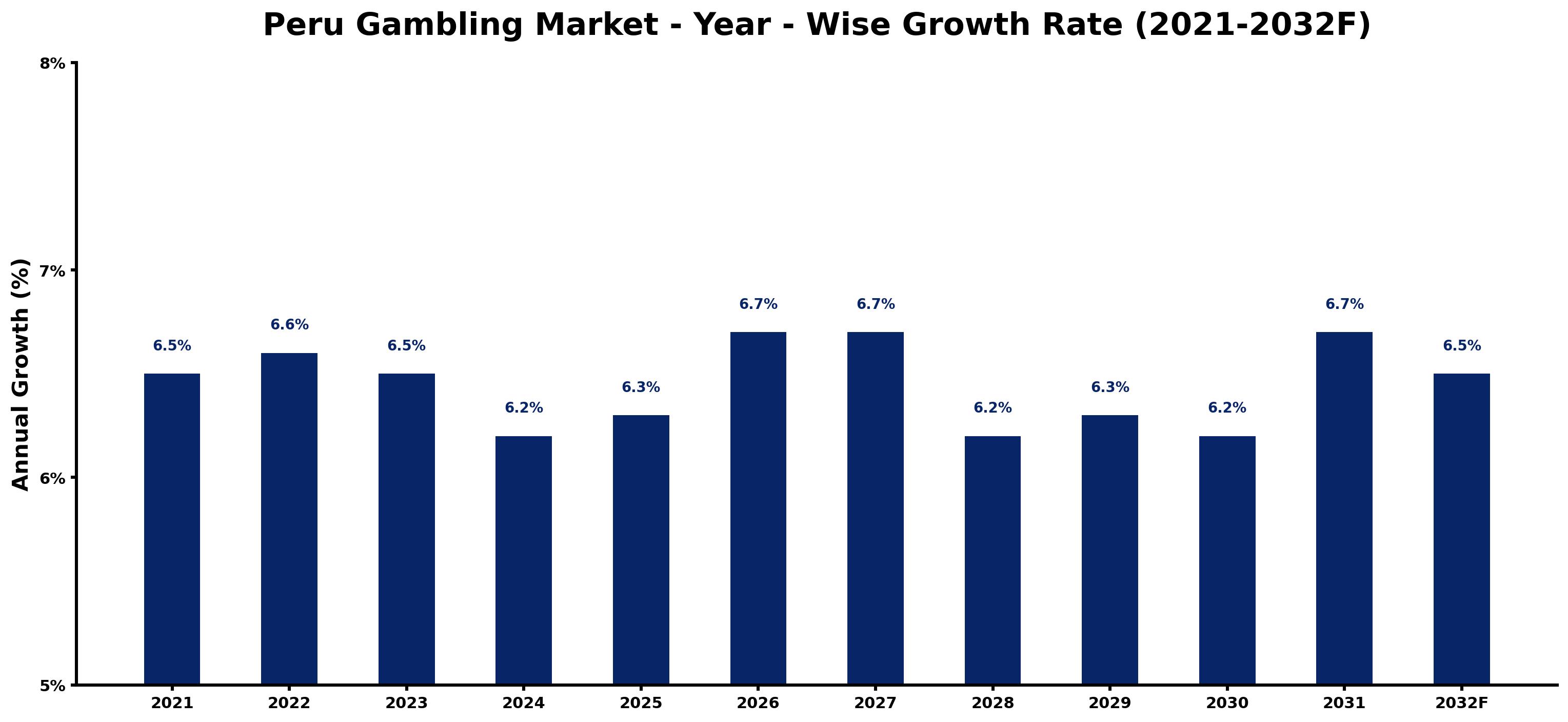
The table below presents the year wise growth rates along with the key drivers influencing the market
| Year | Growth Rate | Major Drivers |
| 2021 | 6.5% | COVID-19 restrictions led to a surge in online gambling preferences among Peruvians. |
| 2022 | 6.6% | Technological enhancements in mobile applications transformed user experiences in gambling activities. |
| 2023 | 6.5% | Local operators expanded offerings, catering to diverse interests in sports betting segments. |
| 2024 | 6.2% | International brands entered, introducing competitive pricing and innovative gaming options. |
| 2025 | 6.3% | Increased internet penetration allowed more individuals access to online gambling platforms. |
| 2026 | 6.7% | Social media marketing became vital, connecting brands with younger, tech-savvy audiences. |
| 2027 | 6.7% | Strategic partnerships with local influencers enhanced brand visibility and customer engagement. |
| 2028 | 6.2% | Virtual reality technology started integrating, enhancing immersive gambling experiences significantly. |
| 2029 | 6.3% | Mobile payment solutions gained traction, simplifying transactions and attracting more players. |
| 2030 | 6.2% | Sustainability considerations began influencing corporate strategies within the gambling sector. |
| 2031 | 6.7% | Emerging esports betting attracted younger demographics, diversifying market participant profiles. |
| 2032 | 6.5% | Consumer behavior shifted towards responsible gambling, prompting safer gaming environments. |
Note - Market size estimations and growth projections presented in this report are based on 6Wresearch's advanced forecasting approach, validated with industry datasets as of June 2026.
Peru Gambling Market Synopsis
The Peru Gambling Market is projected to reach 6.7% and witness significant growth during the forecast period (2026-2032). This growth trajectory, anticipated to reach a compound annual growth rate (CAGR) of 11.5%, underscores the transformative effects of rising internet penetration and increasing disposable incomes within the country. As disposable income rises, individuals are allocating higher amounts towards leisure activities, notably online gaming and sports betting. This evolution signifies a cultural shift towards embracing digital entertainment alternatives, facilitated by ongoing technological advancements and heightened consumer awareness surrounding digitalization.
Peru Gambling Market Growth Drivers
Several key drivers are propelling the growth of the Peru Gambling Market. One of the primary factors is the surge in internet accessibility across urban and rural areas, enabling a broader demographic to engage with online gaming and betting platforms. Additionally, the increasing interest in sports and eSports, particularly among younger populations, is fueling participation in sports betting, which has seen exponential growth.
- Rising Internet Penetration: The ongoing expansion of internet services across Peru has significantly lowered barriers to entry for potential consumers, facilitating access to a variety of gambling platforms.
- Increased Disposable Income: Economic growth has led to enhanced disposable income levels, allowing consumers greater flexibility to spend on leisure activities, including gambling.
- Technological Advancements: Innovations in mobile gaming technology and secure digital payment solutions are enhancing user experiences and increasing consumer trust in online gambling platforms.
- Regulatory Changes: Local authorities are actively pursuing the legalization and regulation of gaming activities, creating a more structured environment that is attractive for both consumers and operators.
- Consumer Awareness: A growing understanding of digital entertainment options among consumers is prompting increased participation in the online gambling market.
Peru Gambling Market Trends and Opportunities
The Peru Gambling Market is poised to experience transformative trends that present numerous opportunities for growth. The integration of advanced technology into gambling platforms is enhancing user interaction and experience, which is pivotal for retaining customer loyalty. Furthermore, the expansion of mobile applications provides operators with an avenue to reach wider audiences directly.
- Mobile Gaming Boom: The proliferation of smartphones is driving mobile gaming trends, allowing users to engage in gambling activities anytime and anywhere.
- Increased Focus on Responsible Gaming: As the market evolves, operators are adopting responsible gaming practices to promote healthy gambling habits, enhancing their brand reputation.
- Esports Betting: With the rise of esports, there is an increasing market for betting on competitive gaming, attracting a tech-savvy younger demographic.
- Social Gaming Integration: The blending of social gaming elements into gambling platforms is enhancing user engagement through community experiences and interaction.
- Localization of Content: Tailoring gaming options to incorporate local culture and interests is becoming essential for success within the Peru Gambling Market.
Peru Gambling Market Challenges and Restraints
While the Peru Gambling Market presents substantial opportunities, several challenges could impede growth. Regulatory hurdles and inconsistent policies can create uncertainty for operators and consumers alike. Additionally, concerns over problem gambling and the need for robust consumer protections may also present barriers to expansion.
- Regulatory Uncertainty: Fluctuating regulations surrounding online gambling can complicate operations for both new and existing market participants, creating potential risks.
- Consumer Protection: Growing awareness of gambling addiction necessitates enhanced consumer protection measures, which could require increased operational costs for operators.
- Competition from Illegal Markets: The existence of unregulated gambling operations can undercut legitimate businesses and complicate market dynamics.
- Technological Vulnerabilities: As the reliance on technology grows, so do the risks associated with cyber threats and data breaches, necessitating ongoing investment in security.
- Market Saturation: As more operators enter the market, the potential for saturation increases, leading to stiff competition and pressure on profit margins.
Peru Gambling Market Government Investment and Initiatives
The Peruvian government has initiated several measures to regulate and enhance the gambling sector, reflecting a commitment to fostering a safe and established gaming environment. Policies aimed at the legalization of various forms of gambling, including online gaming, are under development. These initiatives are designed to harness potential tax revenues, thus promoting public investment.
- Regulatory Framework Development: The government is developing a comprehensive regulatory framework to govern both online and offline gambling, ensuring transparency and accountability.
- Public Awareness Campaigns: Initiatives aimed at educating the public on responsible gambling and the legalities surrounding gaming activities are gaining traction.
- Investment in Technology Infrastructure: The government is encouraging investments in technology to facilitate secure online gambling environments, promoting a smooth user experience.
- Partnerships with International Bodies: Collaborations with international gaming regulators are being explored to align local standards with best practices globally.
- Tax Incentives: The introduction of favorable tax conditions for operators who comply with regulations is aimed at attracting investment into the formal gambling market.
Peru Gambling Market Latest Developments (May 2025 - June 2026)
Recent months have seen notable shifts in the Peru Gambling Market, characterized by a heightened focus on regulatory compliance and market expansion. Authorities are actively rolling out frameworks that will potentially legitimize online gambling, thereby driving participation from wider demographics. The adaptation of platforms to enhance user experience through innovative technologies remains a priority, reflecting ongoing trends in consumer preferences.
- Regulatory Advancements: The government has been pushing forward with regulatory initiatives aimed at establishing a robust framework for the online gambling industry.
- Increased Tech Investments: Operators are investing significantly in technology to improve gaming experiences, attract new users, and ensure data security.
- Growing Market Engagement: More operators are entering the market, indicating an optimistic outlook and a competitive landscape.
- Consumer-Centric Approaches: There is a clear trend toward focusing on customer engagement strategies, including personalized offers and social gaming experiences.
- Collaborative Initiatives: Industry stakeholders are increasingly collaborating with government entities to shape policies that support sustainable market growth.
Peru Gambling Market - Key Attractiveness of the Report
- 10 Years of Market Numbers
- Historical Data Starting from 2022 to 2025
- Base Year: 2025
- Forecast Data until 2032
- Key Performance Indicators Impacting the Market
- Major Upcoming Developments and Projects
Key Highlights of the Report:
- Peru Gambling Market Outlook
- Market Size of Peru Gambling Market, 2025
- Forecast of Peru Gambling Market, 2032F
- Historical Data and Forecast of Peru Gambling Revenues & Volume for the Period 2022-2032F
- Peru Gambling Market Trend Evolution
- Peru Gambling Market Drivers and Challenges
- Peru Gambling Price Trends
- Peru Gambling Porter's Five Forces
- Peru Gambling Industry Life Cycle
- Historical Data and Forecast of Peru Gambling Market Revenues & Volume By Product Type for the Period 2022-2032F
- Historical Data and Forecast of Peru Gambling Market Revenues & Volume By Betting for the Period 2022-2032F
- Historical Data and Forecast of Peru Gambling Market Revenues & Volume By Casino for the Period 2022-2032F
- Historical Data and Forecast of Peru Gambling Market Revenues & Volume By Lottery for the Period 2022-2032F
- Historical Data and Forecast of Peru Gambling Market Revenues & Volume By Others for the Period 2022-2032F
- Historical Data and Forecast of Peru Gambling Market Revenues & Volume By Channel Type for the Period 2022-2032F
- Historical Data and Forecast of Peru Gambling Market Revenues & Volume By Offline for the Period 2022-2032F
- Historical Data and Forecast of Peru Gambling Market Revenues & Volume By Online for the Period 2022-2032F
- Historical Data and Forecast of Peru Gambling Market Revenues & Volume By Virtual Reality VR for the Period 2022-2032F
- Historical Data and Forecast of Peru Gambling Market Revenues & Volume By Platform for the Period 2022-2032F
- Historical Data and Forecast of Peru Gambling Market Revenues & Volume By Land-Based for the Period 2022-2032F
- Historical Data and Forecast of Peru Gambling Market Revenues & Volume By Online for the Period 2022-2032F
- Peru Gambling Import Export Trade Statistics
- Market Opportunity Assessment By Product Type
- Market Opportunity Assessment By Channel Type
- Market Opportunity Assessment By Platform
- Peru Gambling Top Companies Market Share
- Peru Gambling Competitive Benchmarking By Technical and Operational Parameters
- Peru Gambling Company Profiles
- Peru Gambling Key Strategic Recommendations






































