Philippines Gambling Market Summary
The philippines gambling market was estimated at USD 315 Million in 2025 and is projected to reach USD 451 Million by 2032, growing at a CAGR of 5.9% from 2026 to 2032.
Philippines Gambling Market Year-wise Growth Rate and Key Drivers
This graph highlights how the Philippines Gambling Market has steadily grown over the past five years, supported by major growth factors.
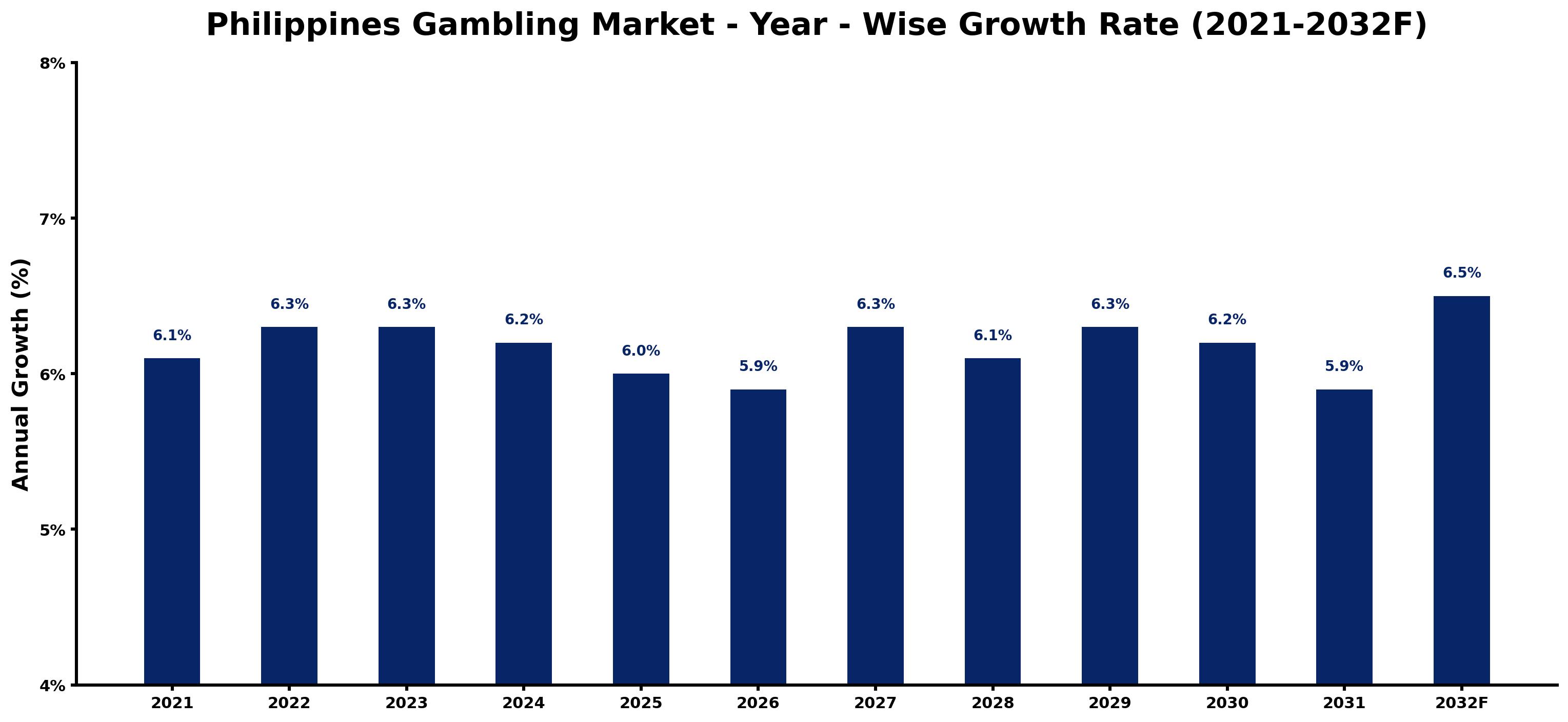
The table below presents the year wise growth rates along with the key drivers influencing the market
| Year | Growth Rate | Major Drivers |
| 2021 | 6.1% | Post-lockdown enthusiasm resulted in increased participation in online gambling platforms. |
| 2022 | 6.3% | Mobile accessibility made gambling more convenient for a tech-savvy population. |
| 2023 | 6.3% | Integration of e-wallets simplified transactions and expanded user engagement in gaming. |
| 2024 | 6.2% | Local competition among operators intensified, enhancing customer incentives and promotions. |
| 2025 | 6.0% | Emergence of virtual reality experiences created immersive gambling environments for users. |
| 2026 | 5.9% | Focus on responsible gaming initiatives improved public perception and trust in operators. |
| 2027 | 6.3% | Regional tourism strategies attracted foreign gamblers, boosting local casino revenues. |
| 2028 | 6.1% | Online gaming licenses encouraged international operators to enter the Philippine market. |
| 2029 | 6.3% | Social media marketing effectively targeted younger demographics interested in gambling experiences. |
| 2030 | 6.2% | Innovations in game design kept players engaged and willing to explore new offerings. |
| 2031 | 5.9% | Collaborations with local celebrities enhanced brand recognition and loyalty among players. |
| 2032 | 6.5% | Emerging technologies like blockchain provided transparency, strengthening user confidence in gambling. |
Note - Market size estimations and growth projections presented in this report are based on 6Wresearch's advanced forecasting approach, validated with industry datasets as of June 2026.
Philippines Gambling Market Synopsis
The Philippines Gambling Market is projected to reach 5.9% and witness significant growth during the forecast period (2026-2032). This anticipated growth is primarily driven by several factors including an uptick in tourism, enhancements in infrastructure, and supportive government regulations. Furthermore, the rising disposable incomes and changing consumer lifestyles are reshaping spending habits, prompting increased investment in gaming activities. Together, these elements create a robust environment for the gambling sector expansion in the Philippines. Technological innovations, particularly in virtual reality (VR) and augmented reality (AR), are expected to bolster market dynamics, offering novel gaming experiences that cater to a diverse range of consumers.
Philippines Gambling Market Growth Drivers
The growth trajectory of the Philippines Gambling Market is influenced by multiple key drivers:
- The increase in international tourist arrivals has significantly contributed to the gambling sector. The Philippines is becoming a popular destination for leisure and entertainment, alongside its vibrant cultural offerings.
- Government initiatives aimed at improving infrastructure, such as better transportation links and hospitality services, are making it easier for tourists and locals alike to access gambling venues.
- Favorable legislation and regulatory frameworks have led to a more secure and inviting environment for gambling operators, ensuring compliance and fostering a competitive marketplace.
- With the rise in disposable income, consumers are more willing to spend on entertainment, including gaming options, enhancing overall market prospects.
- Technological advancements not only elevate user experience but also attract a younger demographic, increasingly interested in interactive gaming platforms.
Philippines Gambling Market Trends and Opportunities
As the Philippines Gambling Market evolves, several trends and opportunities are emerging:
- The integration of online gambling platforms is gaining traction, as more players opt for the convenience and accessibility of digital gaming experiences.
- The introduction of innovative gaming products, such as skill-based games and e-sports betting, is creating new engagement avenues for younger audiences.
- Partnerships between local operators and international gaming firms are paving the way for knowledge transfer and the introduction of cutting-edge technologies.
- The growing acceptance of gambling as a legitimate leisure activity among locals is expanding the customer base for operators.
- There are opportunities for themed gaming resorts that cater not only to gamblers but also to families and entertainment seekers, enhancing the overall appeal of the gambling landscape.
Philippines Gambling Market Government Investment and Initiatives
The Philippine government has recognized the potential of the gambling market as a significant contributor to economic growth. As such, several investments and initiatives have been introduced:
- The government has implemented comprehensive policies that support the establishment and operation of gaming establishments, ensuring they adhere to regulatory standards.
- Public spending on infrastructure improvements, including roads and transportation hubs, aims to boost accessibility to gaming venues.
- Economic zones have been designated to attract both domestic and foreign investments in the gaming sector, promoting a business-friendly environment.
- Incentives have been provided to gaming businesses that prioritize environmental sustainability and social responsibility, aligning with broader national objectives.
- The government actively engages with stakeholders to promote responsible gambling initiatives, ensuring consumer protection while fostering a safe gambling environment.
Philippines Gambling Market Latest Developments (May 2025 - June 2026)
Recent developments in the Philippines Gambling Market have reflected a dynamic and adaptive industry. The period from May 2025 to June 2026 has seen various shifts:
- An increase in regulatory measures aimed at ensuring fair play and consumer protection has been implemented, enhancing trust in the market.
- Emerging technologies such as blockchain are being explored by operators to increase transparency and security in transactions.
- Initiatives promoting e-sports and skill gaming have gained support, catering to a younger demographic and diversifying the market.
- Innovative marketing strategies focusing on digital engagement have been adopted, reflecting changing consumer behavior.
- Collaborations between local authorities and gaming operators have strengthened community ties and fostered localized gambling experiences.
Philippines Gambling Market - Key Attractiveness of the Report
- 10 Years of Market Numbers
- Historical Data Starting from 2022 to 2025
- Base Year: 2025
- Forecast Data until 2032
- Key Performance Indicators Impacting the Market
- Major Upcoming Developments and Projects
Key Highlights of the Report:
- Philippines Gambling Market Outlook
- Market Size of Philippines Gambling Market, 2025
- Forecast of Philippines Gambling Market, 2032F
- Historical Data and Forecast of Philippines Gambling Revenues & Volume for the Period 2022-2032F
- Philippines Gambling Market Trend Evolution
- Philippines Gambling Market Drivers and Challenges
- Philippines Gambling Price Trends
- Philippines Gambling Porter's Five Forces
- Philippines Gambling Industry Life Cycle
- Historical Data and Forecast of Philippines Gambling Market Revenues & Volume By Product Type for the Period 2022-2032F
- Historical Data and Forecast of Philippines Gambling Market Revenues & Volume By Betting for the Period 2022-2032F
- Historical Data and Forecast of Philippines Gambling Market Revenues & Volume By Casino for the Period 2022-2032F
- Historical Data and Forecast of Philippines Gambling Market Revenues & Volume By Lottery for the Period 2022-2032F
- Historical Data and Forecast of Philippines Gambling Market Revenues & Volume By Others for the Period 2022-2032F
- Historical Data and Forecast of Philippines Gambling Market Revenues & Volume By Channel Type for the Period 2022-2032F
- Historical Data and Forecast of Philippines Gambling Market Revenues & Volume By Offline for the Period 2022-2032F
- Historical Data and Forecast of Philippines Gambling Market Revenues & Volume By Online for the Period 2022-2032F
- Historical Data and Forecast of Philippines Gambling Market Revenues & Volume By Virtual Reality VR for the Period 2022-2032F
- Historical Data and Forecast of Philippines Gambling Market Revenues & Volume By Platform for the Period 2022-2032F
- Historical Data and Forecast of Philippines Gambling Market Revenues & Volume By Land-Based for the Period 2022-2032F
- Historical Data and Forecast of Philippines Gambling Market Revenues & Volume By Online for the Period 2022-2032F
- Philippines Gambling Import Export Trade Statistics
- Market Opportunity Assessment By Product Type
- Market Opportunity Assessment By Channel Type
- Market Opportunity Assessment By Platform
- Philippines Gambling Top Companies Market Share
- Philippines Gambling Competitive Benchmarking By Technical and Operational Parameters
- Philippines Gambling Company Profiles
- Philippines Gambling Key Strategic Recommendations






































