Philippines Laboratory Equipment Market (2026-2032) | Share, Forecast, Growth, Size, Industry, Companies, Revenue, Value, Analysis, Trends & Outlook
Market Forecast By Product Type (Autoclaves, Incubators, Centrifuges, Spectrometers, Sonicators, Scopes, Others), By Application (Genetic Testing, Endocrinology, Hematology, Microbiology, Biochemistry, Others), By End-users (Diagnostic Laboratories, Hospitals and Clinics, Others) And Competitive Landscape
| Product Code: ETC023089 | Publication Date: Jul 2023 | Updated Date: Mar 2026 | Product Type: Report | |
| Publisher: 6Wresearch | Author: Ravi Bhandari | No. of Pages: 70 | No. of Figures: 35 | No. of Tables: 5 |
Philippines Laboratory Equipment Market Top 5 Importing Countries and Market Competition (HHI) Analysis
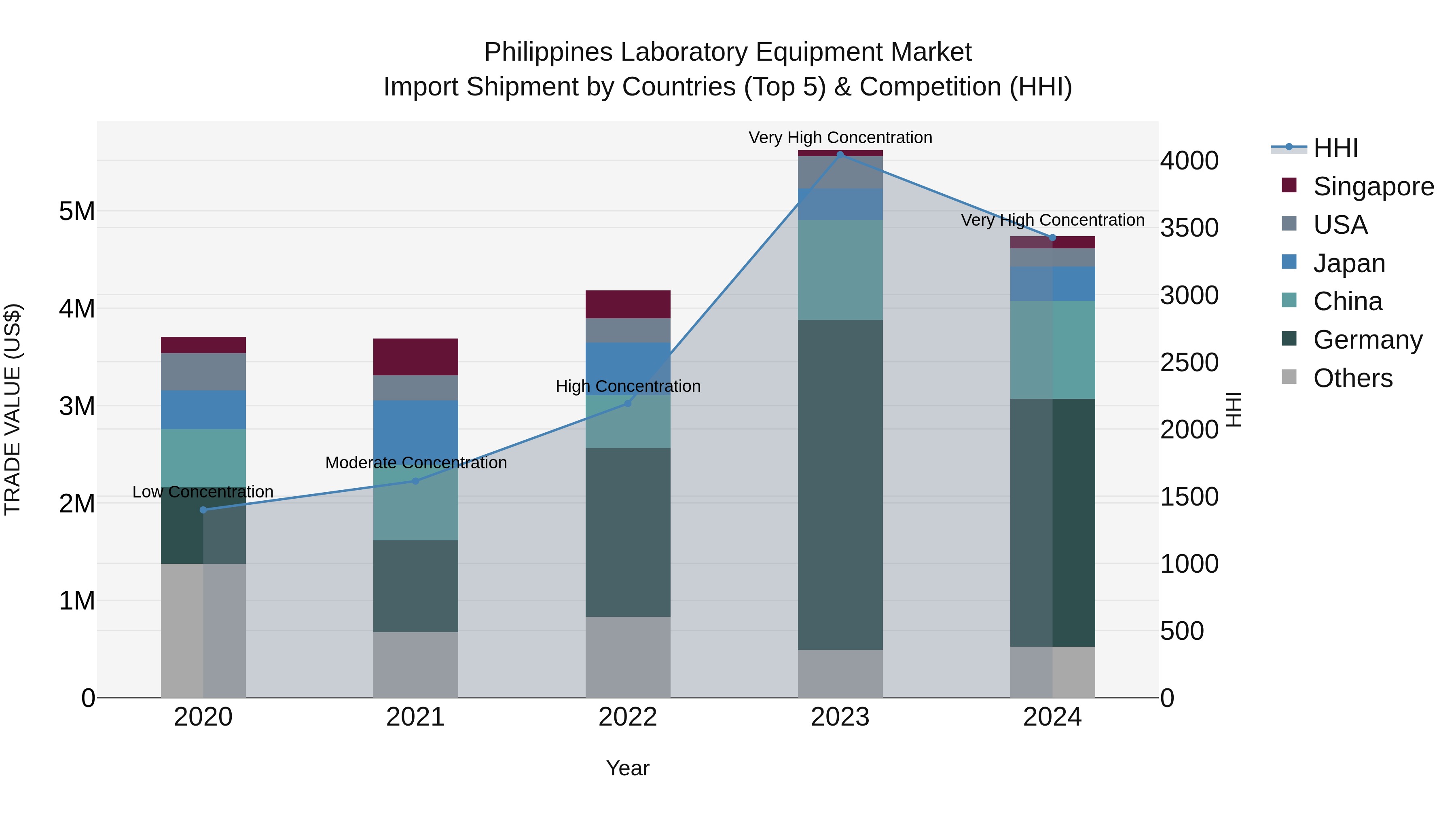
In 2024, the Philippines continued to rely on imports of laboratory equipment, with Germany, China, Japan, USA, and India emerging as the top exporting countries. Despite the high Herfindahl-Hirschman Index (HHI) indicating significant market concentration, the industry maintained a healthy Compound Annual Growth Rate (CAGR) of 6.34% from 2020 to 2024. However, a slight decline was observed in the growth rate from 2023 to 2024 at -15.72%, suggesting a potential shift in market dynamics. Stakeholders should monitor these trends closely to adapt to changing market conditions and seize new opportunities for growth.
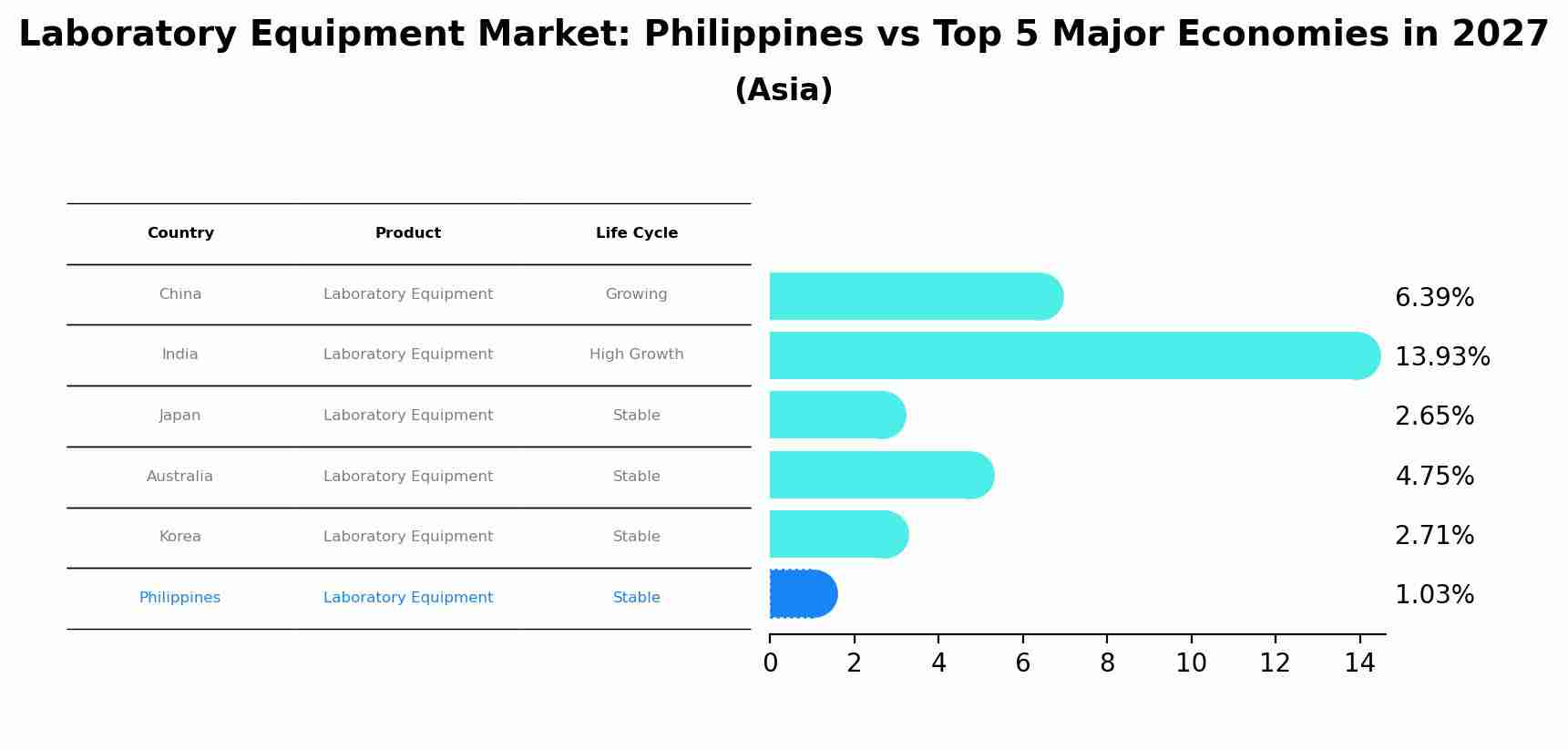
Laboratory Equipment Market: Philippines vs Top 5 Major Economies in 2027 (Asia)
In the Asia region, the Laboratory Equipment market in Philippines is projected to expand at a stable growth rate of 1.03% by 2027. The largest economy is China, followed by India, Japan, Australia and South Korea.
Philippines Laboratory Equipment Market Growth Rate
According to 6Wresearch internal database and industry insights, the Philippines Laboratory Equipment Market is projected to grow at a compound annual growth rate (CAGR) of 8.1% during the forecast period from 2026 to 2032.
Topics Covered in the Philippines Laboratory Equipment Market Report
The Philippines Laboratory Equipment Market report thoroughly covers the market by product type, application, and end-users. It provides an unbiased and detailed analysis of ongoing market trends, opportunities, challenges, and market drivers, helping stakeholders align their strategies with current and future market dynamics.
Philippines Laboratory Equipment Market Highlights
| Report Name | Philippines Laboratory Equipment Market |
| Forecast period | 2026-2032 |
| CAGR | 8.1% |
| Growing Sector | Healthcare & Life Sciences |
Philippines Laboratory Equipment Market Synopsis
Philippines Laboratory Equipment Market has been witnessing substantial growth in the future years. The market is positively influenced by increasing investments in healthcare, education, and research sectors. Laboratory equipment market in Philippine is boosted because of rising demand for advanced diagnostic tools and laboratory instruments in hospitals, diagnostic centres, and academic institutions.
Government initiatives to improve healthcare infrastructure and the growing presence of private laboratories have further contributed to market expansion. Furthermore, the expansion of pharmaceutical and biotechnology industries in the country has increased the need for advanced laboratory equipment. Although challenges such as limited access to new technology in rural areas, the industry is projected to grow in the upcoming years.
Evaluation of Growth Drivers in the Philippines Laboratory Equipment Market
Below mentioned are some prominent drivers and their impact on the Philippines Laboratory Equipment Market dynamics:
| Drivers | Primary Segment Affected | Why It Matters (Evidence) |
| Government Modernization Programs | All Segments | The DOH Health Facilities Enhancement Program (HFEP) allocates billions for upgrading lab equipment in public hospitals. |
| Rise in Chronic Disease Prevalence | Diagnostics, Biochemistry | The growing prevalence of diabetes and cardiovascular disease need regular blood chemistry and metabolic testing. |
| Laboratory Automation | Centrifuges, Spectrometers | Automating laboratory equipment eliminates manual errors and improves turnaround time, leading to increased efficiency for high-volume testing. |
| Expanding Private Healthcare Sector | All Segments | Major private chains, such as Metro Pacific Health, are expanding their diagnostic capacities throughout the archipelago. |
| Medical Tourism Growth | Specialty Diagnostics | The push to make the Philippines a medical hub increases the demand for international-standard laboratory certifications and tools. |
Philippines Laboratory Equipment Market is projected to grow at a CAGR of 8.1% from 2026 to 2032. The major growth factors for this growth are government support for medical research, new advancements in molecular diagnostics, and an increasing demand for precision medicine. The demand for laboratory equipment, particularly spectrometers and incubators, is increasing in clinical and research sectors as the Philippines aims to meet global healthcare standards and reduce the burden of infectious diseases. The expanding diagnostic infrastructure and the rising popularity of integrated lab information systems are also contributing to the Philippines Laboratory Equipment Market Growth.
Evaluation of Restraints in the Philippines Laboratory Equipment Market
Below mentioned are some major restraints and their influence on the Philippines Laboratory Equipment Market dynamics:
| Restraints | Primary Segment Affected | What This Means (Evidence) |
| High Initial Capital Outlay | All Segments | The upfront cost of high-end equipment like mass spectrometers remains a barrier for small-to-medium independent labs. |
| Shortage of Specialized Personnel | Genetic Testing, Microbiology | The shortage of skilled medical technologists to operate complex automated systems restricts the optimal use of advanced machinery. |
| Supply Chain Dependencies | All Segments | Importing high-tech components can cause delays in maintenance and parts replacement. |
| Archipelagic Logistics | Distribution | The geographical barrier of delivering and repairing sensitive equipment across over 7,000+ islands raises operational costs. |
| Regulatory Stringency | All Segments | Strict FDA Philippines registration processes and ISO compliance requirements can delay the market entry of new products. |
Emerging Trends in the Philippines Laboratory Equipment Market
Philippines Laboratory Equipment Market is experiencing significant growth over the past few years. The market is supported by the advancements in technology, increasing demand for diagnostic testing, and expanding research activities across various sectors. As the need for precise and efficient diagnostic tools rises in response to public health concerns, the demand of laboratory equipment is increasing accordingly. The healthcare and pharmaceutical industries play a major role in boosting market demand.
Furthermore, the growth of academic research and development initiatives, combined with government support for scientific innovation. It fuels the adoption of modern laboratory instruments. Trends such as the integration of automation, digitalisation, and smart technologies in laboratory equipment underline the country’s focus on improving accuracy and productivity in lab-based operations. Furthermore, increasing investments from both private and public sectors aim to enhance the infrastructure and accessibility of high-quality laboratory solutions across the country.
Investment Opportunities in the Philippines Laboratory Equipment Market
The Philippines Laboratory Equipment Market presents lucrative investment opportunities. With the time, country is expanding in healthcare, pharmaceutical, and research sectors. To upgrade medical facilities the demand for advanced diagnostic tools has raised. With the support of government initiatives, the need for high-quality laboratory equipment has been fulfilling.
Moreover, the expanding biotechnology and life sciences industries create a favourable environment for investors who are looking to supply modern, innovative equipment. Techniques for instance strategic partnerships with local distributors and institutions, competitive pricing and reliable sales service, have contributed their role to penetrate the market and made its presence in Philippines Laboratory Equipment Industry.
Top 5 Leading Players in the Philippines Laboratory Equipment Market
Below is a list of prominent companies leading in the Philippines Laboratory Equipment Market:
1. Sigmatech Inc.
| Company Name | Sigmatech Inc. |
| Established Year | 2000 |
| Headquarters | Metro Manila, Philippines |
| Official Website | Click Here |
Sigmatech Inc. specializes in the sales and servicing of advanced laboratory equipment used in QA/QC, metrology, R&D, environmental analysis, and process control across industries such as pharmaceuticals, electronics, and biotechnology.
2. Labtraders, Inc.
| Company Name | Labtraders, Inc. |
| Established Year | 2012 |
| Headquarters | Metro Manila, Philippines |
| Official Website | Click Here |
Labtraders represents leading global laboratory brands and supplies analytical instruments and laboratory solutions to research institutions, healthcare laboratories, food industries, and pharmaceutical companies in the Philippines.
3. Gennex Corporation
| Company Name | Gennex Corporation |
| Established Year | 2000 |
| Headquarters | Laguna, Philippines |
| Official Website | Click Here |
Gennex Corporation provides microscopes, sample preparation equipment, measuring tools, and laboratory apparatus for industries including electronics, mining, aerospace, and education.
4. Biomedix Systems Trading Corporation
| Company Name | Biomedix Systems Trading Corporation |
| Established Year | 2012 |
| Headquarters | Mindanao, Philippines |
| Official Website | Click Here |
Biomedix supplies laboratory and diagnostic equipment and provides installation, maintenance, and support services to hospitals, diagnostic centers, and laboratories across the Philippines.
5. Prince Valiant International Corporation
| Company Name | Prince Valiant International Corporation |
| Established Year | 1995 |
| Headquarters | Iloilo City, Philippines |
| Official Website | Click Here |
Prince Valiant distributes scientific laboratory equipment, criminology instruments, and engineering laboratory supplies to universities, research agencies, and healthcare institutions in the Philippines.
Government Regulations Introduced in the Philippines Laboratory Equipment Market
According to Philippines’ government data, the government regulations are aiming to ensure the safety and security of consumers majorly health and welfare of the public of every nation. It includes strict government regulations that protects from the business practises and market failure which cause environmental problems, serious health issues and scams. The sector is governed by stringent standards to ensure the quality, safety, and reliability of all laboratory devices and instruments.
Regulatory bodies, such as the Food and Drug Administration (FDA) Philippines and the Department of Health (DOH), oversee the registration, importation, and distribution of these products to maintain compliance with national and international guidelines. Additionally, policies promoting local production and importation controls aim to balance market growth while safeguarding public health. These regulations also emphasize the accreditation of laboratories to ensure proper usage and maintenance of equipment, fostering a robust market.
Future Insights of the Philippines Laboratory Equipment Market
The future of the Philippines laboratory equipment market looks promising, driven by robust growth in sectors such as healthcare, pharmaceuticals, and education. Among the factors advancements in technology are expected to play a significant role, with increased demand for modern, precise, and automated laboratory instruments. Government initiative has played its role in the expansion of market to support and encourage research and development field.
Most of the initiatives are blend with rising investments from both domestic and international players, are likely to fuel the Philippines Laboratory Equipment Market Share. Moreover, the adoption of advanced laboratory equipment is increasing that has influenced the awareness of quality testing and safety standards across industries.
Market Segmentation Analysis
The report offers a comprehensive study of the following market segments and their leading categories:
By Product Type - Spectrometers to dominate the market
According to Ekta, Senior Research Analyst, 6Wresearch, Spectrometers are expected to dominate the Philippines Laboratory Equipment Market Share due to their critical role in biochemistry, pharmaceutical analysis, and environmental testing. The rising need for precise chemical identification and quantification in food safety and clinical diagnostics is making these instruments a staple in both private and government laboratories.
By Application - Genetic Testing to dominate the market
Genetic testing dominates the Philippine laboratory equipment industry, due to developments in genomics and increased demand for precision medicine. Endocrinology and haematology are also important contributors due to the increasing prevalence of chronic diseases. Biochemistry and microbiological applications are continually evolving, driven by continuing research and diagnostic need.
By End-users - Diagnostic Laboratories to dominate the market
Diagnostic laboratories are the major end-user segment, driven by the rapid expansion of freestanding diagnostic chains and the growing number of outpatient testing. As the Philippine healthcare system shifts toward preventive care, these laboratories are investing heavily in high-throughput automated equipment to properly manage growing patient populations.
Key Attractiveness of the Report
- 10 Years of Market Numbers
- Historical Data Starting from 2022 to 2025
- Base Year: 2025
- Forecast Data until 2032
- Key Performance Indicators Impacting the Market
- Major Upcoming Developments and Projects
Key Highlights of the Report:
- Philippines Laboratory Equipment Market Outlook
- Market Size of Philippines Laboratory Equipment Market, 2025
- Forecast of Philippines Laboratory Equipment Market, 2032
- Historical Data and Forecast of Philippines Laboratory Equipment Revenues & Volume for the Period 2022-2032F
- Philippines Laboratory Equipment Market Trend Evolution
- Philippines Laboratory Equipment Market Drivers and Challenges
- Philippines Laboratory Equipment Price Trends
- Philippines Laboratory Equipment Porter's Five Forces
- Philippines Laboratory Equipment Industry Life Cycle
- Historical Data and Forecast of Philippines Laboratory Equipment Market Revenues & Volume By Product Type for the Period 2022-2032F
- Historical Data and Forecast of Philippines Laboratory Equipment Market Revenues & Volume By Autoclaves for the Period 2022-2032F
- Historical Data and Forecast of Philippines Laboratory Equipment Market Revenues & Volume By Incubators for the Period 2022-2032F
- Historical Data and Forecast of Philippines Laboratory Equipment Market Revenues & Volume By Centrifuges for the Period 2022-2032F
- Historical Data and Forecast of Philippines Laboratory Equipment Market Revenues & Volume By Spectrometers for the Period 2022-2032F
- Historical Data and Forecast of Philippines Laboratory Equipment Market Revenues & Volume By Sonicators for the Period 2022-2032F
- Historical Data and Forecast of Philippines Laboratory Equipment Market Revenues & Volume By Scopes for the Period 2022-2032F
- Historical Data and Forecast of Philippines Laboratory Equipment Market Revenues & Volume By Others for the Period 2022-2032F
- Historical Data and Forecast of Philippines Laboratory Equipment Market Revenues & Volume By Application for the Period 2022-2032F
- Historical Data and Forecast of Philippines Laboratory Equipment Market Revenues & Volume By Genetic Testing for the Period 2022-2032F
- Historical Data and Forecast of Philippines Laboratory Equipment Market Revenues & Volume By Endocrinology for the Period 2022-2032F
- Historical Data and Forecast of Philippines Laboratory Equipment Market Revenues & Volume By Hematology for the Period 2022-2032F
- Historical Data and Forecast of Philippines Laboratory Equipment Market Revenues & Volume By Microbiology for the Period 2022-2032F
- Historical Data and Forecast of Philippines Laboratory Equipment Market Revenues & Volume By Biochemistry for the Period 2022-2032F
- Historical Data and Forecast of Philippines Laboratory Equipment Market Revenues & Volume By Others for the Period 2022-2032F
- Historical Data and Forecast of Philippines Laboratory Equipment Market Revenues & Volume By End-users for the Period 2022-2032F
- Historical Data and Forecast of Philippines Laboratory Equipment Market Revenues & Volume By Diagnostic Laboratories for the Period 2022-2032F
- Historical Data and Forecast of Philippines Laboratory Equipment Market Revenues & Volume By Hospitals and Clinics for the Period 2022-2032F
- Historical Data and Forecast of Philippines Laboratory Equipment Market Revenues & Volume By Others for the Period 2022-2032F
- Philippines Laboratory Equipment Import Export Trade Statistics
- Market Opportunity Assessment By Product Type
- Market Opportunity Assessment By Application
- Market Opportunity Assessment By End-users
- Philippines Laboratory Equipment Top Companies Market Share
- Philippines Laboratory Equipment Competitive Benchmarking By Technical and Operational Parameters
- Philippines Laboratory Equipment Company Profiles
- Philippines Laboratory Equipment Key Strategic Recommendations
Markets Covered
The report provides a detailed analysis of the following market segments and their leading categories
By Application
- Autoclaves
- Incubators
- Centrifuges
- Spectrometers
- Sonicator
- Scopes
- Others
By Product Type
- Genetic Testing
- Endocrinology
- Haematology
- Microbiology
- Biochemistry
- Others
By Regions
- Diagnostic Laboratories
- Hospitals and Clinics
- Others
Philippines Laboratory Equipment Market (2026-2032): FAQs
Philippines Laboratory Equipment Market is expected to grow at a compound annual growth rate of 8.1% during the forecast period of 2026 to 2032.
Some main factors are government modernization programs like HFEP, the rising prevalence of chronic diseases, and the increasing adoption of laboratory automation.
The major trends are rise of Point-of-Care Testing (POCT) in remote areas and the integration of AI in clinical workflows.
Government initiatives such as the Universal Health Care Act and the Health Facilities Enhancement Program (HFEP) provide the necessary funding and framework for upgrading lab infrastructure across the country.
6Wresearch actively monitors the Philippines Laboratory Equipment Market and publishes its comprehensive annual report, highlighting emerging trends, growth drivers, revenue analysis, and forecast outlook. Our insights help businesses to make data-backed strategic decisions with ongoing market dynamics. Our analysts track relevent industries related to the Philippines Laboratory Equipment Market, allowing our clients with actionable intelligence and reliable forecasts tailored to emerging regional needs.
Yes, we provide customisation as per your requirements. To learn more, feel free to contact us on sales@6wresearch.com
| 1 Executive Summary |
| 2 Introduction |
| 2.1 Key Highlights of the Report |
| 2.2 Report Description |
| 2.3 Market Scope & Segmentation |
| 2.4 Research Methodology |
| 2.5 Assumptions |
| 3 Philippines Laboratory Equipment Market Overview |
| 3.1 Philippines Country Macro Economic Indicators |
| 3.2 Philippines Laboratory Equipment Market Revenues & Volume, 2022 & 2032F |
| 3.3 Philippines Laboratory Equipment Market - Industry Life Cycle |
| 3.4 Philippines Laboratory Equipment Market - Porter's Five Forces |
| 3.5 Philippines Laboratory Equipment Market Revenues & Volume Share, By Product Type, 2022 & 2032F |
| 3.6 Philippines Laboratory Equipment Market Revenues & Volume Share, By Application, 2022 & 2032F |
| 3.7 Philippines Laboratory Equipment Market Revenues & Volume Share, By End-users, 2022 & 2032F |
| 4 Philippines Laboratory Equipment Market Dynamics |
| 4.1 Impact Analysis |
| 4.2 Market Drivers |
| 4.3 Market Restraints |
| 5 Philippines Laboratory Equipment Market Trends |
| 6 Philippines Laboratory Equipment Market, By Types |
| 6.1 Philippines Laboratory Equipment Market, By Product Type |
| 6.1.1 Overview and Analysis |
| 6.1.2 Philippines Laboratory Equipment Market Revenues & Volume, By Product Type, 2022- 2032F |
| 6.1.3 Philippines Laboratory Equipment Market Revenues & Volume, By Autoclaves, 2022- 2032F |
| 6.1.4 Philippines Laboratory Equipment Market Revenues & Volume, By Incubators, 2022- 2032F |
| 6.1.5 Philippines Laboratory Equipment Market Revenues & Volume, By Centrifuges, 2022- 2032F |
| 6.1.6 Philippines Laboratory Equipment Market Revenues & Volume, By Spectrometers, 2022- 2032F |
| 6.1.7 Philippines Laboratory Equipment Market Revenues & Volume, By Sonicators, 2022- 2032F |
| 6.1.8 Philippines Laboratory Equipment Market Revenues & Volume, By Scopes, 2022- 2032F |
| 6.2 Philippines Laboratory Equipment Market, By Application |
| 6.2.1 Overview and Analysis |
| 6.2.2 Philippines Laboratory Equipment Market Revenues & Volume, By Genetic Testing, 2022- 2032F |
| 6.2.3 Philippines Laboratory Equipment Market Revenues & Volume, By Endocrinology, 2022- 2032F |
| 6.2.4 Philippines Laboratory Equipment Market Revenues & Volume, By Hematology, 2022- 2032F |
| 6.2.5 Philippines Laboratory Equipment Market Revenues & Volume, By Microbiology, 2022- 2032F |
| 6.2.6 Philippines Laboratory Equipment Market Revenues & Volume, By Biochemistry, 2022- 2032F |
| 6.2.7 Philippines Laboratory Equipment Market Revenues & Volume, By Others, 2022- 2032F |
| 6.3 Philippines Laboratory Equipment Market, By End-users |
| 6.3.1 Overview and Analysis |
| 6.3.2 Philippines Laboratory Equipment Market Revenues & Volume, By Diagnostic Laboratories, 2022- 2032F |
| 6.3.3 Philippines Laboratory Equipment Market Revenues & Volume, By Hospitals and Clinics, 2022- 2032F |
| 6.3.4 Philippines Laboratory Equipment Market Revenues & Volume, By Others, 2022- 2032F |
| 7 Philippines Laboratory Equipment Market Import-Export Trade Statistics |
| 7.1 Philippines Laboratory Equipment Market Export to Major Countries |
| 7.2 Philippines Laboratory Equipment Market Imports from Major Countries |
| 8 Philippines Laboratory Equipment Market Key Performance Indicators |
| 9 Philippines Laboratory Equipment Market - Opportunity Assessment |
| 9.1 Philippines Laboratory Equipment Market Opportunity Assessment, By Product Type, 2022 & 2032F |
| 9.2 Philippines Laboratory Equipment Market Opportunity Assessment, By Application, 2022 & 2032F |
| 9.3 Philippines Laboratory Equipment Market Opportunity Assessment, By End-users, 2022 & 2032F |
| 10 Philippines Laboratory Equipment Market - Competitive Landscape |
| 10.1 Philippines Laboratory Equipment Market Revenue Share, By Companies, 2025 |
| 10.2 Philippines Laboratory Equipment Market Competitive Benchmarking, By Operating and Technical Parameters |
| 11 Company Profiles |
| 12 Recommendations |
| 13 Disclaimer |
Export potential assessment - trade Analytics for 2030
Export potential enables firms to identify high-growth global markets with greater confidence by combining advanced trade intelligence with a structured quantitative methodology. The framework analyzes emerging demand trends and country-level import patterns while integrating macroeconomic and trade datasets such as GDP and population forecasts, bilateral import–export flows, tariff structures, elasticity differentials between developed and developing economies, geographic distance, and import demand projections. Using weighted trade values from 2020–2024 as the base period to project country-to-country export potential for 2030, these inputs are operationalized through calculated drivers such as gravity model parameters, tariff impact factors, and projected GDP per-capita growth. Through an analysis of hidden potentials, demand hotspots, and market conditions that are most favorable to success, this method enables firms to focus on target countries, maximize returns, and global expansion with data, backed by accuracy.
By factoring in the projected importer demand gap that is currently unmet and could be potential opportunity, it identifies the potential for the Exporter (Country) among 190 countries, against the general trade analysis, which identifies the biggest importer or exporter.
To discover high-growth global markets and optimize your business strategy:
Click Here
Pricing
- Single User License$ 1,995
- Department License$ 2,400
- Site License$ 3,120
- Global License$ 3,795

Search
Thought Leadership and Analyst Meet





Our Clients








Latest Reports
- United Kingdom (UK) Long-term Care Insurance Market (2026-2032) | Growth, Share, Consumer Insights, Drivers, Opportunities, Competition, Pricing Analysis, Segments, Restraints, Companies, Competitive, Value, Outlook, Size, Demand, Analysis, Challenges, Strategic Insights, Investment Trends, Revenue, Trends, Supply, Forecast
- United Kingdom (UK) Long Term Care Market (2026-2032) | Companies, Outlook, Analysis, Trends, Value, Revenue, Segmentation, Share, Forecast, Competitive Landscape, Growth, Size & Forecast
- Iraq Insulation and Waterproofing Market (2026-2032) | Outlook, Drivers, Growth, Size, Share, Industry, Revenue, Trends, Demand, Competitive, Strategic Insights, Opportunities, Segments, Companies, Challenges, Strategy, Consumer Insights, Analysis, Investment Trends, Value, Segmentation, Forecast, Restraints
- India Switchgear Market Outlook (2026 - 2032) | Size, Share, Trends, Growth, Revenue, Forecast, Analysis, Value, Outlook
- Pakistan Contraceptive Implants Market (2025-2031) | Demand, Growth, Size, Share, Industry, Pricing Analysis, Competitive, Strategic Insights, Strategy, Consumer Insights, Analysis, Investment Trends, Opportunities, Revenue, Segments, Value, Segmentation, Supply, Forecast, Restraints, Outlook, Competition, Drivers, Trends, Companies, Challenges
- Sri Lanka Packaging Market (2026-2032) | Outlook, Competition, Drivers, Trends, Demand, Pricing Analysis, Competitive, Strategic Insights, Companies, Challenges, Strategy, Consumer Insights, Analysis, Investment Trends, Opportunities, Growth, Size, Share, Industry, Revenue, Segments, Value, Segmentation, Supply, Forecast, Restraints
- India Kids Watches Market (2026-2032) | Strategy, Consumer Insights, Analysis, Investment Trends, Opportunities, Growth, Size, Share, Industry, Revenue, Segments, Value, Segmentation, Supply, Forecast, Restraints, Outlook, Competition, Drivers, Trends, Demand, Pricing Analysis, Competitive, Strategic Insights, Companies, Challenges
- Saudi Arabia Core Assurance Service Market (2025-2031) | Strategy, Consumer Insights, Analysis, Investment Trends, Opportunities, Growth, Size, Share, Industry, Revenue, Segments, Value, Segmentation, Supply, Forecast, Restraints, Outlook, Competition, Drivers, Trends, Demand, Pricing Analysis, Competitive, Strategic Insights, Companies, Challenges
- Romania Uninterruptible Power Supply (UPS) Market (2026-2032) | Industry, Analysis, Revenue, Size, Forecast, Outlook, Value, Trends, Share, Growth & Companies
- Saudi Arabia Car Window Tinting Film, Paint Protection Film (PPF), and Ceramic Coating Market (2025-2031) | Strategy, Consumer Insights, Analysis, Investment Trends, Opportunities, Growth, Size, Share, Industry, Revenue, Segments, Value, Segmentation, Supply, Forecast, Restraints, Outlook, Competition, Drivers, Trends, Demand, Pricing Analysis, Competitive, Strategic Insights, Companies, Challenges
Industry Events and Analyst Meet

India EV Show 2026

EV tech India Expo 2026

Auto Tech Asia 2026

Battery Tech India 2026
Smart Production Solutions Guangzhou 2026
Whitepaper
- Middle East & Africa Commercial Security Market Click here to view more.
- Middle East & Africa Fire Safety Systems & Equipment Market Click here to view more.
- GCC Drone Market Click here to view more.
- Middle East Lighting Fixture Market Click here to view more.
- GCC Physical & Perimeter Security Market Click here to view more.
6WResearch In News
- Doha a strategic location for EV manufacturing hub: IPA Qatar
- Demand for luxury TVs surging in the GCC, says Samsung
- Empowering Growth: The Thriving Journey of Bangladesh’s Cable Industry
- Demand for luxury TVs surging in the GCC, says Samsung
- Video call with a traditional healer? Once unthinkable, it’s now common in South Africa
- Intelligent Buildings To Smooth GCC’s Path To Net Zero


