Philippines Loungewear Market (2025-2031) | Analysis, Competitive Landscape, Segmentation, Companies, Size & Revenue, Outlook, Value, Share, Forecast, Trends, Industry, Growth
Market Forecast By Material (Cotton, Wool, Silk), By End User (Female, Male, Kids), By Distribution Channel (Store-Based, Non-Store-Based) And Competitive Landscape
| Product Code: ETC8844750 | Publication Date: Sep 2024 | Updated Date: Nov 2025 | Product Type: Market Research Report | |
| Publisher: 6Wresearch | Author: Sachin Kumar Rai | No. of Pages: 75 | No. of Figures: 35 | No. of Tables: 20 |
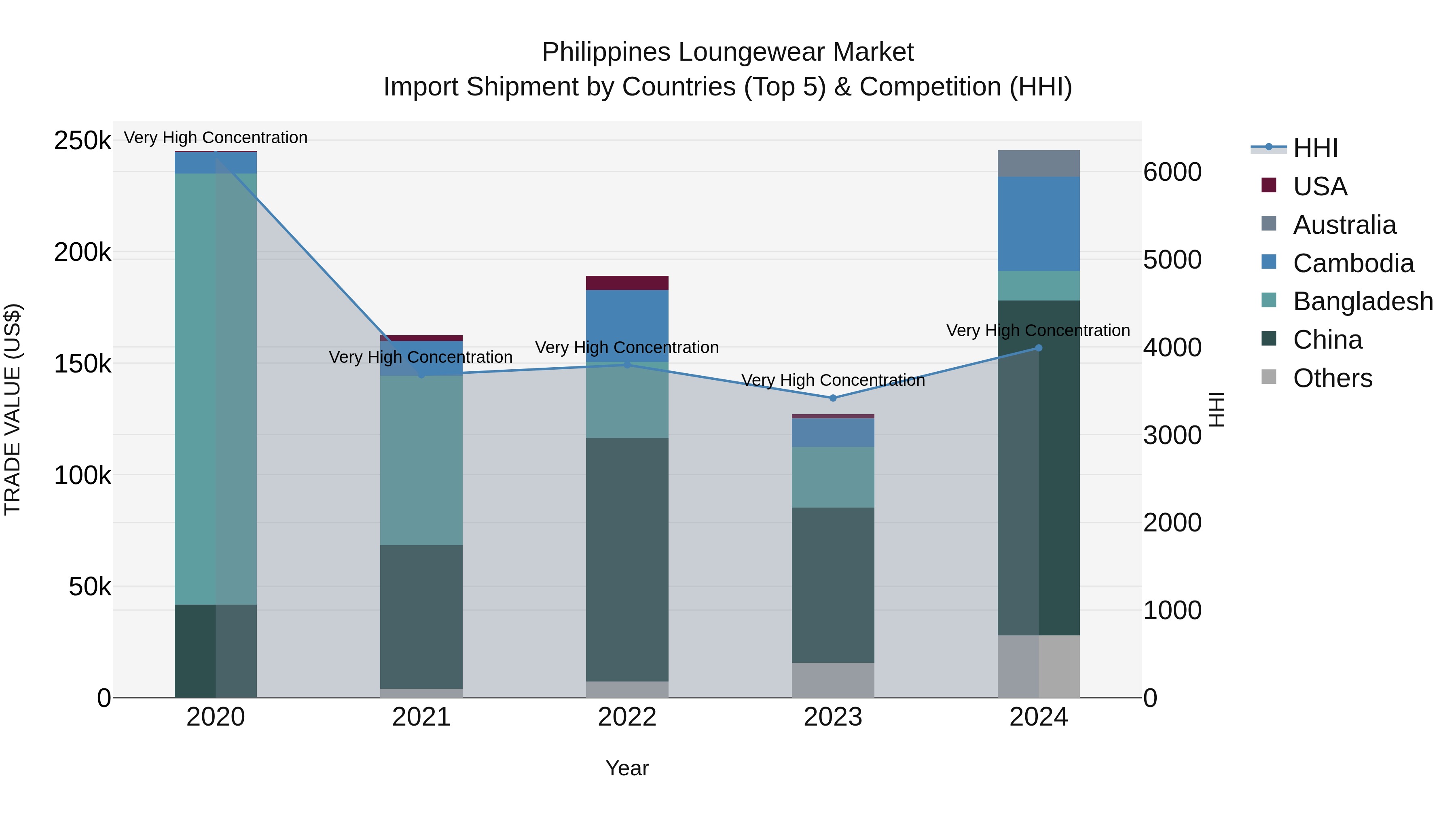
Philippines Loungewear Market Top 5 Importing Countries and Market Competition (HHI) Analysis
Philippines` loungewear import shipments in 2024 continued to be dominated by top exporters such as China, Cambodia, Bangladesh, Australia, and Vietnam. Despite a low Compound Annual Growth Rate (CAGR) of 0.03% from 2020 to 2024, there was a significant growth rate of 93.12% from 2023 to 2024. The market remained highly concentrated, as indicated by the high Herfindahl-Hirschman Index (HHI) in 2024. This data suggests a dynamic and competitive market landscape for loungewear imports in the Philippines, with potential opportunities for further growth and diversification.
Philippines Loungewear Market Synopsis
The Philippines loungewear market is experiencing steady growth, driven by the increasing demand for comfortable and stylish clothing options for casual wear and at-home activities. The market offers a range of loungewear options, including cozy sweatsuits, soft robes, and trendy pajama sets, catering to diverse consumer preferences. Local and international brands are capitalizing on this trend by introducing innovative designs, sustainable materials, and inclusive sizing to meet the evolving needs of consumers. E-commerce platforms and social media influencers play a significant role in promoting loungewear trends and driving sales in the market. With the ongoing shift towards remote work and the prioritization of comfort in clothing choices, the Philippines loungewear market is expected to continue its growth trajectory in the coming years.
Philippines Loungewear Market Trends
The loungewear market in the Philippines is experiencing a surge in demand due to the increased focus on comfort and style amidst the work-from-home culture and lifestyle changes brought about by the pandemic. Consumers are seeking versatile pieces that can be worn both indoors and outdoors, leading to a rise in loungewear sets, cozy separates, and athleisure-inspired designs. Sustainable and eco-friendly loungewear options are also gaining traction, as Filipino consumers are becoming more conscious of their purchasing decisions. With the growing popularity of loungewear as everyday wear, there are ample opportunities for brands to innovate with fabrics, designs, and inclusive sizing to cater to a diverse range of preferences and body types in the market. Online platforms and social media marketing present avenues for brands to engage with consumers and drive sales in this evolving market segment.
Philippines Loungewear Market Challenges
In the Philippines loungewear market, challenges include increasing competition from both local and international brands, price sensitivity among consumers due to economic factors, and the need to continuously innovate and adapt to changing fashion trends. The presence of counterfeit products and issues related to intellectual property rights also pose significant challenges for legitimate brands. Additionally, logistical challenges such as transportation and distribution can impact the timely delivery of products to customers across the archipelago. Furthermore, the ongoing COVID-19 pandemic has disrupted supply chains and consumer behavior, leading to uncertainties in demand and production planning. Overall, navigating these challenges requires brands in the Philippines loungewear market to strategize effectively, maintain quality standards, build brand loyalty, and explore digital marketing channels to reach a wider audience.
Philippines Loungewear Market Investment Opportunities
The Philippines Loungewear Market is being primarily driven by the growing demand for comfortable yet stylish clothing options, especially in the wake of the COVID-19 pandemic. Consumers are increasingly seeking versatile and cozy loungewear pieces that can transition from home to casual outings seamlessly. The rise of remote work and online socializing has also fueled the popularity of loungewear as a wardrobe staple. Additionally, the influence of social media and fashion trends has contributed to the growth of the loungewear market in the Philippines, with influencers and celebrities promoting loungewear as a fashion statement. As a result, retailers and brands are expanding their loungewear offerings to cater to the evolving preferences of consumers, driving further growth in the market.
Philippines Loungewear Market Government Policie
The Philippines government does not have specific policies targeting the loungewear market. However, the country`s overall trade policies, tariffs, and regulations on textile and apparel imports and exports may indirectly impact the loungewear industry. The government`s initiatives to support the local garment industry, promote sustainable practices, and comply with international labor standards could influence loungewear manufacturers and suppliers. Additionally, any changes in consumer protection laws, labor regulations, or tax policies may also affect the loungewear market in the Philippines. Companies operating in the loungewear sector should stay updated on government actions and regulations that could impact their business operations and market opportunities.
Philippines Loungewear Market Future Outlook
The Philippines loungewear market is expected to experience significant growth in the coming years, driven by the increasing trend towards comfort and casual wear among consumers. Factors such as the rise in remote working arrangements, the popularity of athleisure clothing, and the growing emphasis on self-care and wellness are contributing to the demand for loungewear in the country. Additionally, the influence of social media and online shopping platforms is making it easier for consumers to discover and purchase loungewear styles. As a result, both domestic and international loungewear brands are likely to capitalize on this trend by expanding their product offerings and marketing efforts in the Philippines market. Overall, the future outlook for the Philippines loungewear market appears promising with opportunities for growth and innovation.
Key Highlights of the Report:
- Philippines Loungewear Market Outlook
- Market Size of Philippines Loungewear Market, 2024
- Forecast of Philippines Loungewear Market, 2031
- Historical Data and Forecast of Philippines Loungewear Revenues & Volume for the Period 2021- 2031
- Philippines Loungewear Market Trend Evolution
- Philippines Loungewear Market Drivers and Challenges
- Philippines Loungewear Price Trends
- Philippines Loungewear Porter's Five Forces
- Philippines Loungewear Industry Life Cycle
- Historical Data and Forecast of Philippines Loungewear Market Revenues & Volume By Material for the Period 2021- 2031
- Historical Data and Forecast of Philippines Loungewear Market Revenues & Volume By Cotton for the Period 2021- 2031
- Historical Data and Forecast of Philippines Loungewear Market Revenues & Volume By Wool for the Period 2021- 2031
- Historical Data and Forecast of Philippines Loungewear Market Revenues & Volume By Silk for the Period 2021- 2031
- Historical Data and Forecast of Philippines Loungewear Market Revenues & Volume By End User for the Period 2021- 2031
- Historical Data and Forecast of Philippines Loungewear Market Revenues & Volume By Female for the Period 2021- 2031
- Historical Data and Forecast of Philippines Loungewear Market Revenues & Volume By Male for the Period 2021- 2031
- Historical Data and Forecast of Philippines Loungewear Market Revenues & Volume By Kids for the Period 2021- 2031
- Historical Data and Forecast of Philippines Loungewear Market Revenues & Volume By Distribution Channel for the Period 2021- 2031
- Historical Data and Forecast of Philippines Loungewear Market Revenues & Volume By Store-Based for the Period 2021- 2031
- Historical Data and Forecast of Philippines Loungewear Market Revenues & Volume By Non-Store-Based for the Period 2021- 2031
- Philippines Loungewear Import Export Trade Statistics
- Market Opportunity Assessment By Material
- Market Opportunity Assessment By End User
- Market Opportunity Assessment By Distribution Channel
- Philippines Loungewear Top Companies Market Share
- Philippines Loungewear Competitive Benchmarking By Technical and Operational Parameters
- Philippines Loungewear Company Profiles
- Philippines Loungewear Key Strategic Recommendations
Frequently Asked Questions About the Market Study (FAQs):
6Wresearch actively monitors the Philippines Loungewear Market and publishes its comprehensive annual report, highlighting emerging trends, growth drivers, revenue analysis, and forecast outlook. Our insights help businesses to make data-backed strategic decisions with ongoing market dynamics. Our analysts track relevent industries related to the Philippines Loungewear Market, allowing our clients with actionable intelligence and reliable forecasts tailored to emerging regional needs.
Yes, we provide customisation as per your requirements. To learn more, feel free to contact us on sales@6wresearch.com
Export potential assessment - trade Analytics for 2030
Export potential enables firms to identify high-growth global markets with greater confidence by combining advanced trade intelligence with a structured quantitative methodology. The framework analyzes emerging demand trends and country-level import patterns while integrating macroeconomic and trade datasets such as GDP and population forecasts, bilateral import–export flows, tariff structures, elasticity differentials between developed and developing economies, geographic distance, and import demand projections. Using weighted trade values from 2020–2024 as the base period to project country-to-country export potential for 2030, these inputs are operationalized through calculated drivers such as gravity model parameters, tariff impact factors, and projected GDP per-capita growth. Through an analysis of hidden potentials, demand hotspots, and market conditions that are most favorable to success, this method enables firms to focus on target countries, maximize returns, and global expansion with data, backed by accuracy.
By factoring in the projected importer demand gap that is currently unmet and could be potential opportunity, it identifies the potential for the Exporter (Country) among 190 countries, against the general trade analysis, which identifies the biggest importer or exporter.
To discover high-growth global markets and optimize your business strategy:
Click Here
Pricing
- Single User License$ 1,995
- Department License$ 2,400
- Site License$ 3,120
- Global License$ 3,795

Search
Thought Leadership and Analyst Meet





Our Clients








Related Reports
- India Kids Watches Market (2026-2032) | Strategy, Consumer Insights, Analysis, Investment Trends, Opportunities, Growth, Size, Share, Industry, Revenue, Segments, Value, Segmentation, Supply, Forecast, Restraints, Outlook, Competition, Drivers, Trends, Demand, Pricing Analysis, Competitive, Strategic Insights, Companies, Challenges
- Saudi Arabia Core Assurance Service Market (2025-2031) | Strategy, Consumer Insights, Analysis, Investment Trends, Opportunities, Growth, Size, Share, Industry, Revenue, Segments, Value, Segmentation, Supply, Forecast, Restraints, Outlook, Competition, Drivers, Trends, Demand, Pricing Analysis, Competitive, Strategic Insights, Companies, Challenges
- Romania Uninterruptible Power Supply (UPS) Market (2026-2032) | Industry, Analysis, Revenue, Size, Forecast, Outlook, Value, Trends, Share, Growth & Companies
- Saudi Arabia Car Window Tinting Film, Paint Protection Film (PPF), and Ceramic Coating Market (2025-2031) | Strategy, Consumer Insights, Analysis, Investment Trends, Opportunities, Growth, Size, Share, Industry, Revenue, Segments, Value, Segmentation, Supply, Forecast, Restraints, Outlook, Competition, Drivers, Trends, Demand, Pricing Analysis, Competitive, Strategic Insights, Companies, Challenges
- South Africa Stationery Market (2025-2031) | Share, Size, Industry, Value, Growth, Revenue, Analysis, Trends, Segmentation & Outlook
- Afghanistan Rocking Chairs And Adirondack Chairs Market (2026-2032) | Size & Revenue, Competitive Landscape, Share, Segmentation, Industry, Value, Outlook, Analysis, Trends, Growth, Forecast, Companies
- Afghanistan Apparel Market (2026-2032) | Growth, Outlook, Industry, Segmentation, Forecast, Size, Companies, Trends, Value, Share, Analysis & Revenue
- Canada Oil and Gas Market (2026-2032) | Share, Segmentation, Value, Industry, Trends, Forecast, Analysis, Size & Revenue, Growth, Competitive Landscape, Outlook, Companies
- Germany Breakfast Food Market (2026-2032) | Industry, Share, Growth, Size, Companies, Value, Analysis, Revenue, Trends, Forecast & Outlook
- Australia Briquette Market (2025-2031) | Growth, Size, Revenue, Forecast, Analysis, Trends, Value, Share, Industry & Companies
Industry Events and Analyst Meet

Smart Production Solutions Guangzhou 2026

Stationery & Paper Expo Saudi Arabia 2026

Kids & Toys Expo Saudi Arabia 2026

Gifts & Homeware Expo Saudi Arabia 2026

Smart Home Expo 2026
Whitepaper
- Middle East & Africa Commercial Security Market Click here to view more.
- Middle East & Africa Fire Safety Systems & Equipment Market Click here to view more.
- GCC Drone Market Click here to view more.
- Middle East Lighting Fixture Market Click here to view more.
- GCC Physical & Perimeter Security Market Click here to view more.
6WResearch In News
- Doha a strategic location for EV manufacturing hub: IPA Qatar
- Demand for luxury TVs surging in the GCC, says Samsung
- Empowering Growth: The Thriving Journey of Bangladesh’s Cable Industry
- Demand for luxury TVs surging in the GCC, says Samsung
- Video call with a traditional healer? Once unthinkable, it’s now common in South Africa
- Intelligent Buildings To Smooth GCC’s Path To Net Zero


