Philippines Personal Protective Equipment Market (2026-2032) | Growth, Size, Industry, Forecast, Companies, Outlook, Revenue, Share, Value, Trends & Analysis
Market Forecast By Product Types (Head, Eye & Face Protection, Hearing Protection, Protective Clothing, Respiratory Protection, Protective Footwear, Fall Protection, Hand Protection, Otherd), By End-users (Construction, Manufacturing, Oil & Gas, Chemicals, Food, Pharmaceuticals, Mining, Others) And Competitive Landscape
| Product Code: ETC013789 | Publication Date: Jul 2023 | Updated Date: Feb 2026 | Product Type: Report | |
| Publisher: 6Wresearch | Author: Ravi Bhandari | No. of Pages: 70 | No. of Figures: 35 | No. of Tables: 5 |
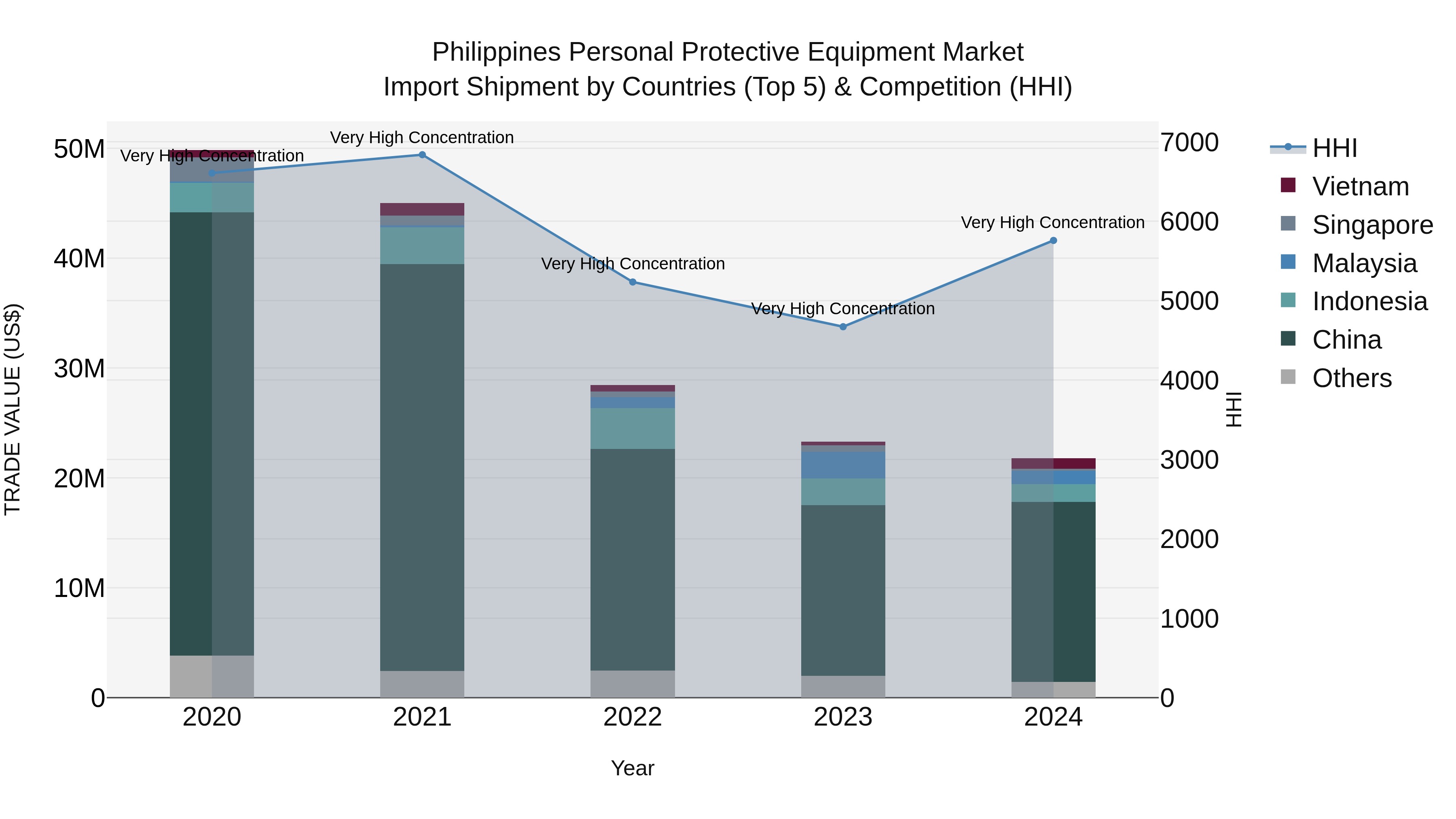
Philippines Personal Protective Equipment Market Top 5 Importing Countries and Market Competition (HHI) Analysis
In 2024, Philippines continued to rely heavily on imports of personal protective equipment, with top suppliers being China, Indonesia, Malaysia, Vietnam, and Taiwan. Despite a high concentration level, the market experienced a significant decline with a negative CAGR of -18.67% from 2020 to 2024. The growth rate in 2024 also remained negative at -6.42%, pointing towards ongoing challenges in the industry. This data underscores the importance of diversifying sources and strengthening domestic production capabilities to ensure a stable supply of PPE in the Philippines.
Philippines Personal Protective Equipment Market Growth Rate
According to 6Wresearch internal database and industry insights, the Philippines Personal Protective Equipment (PPE) Market is projected to grow at a compound annual growth rate (CAGR) of 9.2% during the forecast period (2026–2032).
Five-Year Growth Trajectory of the Philippines Personal Protective Equipment Market with Core Drivers
Below is the evaluation of the year-wise growth rate along with key drivers:
| Years | Estimated Annual Growth (%) | Growth Drivers |
| 2021 | 7.2% | Stricter enforcement of Republic Act 11058 (Occupational Safety and Health Standards). |
| 2022 | 7.9% | Surge in infrastructure projects under the "Build Better More" program. |
| 2023 | 8.5% | Expansion of the manufacturing sector and export-oriented industrial zones. |
| 2024 | 8.9% | Growing awareness of long-term respiratory health in mining and quarrying sectors. |
| 2025 | 9.1% | Adoption of specialized protective gear in the rising renewable energy segment. |
Topics Covered in the Philippines Personal Protective Equipment Market Report
The Philippines Personal Protective Equipment Market report thoroughly covers the market by product types and end-users. The report provides a detailed analysis of ongoing market trends, opportunities/high-growth areas, and market drivers that will help stakeholders align strategies based on current and future market dynamics.
Philippines Personal Protective Equipment Market Highlights
| Report Name | Philippines Personal Protective Equipment Market |
| Forecast Period | 2026–2032 |
| CAGR | 9.20% |
| Growing Sector | Construction and Manufacturing |
Philippines Personal Protective Equipment Market Synopsis
Philippines Personal Protective Equipment Market is expected to achieve enormous growth on account of strict safety guidelines, industrialization, and rising awareness about occupational hazards. PPE includes gloves, helmets, eye protection, protective clothing, and respiratory equipment. Personal protective equipment is essential in several sectors like manufacturing, healthcare, construction, and mining. Demand is accelerated by government-backed programs that enhance safety of workers and pandemic related hygiene needs. These factors drive long-term Philippines Personal Protective Equipment Market growth.
Evaluation of Growth Drivers in Philippines Personal Protective Equipment Market
Below are some prominent drivers and their influence on the market dynamics:
| Drivers | Primary Segments Affected | Why It Matters |
| Build Better More Program | By Product (Head, Foot Protection) | Enormous civil works increase the baseline demand for helmets and safety shoes. |
| Firmer OSH Penalties | By End-user (All Sectors) | High fines for non-compliance augments institutional procurement of certified gear. |
| Mining Revitalization | By Product (Respiratory, Hand) | Renewed mining permits require high-end filtration and impact-resistant gloves. |
| Expansion of E-commerce | By End-user (Logistics/SMEs) | Digital marketplaces make PPE easily accessible to smaller contractors and workshops. |
| Foreign Investment | By End-user (Manufacturing) | International firms bring global safety standards, necessitating premium-grade PPE. |
Philippines Personal Protective Equipment Market is expected to grow at a significant CAGR of 9.2% during the forecast period 2026-2032. Key factors that drive the market growth include the rising urbanization, development of construction and manufacturing activities, implementation of safety regulations, and heightened corporate emphasis on workplace safety. Healthcare enhancement, accompanied by rising consciousness among workers associated with personal safety, is also boosting the adoption of Personal Protective Equipment.
Evaluation of Restraints in Philippines Personal Protective Equipment Market
Below are some prominent restraints and their influence on the market dynamics:
| Restraints | Primary Segments Affected | What This Means |
| Counterfeit Products | By Product (Respiratory, Eye) | Substandard "replica" gear in local markets poses a major threat to worker safety. |
| High Initial Costs | By Product (Fall Protection) | First-class specialized equipment can be expensive for local micro-SMEs. |
| Fragmented Standards | By Product (Others) | Disparities between local and international certifications can confuse buyers. |
| Import Dependency | By End-user (Oil & Gas) | Limited local manufacturing for high-tech PPE leads to price volatility. |
| Worker Resistance | By Product (Hearing, Clothing) | Discomfort or heat stress in tropical climates can lead to unreliable PPE usage. |
Philippines Personal Protective Equipment Market Challenges
Philippines personal protective equipment industry encounters challenges such as presence of counterfeit products, high costs of innovative PPE, and lack of availability in distant areas. Production expenses are impacted by uncertainty in raw material prices and obedience to global safety regulations raises procurement difficulties. In addition, slow implementation of Personal protective equipment in informal sectors limits the whole market entry, acting as barrier for long-term growth.
Philippines Personal Protective Equipment Market Trends
Emerging trends impacting the Philippines personal protective equipment market growth are:
- Integrating Smart PPE: Increasing use of smart PPE like helmets with GPS and fall detection sensors for high-value projects in mining and energy.
- Sustainable Materials: Manufacturers are creating biodegradable gloves and safety vests out of recycled polyester to meet their corporate sustainability initiatives.
- Female-focused Designs: The increase in women working in construction has created a demand for women's PPE that fits women better and is designed with their anatomy in mind.
Investment Opportunities in the Philippines Personal Protective Equipment Market
Opportunities for investment in the Philippines personal protective equipment market include:
- Local Manufacturing Centers: Building local manufacturing centers for high volume items (i.e., safety shoes and vests) to reduce dependency on costly imported products.
- Rental and Maintenance Businesses: Establishing rental and maintenance operations to provide professional repairs and certified inspections on expensive PPE products, especially fall protection systems.
- E-learning Platforms: Providing a combined solution through e-learning platforms that include PPE sales and digital OSH training programs for corporate clients.
Top 5 Leading Players in the Philippines Personal Protective Equipment Market
Below is a list of prominent companies leading the Philippines Personal Protective Equipment Market:
1. 3M Philippines
| Company Name | 3M Philippines |
| Established Year | 1964 (Philippines Operations) |
| Headquarters | Taguig, Metro Manila |
| Official Website | Click Here |
A global science-based company that is a market leader in respiratory, hearing, and fall protection, known for high-tier N95 masks and premium safety eyewear.
2. Honeywell Philippines
| Company Name | Honeywell Philippines |
| Established Year | 1970s (Regional Presence) |
| Headquarters | Taguig, Metro Manila |
| Official Website | Click Here |
A diversified technology giant providing advanced industrial safety solutions, including gas detection and high-performance protective clothing for the Oil & Gas sector.
3. Ansell Philippines
| Company Name | Ansell Philippines |
| Established Year | 1990s (Regional Operations) |
| Headquarters | Makati, Metro Manila |
| Official Website | Click Here |
A world leader in hand and arm protection, focusing on high-durability gloves for the manufacturing, chemical, and healthcare industries in the Philippines.
4. Professional Gear Inc. (PROGEAR)
| Company Name | Professional Gear Inc. (PROGEAR) |
| Established Year | 2002 |
| Headquarters | Makati, Metro Manila |
| Official Website | Click Here |
A prominent local pioneer specializing in maritime and industrial safety apparel, offering a comprehensive range of all-weather gear and safety shoes.
5. Delta Plus Philippines
| Company Name | Delta Plus Philippines |
| Established Year | 2015 (Local Branch) |
| Headquarters | deltaplus.eu/ph |
| Official Website | Click Here |
A major European-based player that has rapidly expanded in the Philippines, offering a "head-to-toe" range of certified PPE for construction and general industry.
Government Regulations in the Philippines Personal Protective Equipment Market
According to Filipino government date, regulations in the Philippines Personal Protective Equipment market greately emphasize on occupational safety, industrial hygiene, and workplace compliance. The Department of Labor and Employment (DOLE) is responsible for enforcing mandatory use of personal protective equipment in particular industries where workers are at high risk.
The DOLE also promotes compliance with international standards for workplace safety and requires that all employees receive adequate training and that safety training be audited on a regular basis. The Philippine government has developed and supported a variety of safety program initiatives to provide employers larger financial incentives to comply with established regulatory requirements and to help influence their request for new types of personal protective equipment that is more technologically advanced, thereby changing traditional demand patterns.
Future Insights of the Philippines Personal Protective Equipment Market
The outlook for the personal protective equipment market in the Philippines is positive as the country continues to experience strong economic growth and the majority of industries continue to abide by increasingly stringent safety requirements. Growth in the personal protective equipment market in the Philippines is expected to remain strong due to many industries that are continuing to expand (construction, manufacturing, healthcare), increased regulations regarding safety and use of personal protective equipment, and increased use of new technologies in manufacturing of new types of personal protective equipment (e.g., smart PPE, wearable safety devices, and sustainable materials).
Market Segmentation Analysis
The report offers a comprehensive study of the subsequent market segments and their leading categories.
Gloves to Dominate the Market – By Product Type
According to Ravi Bhandari, Research Head, 6Wresearch, gloves segment is expected to dominate the Philippines Personal Protective Equipment Market share due to extensive use in construction, manufacturing, and healthcare sectors for hand protection.
Construction to Dominate the Market – By End User
Construction is the leading end-user segment in the Philippines Personal Protective Equipment market. Rapid urbanization, infrastructure development, and increased government projects significantly drive PPE demand.
Key Attractiveness of the Report
- 10 Years of Market Numbers
- Historical Data Starting from 2022 to 2025
- Base Year: 2025
- Forecast Data until 2032
- Key Performance Indicators Impacting the Market
- Major Upcoming Developments and Projects
Key Highlights of the Report:
- Philippines Personal Protective Equipment Market Outlook
- Market Size of Philippines Personal Protective Equipment Market, 2025
- Forecast of Philippines Personal Protective Equipment Market, 2032
- Historical Data and Forecast of Philippines Personal Protective Equipment Revenues & Volume for the Period 2022-2032F
- Philippines Personal Protective Equipment Market Trend Evolution
- Philippines Personal Protective Equipment Market Drivers and Challenges
- Philippines Personal Protective Equipment Price Trends
- Philippines Personal Protective Equipment Porter's Five Forces
- Philippines Personal Protective Equipment Industry Life Cycle
- Historical Data and Forecast of Philippines Personal Protective Equipment Market Revenues & Volume By Product Types for the Period 2022-2032F
- Historical Data and Forecast of Philippines Personal Protective Equipment Market Revenues & Volume By Head, Eye & Face Protection for the Period 2022-2032F
- Historical Data and Forecast of Philippines Personal Protective Equipment Market Revenues & Volume By Hearing Protection for the Period 2022-2032F
- Historical Data and Forecast of Philippines Personal Protective Equipment Market Revenues & Volume By Protective Clothing for the Period 2022-2032F
- Historical Data and Forecast of Philippines Personal Protective Equipment Market Revenues & Volume By Respiratory Protection for the Period 2022-2032F
- Historical Data and Forecast of Philippines Personal Protective Equipment Market Revenues & Volume By Protective Footwear for the Period 2022-2032F
- Historical Data and Forecast of Philippines Personal Protective Equipment Market Revenues & Volume By Fall Protection for the Period 2022-2032F
- Historical Data and Forecast of Philippines Personal Protective Equipment Market Revenues & Volume By Hand Protection for the Period 2022-2032F
- Historical Data and Forecast of Philippines Head, Eye & Face Protection Personal Protective Equipment Market Revenues & Volume By Otherd for the Period 2022-2032F
- Historical Data and Forecast of Philippines Personal Protective Equipment Market Revenues & Volume By End-users for the Period 2022-2032F
- Historical Data and Forecast of Philippines Personal Protective Equipment Market Revenues & Volume By Construction for the Period 2022-2032F
- Historical Data and Forecast of Philippines Personal Protective Equipment Market Revenues & Volume By Manufacturing for the Period 2022-2032F
- Historical Data and Forecast of Philippines Personal Protective Equipment Market Revenues & Volume By Oil & Gas for the Period 2022-2032F
- Historical Data and Forecast of Philippines Personal Protective Equipment Market Revenues & Volume By Chemicals for the Period 2022-2032F
- Historical Data and Forecast of Philippines Personal Protective Equipment Market Revenues & Volume By Food for the Period 2022-2032F
- Historical Data and Forecast of Philippines Personal Protective Equipment Market Revenues & Volume By Pharmaceuticals for the Period 2022-2032F
- Historical Data and Forecast of Philippines Personal Protective Equipment Market Revenues & Volume By Mining for the Period 2022-2032F
- Historical Data and Forecast of Philippines Personal Protective Equipment Market Revenues & Volume By Others for the Period 2022-2032F
- Philippines Personal Protective Equipment Import Export Trade Statistics
- Market Opportunity Assessment By Product Types
- Market Opportunity Assessment By End-users
- Philippines Personal Protective Equipment Top Companies Market Share
- Philippines Personal Protective Equipment Competitive Benchmarking By Technical and Operational Parameters
- Philippines Personal Protective Equipment Company Profiles
- Philippines Personal Protective Equipment Key Strategic Recommendations
Markets Covered
The market report provides a detailed analysis of the following market segments:
By Product Type
- Head
- Eye & Face Protection
- Hearing Protection
- Protective Clothing
- Respiratory Protection
- Protective Footwear
- Fall Protection
- Hand Protection
- Others
By End-user
- Construction
- Manufacturing
- Oil & Gas
- Chemicals
- Food
- Pharmaceuticals
- Mining
- Others
Philippines Personal Protective Equipment Market (2025-2031): FAQs
The expected CAGR of the Philippines personal protective equipment Market is approximately 5.1% during the forecast period.
The Philippines personal protective equipment is rising industrialization, stringent safety regulations, and increasing awareness about occupational hazards.
Key players dominating the Philippines Personal Protective Equipment market include 3M, Honeywell International, DuPont, MSA Safety, and Ansell.
6Wresearch actively monitors the Philippines Personal Protective Equipment Market and publishes its comprehensive annual report, highlighting emerging trends, growth drivers, revenue analysis, and forecast outlook. Our insights help businesses to make data-backed strategic decisions with ongoing market dynamics. Our analysts track relevent industries related to the Philippines Personal Protective Equipment Market, allowing our clients with actionable intelligence and reliable forecasts tailored to emerging regional needs.
Yes, we provide customisation as per your requirements. To learn more, feel free to contact us on sales@6wresearch.com
| 1 Executive Summary |
| 2 Introduction |
| 2.1 Key Highlights of the Report |
| 2.2 Report Description |
| 2.3 Market Scope & Segmentation |
| 2.4 Research Methodology |
| 2.5 Assumptions |
| 3 Philippines Personal Protective Equipment Market Overview |
| 3.1 Philippines Country Macro Economic Indicators |
| 3.2 Philippines Personal Protective Equipment Market Revenues & Volume, 2022–2032F |
| 3.3 Philippines Personal Protective Equipment Market - Industry Life Cycle |
| 3.4 Philippines Personal Protective Equipment Market - Porter's Five Forces |
| 3.5 Philippines Personal Protective Equipment Market Revenues & Volume Share, By Product Types, 2022–2032F |
| 3.6 Philippines Personal Protective Equipment Market Revenues & Volume Share, By End-users, 2022–2032F |
| 4 Philippines Personal Protective Equipment Market Dynamics |
| 4.1 Impact Analysis |
| 4.2 Market Drivers |
| 4.3 Market Restraints |
| 5 Philippines Personal Protective Equipment Market Trends |
| 6 Philippines Personal Protective Equipment Market, By Types |
| 6.1 Philippines Personal Protective Equipment Market, By Product Types |
| 6.1.1 Overview and Analysis |
| 6.1.2 Philippines Personal Protective Equipment Market Revenues & Volume, By Product Types, 2022–2032F |
| 6.1.3 Philippines Personal Protective Equipment Market Revenues & Volume, By Head, Eye & Face Protection, 2022–2032F |
| 6.1.4 Philippines Personal Protective Equipment Market Revenues & Volume, By Hearing Protection, 2022–2032F |
| 6.1.5 Philippines Personal Protective Equipment Market Revenues & Volume, By Protective Clothing, 2022–2032F |
| 6.1.6 Philippines Personal Protective Equipment Market Revenues & Volume, By Respiratory Protection, 2022–2032F |
| 6.1.7 Philippines Personal Protective Equipment Market Revenues & Volume, By Protective Footwear, 2022–2032F |
| 6.1.8 Philippines Personal Protective Equipment Market Revenues & Volume, By Fall Protection, 2022–2032F |
| 6.1.9 Philippines Personal Protective Equipment Market Revenues & Volume, By Otherd, 2022–2032F |
| 6.1.10 Philippines Personal Protective Equipment Market Revenues & Volume, By Otherd, 2022–2032F |
| 6.2 Philippines Personal Protective Equipment Market, By End-users |
| 6.2.1 Overview and Analysis |
| 6.2.2 Philippines Personal Protective Equipment Market Revenues & Volume, By Construction, 2022–2032F |
| 6.2.3 Philippines Personal Protective Equipment Market Revenues & Volume, By Manufacturing, 2022–2032F |
| 6.2.4 Philippines Personal Protective Equipment Market Revenues & Volume, By Oil & Gas, 2022–2032F |
| 6.2.5 Philippines Personal Protective Equipment Market Revenues & Volume, By Chemicals, 2022–2032F |
| 6.2.6 Philippines Personal Protective Equipment Market Revenues & Volume, By Food, 2022–2032F |
| 6.2.7 Philippines Personal Protective Equipment Market Revenues & Volume, By Pharmaceuticals, 2022–2032F |
| 6.2.8 Philippines Personal Protective Equipment Market Revenues & Volume, By Others, 2022–2032F |
| 6.2.9 Philippines Personal Protective Equipment Market Revenues & Volume, By Others, 2022–2032F |
| 7 Philippines Personal Protective Equipment Market Import-Export Trade Statistics |
| 7.1 Philippines Personal Protective Equipment Market Export to Major Countries |
| 7.2 Philippines Personal Protective Equipment Market Imports from Major Countries |
| 8 Philippines Personal Protective Equipment Market Key Performance Indicators |
| 9 Philippines Personal Protective Equipment Market - Opportunity Assessment |
| 9.1 Philippines Personal Protective Equipment Market Opportunity Assessment, By Product Types, 2022–2032F |
| 9.2 Philippines Personal Protective Equipment Market Opportunity Assessment, By End-users, 2022–2032F |
| 10 Philippines Personal Protective Equipment Market - Competitive Landscape |
| 10.1 Philippines Personal Protective Equipment Market Revenue Share, By Companies, 2025 |
| 10.2 Philippines Personal Protective Equipment Market Competitive Benchmarking, By Operating and Technical Parameters |
| 11 Company Profiles |
| 12 Recommendations |
| 13 Disclaimer |
Export potential assessment - trade Analytics for 2030
Export potential enables firms to identify high-growth global markets with greater confidence by combining advanced trade intelligence with a structured quantitative methodology. The framework analyzes emerging demand trends and country-level import patterns while integrating macroeconomic and trade datasets such as GDP and population forecasts, bilateral import–export flows, tariff structures, elasticity differentials between developed and developing economies, geographic distance, and import demand projections. Using weighted trade values from 2020–2024 as the base period to project country-to-country export potential for 2030, these inputs are operationalized through calculated drivers such as gravity model parameters, tariff impact factors, and projected GDP per-capita growth. Through an analysis of hidden potentials, demand hotspots, and market conditions that are most favorable to success, this method enables firms to focus on target countries, maximize returns, and global expansion with data, backed by accuracy.
By factoring in the projected importer demand gap that is currently unmet and could be potential opportunity, it identifies the potential for the Exporter (Country) among 190 countries, against the general trade analysis, which identifies the biggest importer or exporter.
To discover high-growth global markets and optimize your business strategy:
Click Here
Pricing
- Single User License$ 1,995
- Department License$ 2,400
- Site License$ 3,120
- Global License$ 3,795

Search
Thought Leadership and Analyst Meet





Our Clients








Latest Reports
- Taiwan Food Delivery Platform Market (2026-2032) | Companies, Outlook, Analysis, Trends, Value, Revenue, Segmentation, Share, Forecast, Competitive Landscape, Growth, Size & Forecast
- United Kingdom (UK) Long-term Care Insurance Market (2026-2032) | Growth, Share, Consumer Insights, Drivers, Opportunities, Competition, Pricing Analysis, Segments, Restraints, Companies, Competitive, Value, Outlook, Size, Demand, Analysis, Challenges, Strategic Insights, Investment Trends, Revenue, Trends, Supply, Forecast
- United Kingdom (UK) Long Term Care Market (2026-2032) | Companies, Outlook, Analysis, Trends, Value, Revenue, Segmentation, Share, Forecast, Competitive Landscape, Growth, Size & Forecast
- Iraq Insulation and Waterproofing Market (2026-2032) | Outlook, Drivers, Growth, Size, Share, Industry, Revenue, Trends, Demand, Competitive, Strategic Insights, Opportunities, Segments, Companies, Challenges, Strategy, Consumer Insights, Analysis, Investment Trends, Value, Segmentation, Forecast, Restraints
- India Switchgear Market Outlook (2026-2032) | Size, Share, Trends, Growth, Revenue, Forecast, Analysis, Value, Outlook
- Pakistan Contraceptive Implants Market (2025-2031) | Demand, Growth, Size, Share, Industry, Pricing Analysis, Competitive, Strategic Insights, Strategy, Consumer Insights, Analysis, Investment Trends, Opportunities, Revenue, Segments, Value, Segmentation, Supply, Forecast, Restraints, Outlook, Competition, Drivers, Trends, Companies, Challenges
- Sri Lanka Packaging Market (2026-2032) | Outlook, Competition, Drivers, Trends, Demand, Pricing Analysis, Competitive, Strategic Insights, Companies, Challenges, Strategy, Consumer Insights, Analysis, Investment Trends, Opportunities, Growth, Size, Share, Industry, Revenue, Segments, Value, Segmentation, Supply, Forecast, Restraints
- India Kids Watches Market (2026-2032) | Strategy, Consumer Insights, Analysis, Investment Trends, Opportunities, Growth, Size, Share, Industry, Revenue, Segments, Value, Segmentation, Supply, Forecast, Restraints, Outlook, Competition, Drivers, Trends, Demand, Pricing Analysis, Competitive, Strategic Insights, Companies, Challenges
- Saudi Arabia Core Assurance Service Market (2025-2031) | Strategy, Consumer Insights, Analysis, Investment Trends, Opportunities, Growth, Size, Share, Industry, Revenue, Segments, Value, Segmentation, Supply, Forecast, Restraints, Outlook, Competition, Drivers, Trends, Demand, Pricing Analysis, Competitive, Strategic Insights, Companies, Challenges
- Romania Uninterruptible Power Supply (UPS) Market (2026-2032) | Industry, Analysis, Revenue, Size, Forecast, Outlook, Value, Trends, Share, Growth & Companies
Industry Events and Analyst Meet

India EV Show 2026

EV tech India Expo 2026

Auto Tech Asia 2026
Battery Tech India 2026
Smart Production Solutions Guangzhou 2026
Whitepaper
- Middle East & Africa Commercial Security Market Click here to view more.
- Middle East & Africa Fire Safety Systems & Equipment Market Click here to view more.
- GCC Drone Market Click here to view more.
- Middle East Lighting Fixture Market Click here to view more.
- GCC Physical & Perimeter Security Market Click here to view more.
6WResearch In News
- Doha a strategic location for EV manufacturing hub: IPA Qatar
- Demand for luxury TVs surging in the GCC, says Samsung
- Empowering Growth: The Thriving Journey of Bangladesh’s Cable Industry
- Demand for luxury TVs surging in the GCC, says Samsung
- Video call with a traditional healer? Once unthinkable, it’s now common in South Africa
- Intelligent Buildings To Smooth GCC’s Path To Net Zero


