Poland Sodium Silicate Market (2026-2032) | Forecast, Analysis, Outlook, Revenue, Industry, Size, Trends, Share, Value, Growth & Companies
Market Forecast By Form (Crystalline, Anhydrous), By Type (Liquid, Solid), By Grade (Neutral, Alkaline), By Application (Paints, Adhesives, Refractories, Tube Winding, Detergent, Catalyst, Others), By End Use (Pulp & Paper, Construction, Automotive, Others) And Competitive Landscape
| Product Code: ETC082774 | Publication Date: Jun 2021 | Updated Date: Feb 2026 | Product Type: Report | |
| Publisher: 6Wresearch | No. of Pages: 70 | No. of Figures: 35 | No. of Tables: 5 | |
poland sodium silicate market
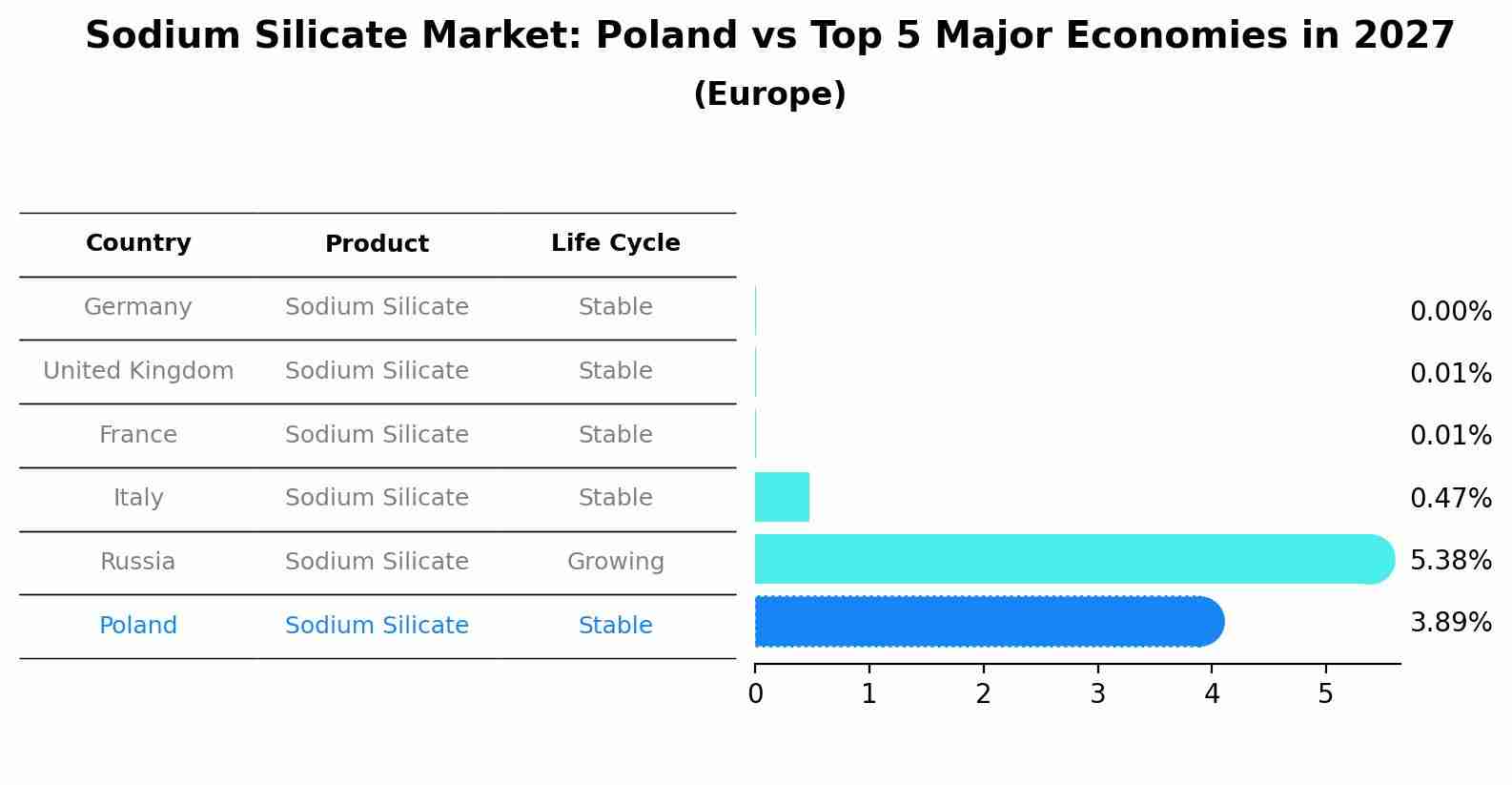
Sodium Silicate Market: Poland vs Top 5 Major Economies in 2027 (Europe)
The Sodium Silicate market in Poland is projected to grow at a stable growth rate of 3.89% by 2027, highlighting the country's increasing focus on advanced technologies within the Europe region, where Germany holds the dominant position, followed closely by United Kingdom, France, Italy and Russia, shaping overall regional demand.
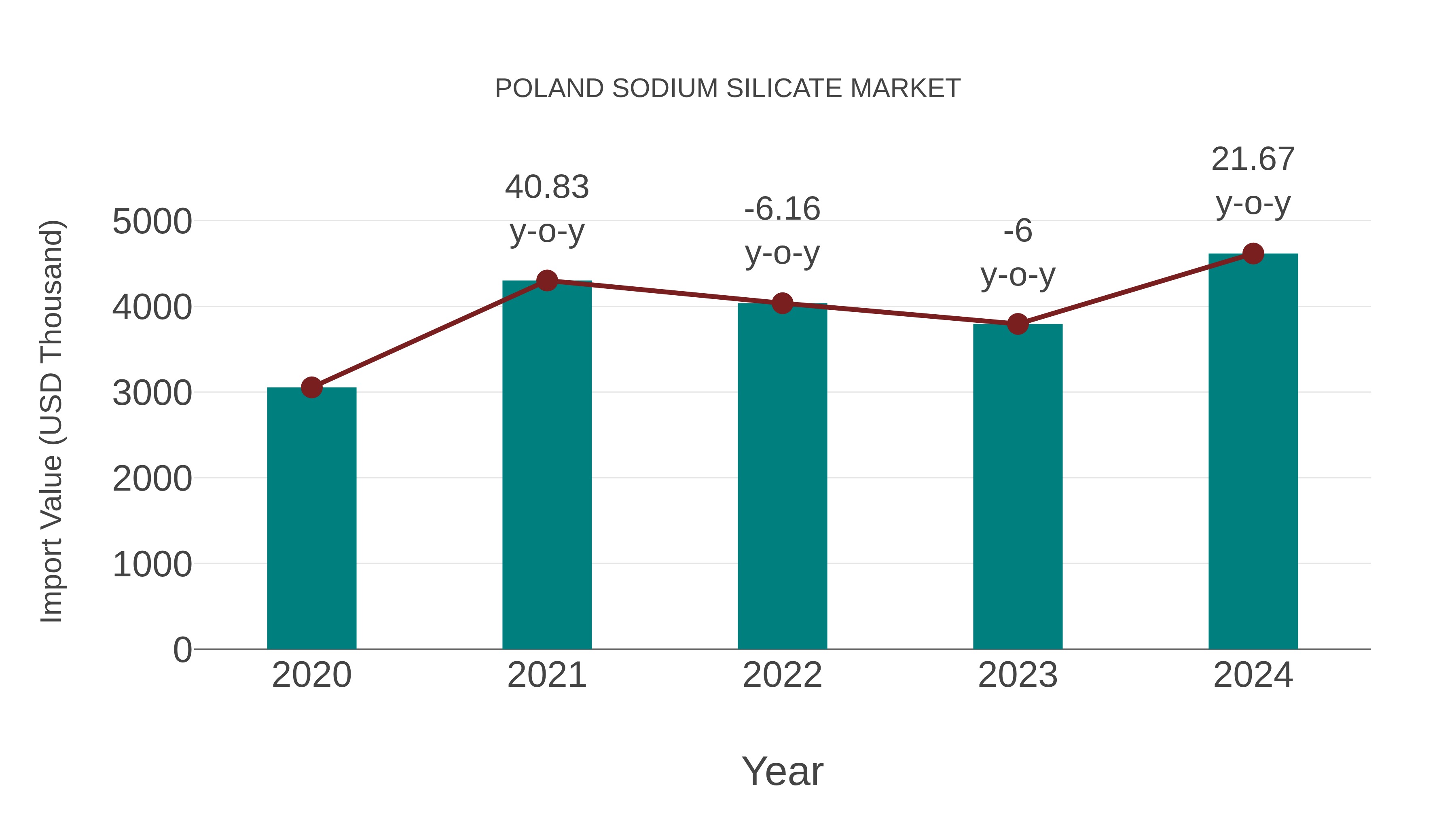
Poland Sodium Silicate Market Growth Rate
According to 6Wresearch internal database and industry insights,
Five-Year Growth Trajectory of the Poland Sodium Silicate Market with Core Drivers
Below mentioned is the evaluation of year-wise growth rate along with key growth drivers:
| Year | Est. Annual Growth (%) | Growth Drivers |
| 2021 | 3% | Expansion in the automotive and construction industries driving sodium silicate demand |
| 2022 | 3.5% | Growing use of sodium silicate in detergents and adhesives industries |
| 2023 | 4% | Increasing application in refractories and the rise in industrial demand for high-quality silicates |
| 2024 | 4.2% | Growing demand for eco-friendly detergents and chemical catalysts |
| 2025 | 5% | Expansion in the pulp & paper industry and rising demand in construction |
Topics Covered in the Poland Sodium Silicate Market Report
The Poland Sodium Silicate Market report thoroughly covers the market by Form, Type, Grade, Application and End Use. The market report provides an unbiased and detailed analysis of ongoing market trends, opportunities/high growth areas, and market drivers, which help stakeholders devise and align their market strategies according to the current and future market dynamics.
Poland Sodium Silicate Market Highlights
| Report Name | Poland Sodium Silicate Market |
| Forecast period | 2026-2032 |
| CAGR | 6% |
| Growing Sector | Construction Industry |
Poland Sodium Silicate Market Synopsis
The Poland Sodium Silicate Market is expected to witness steady growth due to increasing demand in various end-use industries such as automotive, construction, and pulp & paper. Increased industrialization and emphasis on sustainable materials further propel the market growth. Sodium silicate has a variety of uses such as adhesives, detergents, and refractory materials. These are driving the demand for the product. Increased utilization of the compound as a binder in ceramics and cement is further driving the growth and development of the market, especially in Poland due to increased urbanization.
Evaluation of Growth Drivers in the Poland Sodium Silicate Market
Below mentioned are some prominent drivers and their influence on the market dynamics:
| Drivers | Primary Segments Affected | Why it Matters (Evidence) |
| Increased Demand in Automotive | Adhesives, Catalyst, Automotive | The automotive sector’s growth drives demand for high-performance adhesives and coatings. |
| Expanding Construction Sector | Construction, Paints, Refractories | Infrastructure projects boost demand for sodium silicate in concrete and other building materials. |
| Growing Usage in Detergents | Detergents, Cleaning, Household Products | Environmental shifts lead to the adoption of eco-friendly cleaning products, promoting silicate use. |
| Rising Adoption in Refractories | Refractories, Industrial Equipment | Steel and cement industries increasing refractory material demand due to higher production rates. |
| Government Support for Industry | All Types, Construction & Automotive | National initiatives to enhance infrastructure, driving increased demand in the construction sector. |
The Poland Sodium Silicate Market is expected to grow at the CAGR of 6% during the forecast period of 2026-2032. Various drivers are influencing the growth of the market, including the, growing construction, automotive, and detergent industries, which are receiving strong support from government initiatives such as sustainable industrial development and eco-friendly products. Moreover, the growing demand for refractories and catalysts in different industry sectors also plays an important role in the development of the market, and such conditions are likely to continue supporting the growth of the market.
Evaluation of Restraints in the Poland Sodium Silicate Market
Below mentioned are some major restraints and their influence on the market dynamics:
| Restraints | Primary Segments Affected | What This Means (Evidence) |
| High Raw Material Costs | All Types, Construction, Automotive | Increased production costs due to rising prices for raw materials limit market growth. |
| Limited Awareness of Product Benefits | All Types, End Users | Lack of consumer knowledge about the benefits of sodium silicate reduces its widespread use. |
| Complex Manufacturing Process | All Types, Detergents, Paints | The intricate manufacturing process increases production time and cost, limiting accessibility. |
| Regulatory Challenges | All Types, All Sectors | Stringent regulations surrounding chemical safety and environmental standards slow industry expansion. |
| Competitive Substitutes | Paints, Adhesives, Refractories | Other materials like cement and alternative binders are being used as substitutes in some applications. |
Poland Sodium Silicate Market Challenges
Despite strong market growth, the Poland Sodium Silicate Market faces challenges such as the high cost of raw materials, especially silica, and the complex manufacturing process required for sodium silicate production. In addition, product differentiation is brought about by competitors who offer alternative materials, cement, and binders. Similarly, regulations over chemicals limit its wider acceptance, thus a slower rate of growth. Socioeconomic factors and limited awareness about the advantages limit its wider acceptance and, therefore, its maximum usage.
Poland Sodium Silicate Market Trends
Some of the key trends that are determining the Poland sodium silicate market are:
- Increase Focus on Eco-Friendly Products: Based on the growing demand for the use of eco-friendly products within the industry, the involvement of sodium silicate within the context of detergent industry processes would have increased. The demand for eco-friendly products would have increased.
- Advancements in Product Formulation: Companies are focusing on advanced product formulations for sodium silicate. This will enable increased product performance across applications such as coatings, adhesives, and fire-resistant materials. Hence, market growth will gain further impetus.
- Increase in Industrialization and Infrastructure Schemes: There is an increased rate of urbanisation in Poland, and the development of infrastructural schemes is on the rise. This, therefore, leads to an increased consumption rate for sodium silicate.
- Technological Innovations in Production Processes: Manufacturers are trying to modify their production processes to make them less expensive to develop, which improves the overall efficiency of synthesising sodium silicate, hence enhancing its availability.
Investment Opportunities in the Poland Sodium Silicate Market
Some of the key investment avenues in the Poland Sodium Silicate Market are:
- Expansion of Sodium Silicate Production Plant: Increasing production capacities to cater to the market demand emanating from sectors such as the automobile and construction industry.
- Diversification into New Sustainable Product Lines: Invest in the production of green sodium silicate products, such as green building industries and green cleaning agents.
- Strategic Partnerships for Distribution: developing appropriate strategic partnerships with leading regional distributors and stores, particularly to facilitate further reach for the company, focusing on detergent and adhesives products.
- Technology Integration in Manufacturing: Knowledge investment in modern manufacturing technology to improve manufacturing efficiency, minimize the manufacturing costs, and make the manufacturing more environmentally friendly.
Top 5 Leading Players in the Poland Sodium Silicate Market
Major players driving the Poland Sodium Silicate Market include:
1. Evonik Industries AG
| Company Name | Evonik Industries AG |
|---|---|
| Established Year | 2007 |
| Headquarters | Essen, Germany |
| Website | Click Here |
Evonik Industries produces sodium silicate used in various industrial applications, including construction and automotive sectors.
2. PQ Corporation
| Company Name | PQ Corporation |
|---|---|
| Established Year | 1831 |
| Headquarters | Valley Forge, USA |
| Website | Click Here |
PQ Corporation is a leading manufacturer of sodium silicate, providing high-performance solutions for adhesives and detergents.
3. BASF SE
| Company Name | BASF SE |
|---|---|
| Established Year | 1865 |
| Headquarters | Ludwigshafen, Germany |
| Website | Click Here |
BASF develops sodium silicate for industrial applications, including coatings, adhesives, and refractories.
4. W.R. Grace & Co.
| Company Name | W.R. Grace & Co. |
|---|---|
| Established Year | 1854 |
| Headquarters | Columbia, USA |
| Website | Click Here |
W.R. Grace manufactures sodium silicate for use in a variety of industrial sectors, with a strong focus on construction and automotive markets.
5. Solvay S.A.
| Company Name | Solvay S.A. |
|---|---|
| Established Year | 1863 |
| Headquarters | Brussels, Belgium |
| Website | Click Here |
Solvay supplies sodium silicate to industries such as detergents, paints, and refractories, with a focus on sustainable production processes.
Government Regulations Introduced in the Poland Sodium Silicate Market
Poland Sodium Silicate Market (2026-2032): FAQs
Poland Sodium Silicate Market is projected to grow at a CAGR of 6% between 2026-2032.
Growth is driven by the increasing demand from the automotive, construction, and detergent industries, along with technological advancements.
Limited raw material availability and regulatory hurdles are key challenges to the market’s expansion.
A shift towards more sustainable and eco-friendly sodium silicate products is transforming the landscape, with a growing focus on green manufacturing processes.
Export potential assessment - trade Analytics for 2030
Export potential enables firms to identify high-growth global markets with greater confidence by combining advanced trade intelligence with a structured quantitative methodology. The framework analyzes emerging demand trends and country-level import patterns while integrating macroeconomic and trade datasets such as GDP and population forecasts, bilateral import–export flows, tariff structures, elasticity differentials between developed and developing economies, geographic distance, and import demand projections. Using weighted trade values from 2020–2024 as the base period to project country-to-country export potential for 2030, these inputs are operationalized through calculated drivers such as gravity model parameters, tariff impact factors, and projected GDP per-capita growth. Through an analysis of hidden potentials, demand hotspots, and market conditions that are most favorable to success, this method enables firms to focus on target countries, maximize returns, and global expansion with data, backed by accuracy.
By factoring in the projected importer demand gap that is currently unmet and could be potential opportunity, it identifies the potential for the Exporter (Country) among 190 countries, against the general trade analysis, which identifies the biggest importer or exporter.
To discover high-growth global markets and optimize your business strategy:
Click Here
Pricing
- Single User License$ 0
- Department License$ 0
- Site License$ 0
- Global License$ 0

Search
Thought Leadership and Analyst Meet





Our Clients








Related Reports
- India Switchgear Market Outlook (2026 - 2032) | Size, Share, Trends, Growth, Revenue, Forecast, Analysis, Value, Outlook
- Pakistan Contraceptive Implants Market (2025-2031) | Demand, Growth, Size, Share, Industry, Pricing Analysis, Competitive, Strategic Insights, Strategy, Consumer Insights, Analysis, Investment Trends, Opportunities, Revenue, Segments, Value, Segmentation, Supply, Forecast, Restraints, Outlook, Competition, Drivers, Trends, Companies, Challenges
- Sri Lanka Packaging Market (2026-2032) | Outlook, Competition, Drivers, Trends, Demand, Pricing Analysis, Competitive, Strategic Insights, Companies, Challenges, Strategy, Consumer Insights, Analysis, Investment Trends, Opportunities, Growth, Size, Share, Industry, Revenue, Segments, Value, Segmentation, Supply, Forecast, Restraints
- India Kids Watches Market (2026-2032) | Strategy, Consumer Insights, Analysis, Investment Trends, Opportunities, Growth, Size, Share, Industry, Revenue, Segments, Value, Segmentation, Supply, Forecast, Restraints, Outlook, Competition, Drivers, Trends, Demand, Pricing Analysis, Competitive, Strategic Insights, Companies, Challenges
- Saudi Arabia Core Assurance Service Market (2025-2031) | Strategy, Consumer Insights, Analysis, Investment Trends, Opportunities, Growth, Size, Share, Industry, Revenue, Segments, Value, Segmentation, Supply, Forecast, Restraints, Outlook, Competition, Drivers, Trends, Demand, Pricing Analysis, Competitive, Strategic Insights, Companies, Challenges
- Romania Uninterruptible Power Supply (UPS) Market (2026-2032) | Industry, Analysis, Revenue, Size, Forecast, Outlook, Value, Trends, Share, Growth & Companies
- Saudi Arabia Car Window Tinting Film, Paint Protection Film (PPF), and Ceramic Coating Market (2025-2031) | Strategy, Consumer Insights, Analysis, Investment Trends, Opportunities, Growth, Size, Share, Industry, Revenue, Segments, Value, Segmentation, Supply, Forecast, Restraints, Outlook, Competition, Drivers, Trends, Demand, Pricing Analysis, Competitive, Strategic Insights, Companies, Challenges
- South Africa Stationery Market (2025-2031) | Share, Size, Industry, Value, Growth, Revenue, Analysis, Trends, Segmentation & Outlook
- Afghanistan Rocking Chairs And Adirondack Chairs Market (2026-2032) | Size & Revenue, Competitive Landscape, Share, Segmentation, Industry, Value, Outlook, Analysis, Trends, Growth, Forecast, Companies
- Afghanistan Apparel Market (2026-2032) | Growth, Outlook, Industry, Segmentation, Forecast, Size, Companies, Trends, Value, Share, Analysis & Revenue
Industry Events and Analyst Meet

EV tech India Expo 2026

Auto Tech Asia 2026
Battery Tech India 2026

Smart Production Solutions Guangzhou 2026

Stationery & Paper Expo Saudi Arabia 2026
Whitepaper
- Middle East & Africa Commercial Security Market Click here to view more.
- Middle East & Africa Fire Safety Systems & Equipment Market Click here to view more.
- GCC Drone Market Click here to view more.
- Middle East Lighting Fixture Market Click here to view more.
- GCC Physical & Perimeter Security Market Click here to view more.
6WResearch In News
- Doha a strategic location for EV manufacturing hub: IPA Qatar
- Demand for luxury TVs surging in the GCC, says Samsung
- Empowering Growth: The Thriving Journey of Bangladesh’s Cable Industry
- Demand for luxury TVs surging in the GCC, says Samsung
- Video call with a traditional healer? Once unthinkable, it’s now common in South Africa
- Intelligent Buildings To Smooth GCC’s Path To Net Zero
About Us
6Wresearch is the premier, one stop market intelligence and advisory center, known for its best in class business research and consulting activity. We provide industry research reports and consulting service across different industries and geographies which provide industry players an in-depth coverage and help them in decision making before investing or enter into a particular geography.


