Singapore Fire Protection System Market (2026-2032) | Outlook, Forecast, Industry, Companies, Trends, Value, Size, Share, Analysis, Growth & Revenue
Market Forecast By Product (Fire Detection, Fire Suppression, Fire Response, Fire Analysis, Fire Sprinkler System), By Service (Managed Service, Installation and Design Service, Maintenance Service, Others), By Application (Commercial, Industrial, Residential) And Competitive Landscape
| Product Code: ETC292287 | Publication Date: Aug 2022 | Updated Date: Feb 2026 | Product Type: Market Research Report | |
| Publisher: 6Wresearch | Author: Ravi Bhandari | No. of Pages: 75 | No. of Figures: 35 | No. of Tables: 20 |
Singapore Fire Protection System Market Size Growth Rate
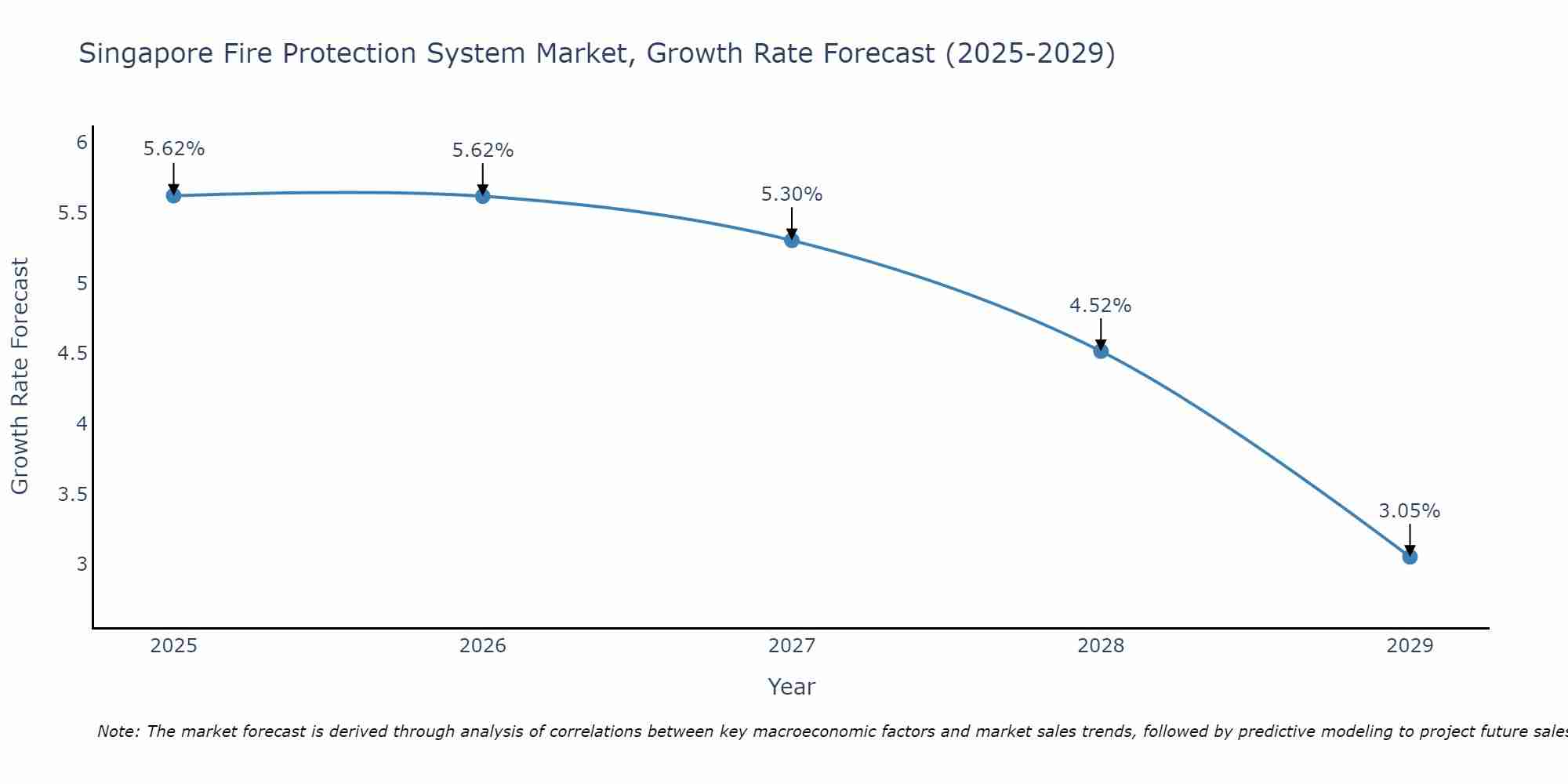
The Singapore Fire Protection System Market could see a tapering of growth rates over 2025 to 2029. Although the growth rate starts strong at 5.62% in 2025, it steadily loses momentum, ending at 3.05% by 2029.
Fire Protection System Market: Singapore vs Top 5 Major Economies in 2027 (Asia)
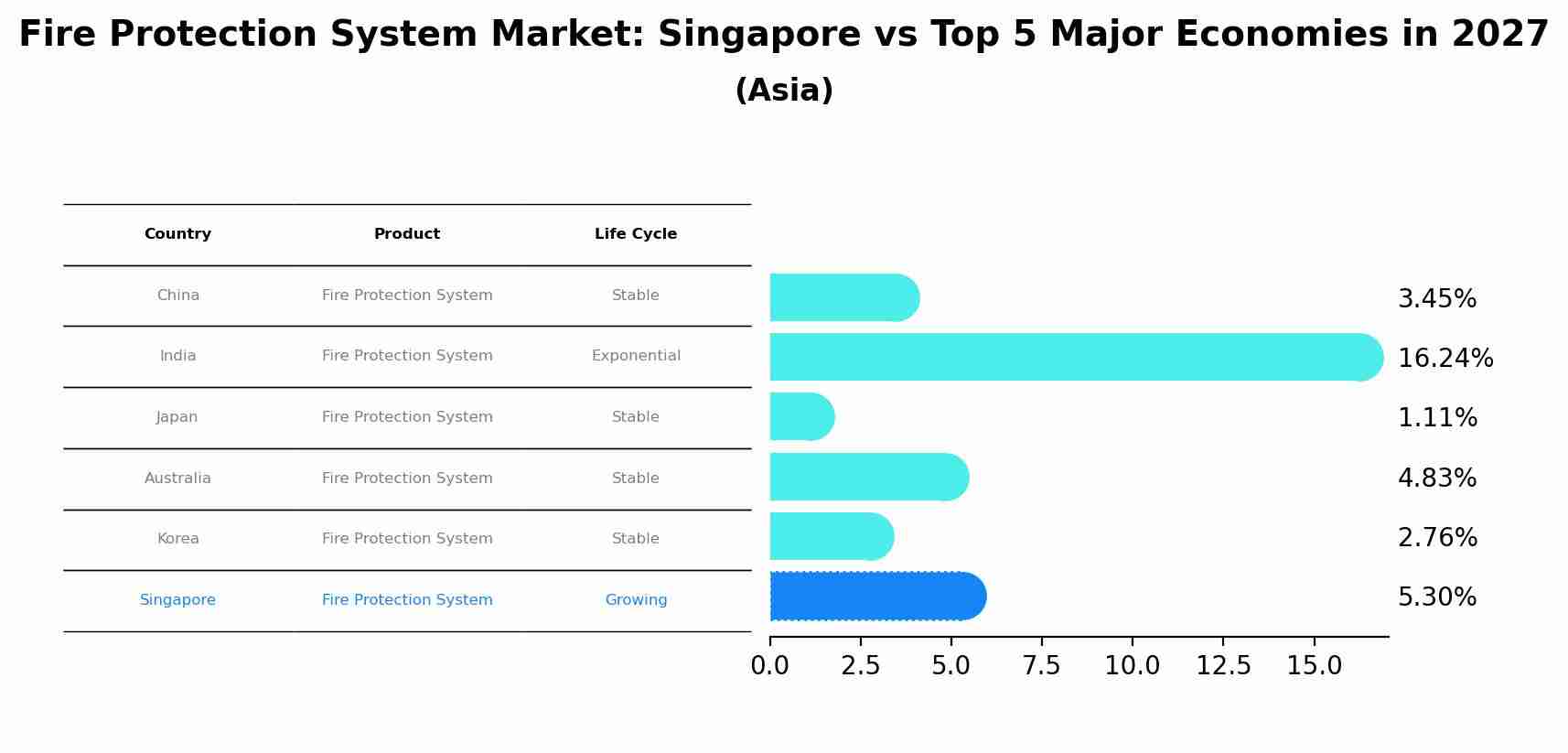
The Fire Protection System market in Singapore is projected to grow at a growing growth rate of 5.30% by 2027, highlighting the country's increasing focus on advanced technologies within the Asia region, where China holds the dominant position, followed closely by India, Japan, Australia and South Korea, shaping overall regional demand.
Singapore Fire Protection System Market Growth Rate
According to 6Wresearch internal database and industry insights, the Singapore Fire Protection System Market is projected to grow at a compound annual growth rate (CAGR) of 7.1% during the forecast period (2026-2032).
Topics Covered in the Singapore Fire Protection System Market Report
The Singapore Fire Protection System Market report thoroughly covers the market by product type, service, and applications. The market report provides an unbiased and detailed analysis of ongoing market trends, opportunities/high growth areas, and market drivers, which help stakeholders devise and align their market strategies according to the current and future market dynamics.
Singapore Fire Protection System Market Highlights
| Report Name | Singapore Fire Protection System Market |
| Forecast period | 2026-2032 |
| CAGR | 7.1% |
| Growing Sector | Commercial Buildings & Data Centers |
Singapore Fire Protection System Market Synopsis
Singapore Fire Protection System Market is expected to witness steady growth due to building safety regulations, urban development, and smart infrastructure. Higher, rise buildings, industrial complexes, and data centers are leading to a greater demand for fire detection and fire extinguishing systems. Besides this, the increased focus on employee safety and risk management is motivating companies to invest in system upgrades. Besides, government implementation of fire safety rules and the use of intelligent surveillance instruments are helping the market to spread over the commercial, industrial, and residential sectors.
Evaluation of Growth Drivers in the Singapore Fire Protection System Market
Below mentioned are some prominent drivers and their influence on the market dynamics:
| Drivers | Primary Segments Affected | Why it Matters (Evidence) |
| Strict Fire Safety Regulations | Fire Detection; Commercial | Mandatory compliance with SCDF standards drives system installations across buildings. |
| Growth in Smart Buildings | Fire Analysis; Commercial & Residential | Smart infrastructure increases demand for integrated fire monitoring solutions. |
| Expansion of Industrial & Data Centers | Fire Suppression; Industrial | High-risk environments require advanced suppression and sprinkler systems. |
| Retrofitting of Aging Infrastructure | Fire Sprinkler & Detection; Commercial | Older buildings are upgrading systems to meet modern safety codes. |
| Rising Awareness of Workplace Safety | All Types; Industrial & Commercial | Organizations prioritize risk mitigation and business continuity planning. |
Singapore Fire Protection System Market is expected to grow at the CAGR of 7.1% during the forecast period of 2026-2032. The growth is primarily fueled by a number of factors including strong regulatory enforcement, a surge in smart infrastructure projects, and the rising activities in the commercial construction sector. Increasingly, high, value assets, particularly those housed in data centers and industrial facilities, are a key reason for the growing demand for state, of, the, art fire protection technologies. It is worth mentioning that building owners are also allocating funds to system upgrade initiatives with the goals of not only ensuring compliance also improving the overall safety of operations.
Evaluation of Restraints in the Singapore Fire Protection System Market
Below mentioned are some major restraints and their influence on the market dynamics:
| Restraints | Primary Segments Affected | What This Means (Evidence) |
| High Installation Costs | Fire Suppression; Residential & SMEs | High initial investment limits adoption among smaller property owners and businesses. |
| Complex System Integration | Fire Analysis; Commercial | Integrating fire safety systems with building automation requires specialized technical expertise. |
| Maintenance and Compliance Costs | Maintenance Services; All Applications | Regular inspections, testing, and system upgrades increase ongoing operational expenses. |
| Space Constraints in Urban Buildings | Fire Sprinkler Systems; Residential | Limited space availability makes system installation difficult in compact or small-sized buildings. |
| Skilled Workforce Requirements | Installation Services; All Types | Shortage of trained professionals can lead to longer project timelines and higher service costs. |
Singapore Fire Protection System Industry Challenges
Despite strong regulatory support and technological advancement, the Singapore Fire Protection System Industry faces several practical challenges that influence its pace of adoption. High installation and lifecycle maintenance costs usually act as a deterrent for small businesses and homeowners to upgrade their systems. Besides, fitting state, of, the, art fire protection devices in old buildings can be a technical challenge and a time, consuming process. On the other hand, the sector has to struggle with the pressure of constantly adapting to changing safety standards and digital technologies. There is also the issue of the shortage of skilled personnel, rising costs, and the lack of installation space in densely populated areas, which still represent major operational and planning challenges for service providers.
Singapore Fire Protection System Market Trends
Key trends shaping the Singapore Fire Protection System Market Growth include:
- Smart and IoT-Enabled Fire Systems: More connected fire detection and monitoring systems are being adopted, which send alerts in real time and enable predictive maintenance. Such solutions lead to quicker response times and better overall safety management of buildings.
- Integration with Building Management Systems (BMS): Fire protection systems are now being more tightly coupled with centralized building controls. This makes it possible to have automated emergency responses like shutting down ventilation, controlling elevators, and managing evacuation without manual intervention.
- Growth of Clean Agent Suppression Systems: Focused and Data centers as well as highly sensitive environments are opting for gas, based suppression systems to avoid any equipment damages. Thus, the demand in facilities with high value assets is being driven up by this trend.
Investment Opportunities in the Singapore Fire Protection System Market
Key investment areas emerging in the Singapore Fire Protection System Market include:
- Advanced Fire Protection for Data Centers – With rapid digital infrastructure growth, specialized suppression and early detection systems are in high demand. Investors can focus on high-reliability solutions for mission-critical facilities.
- Retrofitting and Upgrade Projects – Many old commercial buildings need to be brought up to date with the current safety codes. This results in steady opportunities for installation and system replacement services.
- Smart Fire Monitoring Platforms – The use of cloud, based fire analytics and remote monitoring services is becoming more widespread. Spending on software, driven security solutions may result in long, term service revenue.
- Residential Fire Safety Solutions – Increased awareness is leading to the use of compact and affordable fire protection systems in residential buildings. This area provides growth possibilities for low cost products.
Top 5 Leading Players in the Singapore Fire Protection System Market
Some leading players operating in the Singapore Fire Protection System Market include:
1. Johnson Controls International
| Company Name | Johnson Controls International |
| Established Year | 1885 |
| Headquarters | Cork, Ireland |
| Official Website | Click Here |
Johnson Controls provides integrated fire detection, suppression, and building safety solutions through its Tyco brand. The company focuses on smart fire technologies, system integration, and long-term maintenance services for commercial and industrial facilities across Singapore.
2. Honeywell International Inc.
| Company Name | Honeywell International Inc. |
| Established Year | 1906 |
| Headquarters | North Carolina, USA |
| Official Website | Click Here |
Honeywell offers advanced fire detection, alarm, and life safety systems designed for smart buildings. Its solutions support large-scale commercial complexes, transportation hubs, and industrial facilities, emphasizing automation, reliability, and compliance with Singapore’s safety regulations.
3. Siemens AG
| Company Name | Siemens AG |
| Established Year | 1847 |
| Headquarters | Munich, Germany |
| Official Website | Click Here |
Siemens delivers intelligent fire safety systems integrated with building automation platforms. The company specializes in early detection technologies, digital monitoring solutions, and customized fire protection systems for complex infrastructure and high-rise developments.
4. Carrier Global Corporation
| Company Name | Carrier Global Corporation |
| Established Year | 1915 |
| Headquarters | Florida, USA |
| Official Website | Click Here |
Carrier provides fire suppression, alarm systems, and integrated safety solutions through its Kidde and Edwards brands. The company focuses on high-performance systems for commercial buildings, industrial facilities, and critical infrastructure environments.
5. Bosch Security Systems
| Company Name | Bosch Security Systems |
| Established Year | 1886 |
| Headquarters | Stuttgart, Germany |
| Official Website | Click Here |
Bosch offers reliable fire detection and voice evacuation systems designed for large-scale facilities. Its solutions emphasize early warning, system scalability, and seamless integration with security and building management platforms.
Government Regulations Introduced in the Singapore Fire Protection System Market
According to Singapore’s Government data, fire safety regulations are strictly enforced through the Singapore Civil Defence Force (SCDF) under the Fire Safety Act. The Fire Code mandates the installation, inspection, and certification of fire protection systems in all commercial and high-rise buildings. Besides that, the government is encouraging regular fire risk assessments and the use of licensed contractors for installation and maintenance to keep the systems reliable. The Green Mark Scheme among others encourages smart and energy, efficient safety systems in new developments. On top of that, SCDF carries out nationwide fire safety campaigns and compliance audits thus raising the standard of building safety throughout the country, bringing awareness, and readiness for emergency situations.
Future Insights of the Singapore Fire Protection System Market
The Singapore Fire Protection System Market is forecast to continue its impressive growth through the next few years, supported by new developments, smart city efforts, and more stringent safety laws. The expansion and upgrading of data centers, transportation networks, and mixed, use developments will necessitate the use of the most current detection and suppression technologies. The shift to digital monitoring, the use of predictive maintenance, and the integration of safety platforms will also likely contribute to the expansion of the market. Moreover, the consideration of sustainability and the move towards energy, efficient system designs will be the main drivers of new product development. As regulatory focus and technological innovation continue, the market is expected to present a stable long, term spectrum of opportunities for solution providers and service companies.
Market Segmentation Analysis
The report offers a comprehensive study of the subsequent market segments and their leading categories.
Fire Detection to Dominate the Market – By Product
According to Mohit, Senior Research Analyst, 6Wresearch, the Fire Detection category holds the largest market segment in the Singapore Fire Protection System Market Share. This leadership role is essentially attributed to the imposition of extreme regulatory standards, which require early warning systems in commercial, industrial, and residential buildings. The rise in the number of high, rise and smart buildings has also boosted the demand for top, notch smoke, heat, and multi, sensor detection technologies. Companies are putting a high emphasis on early discovery of incidents as a way to reduce their business risks and exposure to losses. Also, the collaboration with the building management and emergency response systems has made the fire detection products indispensable, thus turning them into one of the most important safety elements in the city of Singapore.
Key Attractiveness of the Report
- 10 Years of Market Numbers.
- Historical Data Starting from 2022 to 2025.
- Base Year: 2025.
- Forecast Data until 2032.
- Key Performance Indicators Impacting the Market.
- Major Upcoming Developments and Projects.
Key Highlights of the Report:
- Singapore Fire Protection System Market Outlook
- Market Size of Singapore Fire Protection System Market, 2025
- Forecast of Singapore Fire Protection System Market, 2032
- Historical Data and Forecast of Singapore Fire Protection System Revenues & Volume for the Period 2022-2032
- Singapore Fire Protection System Market Trend Evolution
- Singapore Fire Protection System Market Drivers and Challenges
- Singapore Fire Protection System Price Trends
- Singapore Fire Protection System Porter's Five Forces
- Singapore Fire Protection System Industry Life Cycle
- Historical Data and Forecast of Singapore Fire Protection System Market Revenues & Volume By Product for the Period 2022-2032
- Historical Data and Forecast of Singapore Fire Protection System Market Revenues & Volume By Fire Detection for the Period 2022-2032
- Historical Data and Forecast of Singapore Fire Protection System Market Revenues & Volume By Fire Suppression for the Period 2022-2032
- Historical Data and Forecast of Singapore Fire Protection System Market Revenues & Volume By Fire Response for the Period 2022-2032
- Historical Data and Forecast of Singapore Fire Protection System Market Revenues & Volume By Fire Analysis for the Period 2022-2032
- Historical Data and Forecast of Singapore Fire Protection System Market Revenues & Volume By Fire Sprinkler System for the Period 2022-2032
- Historical Data and Forecast of Singapore Fire Protection System Market Revenues & Volume By Service for the Period 2022-2032
- Historical Data and Forecast of Singapore Fire Protection System Market Revenues & Volume By Managed Service for the Period 2022-2032
- Historical Data and Forecast of Singapore Fire Protection System Market Revenues & Volume By Installation and Design Service for the Period 2022-2032
- Historical Data and Forecast of Singapore Fire Protection System Market Revenues & Volume By Maintenance Service for the Period 2022-2032
- Historical Data and Forecast of Singapore Fire Protection System Market Revenues & Volume By Others for the Period 2022-2032
- Historical Data and Forecast of Singapore Fire Protection System Market Revenues & Volume By Application for the Period 2022-2032
- Historical Data and Forecast of Singapore Fire Protection System Market Revenues & Volume By Commercial for the Period 2022-2032
- Historical Data and Forecast of Singapore Fire Protection System Market Revenues & Volume By Industrial for the Period 2022-2032
- Historical Data and Forecast of Singapore Fire Protection System Market Revenues & Volume By Residential for the Period 2022-2032
- Singapore Fire Protection System Import Export Trade Statistics
- Market Opportunity Assessment By Product
- Market Opportunity Assessment By Service
- Market Opportunity Assessment By Application
- Singapore Fire Protection System Top Companies Market Share
- Singapore Fire Protection System Competitive Benchmarking By Technical and Operational Parameters
- Singapore Fire Protection System Company Profiles
- Singapore Fire Protection System Key Strategic Recommendations
Market Covered
The report offers a comprehensive study of the subsequent market segments:
By Product
- Fire Detection
- Fire Suppression
- Fire Response
- Fire Analysis
- Fire Sprinkler System
By Service
- Managed Service
- Installation and Design Service
- Maintenance Service
- Others
By Application
- Commercial
- Industrial
- Residential
Singapore Fire Protection System Market (2026-2032) : FAQs
The Singapore Fire Protection System Market is projected to grow at a CAGR of 7.1% during the forecast period 2026-2032.
Since Singapore has strict fire safety regulations, more high-rise buildings are being built, there is an expansion of data centers and industrial facilities, and there is a growing demand for smart and automated fire safety solutions.
The major challenges of the market are high installation and maintenance costs, integration complexity in older buildings, limited space, and the requirement of skilled professionals for system installation and servicing.
The government initiatives are the strict enforcement of the Fire Code by SCDF, mandatory inspections and certifications and sustainability schemes like the Green Mark initiative.
6Wresearch actively monitors the Singapore Fire Protection System Market and publishes its comprehensive annual report, highlighting emerging trends, growth drivers, revenue analysis, and forecast outlook. Our insights help businesses to make data-backed strategic decisions with ongoing market dynamics. Our analysts track relevent industries related to the Singapore Fire Protection System Market, allowing our clients with actionable intelligence and reliable forecasts tailored to emerging regional needs.
Yes, we provide customisation as per your requirements. To learn more, feel free to contact us on sales@6wresearch.com
| 1 Executive Summary |
| 2 Introduction |
| 2.1 Key Highlights of the Report |
| 2.2 Report Description |
| 2.3 Market Scope & Segmentation |
| 2.4 Research Methodology |
| 2.5 Assumptions |
| 3 Singapore Fire Protection System Market Overview |
| 3.1 Singapore Country Macro Economic Indicators |
| 3.2 Singapore Fire Protection System Market Revenues & Volume, 2022 & 2032F |
| 3.3 Singapore Fire Protection System Market - Industry Life Cycle |
| 3.4 Singapore Fire Protection System Market - Porter's Five Forces |
| 3.5 Singapore Fire Protection System Market Revenues & Volume Share, By Product, 2022 & 2032F |
| 3.6 Singapore Fire Protection System Market Revenues & Volume Share, By Service, 2022 & 2032F |
| 3.7 Singapore Fire Protection System Market Revenues & Volume Share, By Application, 2022 & 2032F |
| 4 Singapore Fire Protection System Market Dynamics |
| 4.1 Impact Analysis |
| 4.2 Market Drivers |
| 4.2.1 Increasing government regulations and safety standards for fire protection in Singapore |
| 4.2.2 Growth in infrastructure development and construction activities in the region |
| 4.2.3 Rising awareness about the importance of fire safety measures among residential and commercial sectors |
| 4.3 Market Restraints |
| 4.3.1 High initial investment costs associated with installing advanced fire protection systems |
| 4.3.2 Limited adoption of new technologies due to lack of awareness and expertise |
| 4.3.3 Economic uncertainties and fluctuations affecting overall construction investments |
| 5 Singapore Fire Protection System Market Trends |
| 6 Singapore Fire Protection System Market, By Types |
| 6.1 Singapore Fire Protection System Market, By Product |
| 6.1.1 Overview and Analysis |
| 6.1.2 Singapore Fire Protection System Market Revenues & Volume, By Product, 2022-2032F |
| 6.1.3 Singapore Fire Protection System Market Revenues & Volume, By Fire Detection, 2022-2032F |
| 6.1.4 Singapore Fire Protection System Market Revenues & Volume, By Fire Suppression, 2022-2032F |
| 6.1.5 Singapore Fire Protection System Market Revenues & Volume, By Fire Response, 2022-2032F |
| 6.1.6 Singapore Fire Protection System Market Revenues & Volume, By Fire Analysis, 2022-2032F |
| 6.1.7 Singapore Fire Protection System Market Revenues & Volume, By Fire Sprinkler System, 2022-2032F |
| 6.2 Singapore Fire Protection System Market, By Service |
| 6.2.1 Overview and Analysis |
| 6.2.2 Singapore Fire Protection System Market Revenues & Volume, By Managed Service, 2022-2032F |
| 6.2.3 Singapore Fire Protection System Market Revenues & Volume, By Installation and Design Service, 2022-2032F |
| 6.2.4 Singapore Fire Protection System Market Revenues & Volume, By Maintenance Service, 2022-2032F |
| 6.2.5 Singapore Fire Protection System Market Revenues & Volume, By Others, 2022-2032F |
| 6.3 Singapore Fire Protection System Market, By Application |
| 6.3.1 Overview and Analysis |
| 6.3.2 Singapore Fire Protection System Market Revenues & Volume, By Commercial, 2022-2032F |
| 6.3.3 Singapore Fire Protection System Market Revenues & Volume, By Industrial, 2022-2032F |
| 6.3.4 Singapore Fire Protection System Market Revenues & Volume, By Residential, 2022-2032F |
| 7 Singapore Fire Protection System Market Import-Export Trade Statistics |
| 7.1 Singapore Fire Protection System Market Export to Major Countries |
| 7.2 Singapore Fire Protection System Market Imports from Major Countries |
| 8 Singapore Fire Protection System Market Key Performance Indicators |
| 8.1 Number of fire incidents reported annually in Singapore |
| 8.2 Percentage of buildings equipped with modern fire protection systems |
| 8.3 Rate of compliance with fire safety regulations by businesses and organizations |
| 8.4 Investments in research and development for innovative fire protection technologies |
| 8.5 Adoption rate of smart fire protection systems in Singapore's buildings |
| 9 Singapore Fire Protection System Market - Opportunity Assessment |
| 9.1 Singapore Fire Protection System Market Opportunity Assessment, By Product, 2022 & 2032F |
| 9.2 Singapore Fire Protection System Market Opportunity Assessment, By Service, 2022 & 2032F |
| 9.3 Singapore Fire Protection System Market Opportunity Assessment, By Application, 2022 & 2032F |
| 10 Singapore Fire Protection System Market - Competitive Landscape |
| 10.1 Singapore Fire Protection System Market Revenue Share, By Companies, 2025 |
| 10.2 Singapore Fire Protection System Market Competitive Benchmarking, By Operating and Technical Parameters |
| 11 Company Profiles |
| 12 Recommendations |
| 13 Disclaimer |
Export potential assessment - trade Analytics for 2030
Export potential enables firms to identify high-growth global markets with greater confidence by combining advanced trade intelligence with a structured quantitative methodology. The framework analyzes emerging demand trends and country-level import patterns while integrating macroeconomic and trade datasets such as GDP and population forecasts, bilateral import–export flows, tariff structures, elasticity differentials between developed and developing economies, geographic distance, and import demand projections. Using weighted trade values from 2020–2024 as the base period to project country-to-country export potential for 2030, these inputs are operationalized through calculated drivers such as gravity model parameters, tariff impact factors, and projected GDP per-capita growth. Through an analysis of hidden potentials, demand hotspots, and market conditions that are most favorable to success, this method enables firms to focus on target countries, maximize returns, and global expansion with data, backed by accuracy.
By factoring in the projected importer demand gap that is currently unmet and could be potential opportunity, it identifies the potential for the Exporter (Country) among 190 countries, against the general trade analysis, which identifies the biggest importer or exporter.
To discover high-growth global markets and optimize your business strategy:
Click Here
Pricing
- Single User License$ 1,995
- Department License$ 2,400
- Site License$ 3,120
- Global License$ 3,795

Search
Thought Leadership and Analyst Meet





Our Clients








Latest Reports
- United Kingdom (UK) Long-term Care Insurance Market (2026-2032) | Growth, Share, Consumer Insights, Drivers, Opportunities, Competition, Pricing Analysis, Segments, Restraints, Companies, Competitive, Value, Outlook, Size, Demand, Analysis, Challenges, Strategic Insights, Investment Trends, Revenue, Trends, Supply, Forecast
- United Kingdom (UK) Long Term Care Market (2026-2032) | Companies, Outlook, Analysis, Trends, Value, Revenue, Segmentation, Share, Forecast, Competitive Landscape, Growth, Size & Forecast
- Iraq Insulation and Waterproofing Market (2026-2032) | Outlook, Drivers, Growth, Size, Share, Industry, Revenue, Trends, Demand, Competitive, Strategic Insights, Opportunities, Segments, Companies, Challenges, Strategy, Consumer Insights, Analysis, Investment Trends, Value, Segmentation, Forecast, Restraints
- India Switchgear Market Outlook (2026 - 2032) | Size, Share, Trends, Growth, Revenue, Forecast, Analysis, Value, Outlook
- Pakistan Contraceptive Implants Market (2025-2031) | Demand, Growth, Size, Share, Industry, Pricing Analysis, Competitive, Strategic Insights, Strategy, Consumer Insights, Analysis, Investment Trends, Opportunities, Revenue, Segments, Value, Segmentation, Supply, Forecast, Restraints, Outlook, Competition, Drivers, Trends, Companies, Challenges
- Sri Lanka Packaging Market (2026-2032) | Outlook, Competition, Drivers, Trends, Demand, Pricing Analysis, Competitive, Strategic Insights, Companies, Challenges, Strategy, Consumer Insights, Analysis, Investment Trends, Opportunities, Growth, Size, Share, Industry, Revenue, Segments, Value, Segmentation, Supply, Forecast, Restraints
- India Kids Watches Market (2026-2032) | Strategy, Consumer Insights, Analysis, Investment Trends, Opportunities, Growth, Size, Share, Industry, Revenue, Segments, Value, Segmentation, Supply, Forecast, Restraints, Outlook, Competition, Drivers, Trends, Demand, Pricing Analysis, Competitive, Strategic Insights, Companies, Challenges
- Saudi Arabia Core Assurance Service Market (2025-2031) | Strategy, Consumer Insights, Analysis, Investment Trends, Opportunities, Growth, Size, Share, Industry, Revenue, Segments, Value, Segmentation, Supply, Forecast, Restraints, Outlook, Competition, Drivers, Trends, Demand, Pricing Analysis, Competitive, Strategic Insights, Companies, Challenges
- Romania Uninterruptible Power Supply (UPS) Market (2026-2032) | Industry, Analysis, Revenue, Size, Forecast, Outlook, Value, Trends, Share, Growth & Companies
- Saudi Arabia Car Window Tinting Film, Paint Protection Film (PPF), and Ceramic Coating Market (2025-2031) | Strategy, Consumer Insights, Analysis, Investment Trends, Opportunities, Growth, Size, Share, Industry, Revenue, Segments, Value, Segmentation, Supply, Forecast, Restraints, Outlook, Competition, Drivers, Trends, Demand, Pricing Analysis, Competitive, Strategic Insights, Companies, Challenges
Industry Events and Analyst Meet

India EV Show 2026

EV tech India Expo 2026

Auto Tech Asia 2026

Battery Tech India 2026

Smart Production Solutions Guangzhou 2026
Whitepaper
- Middle East & Africa Commercial Security Market Click here to view more.
- Middle East & Africa Fire Safety Systems & Equipment Market Click here to view more.
- GCC Drone Market Click here to view more.
- Middle East Lighting Fixture Market Click here to view more.
- GCC Physical & Perimeter Security Market Click here to view more.
6WResearch In News
- Doha a strategic location for EV manufacturing hub: IPA Qatar
- Demand for luxury TVs surging in the GCC, says Samsung
- Empowering Growth: The Thriving Journey of Bangladesh’s Cable Industry
- Demand for luxury TVs surging in the GCC, says Samsung
- Video call with a traditional healer? Once unthinkable, it’s now common in South Africa
- Intelligent Buildings To Smooth GCC’s Path To Net Zero


