Singapore Toys Market (2026-2032) | Trends, Forecast, Outlook, Segmentation, Industry, Competitive Landscape, Size & Revenue, Value, Analysis, Share, Growth, Companies
Market Forecast By Type (Infant and Preschool Toys, Dolls, Games and Puzzles, Construction Toys, Outdoor and Sports Toys, Others), By Application (0-3 Years, 3-5 Years, 5-12 Years, 12-18 Years, 18+ Years) And Competitive Landscape
| Product Code: ETC9286100 | Publication Date: Sep 2024 | Updated Date: Feb 2026 | Product Type: Market Research Report | |
| Publisher: 6Wresearch | Author: Summon Dutta | No. of Pages: 75 | No. of Figures: 35 | No. of Tables: 20 |
singapore toys market
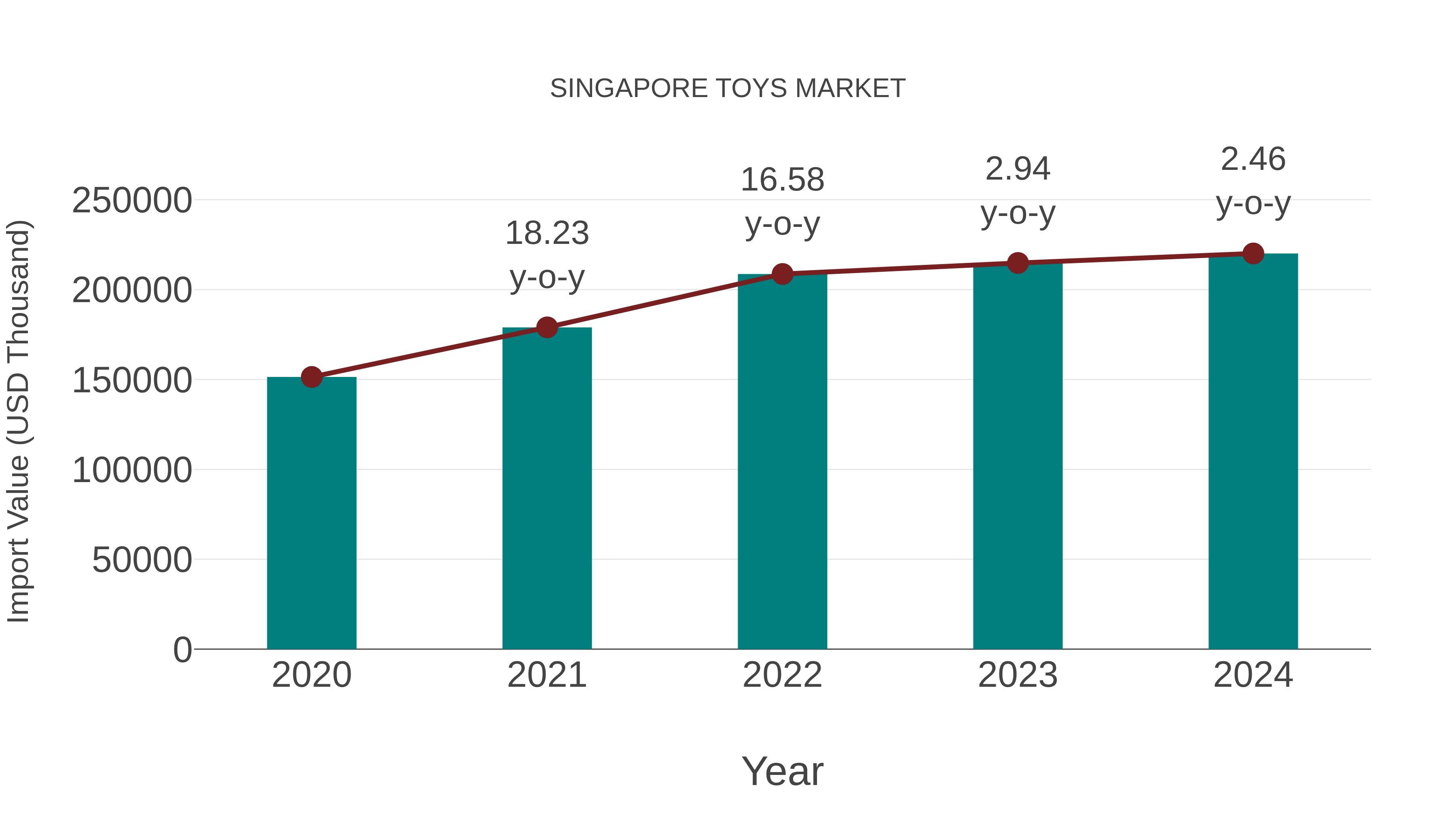
Singapore Toys Market Growth Rate
According to 6Wresearch internal database and industry insights, the Singapore Toys Market is growing at a compound annual growth rate (CAGR) of 6.5% during the forecast period (2026-2032).
Five-Years Growth Trajectory of the Singapore Toys Market with Core Drivers
Below mentioned are the evaluation of year-wise growth rate along with key drivers:
| Years | Est. Annual Growth in % | Growth Drivers |
| 2021 | 4.2% | Surge in demand for educational and interactive toys. |
| 2022 | 4.6% | Increasing focus on eco-friendly and sustainable toys. |
| 2023 | 5.1% | Rising disposable income and inclination towards premium toys. |
| 2024 | 5.7% | Increased focus on online retail and e-commerce platforms. |
| 2025 | 6% | Popularity of tech-driven toys, like robots and drones. |
Topics Covered in the Singapore Toys Market Report
The Singapore Toys Market report thoroughly covers the market by types, applications, and distribution channels. The market report provides an unbiased and detailed analysis of ongoing market trends, opportunities/high-growth areas, and market drivers, which would help stakeholders devise and align their market strategies according to the current and future market dynamics.
Singapore Toys Market Highlights
| Report Name | Singapore Toys Market |
|---|---|
| Forecast period | 2026–2032 |
| CAGR | 6.5% |
| Growing Sector | E-commerce |
Singapore Toys Market Synopsis
The Singapore Toys Market is anticipated to experience tremendous growth owing to the surging demand for novel, nature-friendly, and educational toys. With the consumer base in Singapore getting more conscious about sustainable practices, the demand for eco-friendly products is increasing. In addition, the rise in disposable income and the trend of buying premium toys are among the major factors contributing to the market's growth. The unwavering demand for interactive and educational toys for kids, along with the proliferation of online retail and e-commerce platforms, is also a major factor that is positively impacting the market's growth.
Evaluation of Growth Drivers in the Singapore Toys Market
Below mentioned are some growth drivers and their impact on market dynamics:
| Drivers | Primary Segments Affected | Why It Matters |
| Rising Demand for Educational Toys | Infant and Preschool Toys, Games and Puzzles | Growing interest in learning toys boosts demand. |
| Eco-Friendly Toy Demand | All Toy Types | Sustainability trend appeals to conscious consumers. |
| Tech-Driven Toys | Construction Toys, Dolls, Games and Puzzles | Increased interest in tech-driven innovations. |
| Growing Disposable Income | All Toy Types | Higher spending on premium, innovative toys. |
| E-commerce Growth | All Toy Types, Retail Distribution Channels | Expands accessibility and convenience for consumers. |
The Singapore Toys Market is projected to grow significantly, with a CAGR of 6.5% during the forecast period of 2026-2032. The Singapore toys market is primarily driven by the increasing interest in educational toys, especially in STEM education, which spreads over the categories of infants, preschool, and puzzle toys. The toy market is slowly shifting towards more environmentally friendly products as the consumer base is getting smaller. Moreover, the expansion of the market is credited to the introduction of more tech-savvy toys like robotic dolls and smart building blocks. Besides, the increase in consumers' disposable income is shifting their purchasing patterns toward premium toys. In addition, the growing online marketplace not only makes the toys but also the consumers more accessible and handier. All these factors are together pushing the market towards further growth and innovation.
Evaluation of Restraints in the Singapore Toys Market
Below mentioned are some major restraints and their influence on market dynamics:
| Challenges | Primary Segments Affected | What This Means |
| High Production Costs | All Toy Types | Raises prices, reducing affordability. |
| Intense Competition from Global Brands | All Toy Types | Local brands struggle to compete. |
| Regulatory Compliance & Safety Standards | All Toy Types | Increases production costs. |
| Market Saturation | All Toy Types | Limits growth in a competitive market. |
| Shifting Consumer Preferences | Eco-Friendly, Educational, Tech-Driven Toys | Requires constant adaptation to trends. |
Singapore Toys Market Challenges
The Singapore toys market growth is hampered by high production costs which limits small manufacturers growth. Further, the strict government regulations regarding the safety and material used creates challenges for manufacturers in innovating the products. In addition, the market faces strong competition from foreign brands, which takes up large share in the market. Moreover, the strict foreign regulatory compliance is creating additional challenge for this industry growth. For the expansion of the industry all these above issues are really significant to be addressed.
Singapore Toys Market Trends
Some major trends contributing to the development of the Singapore Toys Market growth are:
- Health-Conscious and Educational Toy Demand: There is an increasing demand for educational toys that boost up the cognitive thinking of the children.
- Sustainable and Eco-Friendly Toys: There is growing preference for more eco-friendly and sustainable toys among consumer of Singapore due to growing awareness about ecological problems.
- Focus on Premium and High-Quality Products: The Singapore people have increased spending power capabilities which is leading to higher demand for premium and high quality products.
Investment Opportunities in the Singapore Toys Market
Here are some investment opportunities in the Singapore Toys Industry:
- Sustainable Toy Manufacturing: Invest in eco-friendly production methods using biodegradable plastics to meet growing sustainability demand.
- E-commerce Platforms: The investors can focus more on developing or partnering with online toy stores to reach a large consumer audience conveniently.
- Smart Toys and Robotics: Invest in tech-driven toys like robots and interactive tools to meet rising demand for innovation.
Top 5 Leading Players in the Singapore Toys Market
Here are some top companies contributing to the Singapore Toys Market Share:
1. Hasbro Singapore
| Company Name | Hasbro Singapore |
|---|---|
| Established Year | 1923 |
| Headquarters | Singapore |
| Official Website | Click Here |
Hasbro is a global toy giant offering a wide range of toys and games, including board games, dolls, and action figures. Their presence in Singapore strengthens the market with popular brands like Transformers, Nerf, and Monopoly.
2. Mattel Singapore
| Company Name | Mattel Singapore |
|---|---|
| Established Year | 1945 |
| Headquarters | Singapore |
| Official Website | Click Here |
Mattel is a well-known player in the toy industry with iconic brands such as Barbie, Hot Wheels, and Fisher-Price. Their presence in Singapore includes a focus on innovative and educational toys.
3. Lego Group Singapore
| Company Name | Lego Group Singapore |
|---|---|
| Established Year | 1932 |
| Headquarters | Singapore |
| Official Website | Click Here |
Lego offers educational and creative building toys, with strong demand in Singapore. Their products, which promote STEM learning, have been successful across multiple age groups.
4. Playmobil Singapore
| Company Name | Playmobil Singapore |
|---|---|
| Established Year | 1974 |
| Headquarters | Singapore |
| Official Website | Click Here |
Playmobil is known for its creative and educational toy figures. Their extensive range of themed playsets has found a solid consumer base in Singapore.
5. Toybox Singapore
| Company Name | Toybox Singapore |
|---|---|
| Established Year | 2010 |
| Headquarters | Singapore |
| Official Website | Click Here |
Toybox specializes in offering a diverse range of toys, focusing on quality, innovation, and customer satisfaction. Their niche in eco-friendly toys positions them as a strong player in the sustainable toy market.
Government Regulations Introduced in the Singapore Toys Market
According to Singaporean government data, the market is well regulated by various regulations. These regulations include the Singapore Standards Council (SSC), which basically makes sure that all safety requirements are met properly. Further, the SS 548 standard provides regulations and standards that need to be followed by all the toy companies, mainly including health and safety concerns. In addition to this, the Sustainable Singapore Blueprint regulation encourages the production of eco-friendly and sustainable toys. The child safety regulations make sure that the substance being used for the making of toys has no hazardous material and does not have any toxic parts.
Future Insights of the Singapore Toys Market
The Singapore toys market growth outlook looks really positive. The market growth is driven by growing consumer demand for educational toys that are really effective in boosting children’s cognitive thinking. On top of that, there is high demand among consumers for eco-friendly toys due to growing eco-consciousness among people of Singapore. Growth in online retail platforms is expected to boost this industry's sales by providing ease of accessibility and catering to a large consumer base. Moreover, growing government initiatives for the safety of material used are expected to boost this industry growth.
Market Segmentation Analysis
The report offers a comprehensive study of the subsequent market segments and their leading categories:
Dolls to Dominate the Market – By Type
According to Guneet Kaur, Senior Research Analyst, 6Wresearch, dolls dominate the market due to their widespread popularity among young children and collectors. Dolls offer a variety of customization, cultural relevance, and brand appeal, making them the preferred choice for both play and display purposes.
0-3 Years to Dominate the Market – By Application
The 0-3 years age group is leading the Singapore Toys Market. Also, parents are increasingly investing in educational toys that help with early development. Moreover, these toys focus on motor skills, cognitive abilities, and sensory development of kids. Which are very important during this stage.
Key attractiveness of the report
- 10 Years Market Numbers
- Historical Data Starting from 2022 to 2025
- Base Year: 2025
- Forecast Data until 2032
- Key Performance Indicators Impacting the Market
- Major Upcoming Developments and Projects
Key Highlights of the Report:
- Singapore Toys Market Outlook
- Market Size of Singapore Toys Market, 2025
- Forecast of Singapore Toys Market, 2032
- Historical Data and Forecast of Singapore Toys Revenues & Volume for the Period 2022- 2032
- Singapore Toys Market Trend Evolution
- Singapore Toys Market Drivers and Challenges
- Singapore Toys Price Trends
- Singapore Toys Porter's Five Forces
- Singapore Toys Industry Life Cycle
- Historical Data and Forecast of Singapore Toys Market Revenues & Volume By Type for the Period 2022- 2032
- Historical Data and Forecast of Singapore Toys Market Revenues & Volume By Infant and Preschool Toys for the Period 2022- 2032
- Historical Data and Forecast of Singapore Toys Market Revenues & Volume By Dolls for the Period 2022- 2032
- Historical Data and Forecast of Singapore Toys Market Revenues & Volume By Games and Puzzles for the Period 2022- 2032
- Historical Data and Forecast of Singapore Toys Market Revenues & Volume By Construction Toys for the Period 2022- 2032
- Historical Data and Forecast of Singapore Toys Market Revenues & Volume By Outdoor and Sports Toys for the Period 2022- 2032
- Historical Data and Forecast of Singapore Toys Market Revenues & Volume By Others for the Period 2022- 2032
- Historical Data and Forecast of Singapore Toys Market Revenues & Volume By Application for the Period 2022- 2032
- Historical Data and Forecast of Singapore Toys Market Revenues & Volume By 0-3 Years for the Period 2022- 2032
- Historical Data and Forecast of Singapore Toys Market Revenues & Volume By 3-5 Years for the Period 2022- 2032
- Historical Data and Forecast of Singapore Toys Market Revenues & Volume By 5-12 Years for the Period 2022- 2032
- Historical Data and Forecast of Singapore Toys Market Revenues & Volume By 12-18 Years for the Period 2022- 2032
- Historical Data and Forecast of Singapore Toys Market Revenues & Volume By 18+ Years for the Period 2022- 2032
- Singapore Toys Import Export Trade Statistics
- Market Opportunity Assessment By Type
- Market Opportunity Assessment By Application
- Singapore Toys Top Companies Market Share
- Singapore Toys Competitive Benchmarking By Technical and Operational Parameters
- Singapore Toys Company Profiles
- Singapore Toys Key Strategic Recommendations
Market Segmentation Analysis
The report offers a comprehensive study of the subsequent market segments and their leading categories.
By Type
- Infant and Preschool Toys
- Dolls
- Games and Puzzles
- Construction Toys
- Outdoor and Sports Toys
- Others
By Application
- 0-3 Years
- 3-5 Years
- 5-12 Years
- 12-18 Years
- 18+ Years
Singapore Toys Market (2026-2032) : FAQ's
The Singapore Toys Market is projected to grow at a CAGR of 6.5% during the forecast period.
Advances in smart toys, including AI-driven interactive features, are reshaping the industry, making toys more attractive and educational.
The market growth is driven by increasing demand for educational, eco-friendly toys and the expansion of e-commerce platforms.
The market opportunities include making of sustainable toys, increasing e-commerce platforms, and focusing on educational and tech-driven toys.
6Wresearch actively monitors the Singapore Toys Market and publishes its comprehensive annual report, highlighting emerging trends, growth drivers, revenue analysis, and forecast outlook. Our insights help businesses to make data-backed strategic decisions with ongoing market dynamics. Our analysts track relevent industries related to the Singapore Toys Market, allowing our clients with actionable intelligence and reliable forecasts tailored to emerging regional needs.
Yes, we provide customisation as per your requirements. To learn more, feel free to contact us on sales@6wresearch.com
| 1 Executive Summary |
| 2 Introduction |
| 2.1 Key Highlights of the Report |
| 2.2 Report Description |
| 2.3 Market Scope & Segmentation |
| 2.4 Research Methodology |
| 2.5 Assumptions |
| 3 Singapore Toys Market Overview |
| 3.1 Singapore Country Macro Economic Indicators |
| 3.2 Singapore Toys Market Revenues & Volume, 2022 & 2032F |
| 3.3 Singapore Toys Market - Industry Life Cycle |
| 3.4 Singapore Toys Market - Porter's Five Forces |
| 3.5 Singapore Toys Market Revenues & Volume Share, By Type, 2022 & 2032F |
| 3.6 Singapore Toys Market Revenues & Volume Share, By Application, 2022 & 2032F |
| 4 Singapore Toys Market Dynamics |
| 4.1 Impact Analysis |
| 4.2 Market Drivers |
| 4.2.1 Increasing disposable income levels in Singapore, leading to higher spending on toys. |
| 4.2.2 Growth in the population of children in Singapore, boosting the demand for toys. |
| 4.2.3 Innovation in toy designs and technology, attracting consumers and driving sales. |
| 4.3 Market Restraints |
| 4.3.1 Intense competition from online retailers and e-commerce platforms impacting traditional toy stores. |
| 4.3.2 Regulatory restrictions on certain toy materials or designs, affecting product offerings and sales. |
| 5 Singapore Toys Market Trends |
| 6 Singapore Toys Market, By Types |
| 6.1 Singapore Toys Market, By Type |
| 6.1.1 Overview and Analysis |
| 6.1.2 Singapore Toys Market Revenues & Volume, By Type, 2022- 2032F |
| 6.1.3 Singapore Toys Market Revenues & Volume, By Infant and Preschool Toys, 2022- 2032F |
| 6.1.4 Singapore Toys Market Revenues & Volume, By Dolls, 2022- 2032F |
| 6.1.5 Singapore Toys Market Revenues & Volume, By Games and Puzzles, 2022- 2032F |
| 6.1.6 Singapore Toys Market Revenues & Volume, By Construction Toys, 2022- 2032F |
| 6.1.7 Singapore Toys Market Revenues & Volume, By Outdoor and Sports Toys, 2022- 2032F |
| 6.1.8 Singapore Toys Market Revenues & Volume, By Others, 2022- 2032F |
| 6.2 Singapore Toys Market, By Application |
| 6.2.1 Overview and Analysis |
| 6.2.2 Singapore Toys Market Revenues & Volume, By 0-3 Years, 2022- 2032F |
| 6.2.3 Singapore Toys Market Revenues & Volume, By 3-5 Years, 2022- 2032F |
| 6.2.4 Singapore Toys Market Revenues & Volume, By 5-12 Years, 2022- 2032F |
| 6.2.5 Singapore Toys Market Revenues & Volume, By 12-18 Years, 2022- 2032F |
| 6.2.6 Singapore Toys Market Revenues & Volume, By 18+ Years, 2022- 2032F |
| 7 Singapore Toys Market Import-Export Trade Statistics |
| 7.1 Singapore Toys Market Export to Major Countries |
| 7.2 Singapore Toys Market Imports from Major Countries |
| 8 Singapore Toys Market Key Performance Indicators |
| 8.1 Number of new toy product launches in the Singapore market. |
| 8.2 Average spending per household on toys in Singapore. |
| 8.3 Percentage of toy sales from innovative and technology-driven toys. |
| 8.4 Number of toy stores opening or closing in Singapore. |
| 8.5 Consumer sentiment towards purchasing toys in Singapore. |
| 9 Singapore Toys Market - Opportunity Assessment |
| 9.1 Singapore Toys Market Opportunity Assessment, By Type, 2022 & 2032F |
| 9.2 Singapore Toys Market Opportunity Assessment, By Application, 2022 & 2032F |
| 10 Singapore Toys Market - Competitive Landscape |
| 10.1 Singapore Toys Market Revenue Share, By Companies, 2025 |
| 10.2 Singapore Toys Market Competitive Benchmarking, By Operating and Technical Parameters |
| 11 Company Profiles |
| 12 Recommendations |
| 13 Disclaimer |
Export potential assessment - trade Analytics for 2030
Export potential enables firms to identify high-growth global markets with greater confidence by combining advanced trade intelligence with a structured quantitative methodology. The framework analyzes emerging demand trends and country-level import patterns while integrating macroeconomic and trade datasets such as GDP and population forecasts, bilateral import–export flows, tariff structures, elasticity differentials between developed and developing economies, geographic distance, and import demand projections. Using weighted trade values from 2020–2024 as the base period to project country-to-country export potential for 2030, these inputs are operationalized through calculated drivers such as gravity model parameters, tariff impact factors, and projected GDP per-capita growth. Through an analysis of hidden potentials, demand hotspots, and market conditions that are most favorable to success, this method enables firms to focus on target countries, maximize returns, and global expansion with data, backed by accuracy.
By factoring in the projected importer demand gap that is currently unmet and could be potential opportunity, it identifies the potential for the Exporter (Country) among 190 countries, against the general trade analysis, which identifies the biggest importer or exporter.
To discover high-growth global markets and optimize your business strategy:
Click Here
Pricing
- Single User License$ 1,995
- Department License$ 2,400
- Site License$ 3,120
- Global License$ 3,795

Search
Thought Leadership and Analyst Meet





Our Clients








Related Reports
- Iraq Insulation and Waterproofing Market (2026-2032) | Outlook, Drivers, Growth, Size, Share, Industry, Revenue, Trends, Demand, Competitive, Strategic Insights, Opportunities, Segments, Companies, Challenges, Strategy, Consumer Insights, Analysis, Investment Trends, Value, Segmentation, Forecast, Restraints
- India Switchgear Market Outlook (2026 - 2032) | Size, Share, Trends, Growth, Revenue, Forecast, Analysis, Value, Outlook
- Pakistan Contraceptive Implants Market (2025-2031) | Demand, Growth, Size, Share, Industry, Pricing Analysis, Competitive, Strategic Insights, Strategy, Consumer Insights, Analysis, Investment Trends, Opportunities, Revenue, Segments, Value, Segmentation, Supply, Forecast, Restraints, Outlook, Competition, Drivers, Trends, Companies, Challenges
- Sri Lanka Packaging Market (2026-2032) | Outlook, Competition, Drivers, Trends, Demand, Pricing Analysis, Competitive, Strategic Insights, Companies, Challenges, Strategy, Consumer Insights, Analysis, Investment Trends, Opportunities, Growth, Size, Share, Industry, Revenue, Segments, Value, Segmentation, Supply, Forecast, Restraints
- India Kids Watches Market (2026-2032) | Strategy, Consumer Insights, Analysis, Investment Trends, Opportunities, Growth, Size, Share, Industry, Revenue, Segments, Value, Segmentation, Supply, Forecast, Restraints, Outlook, Competition, Drivers, Trends, Demand, Pricing Analysis, Competitive, Strategic Insights, Companies, Challenges
- Saudi Arabia Core Assurance Service Market (2025-2031) | Strategy, Consumer Insights, Analysis, Investment Trends, Opportunities, Growth, Size, Share, Industry, Revenue, Segments, Value, Segmentation, Supply, Forecast, Restraints, Outlook, Competition, Drivers, Trends, Demand, Pricing Analysis, Competitive, Strategic Insights, Companies, Challenges
- Romania Uninterruptible Power Supply (UPS) Market (2026-2032) | Industry, Analysis, Revenue, Size, Forecast, Outlook, Value, Trends, Share, Growth & Companies
- Saudi Arabia Car Window Tinting Film, Paint Protection Film (PPF), and Ceramic Coating Market (2025-2031) | Strategy, Consumer Insights, Analysis, Investment Trends, Opportunities, Growth, Size, Share, Industry, Revenue, Segments, Value, Segmentation, Supply, Forecast, Restraints, Outlook, Competition, Drivers, Trends, Demand, Pricing Analysis, Competitive, Strategic Insights, Companies, Challenges
- South Africa Stationery Market (2025-2031) | Share, Size, Industry, Value, Growth, Revenue, Analysis, Trends, Segmentation & Outlook
- Afghanistan Rocking Chairs And Adirondack Chairs Market (2026-2032) | Size & Revenue, Competitive Landscape, Share, Segmentation, Industry, Value, Outlook, Analysis, Trends, Growth, Forecast, Companies
Industry Events and Analyst Meet

India EV Show 2026

EV tech India Expo 2026

Auto Tech Asia 2026
Battery Tech India 2026

Smart Production Solutions Guangzhou 2026
Whitepaper
- Middle East & Africa Commercial Security Market Click here to view more.
- Middle East & Africa Fire Safety Systems & Equipment Market Click here to view more.
- GCC Drone Market Click here to view more.
- Middle East Lighting Fixture Market Click here to view more.
- GCC Physical & Perimeter Security Market Click here to view more.
6WResearch In News
- Doha a strategic location for EV manufacturing hub: IPA Qatar
- Demand for luxury TVs surging in the GCC, says Samsung
- Empowering Growth: The Thriving Journey of Bangladesh’s Cable Industry
- Demand for luxury TVs surging in the GCC, says Samsung
- Video call with a traditional healer? Once unthinkable, it’s now common in South Africa
- Intelligent Buildings To Smooth GCC’s Path To Net Zero


