South Africa Soft Drinks Market (2026-2032) | Share, Analysis, Forecast, Outlook, Size & Revenue, Trends, Segmentation, Industry, Companies, Growth, Value, Competitive Landscape
Market Forecast By Product (Carbonated, Non-Carbonated), By Distribution Channel (Hypermarkets and Supermarkets, Convenience Store, Online, Others) And Competitive Landscape
| Product Code: ETC9392671 | Publication Date: Sep 2024 | Updated Date: Feb 2026 | Product Type: Market Research Report | |
| Publisher: 6Wresearch | Author: Summon Dutta | No. of Pages: 75 | No. of Figures: 35 | No. of Tables: 20 |
south africa soft drinks market
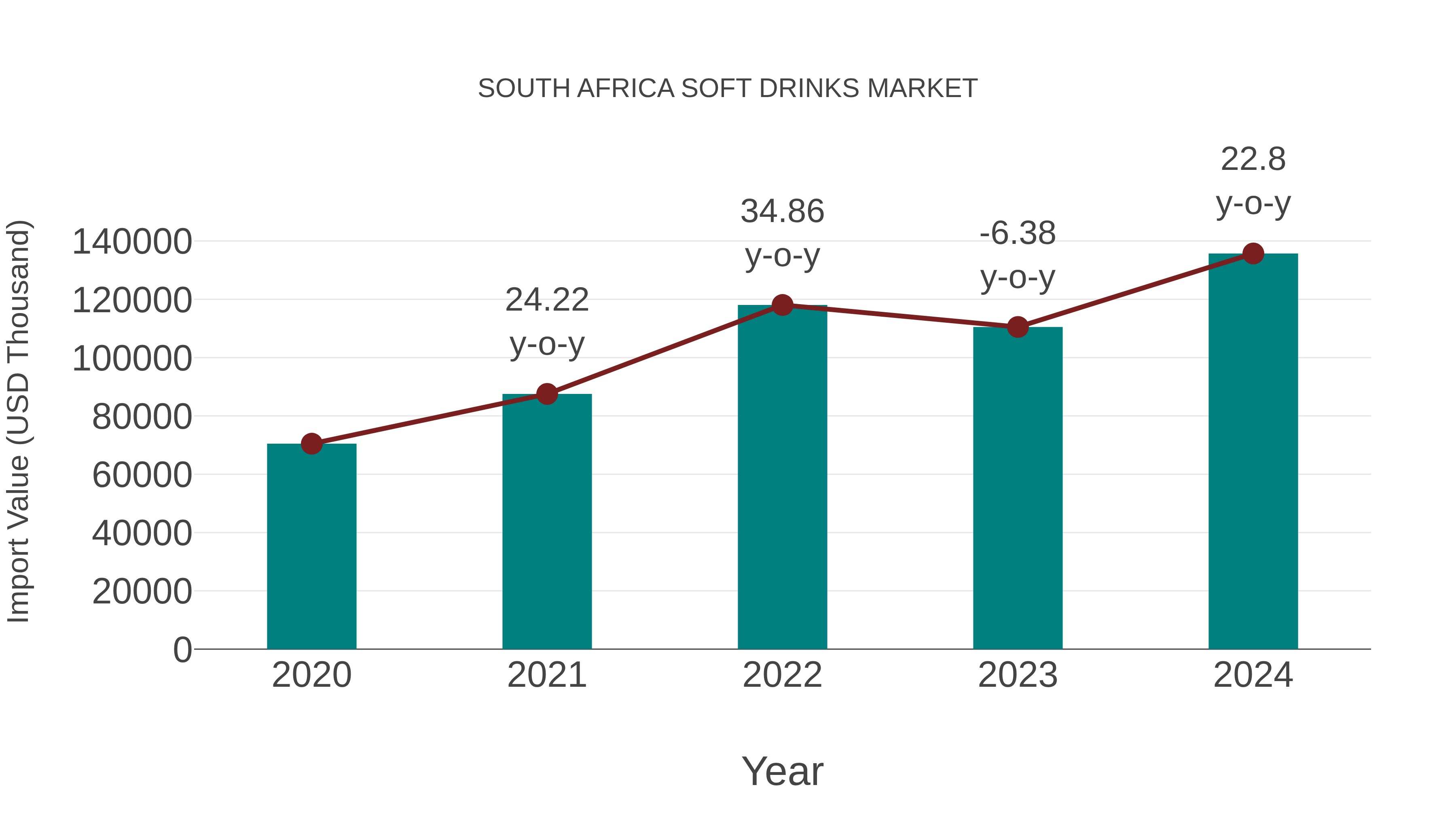
South Africa Soft Drinks Market Growth Rate
According to 6Wresearch internal database and industry insights, the South Africa Soft Drinks Market is projected to grow at a compound annual growth rate (CAGR) of 7.4% during the forecast period from 2026 to 2032.
Five-Year Growth Trajectory of the South Africa Soft Drinks Market with Core Drivers
Below mentioned are the evaluation of year-wise growth rate along with key drivers:
| Year | Est. Annual Growth (%) | Growth Drivers |
| 2021 | 5.2 | High usage of carbonated beverages in urban population and strong retail penetration |
| 2022 | 5.6 | Expansion of hypermarkets and supermarkets and increasing disposable income |
| 2023 | 6 | Change toward flavoured and functional non-carbonated drinks and growing youth population |
| 2024 | 6.4 | High demand for low-sugar and healthy beverages and innovations in product. |
| 2025 | 6.7 | Growth of new online grocery platforms and premium soft drink sales. |
Topics Covered in the South Africa Soft Drinks Market Report
The South Africa Soft Drinks Market report thoroughly covers the market by product and distribution channel. It provides an unbiased and detailed analysis of ongoing market trends, opportunities, challenges, and market drivers, helping stakeholders align their strategies with current and future market dynamics.
South Africa Soft Drinks Market Highlights
| Report Name | South Africa Soft Drinks Market |
| Forecast period | 2026–2032 |
| CAGR | 7.4% |
| Growing Sector | Food & Beverages |
South Africa Soft Drinks Market Synopsis
South Africa Soft Drinks Market is expected to have major growth as it is driven by changing lifestyles of consumer, increasing urbanization, and strong presence of sales in retail channels. The increasing demand for ready-to-drink beverages, and rising popularity of flavoured and functional drinks is also supporting expansion of this market. Increasing population of youth, high on-the-go consumption, and product innovations such as reduced-sugar formulations continue to strengthen the South Africa Soft Drinks Market Industry. Government programs that focus on food safety regulations and investments in local beverage manufacturing also support market demand.
Evaluation of Growth Drivers in the South Africa Soft Drinks Market
Below mentioned are some prominent drivers and their impact on the South Africa Soft Drinks Market dynamics:
| Drivers | Primary Segment Affected | Why It Matters (Evidence) |
| Urban Lifestyle and Convenience Consumption | Carbonated and Non-Carbonated Drinks | Busy urban lifestyles increase demand for ready-to-drink beverages. |
| Expansion of Modern Retail | All Segments | Growth of supermarkets and convenience stores improves availability of product. |
| Product Innovation and Flavours | Non-Carbonated Drinks | New flavours, energy drinks, and functional beverages attract more younger consumers. |
| Rising Disposable Income | All Segments | Higher spending by consumers supports consumption of premium and branded soft drink. |
| Strong Brand Presence | Carbonated Drinks | Established brands maintain consumer loyalty which results in high repeat purchases. |
South Africa Soft Drinks Market Size is projected to grow at a CAGR of 7.4% from 2026 to 2032. Some important factors that driver this growth are increasing urban population, expanding retail infrastructure, and high demand for convenient beverage options. The growing demand for non-carbonated drinks such as juices, energy drinks, and flavoured water is also changing consumption patterns of consumers. Manufacturers are focusing more on reducing sugar, adding natural ingredients, and innovative packaging to fulfil evolving consumer choices. Increasing penetration of online grocery and premiumization trends are also contributing to South Africa Soft Drinks Market Growth.
Evaluation of Restraints in the South Africa Soft Drinks Market
Below mentioned are some major restraints and their influence on the South Africa Soft Drinks Market dynamics:
| Restraints | Primary Segment Affected | What This Means (Evidence) |
| Sugar Tax Regulations | Carbonated Drinks | Higher taxes on sugary beverages also changes pricing and demand. |
| Health Awareness | Carbonated Drinks | Consumers are reducing sales of high-sugar soft drinks. |
| Price Sensitivity | All Segments | Inflation and income differences is likely to reduce discretionary beverage spending. |
| Intense Competition | All Segments | High competition reduces pricing of products and margins. |
| Distribution Costs | All Segments | Logistics and cold-chain prices also impact profitability of businesses. |
South Africa Soft Drinks Market Challenges
South Africa Soft Drinks Market faces many challenges such as sugar taxation, changing consumer demand toward healthier alternatives, and high competition among domestic and international brands. Price related issues in lower-income groups and increasing operational prices also impact market players. Despite all these challenges, continuous innovation of product, brand diversification, and expansion into non-carbonated categories also help companies to increase eco-friendly practices which will likely to push more environmentally conscious to buy those products.
South Africa Soft Drinks Market Trends
Major trends that are changing the South Africa Soft Drinks Market dynamics include:
- Shift Toward Low-Sugar Beverages: Manufacturers are creating more products with less sugar to fulfil health-conscious consumer demand.
- Growth of Non-Carbonated Drinks: Juices, energy drinks, and flavoured water are gaining popularity due to major health benefits.
- Premium and Craft Soft Drinks: Consumers are now showing more interest in premium, unique flavours, and beverages that are local.
- Expansion of Online Sales: Online grocery platforms are now becoming an important sales channel for soft drinks.
- Sustainable Packaging: Companies are investing more in recyclable and lightweight packaging to fulfil environmental goals.
Major Investment Opportunities in the South Africa Soft Drinks Industry
Some investment opportunities in the South Africa Soft Drinks Industry are:
- Functional and Energy Drinks: High demand for energy-boosting and fortified beverages has strong growth potential.
- Local Manufacturing Expansion: Investments in local bottling and manufacturing reduce prices and improve supply.
- E-commerce and Direct-to-Consumer Models: Digital sales platforms offer larger reach and better engagement in consumer.
- Premium Product Lines: Launch of premium and niche beverages can attract consumers who are high-class.
- Sustainable Packaging Solutions: Investments in eco-friendly packaging likely to increase long-term brand value.
Top 5 Leading Players in the South Africa Soft Drinks Market
Below is the list of prominent companies leading in the South Africa Soft Drinks Market:
1. The Coca-Cola Company
| Company Name | The Coca-Cola Company |
|---|---|
| Established Year | 1892 |
| Headquarters | Atlanta, United States |
| Official Website | Click Here |
The Coca-Cola Company is a dominant player in South Africa, offering a wide portfolio of carbonated and non-carbonated soft drinks, with strong distribution and brand loyalty across urban and rural markets.
2. PepsiCo Inc.
| Company Name | PepsiCo Inc. |
|---|---|
| Established Year | 1965 |
| Headquarters | New York, United States |
| Official Website | Click Here |
PepsiCo operates in South Africa with a diverse range of soft drinks and flavoured beverages, focusing on innovation, youth-centric branding, and strong retail partnerships.
3. Red Bull GmbH
| Company Name | Red Bull GmbH |
|---|---|
| Established Year | 1987 |
| Headquarters | Fuschl am See, Austria |
| Official Website | Click Here |
Red Bull is a leading energy drink brand in South Africa, known for its strong presence in sports, events, and premium beverage segments.
4. SAB Beverages (Soft Drinks Division)
| Company Name | SAB Beverages (Soft Drinks Division) |
|---|---|
| Established Year | 1895 |
| Headquarters | Johannesburg, South Africa |
| Official Website | Click Here |
SAB Beverages produces and distributes a range of locally popular soft drinks, leveraging extensive manufacturing and distribution networks across the country.
5. Rhodes Food Group
| Company Name | Rhodes Food Group |
|---|---|
| Established Year | 1899 |
| Headquarters | Cape Town, South Africa |
| Official Website | Click Here |
Rhodes Food Group offers non-carbonated beverages such as juices and concentrates, focusing on quality, local sourcing, and strong retail presence.
Government Regulations Introduced in the South Africa Soft Drinks Market
According to South Africa’s government data, they have started many programs that support the beverage sector and also promote public health. The Health Promotion Levy pushes manufacturers to reduce sugar content in soft drinks. The Department of Trade, Industry and Competition supports manufacturing of local beverage by industrial incentives. Food safety and labelling rules makes better and high-quality standards and transparency for consumers and better recycling and packaging policies promote sustainability for environment. The government-backed youth employment and skills development programs also support growth in the beverage manufacturing and distribution sector.
Future Insights of the South Africa Soft Drinks Market
South Africa Soft Drinks Market is expected to grow steadily in the upcoming years due to evolving consumer demand, high demand for non-carbonated and functional beverages, and expansion of modern sales and online channels. Product innovation, premiumization, and eco-friendly practices will play an important role in shaping future market dynamics. High investment in local manufacturing will improve efficiency of supply and reduce dependency on imports. Strong branding strategies and digital marketing usage will also likely to improve consumer engagement and market demand.
Market Segmentation Analysis
The report offers a comprehensive study of the following market segments and their leading categories:
By Product – Carbonated Drinks to dominate the market
According to Lakshita, Senior Research Analyst, 6Wresearch, Carbonated Soft Drinks dominate the South Africa Soft Drinks Market Share due to their large consumer base, strong brand loyalty, and widespread availability on all sales formats. These drinks are also highly popular in younger consumers and during social occasions as it is supported by aggressive marketing and many distribution networks.
By Distribution Channel – Hypermarkets and Supermarkets to dominate the market
Hypermarkets and Supermarkets dominate distribution due to their wide product line, competitive pricing, and high footfall. These outlets play an important role in bulk purchases and promotional sales which makes them the famous channel for both manufacturers and consumers.
Key Attractiveness of the Report
- 10 Years of Market Numbers
- Historical Data Starting from 2022 to 2025
- Base Year: 2025
- Forecast Data until 2032
- Key Performance Indicators Impacting the Market
- Major Upcoming Developments and Projects
Key Highlights of the Report:
- South Africa Soft Drinks Market Outlook
- Market Size of South Africa Soft Drinks Market, 2025
- Forecast of South Africa Soft Drinks Market, 2032
- Historical Data and Forecast of South Africa Soft Drinks Revenues & Volume for the Period 2022- 2032
- South Africa Soft Drinks Market Trend Evolution
- South Africa Soft Drinks Market Drivers and Challenges
- South Africa Soft Drinks Price Trends
- South Africa Soft Drinks Porter's Five Forces
- South Africa Soft Drinks Industry Life Cycle
- Historical Data and Forecast of South Africa Soft Drinks Market Revenues & Volume By Product for the Period 2022- 2032
- Historical Data and Forecast of South Africa Soft Drinks Market Revenues & Volume By Carbonated for the Period 2022- 2032
- Historical Data and Forecast of South Africa Soft Drinks Market Revenues & Volume By Non-Carbonated for the Period 2022- 2032
- Historical Data and Forecast of South Africa Soft Drinks Market Revenues & Volume By Distribution Channel for the Period 2022- 2032
- Historical Data and Forecast of South Africa Soft Drinks Market Revenues & Volume By Hypermarkets and Supermarkets for the Period 2022- 2032
- Historical Data and Forecast of South Africa Soft Drinks Market Revenues & Volume By Convenience Store for the Period 2022- 2032
- Historical Data and Forecast of South Africa Soft Drinks Market Revenues & Volume By Online for the Period 2022- 2032
- Historical Data and Forecast of South Africa Soft Drinks Market Revenues & Volume By Others for the Period 2022- 2032
- South Africa Soft Drinks Import Export Trade Statistics
- Market Opportunity Assessment By Product
- Market Opportunity Assessment By Distribution Channel
- South Africa Soft Drinks Top Companies Market Share
- South Africa Soft Drinks Competitive Benchmarking By Technical and Operational Parameters
- South Africa Soft Drinks Company Profiles
- South Africa Soft Drinks Key Strategic Recommendations
Market Covered
The report offers a comprehensive study of the following South Africa Soft Drinks Market segments:
By Product
- Carbonated
- Non-Carbonated
By Distribution Channel
- Hypermarkets and Supermarkets
- Convenience Store
- Online
- Others
South Africa Soft Drinks Market (2026-2032) : FAQ's
South Africa Soft Drinks Market is expected to grow at a compound annual growth rate of 7.4% during the forecast period of 2026 to 2032.
Some important factors are urbanization, expansion of modern retail, product innovation, and high demand for convenient beverages.
Carbonated soft drinks dominate due to their strong brand presence and high usage in all demographics.
Online channels are improving accessibility and supporting growth by home delivery and digital promotions.
Opportunities include functional beverages, premium soft drinks, and eco-friendly packaging solutions.
6Wresearch actively monitors the South Africa Soft Drinks Market and publishes its comprehensive annual report, highlighting emerging trends, growth drivers, revenue analysis, and forecast outlook. Our insights help businesses to make data-backed strategic decisions with ongoing market dynamics. Our analysts track relevent industries related to the South Africa Soft Drinks Market, allowing our clients with actionable intelligence and reliable forecasts tailored to emerging regional needs.
Yes, we provide customisation as per your requirements. To learn more, feel free to contact us on sales@6wresearch.com
| 1 Executive Summary |
| 2 Introduction |
| 2.1 Key Highlights of the Report |
| 2.2 Report Description |
| 2.3 Market Scope & Segmentation |
| 2.4 Research Methodology |
| 2.5 Assumptions |
| 3 South Africa Soft Drinks Market Overview |
| 3.1 South Africa Country Macro Economic Indicators |
| 3.2 South Africa Soft Drinks Market Revenues & Volume, 2022 & 2032F |
| 3.3 South Africa Soft Drinks Market - Industry Life Cycle |
| 3.4 South Africa Soft Drinks Market - Porter's Five Forces |
| 3.5 South Africa Soft Drinks Market Revenues & Volume Share, By Product, 2022 & 2032F |
| 3.6 South Africa Soft Drinks Market Revenues & Volume Share, By Distribution Channel, 2022 & 2032F |
| 4 South Africa Soft Drinks Market Dynamics |
| 4.1 Impact Analysis |
| 4.2 Market Drivers |
| 4.2.1 Growing health consciousness among consumers leading to increased demand for healthier soft drink options |
| 4.2.2 Rising disposable income levels in South Africa boosting consumer spending on soft drinks |
| 4.2.3 Innovation in flavors and packaging attracting new consumers and driving market growth |
| 4.3 Market Restraints |
| 4.3.1 Increasing health concerns related to sugar content in soft drinks leading to a shift towards healthier alternatives |
| 4.3.2 Economic instability in the region impacting consumer purchasing power and overall demand for soft drinks |
| 4.3.3 Stringent regulations and taxes on sugary beverages affecting pricing and consumption patterns |
| 5 South Africa Soft Drinks Market Trends |
| 6 South Africa Soft Drinks Market, By Types |
| 6.1 South Africa Soft Drinks Market, By Product |
| 6.1.1 Overview and Analysis |
| 6.1.2 South Africa Soft Drinks Market Revenues & Volume, By Product, 2022- 2032F |
| 6.1.3 South Africa Soft Drinks Market Revenues & Volume, By Carbonated, 2022- 2032F |
| 6.1.4 South Africa Soft Drinks Market Revenues & Volume, By Non-Carbonated, 2022- 2032F |
| 6.2 South Africa Soft Drinks Market, By Distribution Channel |
| 6.2.1 Overview and Analysis |
| 6.2.2 South Africa Soft Drinks Market Revenues & Volume, By Hypermarkets and Supermarkets, 2022- 2032F |
| 6.2.3 South Africa Soft Drinks Market Revenues & Volume, By Convenience Store, 2022- 2032F |
| 6.2.4 South Africa Soft Drinks Market Revenues & Volume, By Online, 2022- 2032F |
| 6.2.5 South Africa Soft Drinks Market Revenues & Volume, By Others, 2022- 2032F |
| 7 South Africa Soft Drinks Market Import-Export Trade Statistics |
| 7.1 South Africa Soft Drinks Market Export to Major Countries |
| 7.2 South Africa Soft Drinks Market Imports from Major Countries |
| 8 South Africa Soft Drinks Market Key Performance Indicators |
| 8.1 Consumer engagement with new product launches and flavors |
| 8.2 Market penetration of healthier soft drink options |
| 8.3 Adoption rate of innovative packaging solutions |
| 8.4 Consumer perception surveys on brand image and product quality |
| 8.5 Sustainability initiatives and their impact on brand reputation |
| 9 South Africa Soft Drinks Market - Opportunity Assessment |
| 9.1 South Africa Soft Drinks Market Opportunity Assessment, By Product, 2022 & 2032F |
| 9.2 South Africa Soft Drinks Market Opportunity Assessment, By Distribution Channel, 2022 & 2032F |
| 10 South Africa Soft Drinks Market - Competitive Landscape |
| 10.1 South Africa Soft Drinks Market Revenue Share, By Companies, 2022-2032F |
| 10.2 South Africa Soft Drinks Market Competitive Benchmarking, By Operating and Technical Parameters |
| 11 Company Profiles |
| 12 Recommendations |
| 13 Disclaimer |
Export potential assessment - trade Analytics for 2030
Export potential enables firms to identify high-growth global markets with greater confidence by combining advanced trade intelligence with a structured quantitative methodology. The framework analyzes emerging demand trends and country-level import patterns while integrating macroeconomic and trade datasets such as GDP and population forecasts, bilateral import–export flows, tariff structures, elasticity differentials between developed and developing economies, geographic distance, and import demand projections. Using weighted trade values from 2020–2024 as the base period to project country-to-country export potential for 2030, these inputs are operationalized through calculated drivers such as gravity model parameters, tariff impact factors, and projected GDP per-capita growth. Through an analysis of hidden potentials, demand hotspots, and market conditions that are most favorable to success, this method enables firms to focus on target countries, maximize returns, and global expansion with data, backed by accuracy.
By factoring in the projected importer demand gap that is currently unmet and could be potential opportunity, it identifies the potential for the Exporter (Country) among 190 countries, against the general trade analysis, which identifies the biggest importer or exporter.
To discover high-growth global markets and optimize your business strategy:
Click Here
Pricing
- Single User License$ 1,995
- Department License$ 2,400
- Site License$ 3,120
- Global License$ 3,795

Search
Thought Leadership and Analyst Meet





Our Clients








Related Reports
- India Switchgear Market Outlook (2026 - 2032) | Size, Share, Trends, Growth, Revenue, Forecast, Analysis, Value, Outlook
- Pakistan Contraceptive Implants Market (2025-2031) | Demand, Growth, Size, Share, Industry, Pricing Analysis, Competitive, Strategic Insights, Strategy, Consumer Insights, Analysis, Investment Trends, Opportunities, Revenue, Segments, Value, Segmentation, Supply, Forecast, Restraints, Outlook, Competition, Drivers, Trends, Companies, Challenges
- Sri Lanka Packaging Market (2026-2032) | Outlook, Competition, Drivers, Trends, Demand, Pricing Analysis, Competitive, Strategic Insights, Companies, Challenges, Strategy, Consumer Insights, Analysis, Investment Trends, Opportunities, Growth, Size, Share, Industry, Revenue, Segments, Value, Segmentation, Supply, Forecast, Restraints
- India Kids Watches Market (2026-2032) | Strategy, Consumer Insights, Analysis, Investment Trends, Opportunities, Growth, Size, Share, Industry, Revenue, Segments, Value, Segmentation, Supply, Forecast, Restraints, Outlook, Competition, Drivers, Trends, Demand, Pricing Analysis, Competitive, Strategic Insights, Companies, Challenges
- Saudi Arabia Core Assurance Service Market (2025-2031) | Strategy, Consumer Insights, Analysis, Investment Trends, Opportunities, Growth, Size, Share, Industry, Revenue, Segments, Value, Segmentation, Supply, Forecast, Restraints, Outlook, Competition, Drivers, Trends, Demand, Pricing Analysis, Competitive, Strategic Insights, Companies, Challenges
- Romania Uninterruptible Power Supply (UPS) Market (2026-2032) | Industry, Analysis, Revenue, Size, Forecast, Outlook, Value, Trends, Share, Growth & Companies
- Saudi Arabia Car Window Tinting Film, Paint Protection Film (PPF), and Ceramic Coating Market (2025-2031) | Strategy, Consumer Insights, Analysis, Investment Trends, Opportunities, Growth, Size, Share, Industry, Revenue, Segments, Value, Segmentation, Supply, Forecast, Restraints, Outlook, Competition, Drivers, Trends, Demand, Pricing Analysis, Competitive, Strategic Insights, Companies, Challenges
- South Africa Stationery Market (2025-2031) | Share, Size, Industry, Value, Growth, Revenue, Analysis, Trends, Segmentation & Outlook
- Afghanistan Rocking Chairs And Adirondack Chairs Market (2026-2032) | Size & Revenue, Competitive Landscape, Share, Segmentation, Industry, Value, Outlook, Analysis, Trends, Growth, Forecast, Companies
- Afghanistan Apparel Market (2026-2032) | Growth, Outlook, Industry, Segmentation, Forecast, Size, Companies, Trends, Value, Share, Analysis & Revenue
Industry Events and Analyst Meet

India EV Show 2026

EV tech India Expo 2026

Auto Tech Asia 2026

Battery Tech India 2026

Smart Production Solutions Guangzhou 2026
Whitepaper
- Middle East & Africa Commercial Security Market Click here to view more.
- Middle East & Africa Fire Safety Systems & Equipment Market Click here to view more.
- GCC Drone Market Click here to view more.
- Middle East Lighting Fixture Market Click here to view more.
- GCC Physical & Perimeter Security Market Click here to view more.
6WResearch In News
- Doha a strategic location for EV manufacturing hub: IPA Qatar
- Demand for luxury TVs surging in the GCC, says Samsung
- Empowering Growth: The Thriving Journey of Bangladesh’s Cable Industry
- Demand for luxury TVs surging in the GCC, says Samsung
- Video call with a traditional healer? Once unthinkable, it’s now common in South Africa
- Intelligent Buildings To Smooth GCC’s Path To Net Zero


