South Korea Electric Vehicle Market report comprehensively covers the market by vehicle types, charger types, DC charger power ratings, and by-charger end consumers. South Korea electric vehicle market report provides an unbiased and detailed analysis of the on-going trends, opportunities/high growth areas, and market drivers which would help the stakeholders to devise and align their market strategies according to the current and future market dynamics.
South Korea Electric Vehicle Market Synopsis
South Korea electric vehicle market is at a nascent stage, the market witnessed minimum sales in the previous few years due to the outbreak of Covid-19 pandemic. Incentives provided by the Korean government are expected to drive the demand for electric vehicles over the coming years. The number of subsidies for the purchase of electric and hydrogen vehicles in 2020 increased by 57% from 60,000 units in 2019 to 94,000 units in 2020. However, the amount of support per unit has been reduced from a maximum of 9 million won (4.2 million won for the micro) to 8.2 million won (4 million won for the micro).
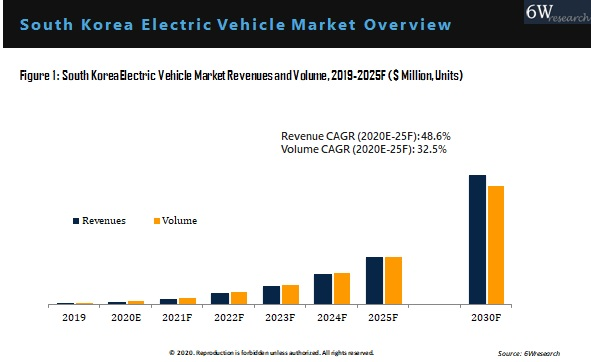
According to 6Wresearch, South Korea electric vehicle market size grew at a CAGR of 48.6% during 2020-2025. South Korea electric vehicle market has significant growth prospects. South Korean government as well as the private sector is actively working towards the development of smart cities in the 4th industrial revolution, which would drive the demand for electric vehicles over the forecast period. For instance, the Solaseado Enterprise City project which is to be completed in phases between 2021 and 2025, aims to be a zero-carbon city where the main mode of transportation is expected to be electric cars.
Market Analysis By Vehicle Types
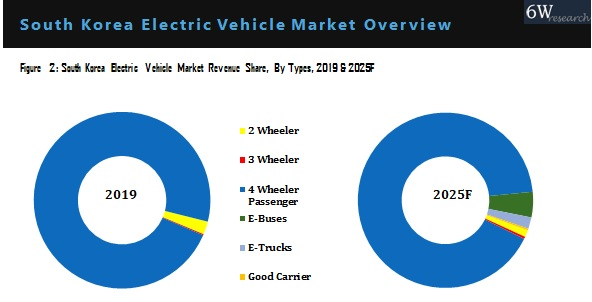
4 wheeler passenger vehicles dominated the overall South Korea electric vehicle market in 2019 and the segment is likely to continue its dominance over the next few years. Additionally, electric motorcycles sold in Korea in 2020 accounted for approximately 8% of the overall motorcycle sales in the country. Seoul announced in 2020 that it would begin subsidizing 500 environmentally-friendly electric two-wheelers per year with the goal of helping cover the cost of 4,700 vehicles total by 2025. Further, the pandemic has increased the demand for e-scooters and e-bikes in the country, and concerns about the environment would further propel the market for electric two-wheelers over the coming years.
Key Attractiveness of the Report
- COVID-19 Impact on the Market.
- 6 Years Market Numbers.
- Estimated Data Starting from 2020 to 2025F.
- Base Year: 2019
- Forecast Data until 2025F.
- Key Performance Indicators Impacting the Market.
- Major Upcoming Developments and Projects.
Key Highlights of the Report:
- South Korea Electric Vehicle Market Overview
- South Korea Electric Vehicle Market Outlook
- South Korea Electric Vehicle Market Forecast
- Historical Data and Forecast South Korea Electric Vehicle Market Revenues and Volume for the Period 2018-2028F
- Historical Data and Forecast of South Korea Electric Vehicle Market Revenues and Volume, By Vehicle Types, for the Period 2018-2028F
- Historical Data and Forecast of South Korea Electric Vehicle Market Revenues and Volume, By Charger Types, for the Period 2018-2028F
- Historical Data and Forecast of South Korea Electric Vehicle Market Revenues and Volume, By DC Charger Power Ratings, for the Period 2018-2028F
- Historical Data and Forecast of South Korea Electric Vehicle Market Revenues and Volume, By Charger End Consumers, for the Period 2018-2028F
- Market Drivers and Restraints
- Industry Life Cycle
- Porter’s Five Force Analysis
- Impact Analysis of COVID-19
- Market Trends
- South Korea Vehicle Market Revenue Ranking, By Companies
- Competitive Benchmarking
- Company Profiles
- Key Strategic Recommendations
Market Scope and Segmentation
Thereportprovides a detailed analysis of the following market segments:
By Vehicle Types
- Electric 2-Wheeler
- Electric 3-Wheeler
- Electric 4-Wheeler
- Passenger Car
- Light Commercial Vehicle (Goods Carrier)
- Electric Bus
- Electric Truck
By Charger Types
- AC
- DC
By DC Charger Connector Types
- CHAdeMO
- CCS
- Others (including Tesla superchargers and GB/T)
By DC Charger Power Ratings
- 40-80 kW
- 80-120 kW
- 120-200 kW
By Charger End Consumers
- Public
- Private






































