South Korea Magazines Market (2026-2032) | Share, Industry, Revenue, Analysis, Companies, Forecast, Value, Growth, Outlook, Trends & Size
Market Forecast By Applications (Household, Commercial), By Product Types (General Interest Magazines, News Magazine, Men’s Interest Magazine, Technical Magazines, Religious Magazine, Film Magazine, Sports Magazine, Others) And Competitive Landscape
| Product Code: ETC006583 | Publication Date: Sep 2020 | Updated Date: Jun 2026 | Product Type: Report | |
| Publisher: 6Wresearch | Author: Sachin Kumar Rai | No. of Pages: 70 | No. of Figures: 35 | No. of Tables: 5 |
South Korea Magazines Market Summary
The south korea magazines market was estimated at USD 246 Million in 2025 and is projected to reach USD 342 Million by 2032, growing at a CAGR of 5.6% from 2026 to 2032.
South Korea Magazines Market Growth Rate Analysis (2021-2032)
The South Korea magazines market has shown a robust annual growth, with rates fluctuating between 5.4% and 6.0% from 2021 to 2032. The growth was notably strong in 2021 at 5.9%, driven by an increase in consumer demand for lifestyle and niche publications. In subsequent years, while 2022 saw a slight dip to 5.4%, 2023 rebounded to 6.0%, reflecting a shift towards digital integration and personalized content that resonates with younger audiences. The stability projected through 2024 to 2028, with variations around 5.5% to 6.0%, indicates ongoing investments in technology and infrastructure, bolstered by innovative marketing strategies and evolving consumer preferences within South Korea's vibrant cultural landscape.
South Korea Magazines Market Year-wise Growth Rate and Key Drivers
This graph highlights how the South Korea Magazines Market has steadily grown over the past five years, supported by major growth factors.
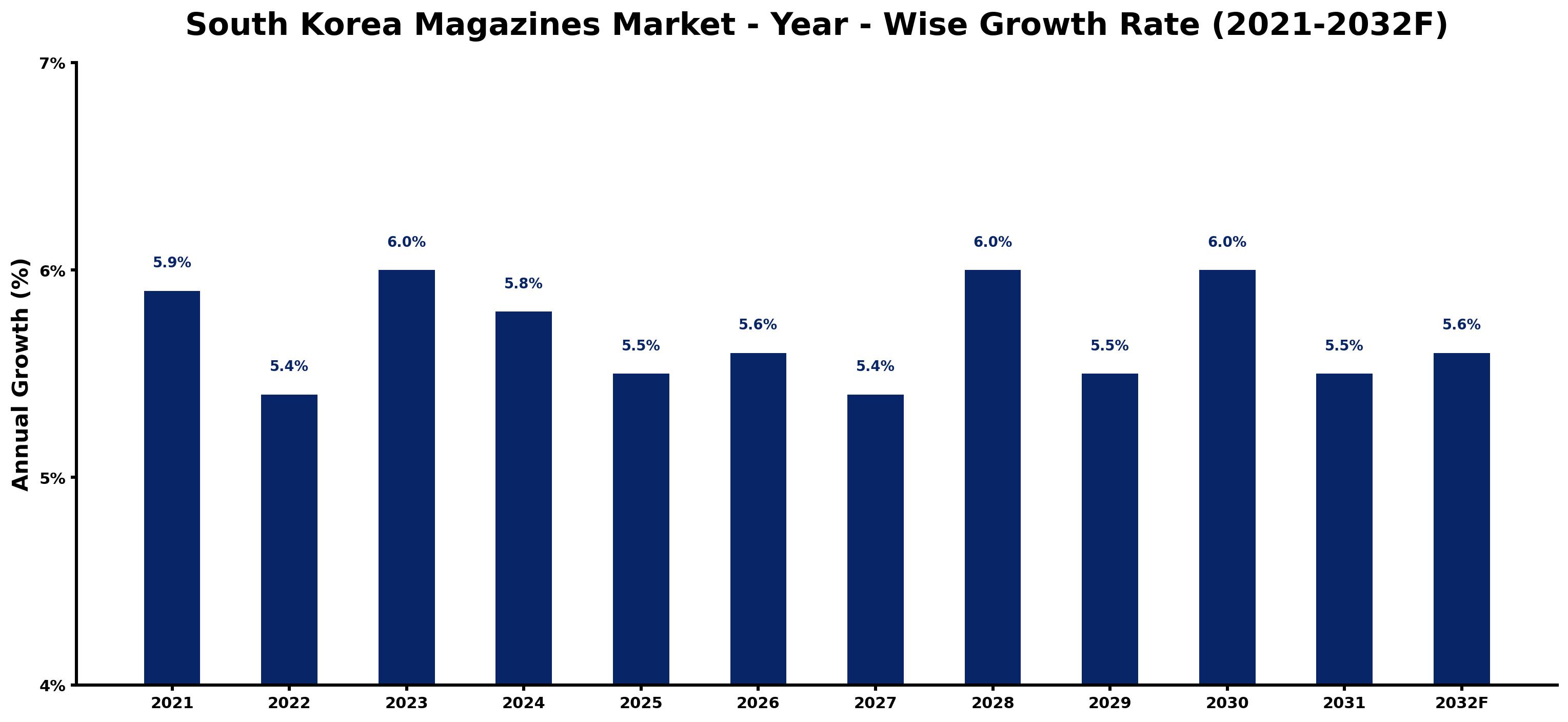
The table below presents the year wise growth rates along with the key drivers influencing the market
| Year | Growth Rate | Major Drivers |
| 2021 | 5.9% | Pandemic-related shifts sparked a surge in digital magazine subscriptions across demographics. |
| 2022 | 5.4% | Cultural trends leaned heavily towards wellness and lifestyle magazines in urban areas. |
| 2023 | 6.0% | Youth engagement through social media channels began redefining traditional magazine marketing strategies. |
| 2024 | 5.8% | Niche publications gained traction, catering to specific hobbies and interests of readers. |
| 2025 | 5.5% | Print magazines experienced a revival due to collectors seeking tangible content experiences. |
| 2026 | 5.6% | Collaborations between print and digital platforms enhanced content accessibility for diverse audiences. |
| 2027 | 5.4% | Sustainability efforts in publishing encouraged eco-friendly materials and practices across magazines. |
| 2028 | 6.0% | Local content began dominating market narratives, promoting regional culture and identity themes. |
| 2029 | 5.5% | Innovations in augmented reality provided interactive experiences within magazine content offerings. |
| 2030 | 6.0% | Diverse revenue streams, including events and merchandise, helped stabilize magazine financials. |
| 2031 | 5.5% | Personalization technologies transformed reader engagement, enhancing loyalty to specific magazine brands. |
| 2032 | 5.6% | Cross-industry partnerships with tech firms facilitated data-driven approaches to magazine content curation. |
Note - Market size estimations and growth projections presented in this report are based on 6Wresearch's advanced forecasting approach, validated with industry datasets as of June 2026.
South Korea Magazines Market Synopsis
The South Korea Magazines Market is projected to reach 5.6% and witness significant growth during the forecast period (2026-2032). This market is characterized by a rich variety of publications that cater to numerous interests, including fashion, beauty, lifestyle, technology, and entertainment. Despite the rising preference for digital formats, print magazines continue to play a vital role in the market landscape. Major trends indicate that the industry is progressively adapting to digital innovations, integrating online versions and multimedia content to captivate broader audiences.
South Korea Magazines Market Trends and Opportunities
The South Korea Magazines Market is currently witnessing a pronounced shift towards digitalization. Traditional print publications are increasingly launching digital editions or mobile applications to engage with tech-savvy consumers. Among younger demographics, lifestyle and fashion magazines maintain strong popularity, driven by the cultural phenomena of K-beauty, K-pop, and emerging Korean fashion trends. Furthermore, specialized magazines focusing on niche subjects such as health, food, and travel are gaining traction within the market.
The rise in demand for interactive content, such as videos, podcasts, and social media integration, is reshaping how magazines connect with their audiences. Advertisers are also repositioning their strategies, investing in digital advertising to effectively reach targeted consumer bases. The focus on innovation and engagement is creating numerous opportunities for publishers to expand their reach in an increasingly digital landscape.
South Korea Magazines Market Challenges and Restraints
Despite the promising opportunities, the South Korea Magazines Market is grappling with several challenges. One of the foremost issues is the declining readership attributed to the growing preference for digital media. As consumers turn to online platforms for news and entertainment, traditional print magazines have experienced diminished circulation and a reduction in advertising revenues.
Moreover, the competitive landscape is intensifying as online platforms offer accessible and often free content, compelling traditional publishers to innovate continuously. The high production and distribution costs associated with print media further complicate the profitability of magazines. To address these challenges, magazines are shifting focus towards digital transformation, enhancing multimedia offerings, and fortifying their online presence to attract and retain readers.
South Korea Magazines Market Investment Opportunities
The South Korea Magazines Market presents lucrative investment opportunities for entities aiming to connect with a diverse and enthusiastic audience. The ongoing emphasis on technology and innovation has paved the way for growth in digital magazines and subscription-based models. Niche segments, such as lifestyle, fashion, and beauty publications, continue to generate substantial interest and loyalty.
Collaborations with influencers and celebrities are also emerging as effective strategies to enhance readership and elevate brand visibility. Investing in quality content creation and distribution mechanisms, alongside exploring partnerships with local entities, can allow companies to fully tap into the expanding Korean magazine landscape and its vibrant media environment.
South Korea Magazines Market Government Investment and Initiatives
Government policies significantly influence the dynamics of the South Korea Magazines Market, with regulations overseeing publication content, distribution, and ownership. The Ministry of Culture, Sports, and Tourism is pivotal in monitoring the industry, ensuring adherence to laws that govern media content and circulation. Initiatives have been implemented to foster the growth of the digital magazine sector, with funding and incentives aimed at facilitating publishers' transitions to online formats.
Furthermore, regulatory measures are in place to promote fair market competition and prevent monopolistic tendencies. Overall, these governmental policies strive to uphold a balance between encouraging creativity and innovation within the industry while maintaining high standards of quality and ethics in magazine publishing in South Korea.
South Korea Magazines Market Latest Developments (May 2025 - June 2026)
During the period from May 2025 to June 2026, the South Korea Magazines Market has experienced notable shifts, particularly in enhancing digital presence. Traditional publishers have accelerated their investment in digital formats, focusing on integrating multimedia content to engage a younger audience. This strategic pivot aims to address changing consumer behaviors, where digital consumption continues to surge.
Additionally, various publications have started adopting subscription models to create steady revenue streams, reflecting a broader trend in the media landscape. The integration of social media interactions with magazine content is also becoming commonplace, enabling brands to connect more intimately with their audience. As these developments unfold, the market is expected to continue its trajectory of adaptation and innovation, setting the stage for future growth.
South Korea Magazines Market - Key Attractiveness of the Report
- 10 Years of Market Numbers
- Historical Data Starting from 2022 to 2025
- Base Year: 2025
- Forecast Data until 2032
- Key Performance Indicators Impacting the Market
- Major Upcoming Developments and Projects
Key Highlights of the Report:
- South Korea Magazines Market Outlook
- Market Size of South Korea Magazines Market, 2025
- Forecast of South Korea Magazines Market, 2032F
- Historical Data and Forecast of South Korea Magazines Revenues & Volume for the Period 2022-2032F
- South Korea Magazines Market Trend Evolution
- South Korea Magazines Market Drivers and Challenges
- South Korea Magazines Price Trends
- South Korea Magazines Porter's Five Forces
- South Korea Magazines Industry Life Cycle
- Historical Data and Forecast of South Korea Magazines Market Revenues & Volume By Applications for the Period 2022-2032F
- Historical Data and Forecast of South Korea Magazines Market Revenues & Volume By Household for the Period 2022-2032F
- Historical Data and Forecast of South Korea Magazines Market Revenues & Volume By Commercial for the Period 2022-2032F
- Historical Data and Forecast of South Korea Magazines Market Revenues & Volume By Product Types for the Period 2022-2032F
- Historical Data and Forecast of South Korea Magazines Market Revenues & Volume By General Interest Magazines for the Period 2022-2032F
- Historical Data and Forecast of South Korea Magazines Market Revenues & Volume By News Magazine for the Period 2022-2032F
- Historical Data and Forecast of South Korea Magazines Market Revenues & Volume By Men?s Interest Magazine for the Period 2022-2032F
- Historical Data and Forecast of South Korea Magazines Market Revenues & Volume By Technical Magazines for the Period 2022-2032F
- Historical Data and Forecast of South Korea Magazines Market Revenues & Volume By Religious Magazine for the Period 2022-2032F
- Historical Data and Forecast of South Korea Magazines Market Revenues & Volume By Film Magazine for the Period 2022-2032F
- Historical Data and Forecast of South Korea Magazines Market Revenues & Volume By Sports Magazine for the Period 2022-2032F
- Historical Data and Forecast of South Korea Magazines Market Revenues & Volume By Others for the Period 2022-2032F
- South Korea Magazines Import Export Trade Statistics
- Market Opportunity Assessment By Applications
- Market Opportunity Assessment By Product Types
- South Korea Magazines Top Companies Market Share
- South Korea Magazines Competitive Benchmarking By Technical and Operational Parameters
- South Korea Magazines Company Profiles
- South Korea Magazines Key Strategic Recommendations
Frequently Asked Questions About the Market Study (FAQs):
The market is currently witnessing a substantial digital shift, with increasing investments in online subscriptions and multimedia content.
The government provides funding and incentives for digital transition while ensuring fair competition through regulations.
The primary challenges include declining print readership and rising competition from digital media, necessitating continuous innovation from publishers.
There is room for growth in digital magazine formats, especially within niche markets like lifestyle and fashion, as well as through influencer collaborations.
6Wresearch actively monitors the South Korea Magazines Market and publishes its comprehensive annual report, highlighting emerging trends, growth drivers, revenue analysis, and forecast outlook. Our insights help businesses to make data-backed strategic decisions with ongoing market dynamics. Our analysts track relevent industries related to the South Korea Magazines Market, allowing our clients with actionable intelligence and reliable forecasts tailored to emerging regional needs.
Yes, we provide customisation as per your requirements. To learn more, feel free to contact us on sales@6wresearch.com
1 Executive Summary |
2 Introduction |
2.1 Key Highlights of the Report |
2.2 Report Description |
2.3 Market Scope & Segmentation |
2.4 Research Methodology |
2.5 Assumptions |
3 South Korea Magazines Market Overview |
3.1 South Korea Country Macro Economic Indicators |
3.2 South Korea Magazines Market Revenues & Volume, 2022 & 2032F |
3.3 South Korea Magazines Market - Industry Life Cycle |
3.4 South Korea Magazines Market - Porter's Five Forces |
3.5 South Korea Magazines Market Revenues & Volume Share, By Applications, 2022 & 2032F |
3.6 South Korea Magazines Market Revenues & Volume Share, By Product Types, 2022 & 2032F |
4 South Korea Magazines Market Dynamics |
4.1 Impact Analysis |
4.2 Market Drivers |
4.2.1 Increasing internet penetration and digitalization leading to online magazines consumption |
4.2.2 Growing interest in niche magazines catering to specific interests and hobbies |
4.2.3 Rising disposable income and consumer spending on leisure activities |
4.3 Market Restraints |
4.3.1 Competition from digital media platforms and social media for consumer attention |
4.3.2 Decline in print advertising budgets impacting magazine revenues |
4.3.3 Changing consumer preferences towards digital content over traditional print magazines |
5 South Korea Magazines Market Trends |
6 South Korea Magazines Market, By Types |
6.1 South Korea Magazines Market, By Applications |
6.1.1 Overview and Analysis |
6.1.2 South Korea Magazines Market Revenues & Volume, By Applications, 2022-2032F |
6.1.3 South Korea Magazines Market Revenues & Volume, By Household, 2022-2032F |
6.1.4 South Korea Magazines Market Revenues & Volume, By Commercial, 2022-2032F |
6.2 South Korea Magazines Market, By Product Types |
6.2.1 Overview and Analysis |
6.2.2 South Korea Magazines Market Revenues & Volume, By General Interest Magazines, 2022-2032F |
6.2.3 South Korea Magazines Market Revenues & Volume, By News Magazine, 2022-2032F |
6.2.4 South Korea Magazines Market Revenues & Volume, By Men?s Interest Magazine, 2022-2032F |
6.2.5 South Korea Magazines Market Revenues & Volume, By Technical Magazines, 2022-2032F |
6.2.6 South Korea Magazines Market Revenues & Volume, By Religious Magazine, 2022-2032F |
6.2.7 South Korea Magazines Market Revenues & Volume, By Film Magazine, 2022-2032F |
6.2.8 South Korea Magazines Market Revenues & Volume, By Others, 2022-2032F |
6.2.9 South Korea Magazines Market Revenues & Volume, By Others, 2022-2032F |
7 South Korea Magazines Market Import-Export Trade Statistics |
7.1 South Korea Magazines Market Export to Major Countries |
7.2 South Korea Magazines Market Imports from Major Countries |
8 South Korea Magazines Market Key Performance Indicators |
8.1 Average time spent per user on digital magazine platforms |
8.2 Growth in subscription rates for niche magazines |
8.3 Engagement metrics such as social media shares and comments on magazine content |
9 South Korea Magazines Market - Opportunity Assessment |
9.1 South Korea Magazines Market Opportunity Assessment, By Applications, 2022 & 2032F |
9.2 South Korea Magazines Market Opportunity Assessment, By Product Types, 2022 & 2032F |
10 South Korea Magazines Market - Competitive Landscape |
10.1 South Korea Magazines Market Revenue Share, By Companies, 2025 |
10.2 South Korea Magazines Market Competitive Benchmarking, By Operating and Technical Parameters |
11 Company Profiles |
12 Recommendations |
13 Disclaimer |
Global Go To Market Strategy - 2030
Export potential enables firms to identify high-growth global markets with greater confidence by combining advanced trade intelligence with a structured quantitative methodology. The framework analyzes emerging demand trends and country-level import patterns while integrating macroeconomic and trade datasets such as GDP and population forecasts, bilateral import–export flows, tariff structures, elasticity differentials between developed and developing economies, geographic distance, and import demand projections. Using weighted trade values from 2020–2024 as the base period to project country-to-country export potential for 2030, these inputs are operationalized through calculated drivers such as gravity model parameters, tariff impact factors, and projected GDP per-capita growth. Through an analysis of hidden potentials, demand hotspots, and market conditions that are most favorable to success, this method enables firms to focus on target countries, maximize returns, and global expansion with data, backed by accuracy.
By factoring in the projected importer demand gap that is currently unmet and could be potential opportunity, it identifies the potential for the Exporter (Country) among 190 countries, against the general trade analysis, which identifies the biggest importer or exporter.
To discover high-growth global markets and optimize your business strategy:
Click Here
Pricing
- Single User License$ 1,995
- Department License$ 2,400
- Site License$ 3,120
- Global License$ 3,795

Leadership Perspectives from Industry Events
Search
Thought Leadership and Analyst Meet





Our Clients








6WResearch In News
- India Air Conditioner Market Set for Strong Rebound in 2026 After Weather-Led Correction and GST-Driven Recovery: 6Wresearch
- ADAS in India: How Automatic Emergency Braking, Blind Spot Detection & Driver Monitoring are Transforming Road Safety
- Doha a strategic location for EV manufacturing hub: IPA Qatar
- Demand for luxury TVs surging in the GCC, says Samsung
- Empowering Growth: The Thriving Journey of Bangladesh’s Cable Industry
- Demand for luxury TVs surging in the GCC, says Samsung
Latest Reports
- Poland Fire Protection Systems Market (2026-2032)
- Cape Verde Portable Hand-Thrown Extinguisher Market (2026-2032)
- Canada Portable Hand-Thrown Extinguisher Market (2026-2032)
- Cameroon Portable Hand-Thrown Extinguisher Market (2026-2032)
- Burundi Portable Hand-Thrown Extinguisher Market (2026-2032)
- Burkina Faso Portable Hand-Thrown Extinguisher Market (2026-2032)
- Bulgaria Portable Hand-Thrown Extinguisher Market (2026-2032)
- Brunei Portable Hand-Thrown Extinguisher Market (2026-2032)
- Botswana Portable Hand-Thrown Extinguisher Market (2026-2032)
- Bosnia and Herzegovina Portable Hand-Thrown Extinguisher Market (2026-2032)
Industry Events and Analyst Meet

HIMTEX 2026

India Refining Summit 2026

India EV Show 2026

EV tech India Expo 2026

Auto Tech Asia 2026
Whitepaper
- Middle East & Africa Commercial Security Market Click here to view more.
- Middle East & Africa Fire Safety Systems & Equipment Market Click here to view more.
- GCC Drone Market Click here to view more.
- Middle East Lighting Fixture Market Click here to view more.
- GCC Physical & Perimeter Security Market Click here to view more.


