Sri Lanka Starch and Starch Derivative Market (2026-2032) | Growth, Value, Outlook, Analysis, Segmentation, Forecast, Industry, Companies, Trends, Size & Revenue, Competitive Landscape, Share
Market Forecast By Application (Textile, Food and Beverage, Paper and Corrugation, Pharmaceuticals) And Competitive Landscape
| Product Code: ETC9479645 | Publication Date: Sep 2024 | Updated Date: Mar 2026 | Product Type: Market Research Report | |
| Publisher: 6Wresearch | Author: Summon Dutta | No. of Pages: 75 | No. of Figures: 35 | No. of Tables: 20 |
sri lanka starch and starch derivative market
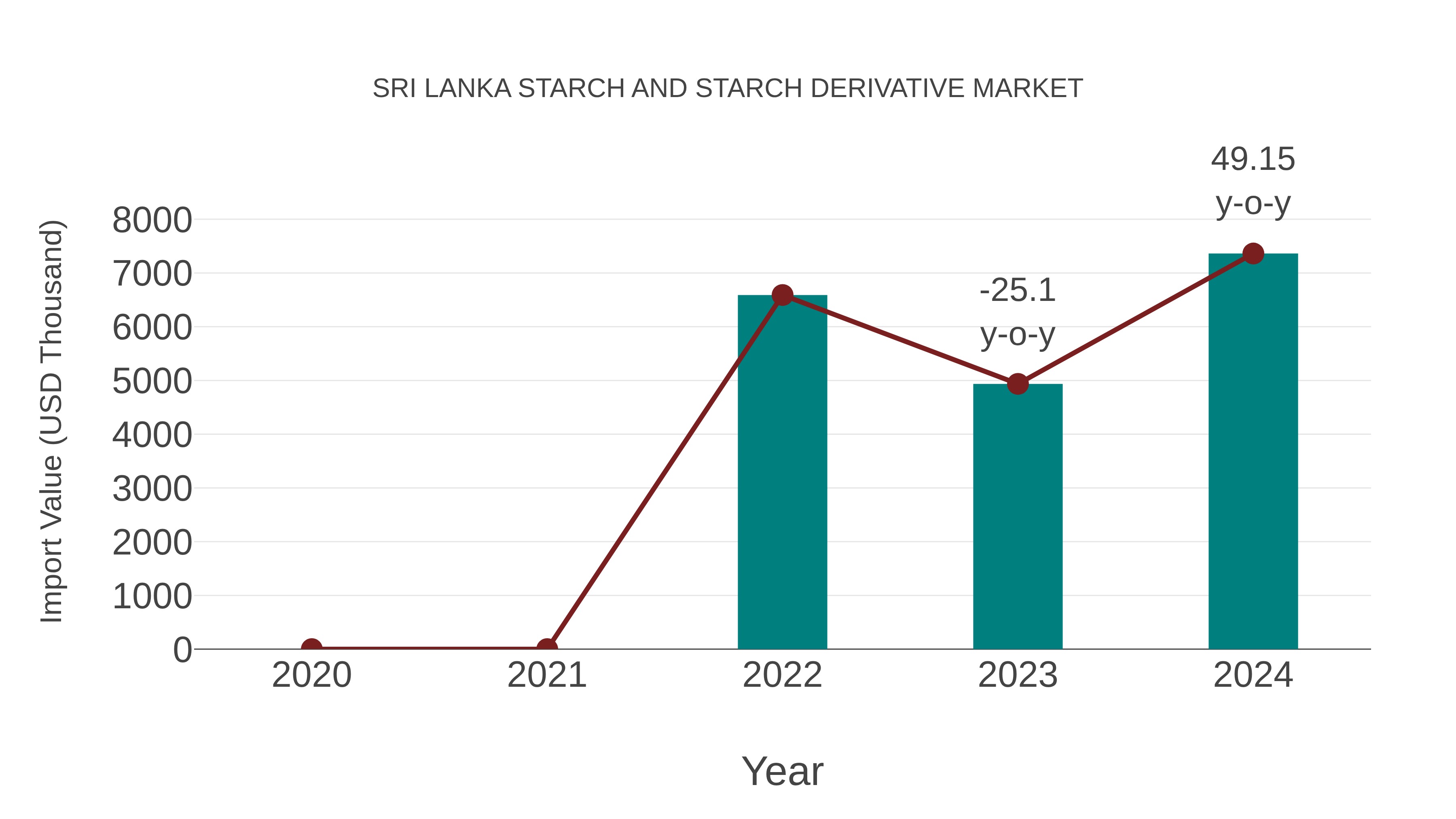
Sri Lanka Starch and Starch Derivative Market Growth Rate
According to 6Wresearch internal database and industry insights, the Sri Lanka Starch and Starch Derivative Market is projected to grow at a compound annual growth rate (CAGR) of 5.9% during the forecast period (2026-2032).
Five-Year Growth Trajectory of the Sri Lanka Starch and Starch Derivative Market with Core Drivers
Below mentioned is the evaluation of year-wise growth rate along with key growth drivers:
| Year | Est. Annual Growth (%) | Growth Drivers |
| 2021 | 2.7 | Increasing use of starch derivatives in textile processing to improve fabric finish and handle |
| 2022 | 3.4 | Recovery in domestic food and beverage production boosting demand for modified starch as thickening agent |
| 2023 | 3.9 | Growth in paper and corrugation demand driving consumption of specialty starch binders |
| 2024 | 4.7 | Expansion of pharmaceutical formulations requiring starch excipients for tablets and capsules |
| 2025 | 5.8 | Rising industrial applications and local production capacity enhancements across sectors |
Topics Covered in the Sri Lanka Starch and Starch Derivative Market Report
The Sri Lanka Starch and Starch Derivative Market report thoroughly covers the market by application. The market report provides an unbiased and detailed analysis of ongoing market trends, opportunities/high growth areas, and market drivers, which help stakeholders devise and align their market strategies according to the current and future market dynamics.
Sri Lanka Starch and Starch Derivative Market Highlights
| Report Name | Sri Lanka Starch and Starch Derivative Market |
| Forecast period | 2026-2032 |
| CAGR | 5.9% |
| Growing Sector | Food and Beverage & Textile |
Sri Lanka Starch and Starch Derivative Market Synopsis
Sri Lanka Starch and Starch Derivative Market is expected to record significant growth as industrial sectors expand and downstream demand across textile, food and beverage, paper, and pharmaceutical industries rises, encouraging higher intake of starch and its functional derivatives. Apart from this, widespread adoption in textile processing for finishing improves fiber quality, while on the other hand, food manufacturers heavily depend on starch as a thickener and stabilizer. Besides, paper and corrugation sectors use specialty binders, and pharmaceuticals increasingly depend on excipients derived from starch to produce solid dosage forms.
Evaluation of Growth Drivers in the Sri Lanka Starch and Starch Derivative Market
Below mentioned are some prominent drivers and their influence on the market dynamics:
| Drivers | Primary Segments Affected | Why it Matters (Evidence) |
| Textile Sector Expansion | Textile Application | Higher fabric production increases demand for starch in sizing and finishing |
| Growth in Food Processing | Food and Beverage | Rising use of modified starch improves texture, stability, and shelf life |
| Paper Packaging Demand | Paper and Corrugation | Corrugated packaging growth supports increased specialty starch uptake |
| Pharmaceutical Manufacturing Growth | Pharmaceuticals | Starch derivatives are essential as excipients for tablets and capsules |
| Local Production Capacity Enhancements | All Applications | Improved local manufacturing reduces dependency on imports and supports volume growth |
Sri Lanka Starch and Starch Derivative Market is expected to grow at a CAGR of 5.9% during the forecast period of 2026-2032. Growth is supported by rising industrialization and stronger demand across diverse end-use sectors such as textile, food and beverage, paper, and pharmaceuticals. In addition, increased adoption of starch in value-added functions such as fabric finishing, food stabilization, specialty paper bonding, and pharmaceutical formulation improves overall ingredient utilization. These factors coupled with local capacity expansions and better supply chain efficiency further strengthen Sri Lanka Starch and Starch Derivative Market Growth.
Evaluation of Restraints in the Sri Lanka Starch and Starch Derivative Market
Below mentioned are some major restraints and their influence on the market dynamics:
| Restraints | Primary Segments Affected | What This Means |
| Volatility in Raw Material Prices | All Applications | Fluctuating prices of maize and cassava increase production costs |
| Limited Processing Technology | Pharmaceuticals & Food | Inadequate advanced processing reduces competitiveness in high-purity derivatives |
| Competition from Imported Starches | Textile & Paper | Imports with competitive pricing can limit local producer share |
| Environmental Compliance Costs | All Applications | Regulatory requirements on effluent and emissions raise compliance costs |
| Seasonal Supply Disruptions | Food and Beverage | Harvest seasonality impacts consistent availability of base starch |
Sri Lanka Starch and Starch Derivative Market Challenges
Irrespective of considerable growth potential, the Sri Lanka Starch and Starch Derivative Market encounters challenges such as volatile raw material availability, especially maize and cassava, leading to cost fluctuations and supply inconsistency. In addition, the lack of advanced processing technology for producing high-purity derivatives limits local capacity to serve specialized segments like pharmaceuticals, while competition from imported starch compounds pressure on pricing and margins. Environmental compliance costs and seasonal raw material disruptions further add complexity to operational planning.
Sri Lanka Starch and Starch Derivative Market Trends
The future of Sri Lanka Starch and Starch Derivative Industry is guided by these key trends:
- Shift toward Modified Starches: Processors increasingly adopt modified starches to meet specific functional requirements in food, textile, and paper applications.
- Eco-Friendly Manufacturing: The manufacturers are also investing in practices that reduce effluent and energy waste from manufacturing processes.
- Pharmaceutical Excipients: The rise in demand for pharmaceutical formulations is creating a growing need for high-quality starch derivatives.
Investment Opportunities in the Sri Lanka Starch and Starch Derivative Market
Attractive investment avenues in the Sri Lanka Starch and Starch Derivative Market involve:
- Specialty Starch Production Facilities: Establishing plants focused on modified starches for food, paper, and pharma segments.
- Technological Upgrade Programmes: Making investments in high-purity starch production through advances in technology.
- Backward Integration Initiatives: Partnering with local farmers to secure stable raw material sources.
Top 5 Leading Players in the Sri Lanka Starch and Starch Derivative Market
Some leading players operating in the Sri Lanka Starch and Starch Derivative Market include:
1. Cargill Lanka (Pvt) Ltd
| Company Name | Cargill Lanka (Pvt) Ltd |
|---|---|
| Established Year | 1990 |
| Headquarters | Colombo, Sri Lanka |
| Official Website | Click Here |
Cargill produces a wide range of starch and derivatives that serve the textile, food, and paper sectors with consistent functional performance.
2. DFCC Bank Starch Processing Partners
| Company Name | DFCC Bank Starch Processing Partners |
|---|---|
| Established Year | 1955 |
| Headquarters | Colombo, Sri Lanka |
| Official Website | Click Here |
DFCC Bank collaborates with local processing firms to finance and develop starch-based solutions that improve industrial applications.
3. Hayleys Group
| Company Name | Hayleys Group |
|---|---|
| Established Year | 1878 |
| Headquarters | Colombo, Sri Lanka |
| Official Website | Click Here |
Hayleys supports the market with specialty starch products and distribution networks that cater to diverse applications.
4. Melstacorp PLC
| Company Name | Melstacorp PLC |
|---|---|
| Established Year | 1996 |
| Headquarters | Colombo, Sri Lanka |
| Official Website | Click Here |
Melstacorp’s portfolio includes starch and derivative inputs used for textile finishing and paper bonding.
5. Arpico Consumer Products PLC
| Company Name | Arpico Consumer Products PLC |
|---|---|
| Established Year | 1965 |
| Headquarters | Colombo, Sri Lanka |
| Official Website | Click Here |
Arpico supplies starch-based products across food and beverage segments, meeting consistent quality and performance needs.
Government Regulations Introduced in the Sri Lanka Starch and Starch Derivative Market
According to Sri Lankan Government Data, the Sri Lanka starch and starch derivatives market has been shaped by major government policies each of which governs the delivery of high-quality products, including labeling and environmental compliance, throughout the production process. Regulations from the Central Environmental Authority regarding effluent management also set the parameters for cleaner effluent practices by production plants. Through advanced agricultural incentive programs, the country is facilitating the expansion of the raw material supply to farmers, thus enhancing the relationship between farmers and processors.
Future Insights of the Sri Lanka Starch and Starch Derivative Market
With the growth of new downstream industries (e.g., textile manufacturing, food processing, paper packaging, pharmaceuticals), the Sri Lanka starch and starch derivative market is expected to witness transformative and continued growth as these sectors will increase the demand for starches and functional derivatives. Also, improved processing technologies and increased use of sustainable practices will help create higher-quality product lines over the forecast period. In conjunction with improved collaboration between farm and processor, this dynamic will help ensure that farmers have a steady supply of raw materials.
Market Segmentation Analysis
The report offers a comprehensive study of the subsequent market segments and their leading categories.
Textile to Dominate the Market – By Application
According to Mansi, Senior Research Analyst, 6Wresearch, Textile application is expected to dominate the Sri Lanka Starch and Starch Derivative Market Share as local apparel and fabric processing operations expand, relying on starch derivatives to enhance fabric strength, handle, and finish. Increased textile exports and investments in fabric processing units drive higher intake of sizing and finish starch products, as manufacturers seek consistent processability and end-product quality.
Key Attractiveness of the Report
- 10 Years of Market Numbers.
- Historical Data Starting from 2022 to 2025.
- Base Year: 2025.
- Forecast Data until 2032.
- Key Performance Indicators Impacting the Market.
- Major Upcoming Developments and Projects.
Key Highlights of the Report:
- Sri Lanka Starch and Starch Derivative Market Outlook
- Market Size of Sri Lanka Starch and Starch Derivative Market, 2025
- Forecast of Sri Lanka Starch and Starch Derivative Market, 2031
- Historical Data and Forecast of Sri Lanka Starch and Starch Derivative Revenues & Volume for the Period 2022-2032
- Sri Lanka Starch and Starch Derivative Market Trend Evolution
- Sri Lanka Starch and Starch Derivative Market Drivers and Challenges
- Sri Lanka Starch and Starch Derivative Price Trends
- Sri Lanka Starch and Starch Derivative Porter's Five Forces
- Sri Lanka Starch and Starch Derivative Industry Life Cycle
- Historical Data and Forecast of Sri Lanka Starch and Starch Derivative Market Revenues & Volume By Application for the Period 2022-2032
- Historical Data and Forecast of Sri Lanka Starch and Starch Derivative Market Revenues & Volume By Textile for the Period 2022-2032
- Historical Data and Forecast of Sri Lanka Starch and Starch Derivative Market Revenues & Volume By Food and Beverage for the Period 2022-2032
- Historical Data and Forecast of Sri Lanka Starch and Starch Derivative Market Revenues & Volume By Paper and Corrugation for the Period 2022-2032
- Historical Data and Forecast of Sri Lanka Starch and Starch Derivative Market Revenues & Volume By Pharmaceuticals for the Period 2022-2032
- Sri Lanka Starch and Starch Derivative Import Export Trade Statistics
- Market Opportunity Assessment By Application
- Sri Lanka Starch and Starch Derivative Top Companies Market Share
- Sri Lanka Starch and Starch Derivative Competitive Benchmarking By Technical and Operational Parameters
- Sri Lanka Starch and Starch Derivative Company Profiles
- Sri Lanka Starch and Starch Derivative Key Strategic Recommendations
Market Covered
The report offers a comprehensive study of the subsequent market segments:
By Application
- Textile
- Food and Beverage
- Paper and Corrugation
- Pharmaceuticals
Sri Lanka Starch and Starch Derivative Market (2026-2032): FAQs
Sri Lanka Starch and Starch Derivative Market is projected to grow at a CAGR of 5.9% between 2026-2032.
Sri Lanka Starch and Starch Derivative Market is driven by demand from textile, food and beverage, paper and corrugation, and pharmaceutical industries.
Major challenges are volatile raw material prices and limited advanced processing capabilities.
Major players are Cargill Lanka (Pvt) Ltd, Hayleys Group, Melstacorp PLC, and Arpico Consumer Products PLC.
6Wresearch actively monitors the Sri Lanka Starch and Starch Derivative Market and publishes its comprehensive annual report, highlighting emerging trends, growth drivers, revenue analysis, and forecast outlook. Our insights help businesses to make data-backed strategic decisions with ongoing market dynamics. Our analysts track relevent industries related to the Sri Lanka Starch and Starch Derivative Market, allowing our clients with actionable intelligence and reliable forecasts tailored to emerging regional needs.
Yes, we provide customisation as per your requirements. To learn more, feel free to contact us on sales@6wresearch.com
| 1 Executive Summary |
| 2 Introduction |
| 2.1 Key Highlights of the Report |
| 2.2 Report Description |
| 2.3 Market Scope & Segmentation |
| 2.4 Research Methodology |
| 2.5 Assumptions |
| 3 Sri Lanka Starch and Starch Derivative Market Overview |
| 3.1 Sri Lanka Country Macro Economic Indicators |
| 3.2 Sri Lanka Starch and Starch Derivative Market Revenues & Volume, 2022 & 2032F |
| 3.3 Sri Lanka Starch and Starch Derivative Market - Industry Life Cycle |
| 3.4 Sri Lanka Starch and Starch Derivative Market - Porter's Five Forces |
| 3.5 Sri Lanka Starch and Starch Derivative Market Revenues & Volume Share, By Application, 2022 & 2032F |
| 4 Sri Lanka Starch and Starch Derivative Market Dynamics |
| 4.1 Impact Analysis |
| 4.2 Market Drivers |
| 4.3 Market Restraints |
| 5 Sri Lanka Starch and Starch Derivative Market Trends |
| 6 Sri Lanka Starch and Starch Derivative Market, By Types |
| 6.1 Sri Lanka Starch and Starch Derivative Market, By Application |
| 6.1.1 Overview and Analysis |
| 6.1.2 Sri Lanka Starch and Starch Derivative Market Revenues & Volume, By Application, 2022- 2032F |
| 6.1.3 Sri Lanka Starch and Starch Derivative Market Revenues & Volume, By Textile, 2022- 2032F |
| 6.1.4 Sri Lanka Starch and Starch Derivative Market Revenues & Volume, By Food and Beverage, 2022- 2032F |
| 6.1.5 Sri Lanka Starch and Starch Derivative Market Revenues & Volume, By Paper and Corrugation, 2022- 2032F |
| 6.1.6 Sri Lanka Starch and Starch Derivative Market Revenues & Volume, By Pharmaceuticals, 2022- 2032F |
| 7 Sri Lanka Starch and Starch Derivative Market Import-Export Trade Statistics |
| 7.1 Sri Lanka Starch and Starch Derivative Market Export to Major Countries |
| 7.2 Sri Lanka Starch and Starch Derivative Market Imports from Major Countries |
| 8 Sri Lanka Starch and Starch Derivative Market Key Performance Indicators |
| 9 Sri Lanka Starch and Starch Derivative Market - Opportunity Assessment |
| 9.1 Sri Lanka Starch and Starch Derivative Market Opportunity Assessment, By Application, 2022 & 2032F |
| 10 Sri Lanka Starch and Starch Derivative Market - Competitive Landscape |
| 10.1 Sri Lanka Starch and Starch Derivative Market Revenue Share, By Companies, 2022-2032F |
| 10.2 Sri Lanka Starch and Starch Derivative Market Competitive Benchmarking, By Operating and Technical Parameters |
| 11 Company Profiles |
| 12 Recommendations |
| 13 Disclaimer |
Export potential assessment - trade Analytics for 2030
Export potential enables firms to identify high-growth global markets with greater confidence by combining advanced trade intelligence with a structured quantitative methodology. The framework analyzes emerging demand trends and country-level import patterns while integrating macroeconomic and trade datasets such as GDP and population forecasts, bilateral import–export flows, tariff structures, elasticity differentials between developed and developing economies, geographic distance, and import demand projections. Using weighted trade values from 2020–2024 as the base period to project country-to-country export potential for 2030, these inputs are operationalized through calculated drivers such as gravity model parameters, tariff impact factors, and projected GDP per-capita growth. Through an analysis of hidden potentials, demand hotspots, and market conditions that are most favorable to success, this method enables firms to focus on target countries, maximize returns, and global expansion with data, backed by accuracy.
By factoring in the projected importer demand gap that is currently unmet and could be potential opportunity, it identifies the potential for the Exporter (Country) among 190 countries, against the general trade analysis, which identifies the biggest importer or exporter.
To discover high-growth global markets and optimize your business strategy:
Click Here
Pricing
- Single User License$ 1,995
- Department License$ 2,400
- Site License$ 3,120
- Global License$ 3,795

Search
Thought Leadership and Analyst Meet





Our Clients








Latest Reports
- United Kingdom (UK) Long-term Care Insurance Market (2026-2032) | Growth, Share, Consumer Insights, Drivers, Opportunities, Competition, Pricing Analysis, Segments, Restraints, Companies, Competitive, Value, Outlook, Size, Demand, Analysis, Challenges, Strategic Insights, Investment Trends, Revenue, Trends, Supply, Forecast
- United Kingdom (UK) Long Term Care Market (2026-2032) | Companies, Outlook, Analysis, Trends, Value, Revenue, Segmentation, Share, Forecast, Competitive Landscape, Growth, Size & Forecast
- Iraq Insulation and Waterproofing Market (2026-2032) | Outlook, Drivers, Growth, Size, Share, Industry, Revenue, Trends, Demand, Competitive, Strategic Insights, Opportunities, Segments, Companies, Challenges, Strategy, Consumer Insights, Analysis, Investment Trends, Value, Segmentation, Forecast, Restraints
- India Switchgear Market Outlook (2026 - 2032) | Size, Share, Trends, Growth, Revenue, Forecast, Analysis, Value, Outlook
- Pakistan Contraceptive Implants Market (2025-2031) | Demand, Growth, Size, Share, Industry, Pricing Analysis, Competitive, Strategic Insights, Strategy, Consumer Insights, Analysis, Investment Trends, Opportunities, Revenue, Segments, Value, Segmentation, Supply, Forecast, Restraints, Outlook, Competition, Drivers, Trends, Companies, Challenges
- Sri Lanka Packaging Market (2026-2032) | Outlook, Competition, Drivers, Trends, Demand, Pricing Analysis, Competitive, Strategic Insights, Companies, Challenges, Strategy, Consumer Insights, Analysis, Investment Trends, Opportunities, Growth, Size, Share, Industry, Revenue, Segments, Value, Segmentation, Supply, Forecast, Restraints
- India Kids Watches Market (2026-2032) | Strategy, Consumer Insights, Analysis, Investment Trends, Opportunities, Growth, Size, Share, Industry, Revenue, Segments, Value, Segmentation, Supply, Forecast, Restraints, Outlook, Competition, Drivers, Trends, Demand, Pricing Analysis, Competitive, Strategic Insights, Companies, Challenges
- Saudi Arabia Core Assurance Service Market (2025-2031) | Strategy, Consumer Insights, Analysis, Investment Trends, Opportunities, Growth, Size, Share, Industry, Revenue, Segments, Value, Segmentation, Supply, Forecast, Restraints, Outlook, Competition, Drivers, Trends, Demand, Pricing Analysis, Competitive, Strategic Insights, Companies, Challenges
- Romania Uninterruptible Power Supply (UPS) Market (2026-2032) | Industry, Analysis, Revenue, Size, Forecast, Outlook, Value, Trends, Share, Growth & Companies
- Saudi Arabia Car Window Tinting Film, Paint Protection Film (PPF), and Ceramic Coating Market (2025-2031) | Strategy, Consumer Insights, Analysis, Investment Trends, Opportunities, Growth, Size, Share, Industry, Revenue, Segments, Value, Segmentation, Supply, Forecast, Restraints, Outlook, Competition, Drivers, Trends, Demand, Pricing Analysis, Competitive, Strategic Insights, Companies, Challenges
Industry Events and Analyst Meet

India EV Show 2026

EV tech India Expo 2026

Auto Tech Asia 2026

Battery Tech India 2026

Smart Production Solutions Guangzhou 2026
Whitepaper
- Middle East & Africa Commercial Security Market Click here to view more.
- Middle East & Africa Fire Safety Systems & Equipment Market Click here to view more.
- GCC Drone Market Click here to view more.
- Middle East Lighting Fixture Market Click here to view more.
- GCC Physical & Perimeter Security Market Click here to view more.
6WResearch In News
- Doha a strategic location for EV manufacturing hub: IPA Qatar
- Demand for luxury TVs surging in the GCC, says Samsung
- Empowering Growth: The Thriving Journey of Bangladesh’s Cable Industry
- Demand for luxury TVs surging in the GCC, says Samsung
- Video call with a traditional healer? Once unthinkable, it’s now common in South Africa
- Intelligent Buildings To Smooth GCC’s Path To Net Zero


