Thailand Poultry Market (2026-2032) | Industry, Size, Companies, Forecast, Trends, Revenue, Share, Growth, Analysis & Value
Market Forecast By Segments (Broiler, Eggs), By End Uses (Food Service, Household), By Distribution Channels (Traditional Retail Stores, Business To Business, Modern Retail Stores) And Competitive Landscape
| Product Code: ETC384205 | Publication Date: Aug 2022 | Updated Date: Feb 2026 | Product Type: Market Research Report | |
| Publisher: 6Wresearch | Author: Ravi Bhandari | No. of Pages: 75 | No. of Figures: 35 | No. of Tables: 20 |
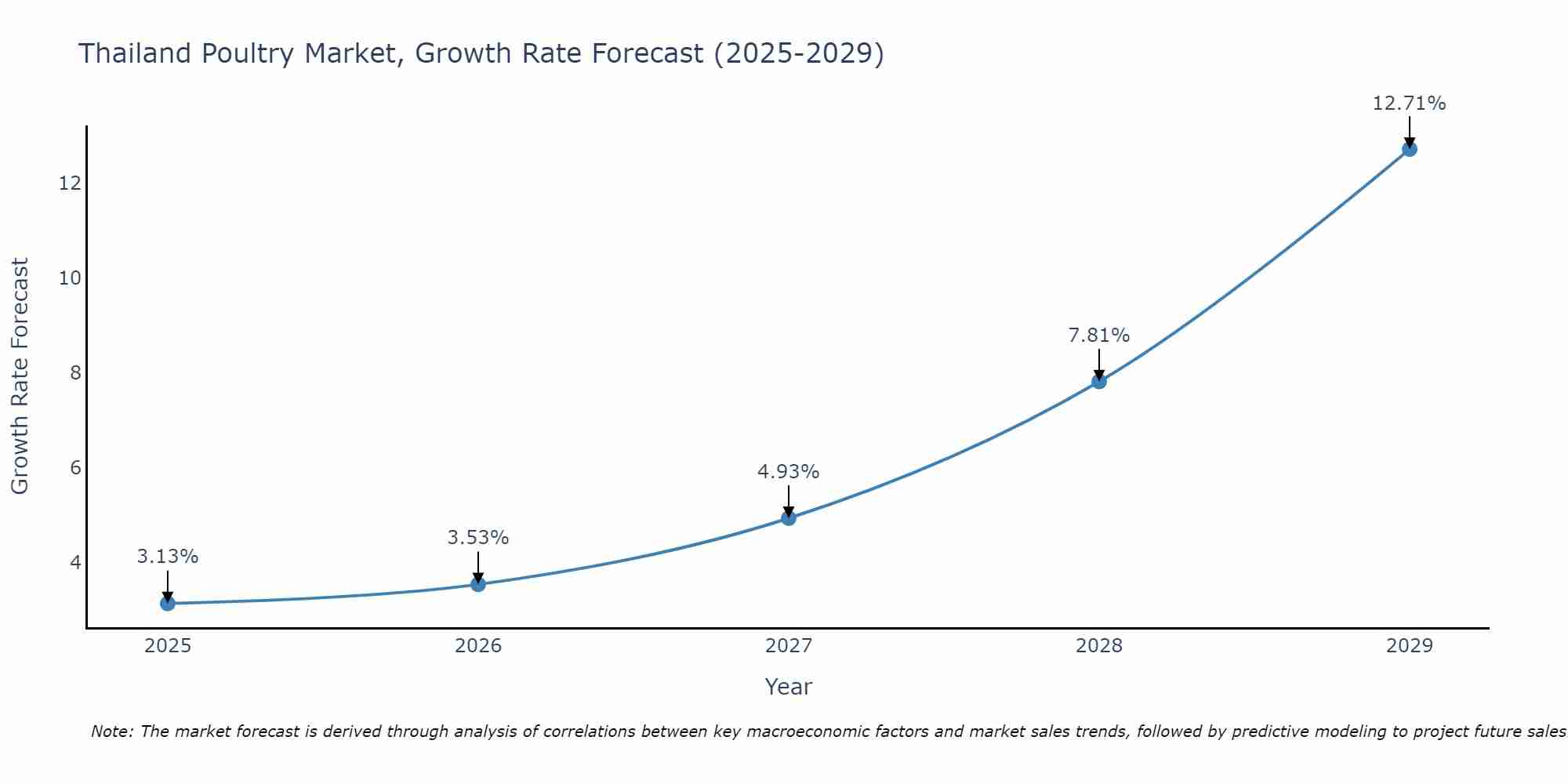
Thailand Poultry Market Size Growth Rate
The Thailand Poultry Market is likely to experience consistent growth rate gains over the period 2025 to 2029. From 3.13% in 2025, the growth rate steadily ascends to 12.71% in 2029.
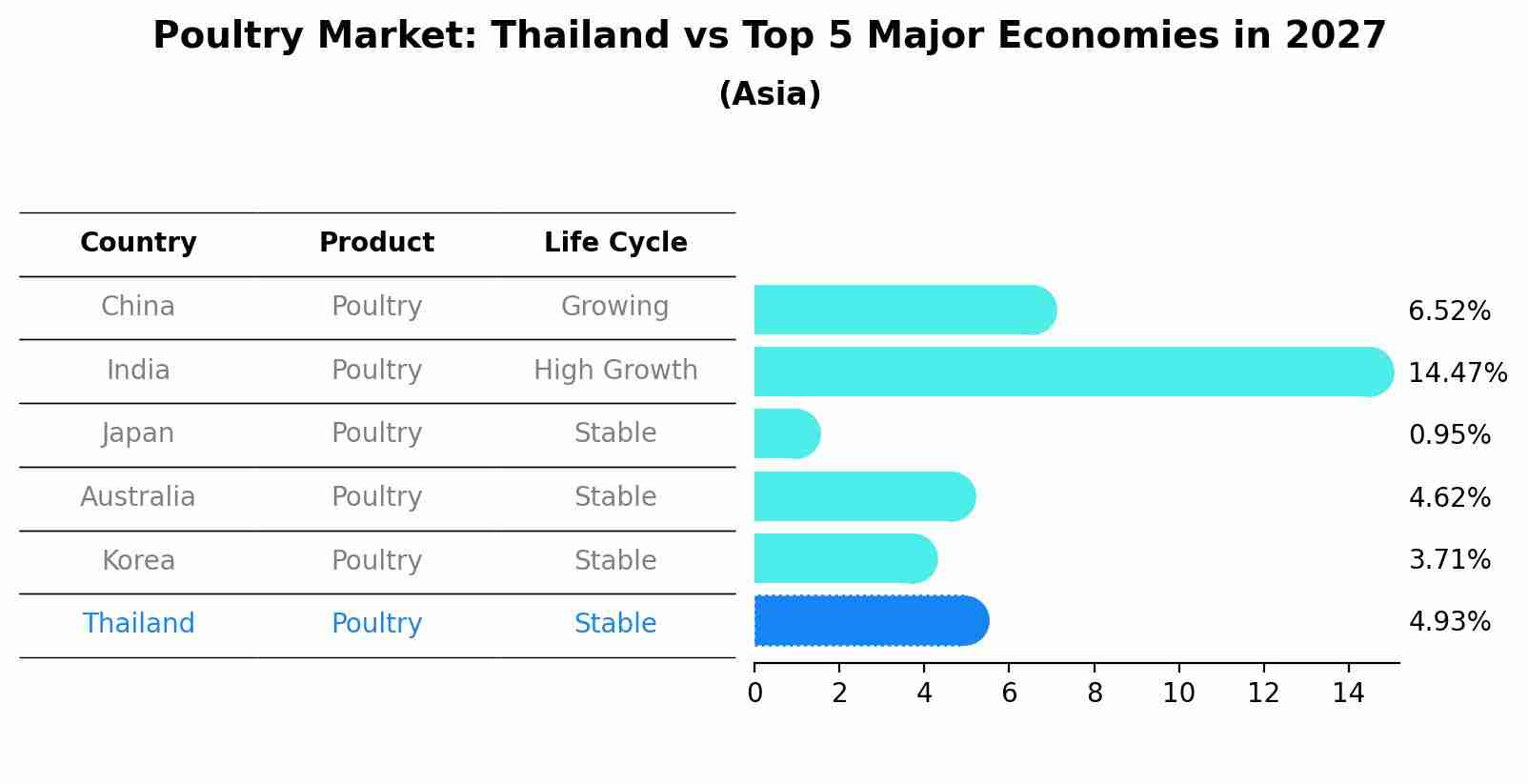
Poultry Market: Thailand vs Top 5 Major Economies in 2027 (Asia)
In the Asia region, the Poultry market in Thailand is projected to expand at a stable growth rate of 4.93% by 2027. The largest economy is China, followed by India, Japan, Australia and South Korea.
Thailand Poultry Market Growth Rate
According to 6Wresearch internal database and industry insights, the Thailand Poultry Market is projected to grow at a compound annual growth rate (CAGR) of 5.7% during the forecast period (2026-2032).
Topics Covered in the Thailand Poultry Market Report
The Thailand Poultry Market report thoroughly covers the market by segments, end uses, and distribution channels. The market report provides an unbiased and detailed analysis of ongoing market trends, opportunities/high growth areas, and market drivers, which help stakeholders devise and align their market strategies according to the current and future market dynamics.
Thailand Poultry Market Highlights
| Report Name | Thailand Poultry Market |
| Forecast Period | 2026–2032 |
| CAGR | 5.7% |
| Growing Sector | Broiler |
Thailand Poultry Market Synopsis
Thailand Poultry Market is anticipated to witness steady growth driven by growing demand for affordable protein sources, strong export performance, and rising domestic consumption. People like poultry products a lot because they are cheap and can be used in many different types of cooking. The growth of quick-service restaurants, better cold chain logistics, and the rise of modern retail formats are all helping to boost market demand. In addition, the presence of integrated poultry producers, advancements in farming practices, and government support for livestock development are contributing to improved productivity and consistent supply across domestic and international markets.
Evaluation of Growth Drivers in the Thailand Poultry Market
Below mentioned are some prominent drivers and their influence on the market dynamics:
| Drivers | Primary Segments Affected | Why it Matters (Evidence) |
| Rising Demand for Affordable Protein | Broiler; Household | Consumers prefer poultry as a cost-effective alternative to other protein sources. |
| Growth in Export Markets | Broiler; B2B | Thailand’s strong export network drives demand for large-scale production. |
| Expansion of Food Service Industry | Broiler & Eggs; Food Service | Restaurants and QSR chains generate significant bulk poultry demand. |
| Development of Cold Chain Infrastructure | All Segments; Modern Retail | Improved storage and transportation reduce spoilage and expand distribution reach. |
| Integrated Poultry Farming Investments | Broiler; B2B | Large-scale producers achieve higher efficiency, better quality control, and stable supply. |
Thailand Poultry Market is expected to grow at the CAGR of 5.7% during the forecast period of 2026-2032. Rising demand for chicken and eggs as affordable and healthy sources of protein is supporting market growth. Increasing bulk purchases from food service businesses, quick-service restaurants, and institutional catering providers are further driving consumption. Strong export potential is encouraging investments in large-scale integrated farms and modern processing facilities. In addition, improvements in cold chain logistics and the expansion of modern retail channels are enhancing product availability and extending shelf life. Government support through programs aimed at improving livestock productivity and disease control is also contributing to long-term market stability.
Evaluation of Restraints in the Thailand Poultry Market
Below mentioned are some major restraints and their influence on the market dynamics:
| Restraints | Primary Segments Affected | What This Means (Evidence) |
| Fluctuating Feed Costs | Broiler & Eggs; Producers | Rising feed prices increase production costs and reduce profit margins. |
| Disease Outbreak Risks | All Segments; Production | Livestock diseases can disrupt supply and increase operational risks. |
| Price Volatility in Export Markets | Broiler; B2B | Changes in global demand led to fluctuations in revenue streams. |
| Small-Scale Farmer Challenges | Eggs; Traditional Retail | Limited financial resources restrict investment, resulting in low productivity and inconsistent quality. |
| Strict Export Quality Standards | Broiler; Processing Units | Compliance with international certifications and regulations increases operational and processing costs. |
Thailand Poultry Industry Challenges
Despite strong growth prospects, the Thailand Poultry Industry faces several operational and structural challenges. Rising feed costs, driven by fluctuations in global grain prices, significantly affect production expenses and profit margins for farmers and processors. The industry also remains vulnerable to disease outbreaks, which can disrupt supply chains and require strict biosecurity measures. Small, scale farmers are always at a disadvantage because of their restricted access to advanced technology, credit, and efficient distribution avenues. Apart from that, maintaining the quality and safety standards demanded by export markets inevitably leads to higher costs of compliance. Uncertainty is added for producers and exporters by price fluctuations in international markets and changing consumer demand patterns.
Thailand Poultry Market Trends
Major trends shaping the Thailand Poultry Market Growth are as follows
- Growth of Processed and Value-Added Poultry Products: With increasingly busy lifestyles and a strong preference for convenience, consumers are purchasing more ready-to-cook and ready-to-eat poultry products. This shift is driving demand for processed and packaged poultry across retail and food service channels.
- Expansion of Integrated Poultry Operations: Large companies are adopting vertical integration across feed production, farming, processing, and distribution. This approach improves operational efficiency, enhances product traceability, and ensures consistent quality and supply.
- Rising Demand from Quick-Service Restaurants: The rapid expansion of fast-food chains and casual dining outlets is increasing bulk demand for poultry. Food service operators prefer standardized and processed poultry products due to their ease of handling, uniformity, and operational efficiency.
- Shift Toward Modern Retail Channels: Consumers are increasingly purchasing poultry from supermarkets and hypermarkets that offer better hygiene, packaging, and product variety. Improved cold storage facilities are further strengthening consumer trust and product quality.
- Focus on Food Safety and Traceability: Producers are strengthening biosecurity measures and adopting digital monitoring systems across farms and processing units. These practices support export compliance and enhance consumer confidence in product safety and quality.
Investment Opportunities in the Thailand Poultry Market
Some prominent investment opportunities in the Thailand Poultry Market include:
- Processed Poultry Manufacturing Facilities: Setting up frozen, marinated, and ready- to- eat products manufacturing plants has been identified as a key growth area. Such products command higher margins and are also more consistent with the changing tastes of consumers.
- Cold Chain and Logistics Infrastructure: A significant benefit from increasing refrigerated storage and transportation capacity is that products can be kept longer, hence less wastage. Moreover, having an efficient transport network also makes it easier to enter new domestic and export markets.
- Modern Poultry Farming Technologies: Adoption of Automation and Climate-Controlled Farming Systems: The use of automated operations, climate-controlled housing, and advanced feeding systems is improving productivity while enhancing animal welfare. Technology-driven farming also helps reduce operational costs and ensures consistent production output.
- Export-Oriented Processing Units: Thailand is known worldwide for its brand. One of the advantages of this is the great potential that exists to set up export, oriented production facilities. It will ensure a steady inflow of revenues from time to time through initially securing the guarantee of international quality standard requirements.
- Supply Partnerships with Food Service Chains: Signing long term contracts with restaurant and catering companies ensures that the demand is stable. The rise in the QSR and institutional catering sectors is a driving factor for bulk sales on a regular basis.
Top 5 Leading Players in the Thailand Poultry Market
Some leading players operating in the Thailand Poultry Market include:
1. Charoen Pokphand Foods Public Company Limited (CPF)
| Company Name | Charoen Pokphand Foods Public Company Limited (CPF) |
|---|---|
| Established Year | 1978 |
| Headquarters | Bangkok, Thailand |
| Official Website | Click Here |
CPF is one of Thailand’s largest integrated poultry producers, covering feed production, farming, processing, and distribution. The company supplies fresh, frozen, and processed poultry products for domestic consumption and export markets worldwide.
2. GFPT Public Company Limited
| Company Name | GFPT Public Company Limited |
|---|---|
| Established Year | 1981 |
| Headquarters | Bangkok, Thailand |
| Official Website | - |
GFPT specializes in integrated poultry production and exports high-quality chicken products to international markets. The company focuses on modern processing facilities, strict quality control, and expanding value-added product offerings.
3. Betagro Group
| Company Name | Betagro Group |
|---|---|
| Established Year | 1967 |
| Headquarters | Bangkok, Thailand |
| Official Website | Click Here |
Betagro operates integrated poultry and livestock businesses with strong emphasis on food safety and traceability. The company supplies fresh and processed poultry products through modern retail, food service, and export channels.
4. Thai Foods Group Public Company Limited
| Company Name | Thai Foods Group Public Company Limited |
|---|---|
| Established Year | 1987 |
| Headquarters | Bangkok, Thailand |
| Official Website | - |
Thai Foods Group focuses on integrated poultry and feed operations to ensure consistent quality and supply. The company serves both domestic markets and international customers through efficient production and distribution systems.
5. Saha Farms Co., Ltd.
| Company Name | Saha Farms Co., Ltd. |
|---|---|
| Established Year | 1969 |
| Headquarters | Bangkok, Thailand |
| Official Website | Click Here |
Saha Farms produces and exports high-quality chicken products using advanced farming and processing technologies. The company emphasizes biosecurity, product safety, and strong partnerships with global food service and retail clients.
Government Regulations Introduced in the Thailand Poultry Market
According to Thailand’s government data, several initiatives support the development and regulation of the poultry industry. The Department of Livestock Development (DLD) has set up very rigorous biosecurity and disease control measures to protect animal health as well as to make production stable and reliable. Besides that, the government encourages the implementation of Good Agricultural Practices (GAP) and international food safety certifications as a means to raise the level of export competitiveness. It has also come up with financial assistance and training programs to small and medium poultry farmers through which the changes in productivity and farm management can be realized. Moreover, the regulations standards of the cold chain, processing hygiene and traceability systems are ways by which the product quality can be maintained, consumer confidence can be enhanced and Thailand's strong position in the global poultry trade can be supported.
Future Insights of the Thailand Poultry Market
The Thailand Poultry Market is projected to witness a continuous growth at the present pace and this will come as a result of several factors such as increasing domestic consumption, growing food service demand, and availability of strong export opportunities. The main factors that will still continue to support broiler production are the rising consumer preference for protein sources that are not only affordable but also of high quality whereas the market will most probably be benefited from the more extensive use of automated farming systems, better genetics as well as the advanced processing technologies.
Market Segmentation Analysis
The report offers a comprehensive study of the subsequent market segments and their leading categories.
Broiler to Dominate the Market – By Segments
According to Mohit, Senior Research Analyst, 6Wresearch, the Broiler segment holds the largest share in the Thailand Poultry Market Share due to strong domestic consumption and high export demand for chicken meat. Broiler products have become the first choice of consumers, restaurants, and food processing industries due to their low prices, usefulness for various cooking methods, and quick production cycles. The fast growth of fast-food chains and catering to schools and hospitals is again raising the demand for broiler meat in large quantities.
Household to Dominate the Market – By End Uses
The Household segment is leading the market due to the increasing consumption of poultry as the main source of protein in the diet. Population growth, urbanization, and the preference for inexpensive meat products are the main factors leading to a stable retail demand from residential consumers.
Business To Business to Dominate the Market – By Distribution Channels
The Business To Business channel accounts for the largest share of the market as the largest volumes are delivered to food service operators, processors, exporters, and institutional buyers. Stable producer demand is ensured by long, term agreements and bulk purchases.
Key Attractiveness of the Report
- 10 Years of Market Numbers.
- Historical Data Starting from 2022 to 2025.
- Base Year: 2025.
- Forecast Data until 2032.
- Key Performance Indicators Impacting the Market.
- Major Upcoming Developments and Projects.
Key Highlights of the Report:
- Thailand Poultry Market Outlook
- Market Size of Thailand Poultry Market, 2024
- Forecast of Thailand Poultry Market, 2032
- Historical Data and Forecast of Thailand Poultry Revenues & Volume for the Period 2022-2032
- Thailand Poultry Market Trend Evolution
- Thailand Poultry Market Drivers and Challenges
- Thailand Poultry Price Trends
- Thailand Poultry Porter's Five Forces
- Thailand Poultry Industry Life Cycle
- Historical Data and Forecast of Thailand Poultry Market Revenues & Volume By Segments for the Period 2022-2032
- Historical Data and Forecast of Thailand Poultry Market Revenues & Volume By Broiler for the Period 2022-2032
- Historical Data and Forecast of Thailand Poultry Market Revenues & Volume By Eggs for the Period 2022-2032
- Historical Data and Forecast of Thailand Poultry Market Revenues & Volume By End Uses for the Period 2022-2032
- Historical Data and Forecast of Thailand Poultry Market Revenues & Volume By Food Service for the Period 2022-2032
- Historical Data and Forecast of Thailand Poultry Market Revenues & Volume By Household for the Period 2022-2032
- Historical Data and Forecast of Thailand Poultry Market Revenues & Volume By Distribution Channels for the Period 2022-2032
- Historical Data and Forecast of Thailand Poultry Market Revenues & Volume By Traditional Retail Stores for the Period 2022-2032
- Historical Data and Forecast of Thailand Poultry Market Revenues & Volume By Business To Business for the Period 2022-2032
- Historical Data and Forecast of Thailand Poultry Market Revenues & Volume By Modern Retail Stores for the Period 2022-2032
- Thailand Poultry Import Export Trade Statistics
- Market Opportunity Assessment By Segments
- Market Opportunity Assessment By End Uses
- Market Opportunity Assessment By Distribution Channels
- Thailand Poultry Top Companies Market Share
- Thailand Poultry Competitive Benchmarking By Technical and Operational Parameters
- Thailand Poultry Company Profiles
- Thailand Poultry Key Strategic Recommendations
Market Covered
The report offers a comprehensive study of the subsequent market segments:
By Segments
- Broiler
- Eggs
By End Uses
- Food Service
- Household
By Distribution Channels
- Traditional Retail Stores
- Business To Business
- Modern Retail Stores
Thailand Poultry Market (2026-2032): FAQs
The Thailand Poultry Market is projected to grow at a CAGR of 5.7% during the forecast period 2026-2032.
Growth is driven by several factors, including rising domestic consumption, strong export demand, more food service outlets, cold chain infrastructure development, and increasing investments in integrated poultry production.
The broiler segment holds the largest market share due to high domestic consumption, strong export demand, a short production cycle, and wide usage across households, restaurants, and food processing industries.
The industry faces several challenges, including fluctuating feed costs, risks of disease outbreaks, strict export quality requirements, limited resources for small-scale farmers, and volatility in international market prices.
6Wresearch actively monitors the Thailand Poultry Market and publishes its comprehensive annual report, highlighting emerging trends, growth drivers, revenue analysis, and forecast outlook. Our insights help businesses to make data-backed strategic decisions with ongoing market dynamics. Our analysts track relevent industries related to the Thailand Poultry Market, allowing our clients with actionable intelligence and reliable forecasts tailored to emerging regional needs.
Yes, we provide customisation as per your requirements. To learn more, feel free to contact us on sales@6wresearch.com
Export potential assessment - trade Analytics for 2030
Export potential enables firms to identify high-growth global markets with greater confidence by combining advanced trade intelligence with a structured quantitative methodology. The framework analyzes emerging demand trends and country-level import patterns while integrating macroeconomic and trade datasets such as GDP and population forecasts, bilateral import–export flows, tariff structures, elasticity differentials between developed and developing economies, geographic distance, and import demand projections. Using weighted trade values from 2020–2024 as the base period to project country-to-country export potential for 2030, these inputs are operationalized through calculated drivers such as gravity model parameters, tariff impact factors, and projected GDP per-capita growth. Through an analysis of hidden potentials, demand hotspots, and market conditions that are most favorable to success, this method enables firms to focus on target countries, maximize returns, and global expansion with data, backed by accuracy.
By factoring in the projected importer demand gap that is currently unmet and could be potential opportunity, it identifies the potential for the Exporter (Country) among 190 countries, against the general trade analysis, which identifies the biggest importer or exporter.
To discover high-growth global markets and optimize your business strategy:
Click Here
Pricing
- Single User License$ 1,995
- Department License$ 2,400
- Site License$ 3,120
- Global License$ 3,795

Search
Thought Leadership and Analyst Meet





Our Clients








Related Reports
- India Switchgear Market Outlook (2026 - 2032) | Size, Share, Trends, Growth, Revenue, Forecast, Analysis, Value, Outlook
- Pakistan Contraceptive Implants Market (2025-2031) | Demand, Growth, Size, Share, Industry, Pricing Analysis, Competitive, Strategic Insights, Strategy, Consumer Insights, Analysis, Investment Trends, Opportunities, Revenue, Segments, Value, Segmentation, Supply, Forecast, Restraints, Outlook, Competition, Drivers, Trends, Companies, Challenges
- Sri Lanka Packaging Market (2026-2032) | Outlook, Competition, Drivers, Trends, Demand, Pricing Analysis, Competitive, Strategic Insights, Companies, Challenges, Strategy, Consumer Insights, Analysis, Investment Trends, Opportunities, Growth, Size, Share, Industry, Revenue, Segments, Value, Segmentation, Supply, Forecast, Restraints
- India Kids Watches Market (2026-2032) | Strategy, Consumer Insights, Analysis, Investment Trends, Opportunities, Growth, Size, Share, Industry, Revenue, Segments, Value, Segmentation, Supply, Forecast, Restraints, Outlook, Competition, Drivers, Trends, Demand, Pricing Analysis, Competitive, Strategic Insights, Companies, Challenges
- Saudi Arabia Core Assurance Service Market (2025-2031) | Strategy, Consumer Insights, Analysis, Investment Trends, Opportunities, Growth, Size, Share, Industry, Revenue, Segments, Value, Segmentation, Supply, Forecast, Restraints, Outlook, Competition, Drivers, Trends, Demand, Pricing Analysis, Competitive, Strategic Insights, Companies, Challenges
- Romania Uninterruptible Power Supply (UPS) Market (2026-2032) | Industry, Analysis, Revenue, Size, Forecast, Outlook, Value, Trends, Share, Growth & Companies
- Saudi Arabia Car Window Tinting Film, Paint Protection Film (PPF), and Ceramic Coating Market (2025-2031) | Strategy, Consumer Insights, Analysis, Investment Trends, Opportunities, Growth, Size, Share, Industry, Revenue, Segments, Value, Segmentation, Supply, Forecast, Restraints, Outlook, Competition, Drivers, Trends, Demand, Pricing Analysis, Competitive, Strategic Insights, Companies, Challenges
- South Africa Stationery Market (2025-2031) | Share, Size, Industry, Value, Growth, Revenue, Analysis, Trends, Segmentation & Outlook
- Afghanistan Rocking Chairs And Adirondack Chairs Market (2026-2032) | Size & Revenue, Competitive Landscape, Share, Segmentation, Industry, Value, Outlook, Analysis, Trends, Growth, Forecast, Companies
- Afghanistan Apparel Market (2026-2032) | Growth, Outlook, Industry, Segmentation, Forecast, Size, Companies, Trends, Value, Share, Analysis & Revenue
Industry Events and Analyst Meet

India EV Show 2026

EV tech India Expo 2026

Auto Tech Asia 2026

Battery Tech India 2026

Smart Production Solutions Guangzhou 2026
Whitepaper
- Middle East & Africa Commercial Security Market Click here to view more.
- Middle East & Africa Fire Safety Systems & Equipment Market Click here to view more.
- GCC Drone Market Click here to view more.
- Middle East Lighting Fixture Market Click here to view more.
- GCC Physical & Perimeter Security Market Click here to view more.
6WResearch In News
- Doha a strategic location for EV manufacturing hub: IPA Qatar
- Demand for luxury TVs surging in the GCC, says Samsung
- Empowering Growth: The Thriving Journey of Bangladesh’s Cable Industry
- Demand for luxury TVs surging in the GCC, says Samsung
- Video call with a traditional healer? Once unthinkable, it’s now common in South Africa
- Intelligent Buildings To Smooth GCC’s Path To Net Zero


