Thailand Soap Market (2026-2032) | Trends, Size, Analysis, Value, Outlook, Industry, Share, Revenue, Forecast, Companies & Growth
Market Forecast By Type (Bar Soap, Liquid Soap), By Application (Household, Commercial, Other), By Distribution Channel (Modern Trade, Traditional Trade, Online) And Competitive Landscape
| Product Code: ETC021405 | Publication Date: Jul 2023 | Updated Date: Mar 2026 | Product Type: Report | |
| Publisher: 6Wresearch | Author: Ravi Bhandari | No. of Pages: 70 | No. of Figures: 35 | No. of Tables: 5 |
Thailand Soap Market: Import Trend Analysis
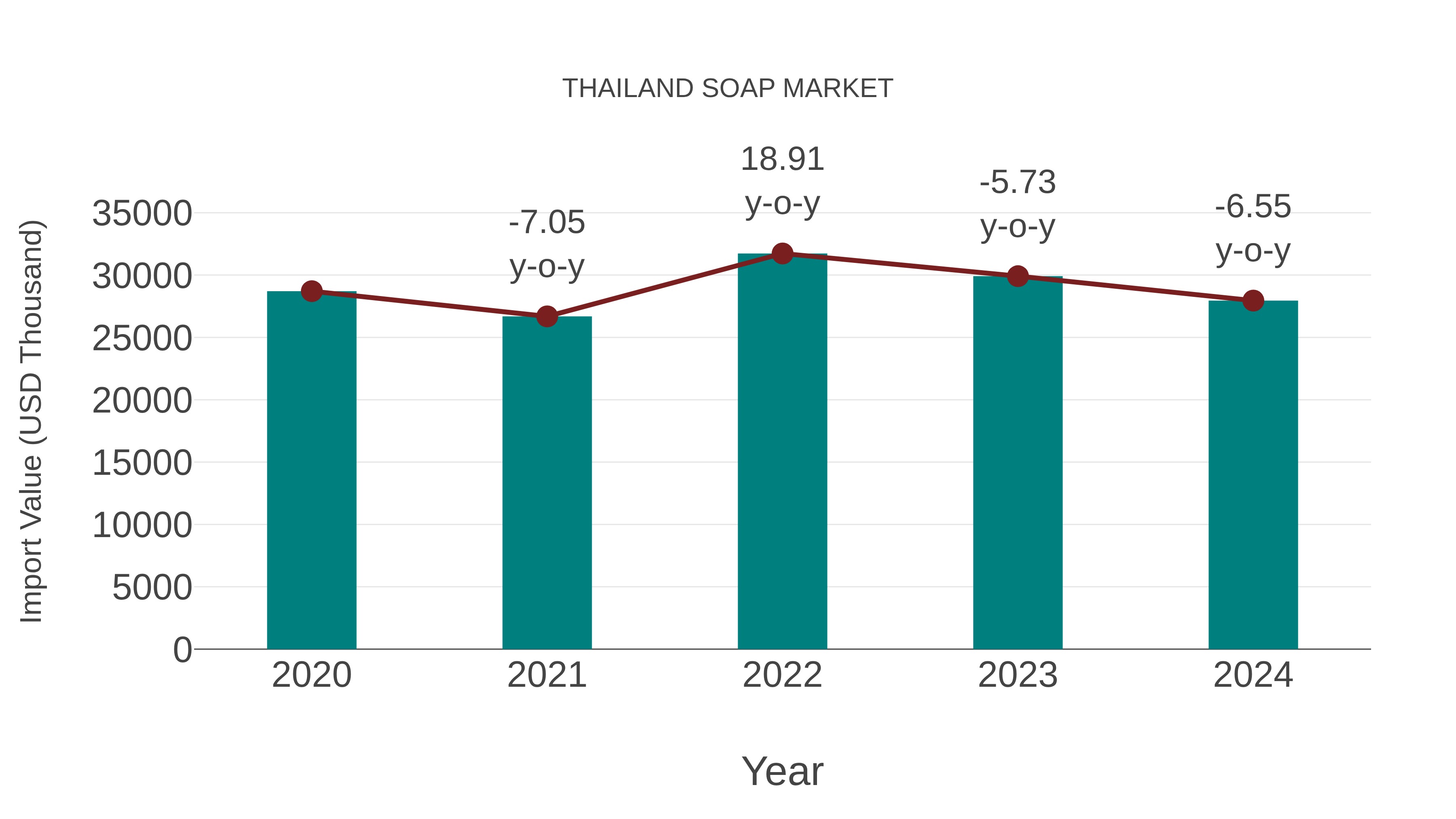
Thailand soap market witnessed a decline in import momentum from 2023 to 2024, with a growth rate of -6.55% during this period. The compound annual growth rate (CAGR) for imports from 2020 to 2024 stood at -0.66%. This negative trend could be attributed to shifting consumer preferences, changing trade policies, or market saturation impacting demand dynamics.
Thailand Soap Market Growth Rate
According to 6Wresearch internal database and industry insights, the Thailand Soap Market is growing at a compound annual growth rate (CAGR) of 6.20% during the forecast period (2026-2032).
Topics Covered in the Thailand Soap Market Report
Thailand Soap Market report thoroughly covers the market by type, application and distribution channel. The market report provides an unbiased and detailed analysis of ongoing market trends, opportunities/high growth areas, and market drivers, which would help stakeholders devise and align their market strategies according to the current and future market dynamics.
Thailand Soap Market Highlights
| Report Name | Thailand Soap Market |
| Forecast period | 2026-2032 |
| CAGR | 6.20% |
| Growing Sector | Household |
Thailand Soap Market Synopsis
The Thailand Soap Market will keep growing as people in both homes and businesses now require better hygiene and personal care products. Consumers are increasingly adopting premium soap products containing herbal extracts, natural fragrances, and skin-friendly ingredients. The growth of tourism and hospitality services in Thailand is further strengthening demand for soap products in hotels, resorts, and wellness centers. The rapid expansion of e-commerce platforms and modern retail chains has improved product accessibility which encourages consumers to buy branded and specialty soap products.
Evaluation of Growth Drivers in the Thailand Soap Market
Below mentioned some growth drivers and their impact on market dynamics:
| Drivers | Primary Segments Affected | Why It Matters |
| Rising Hygiene Awareness | Household Application, Bar Soap | Increases regular soap usage among consumers |
| Expansion of Tourism Sector | Commercial Application, Liquid Soap | Drives soap demand in hotels and hospitality facilities |
| Growth of Modern Retail | Modern Trade Distribution | Improves product availability through supermarkets |
| Demand for Herbal Products | Bar Soap, Liquid Soap | Encourages sales of natural and skin-friendly soaps |
| E-commerce Expansion | Online Distribution | Expands consumer access to soap through digital platforms |
The Thailand Soap Market is projected to grow significantly, with a CAGR of 6.20% during the forecast period of 2026-2032. The Thailand Soap Market is expanding as consumers now prioritize hygiene needs and skincare requirements and soap products that offer convenience during their daily activities. Urbanization trends and increased disposable income levels are driving consumers to purchase soap products that have both premium quality and dermatological testing. The growing demand for commercial spaces includes hotels and spas & restaurants and hospitals which now require higher cleanliness standards. The market demand for soap products is increasing as manufacturers now offer new product combinations that include herbal soaps and antibacterial liquid soaps and moisturizing bars. The soap market in Thailand continues to expand as these factors work together to create market growth.
Evaluation of Restraints in the Thailand Soap Market
Below mentioned are some major restraints and their influence on market dynamics:
| Restraints | Primary Segments Affected | What This Means |
| Price Competition | Bar Soap, Traditional Trade | Reduces profit margins for manufacturers |
| Raw Material Cost Fluctuations | All Segments | Increases production and pricing pressures |
| Competition from Body Wash | Liquid Soap | Shifts consumer preference to alternatives |
| Environmental Concerns | Packaging, Distribution | Pushes demand for sustainable packaging |
| Regulatory Compliance | All Segments | Raises compliance and operational costs |
Thailand Soap Market Challenges
The Thailand Soap Market experiences growing competition between local personal care brands and international personal care brands which forces manufacturers to develop new products while keeping their prices competitive. The production costs and profitability of a business depend on the changing prices of raw materials which include vegetable oils and fragrances and chemical additives. The rising popularity of body wash and shower gel products as alternative cleansing options will decrease the demand for traditional soap products. Companies are investing in sustainable production and packaging solutions as environmental concerns about plastic packaging and chemical ingredients are becoming more prominent.
Thailand Soap Market Trends
Some major trends contributing to the Thailand Soap Market Growth are:
- Natural & Herbal Soap Products: There is an increasing demand among consumers for herbal extracts such as lemongrass, turmeric, and aloe vera as they are delicate on the skin and are eco-friendly.
- Premium Personal Care Products: consumers are increasingly proffering for personalized products according to their skin type due to increased awareness about skin health and ingredient safety.
- Rise of Travel and Hospitality Demand: Growing tourism in Thailand is increasing the demand for soaps in hotels, resorts, and wellness centers to meet the needs of visitors.
Investment Opportunities in the Thailand Soap Market
Here are some investment opportunities in the Thailand Soap Industry:
- Organic Soap Manufacturing: Investors can invest more in the organic and herbal soap manufacturing as consumer tend to buy more of natural and personal care products.
- Online Personal Care Retail Platforms: Growing partnerships with multiple brands will be really beneficial for the market growth as consumer tend to shop products from online retail platforms.
- Sustainable Packaging Solutions: Providing consumers with eco-friendly and sustainable packaging will be really beneficial for the market growth as consumers are increasingly becoming eco-consious.
Top 5 Leading Players in the Thailand Soap Market
Here are some top companies contributing to Thailand Soap Market Share:
Unilever Thailand
| Company Name | Unilever Thailand |
| Established Year | 1932 |
| Headquarters | Bangkok, Thailand |
| Official Website | Click Here |
Unilever Thailand is a leading player in the soap market with well-known brands such as Lux, Lifebuoy, and Dove. The company focuses on hygiene-focused formulations and premium personal care products, strengthening its presence in both household and commercial sectors.
Procter & Gamble Thailand
| Company Name | Procter & Gamble Thailand |
| Established Year | 1987 |
| Headquarters | Bangkok, Thailand |
| Official Website | Click Here |
Procter & Gamble Thailand offers personal hygiene products through internationally recognized brands. The company emphasizes research-driven formulations that provide antibacterial protection and skin nourishment.
Lion Corporation Thailand
| Company Name | Lion Corporation Thailand |
| Established Year | 1968 |
| Headquarters | Bangkok, Thailand |
| Official Website | Click Here |
Lion Corporation Thailand manufactures a wide range of personal care products including soap and skincare items. The company is known for producing herbal and skin-friendly soap products tailored to consumer preferences in Southeast Asia.
Colgate-Palmolive Thailand
| Company Name | Colgate-Palmolive Thailand |
| Established Year | 1977 |
| Headquarters | Bangkok, Thailand |
| Official Website | Click Here |
Colgate-Palmolive Thailand manufactures hygiene and personal care products including soap and cleansing products. The company focuses on dermatologically tested products and strong distribution networks.
Kao Industrial Thailand
| Company Name | Kao Industrial Thailand |
| Established Year | 1964 |
| Headquarters | Bangkok, Thailand |
| Official Website | - |
Kao Industrial Thailand offers a variety of personal care and hygiene products. The company is recognized for innovative skincare technologies and environmentally responsible production practices.
Government Regulations Introduced in the Thailand Soap Market
According to Thai government data, the Thailand Soap Market gets its main direction from two essential elements which are regulatory frameworks and industry initiatives. The Thai Food and Drug Administration (Thai FDA) controls all cosmetic and personal care products to protect public safety while requiring soap manufacturers to provide complete information about their product ingredients. The Ministry of Public Health implements hygiene awareness campaigns which teach communities about proper handwashing and sanitation techniques. The Thai government supports local manufacturers through industrial development programs and small business initiatives which aim to increase domestic production of personal care goods.
Future Insights of the Thailand Soap Market
The Thailand Soap Market shows positive market prospects as more people now understand hygiene practices and skincare products. The market demand for herbal and dermatologically tested soap products will drive manufacturers to develop new innovations. The ongoing growth of the tourism and hospitality industry will create continuous demand for commercial soap products. Also, the growth of online retail platforms together with direct-to-consumer brands will enhance distribution networks while making products easier to access. The market environment of the future will see sustainable manufacturing practices and eco-friendly packaging solutions become essential business requirements, as consumers increasingly prioritize environmentally responsible products and companies that demonstrate a commitment to sustainability.
Market Segmentation Analysis
The report offers a comprehensive study of the subsequent market segments and their leading categories.
Bar Soap to Dominate the Market - By Type
According to Guneet Kaur, Senior Research Analyst at 6Wresearch, bar soap dominates the Thailand Soap Market due to its affordability, convenience, and long-standing consumer familiarity. Many households in Thailand prefer bar soaps for daily bathing and handwashing purposes.
Household to Dominate the Market – By Application
The household segment is leading the Thailand soap market. As soap remains an important product used daily for bathing and hygiene maintenance. Rising hygiene awareness among families and government-led sanitation campaigns have increased soap consumption in residential settings.
Modern Trade to Dominate the Market – By Distribution Channel
Modern trade is leading the market by distribution channel. As supermarkets, hypermarkets, and convenience store chains are widely expanding across Thailand. Also, these retail outlets offer consumers access to a wide range of branded soap products and promotional offers, which encourage higher purchase volumes.
Key attractiveness of the report
- 10 Years Market Numbers.
- Historical Data Starting from 2022 to 2025.
- Base Year: 2025
- Forecast Data until 2032.
- Key Performance Indicators Impacting the Market.
- Major Upcoming Developments and Projects.
Key Highlights of the Report:
- Thailand Soap Market Outlook
- Market Size of Thailand Soap Market, 2025
- Forecast of Thailand Soap Market, 2032
- Historical Data and Forecast of Thailand Soap Revenues & Volume for the Period 2022-2032F
- Thailand Soap Market Trend Evolution
- Thailand Soap Market Drivers and Challenges
- Thailand Soap Price Trends
- Thailand Soap Porter's Five Forces
- Thailand Soap Industry Life Cycle
- Historical Data and Forecast of Thailand Soap Market Revenues & Volume By Type for the Period 2022-2032F
- Historical Data and Forecast of Thailand Soap Market Revenues & Volume By Bar Soap for the Period 2022-2032F
- Historical Data and Forecast of Thailand Soap Market Revenues & Volume By Liquid Soap for the Period 2022-2032F
- Historical Data and Forecast of Thailand Soap Market Revenues & Volume By Application for the Period 2022-2032F
- Historical Data and Forecast of Thailand Soap Market Revenues & Volume By Household for the Period 2022-2032F
- Historical Data and Forecast of Thailand Soap Market Revenues & Volume By Commercial for the Period 2022-2032F
- Historical Data and Forecast of Thailand Soap Market Revenues & Volume By Other for the Period 2022-2032F
- Historical Data and Forecast of Thailand Soap Market Revenues & Volume By Distribution Channel for the Period 2022-2032F
- Historical Data and Forecast of Thailand Soap Market Revenues & Volume By Modern Trade for the Period 2022-2032F
- Historical Data and Forecast of Thailand Soap Market Revenues & Volume By Traditional Trade for the Period 2022-2032F
- Historical Data and Forecast of Thailand Soap Market Revenues & Volume By Online for the Period 2022-2032F
- Thailand Soap Import Export Trade Statistics
- Market Opportunity Assessment By Type
- Market Opportunity Assessment By Application
- Market Opportunity Assessment By Distribution Channel
- Thailand Soap Top Companies Market Share
- Thailand Soap Competitive Benchmarking By Technical and Operational Parameters
- Thailand Soap Company Profiles
- Thailand Soap Key Strategic Recommendations
Markets Covered
The report provides a detailed analysis of the following market segments:
By Type
- Bar Soap
- Liquid Soap
By Application
- Household
- Commercial
- Other
By Distribution Channel
- Modern Trade
- Traditional Trade
- Online
Thailand Soap Market (2026-2032): FAQs
The Thailand Soap Market is projected to grow at a CAGR of 6.20% during the forecast period.
The Thailand Soap Market is expanding due to rising hygiene awareness, retail expansion, and increasing demand for herbal personal care products.
Hygiene promotion campaigns by the Ministry of Public Health and regulatory oversight by the Thai FDA support product safety and encourage consumer adoption of hygiene products.
Market new opportunities include organic soap manufacturing, eco-friendly packaging solutions, and online personal care retail platforms.
6Wresearch actively monitors the Thailand Soap Market and publishes its comprehensive annual report, highlighting emerging trends, growth drivers, revenue analysis, and forecast outlook. Our insights help businesses to make data-backed strategic decisions with ongoing market dynamics. Our analysts track relevent industries related to the Thailand Soap Market, allowing our clients with actionable intelligence and reliable forecasts tailored to emerging regional needs.
Yes, we provide customisation as per your requirements. To learn more, feel free to contact us on sales@6wresearch.com
| 1 Executive Summary |
| 2 Introduction |
| 2.1 Key Highlights of the Report |
| 2.2 Report Description |
| 2.3 Market Scope & Segmentation |
| 2.4 Research Methodology |
| 2.5 Assumptions |
| 3 Thailand Soap Market Overview |
| 3.1 Thailand Country Macro Economic Indicators |
| 3.2 Thailand Soap Market Revenues & Volume, 2022 & 2032F |
| 3.3 Thailand Soap Market - Industry Life Cycle |
| 3.4 Thailand Soap Market - Porter's Five Forces |
| 3.5 Thailand Soap Market Revenues & Volume Share, By Type, 2022 & 2032F |
| 3.6 Thailand Soap Market Revenues & Volume Share, By Application , 2022 & 2032F |
| 3.7 Thailand Soap Market Revenues & Volume Share, By Distribution Channel, 2022 & 2032F |
| 4 Thailand Soap Market Dynamics |
| 4.1 Impact Analysis |
| 4.2 Market Drivers |
| 4.3 Market Restraints |
| 5 Thailand Soap Market Trends |
| 6 Thailand Soap Market, By Types |
| 6.1 Thailand Soap Market, By Type |
| 6.1.1 Overview and Analysis |
| 6.1.2 Thailand Soap Market Revenues & Volume, By Type, 2022-2032F |
| 6.1.3 Thailand Soap Market Revenues & Volume, By Bar Soap, 2022-2032F |
| 6.1.4 Thailand Soap Market Revenues & Volume, By Liquid Soap, 2022-2032F |
| 6.2 Thailand Soap Market, By Application |
| 6.2.1 Overview and Analysis |
| 6.2.2 Thailand Soap Market Revenues & Volume, By Household, 2022-2032F |
| 6.2.3 Thailand Soap Market Revenues & Volume, By Commercial, 2022-2032F |
| 6.2.4 Thailand Soap Market Revenues & Volume, By Other, 2022-2032F |
| 6.3 Thailand Soap Market, By Distribution Channel |
| 6.3.1 Overview and Analysis |
| 6.3.2 Thailand Soap Market Revenues & Volume, By Modern Trade, 2022-2032F |
| 6.3.3 Thailand Soap Market Revenues & Volume, By Traditional Trade, 2022-2032F |
| 6.3.4 Thailand Soap Market Revenues & Volume, By Online, 2022-2032F |
| 7 Thailand Soap Market Import-Export Trade Statistics |
| 7.1 Thailand Soap Market Export to Major Countries |
| 7.2 Thailand Soap Market Imports from Major Countries |
| 8 Thailand Soap Market Key Performance Indicators |
| 9 Thailand Soap Market - Opportunity Assessment |
| 9.1 Thailand Soap Market Opportunity Assessment, By Type, 2022 & 2032F |
| 9.2 Thailand Soap Market Opportunity Assessment, By Application , 2022 & 2032F |
| 9.3 Thailand Soap Market Opportunity Assessment, By Distribution Channel, 2022 & 2032F |
| 10 Thailand Soap Market - Competitive Landscape |
| 10.1 Thailand Soap Market Revenue Share, By Companies, 2025 |
| 10.2 Thailand Soap Market Competitive Benchmarking, By Operating and Technical Parameters |
| 11 Company Profiles |
| 12 Recommendations |
| 13 Disclaimer |
Export potential assessment - trade Analytics for 2030
Export potential enables firms to identify high-growth global markets with greater confidence by combining advanced trade intelligence with a structured quantitative methodology. The framework analyzes emerging demand trends and country-level import patterns while integrating macroeconomic and trade datasets such as GDP and population forecasts, bilateral import–export flows, tariff structures, elasticity differentials between developed and developing economies, geographic distance, and import demand projections. Using weighted trade values from 2020–2024 as the base period to project country-to-country export potential for 2030, these inputs are operationalized through calculated drivers such as gravity model parameters, tariff impact factors, and projected GDP per-capita growth. Through an analysis of hidden potentials, demand hotspots, and market conditions that are most favorable to success, this method enables firms to focus on target countries, maximize returns, and global expansion with data, backed by accuracy.
By factoring in the projected importer demand gap that is currently unmet and could be potential opportunity, it identifies the potential for the Exporter (Country) among 190 countries, against the general trade analysis, which identifies the biggest importer or exporter.
To discover high-growth global markets and optimize your business strategy:
Click Here
Pricing
- Single User License$ 1,995
- Department License$ 2,400
- Site License$ 3,120
- Global License$ 3,795

Search
Thought Leadership and Analyst Meet





Our Clients








Latest Reports
- United Kingdom (UK) Long-term Care Insurance Market (2026-2032) | Growth, Share, Consumer Insights, Drivers, Opportunities, Competition, Pricing Analysis, Segments, Restraints, Companies, Competitive, Value, Outlook, Size, Demand, Analysis, Challenges, Strategic Insights, Investment Trends, Revenue, Trends, Supply, Forecast
- United Kingdom (UK) Long Term Care Market (2026-2032) | Companies, Outlook, Analysis, Trends, Value, Revenue, Segmentation, Share, Forecast, Competitive Landscape, Growth, Size & Forecast
- Iraq Insulation and Waterproofing Market (2026-2032) | Outlook, Drivers, Growth, Size, Share, Industry, Revenue, Trends, Demand, Competitive, Strategic Insights, Opportunities, Segments, Companies, Challenges, Strategy, Consumer Insights, Analysis, Investment Trends, Value, Segmentation, Forecast, Restraints
- India Switchgear Market Outlook (2026 - 2032) | Size, Share, Trends, Growth, Revenue, Forecast, Analysis, Value, Outlook
- Pakistan Contraceptive Implants Market (2025-2031) | Demand, Growth, Size, Share, Industry, Pricing Analysis, Competitive, Strategic Insights, Strategy, Consumer Insights, Analysis, Investment Trends, Opportunities, Revenue, Segments, Value, Segmentation, Supply, Forecast, Restraints, Outlook, Competition, Drivers, Trends, Companies, Challenges
- Sri Lanka Packaging Market (2026-2032) | Outlook, Competition, Drivers, Trends, Demand, Pricing Analysis, Competitive, Strategic Insights, Companies, Challenges, Strategy, Consumer Insights, Analysis, Investment Trends, Opportunities, Growth, Size, Share, Industry, Revenue, Segments, Value, Segmentation, Supply, Forecast, Restraints
- India Kids Watches Market (2026-2032) | Strategy, Consumer Insights, Analysis, Investment Trends, Opportunities, Growth, Size, Share, Industry, Revenue, Segments, Value, Segmentation, Supply, Forecast, Restraints, Outlook, Competition, Drivers, Trends, Demand, Pricing Analysis, Competitive, Strategic Insights, Companies, Challenges
- Saudi Arabia Core Assurance Service Market (2025-2031) | Strategy, Consumer Insights, Analysis, Investment Trends, Opportunities, Growth, Size, Share, Industry, Revenue, Segments, Value, Segmentation, Supply, Forecast, Restraints, Outlook, Competition, Drivers, Trends, Demand, Pricing Analysis, Competitive, Strategic Insights, Companies, Challenges
- Romania Uninterruptible Power Supply (UPS) Market (2026-2032) | Industry, Analysis, Revenue, Size, Forecast, Outlook, Value, Trends, Share, Growth & Companies
- Saudi Arabia Car Window Tinting Film, Paint Protection Film (PPF), and Ceramic Coating Market (2025-2031) | Strategy, Consumer Insights, Analysis, Investment Trends, Opportunities, Growth, Size, Share, Industry, Revenue, Segments, Value, Segmentation, Supply, Forecast, Restraints, Outlook, Competition, Drivers, Trends, Demand, Pricing Analysis, Competitive, Strategic Insights, Companies, Challenges
Industry Events and Analyst Meet

India EV Show 2026

EV tech India Expo 2026

Auto Tech Asia 2026

Battery Tech India 2026

Smart Production Solutions Guangzhou 2026
Whitepaper
- Middle East & Africa Commercial Security Market Click here to view more.
- Middle East & Africa Fire Safety Systems & Equipment Market Click here to view more.
- GCC Drone Market Click here to view more.
- Middle East Lighting Fixture Market Click here to view more.
- GCC Physical & Perimeter Security Market Click here to view more.
6WResearch In News
- Doha a strategic location for EV manufacturing hub: IPA Qatar
- Demand for luxury TVs surging in the GCC, says Samsung
- Empowering Growth: The Thriving Journey of Bangladesh’s Cable Industry
- Demand for luxury TVs surging in the GCC, says Samsung
- Video call with a traditional healer? Once unthinkable, it’s now common in South Africa
- Intelligent Buildings To Smooth GCC’s Path To Net Zero


