Zambia Tobacco Market (2026-2032) | Size, Growth, Trends, Share, Companies, Analysis, Outlook, Revenue, Forecast, Industry, Value & Segmentation
Market Forecast By Product (Smokeless, Cigarettes, Cigar & Cigarillos, Next Generation Products, Waterpipes), By Distribution Channel (Offline, Online) And Competitive Landscape
| Product Code: ETC5028987 | Publication Date: Nov 2023 | Updated Date: Mar 2026 | Product Type: Market Research Report | |
| Publisher: 6Wresearch | Author: Shubham Padhi | No. of Pages: 60 | No. of Figures: 30 | No. of Tables: 5 |
Zambia Tobacco Market Size Growth Rate
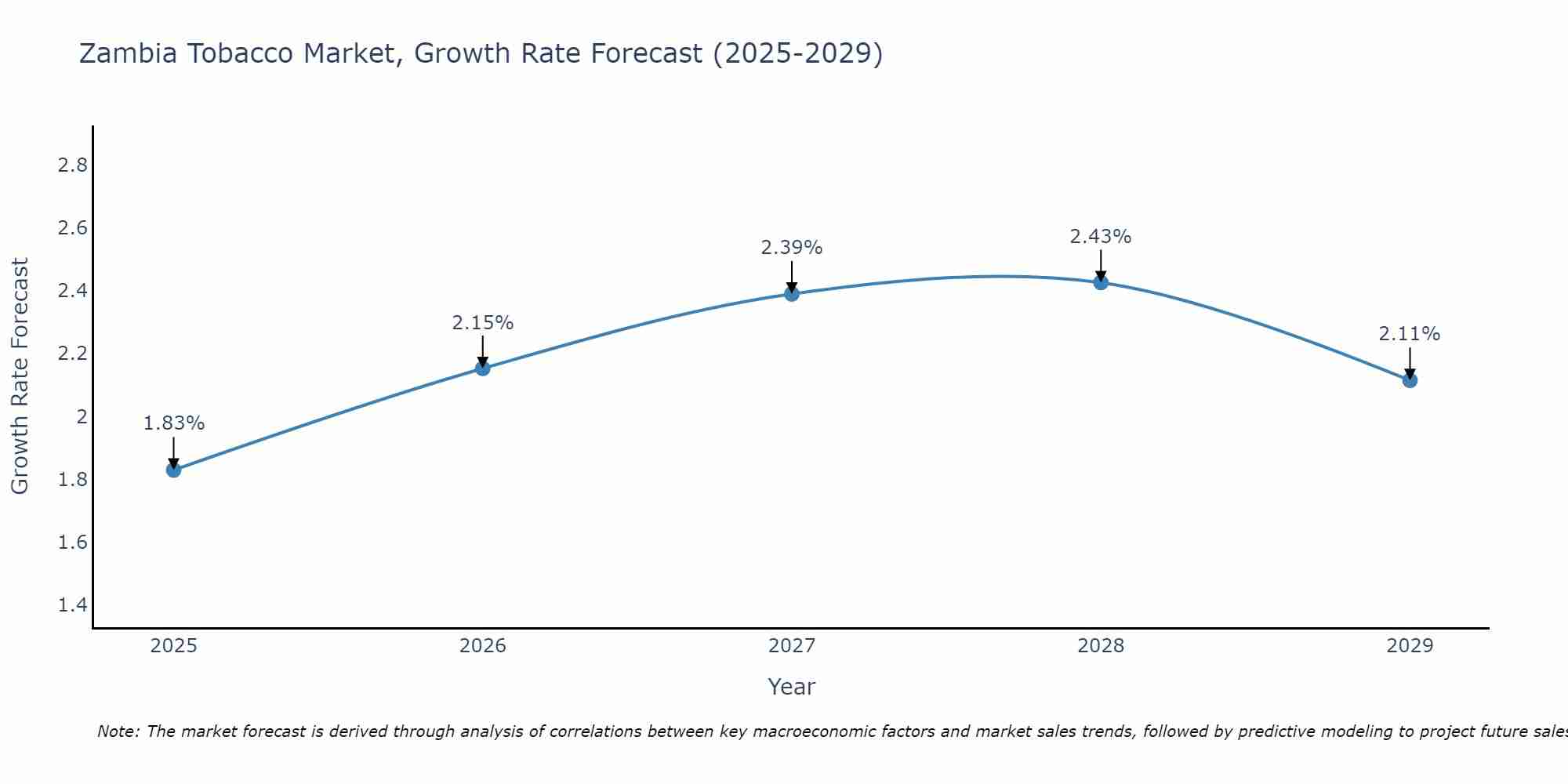
The Zambia Tobacco Market is projected to witness mixed growth rate patterns during 2025 to 2029. Starting at 1.83% in 2025, the market peaks at 2.43% in 2028, and settles at 2.11% by 2029.
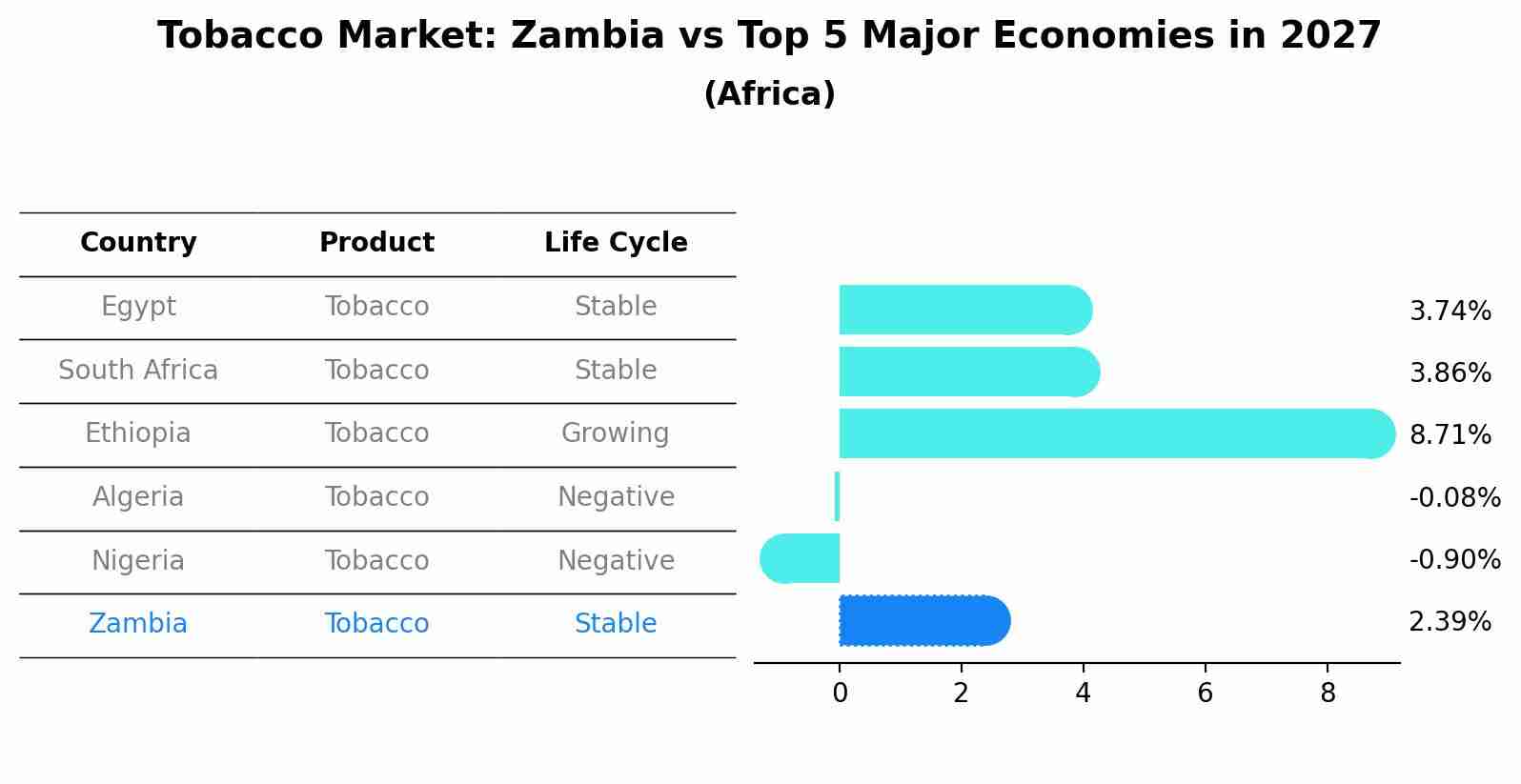
Tobacco Market: Zambia vs Top 5 Major Economies in 2027 (Africa)
By 2027, Zambia's Tobacco market is forecasted to achieve a stable growth rate of 2.39%, with Egypt leading the Africa region, followed by South Africa, Ethiopia, Algeria and Nigeria.
Zambia Tobacco Market Growth Rate
According to 6Wresearch internal database and industry insights, the Zambia Tobacco Market is projected to grow at a compound annual growth rate (CAGR) of 6.5% during the forecast period (2026-2032).
Topics Covered in the Zambia Tobacco Market Report
The Zambia Tobacco Market report thoroughly covers the market by product, distribution channel, and competitive landscape. The report provides a detailed analysis of ongoing market trends, opportunities/high-growth areas, and market drivers that will help stakeholders align strategies based on current and future market dynamics.
Zambia Tobacco Market Highlights
| Report Name | Zambia Tobacco Market |
| Forecast period | 2026-2032 |
| CAGR | 6.5% |
| Growing Sector | Cigarettes and Next Generation Products |
Zambia Tobacco Market Synopsis
Zambia Tobacco Market is projected to experience steady growth in the coming years, due to increase in tobacco cultivation and the expansion of export-dependent processing industries. Zambia is a major player in South Africa's tobacco-production industry, with large production of flue-cured Virginia tobacco which fuels the country's domestic manufacturing along with the international markets. Apart from this, government initiatives support agricultural commercialization and contract farming programs, which encourages small farmers to increase tobacco cultivation. Simultaneously, the establishment of multinational tobacco firms operating leaf processing plants in the country is strengthening supply chain infrastructure and export capacity, further contributing to the Zambia Tobacco Market growth.
Evaluation of Growth Drivers in the Zambia Tobacco Market
Below are some major drivers and their influence on the market dynamics:
| Drivers | Primary Segments Affected | Why It Matters |
| Expanding Tobacco Cultivation | By Product (Cigarettes) | A surge in leaf production ensures constant raw material supply for manufacturing of cigarette. |
| Rising Export Demand | By Product (Cigar & Cigarillos) | International markets appetite for premium tobacco products encourages the support of value-added production. |
| Contract Farming Programs | By Product (Smokeless) | Collaborations between organizations and farmers boosts productivity and consistent supply. |
| Growing Urban Consumption | By Distribution Channel (Offline) | Urbanization fuels greater tobacco consumption via retail stores and kiosks. |
| Product Innovation | By Product (Next Generation Products) | Tobacco companies are introducing less-risk alternatives to diversify offerings. |
Zambia Tobacco Market is projected to grow at a CAGR of 6.5% during the forecast period (2026-2032). Spurred by increase in tobacco cultivation, expansion of cigarette production domestically, and growing export demand for processed tobacco products. Zambia Tobacco Market Growth is estimated to maintain a stable upward trajectory. Apart from this, investments in tobacco processing plants and modernized agricultural practices are improving supply chain efficiency and improving product quality, further strengthening Zambia’s position as a competitive supplier in the African tobacco Industry.
Evaluation of Restraints in the Zambia Tobacco Market
Below are some prominent restraints and their influence on the market dynamics:
| Restraints | Primary Segments Affected | Why It Means |
| Health Awareness Campaigns | By Product (Cigarettes) | Initiatives emphasizing public health discourage tobacco consumption. |
| Export Market Regulations | By Product (Cigar & Cigarillos) | Strict import standards in the countries they are exported to increase the costs of compliance. |
| Climate Variability | By Product (Smokeless) | Unpredictable rainfall affects tobacco crop yields and farmer income. |
| High Production Costs | By Product (Next Generation Products) | Use of advanced technology in more evolved tobacco products increases overall costs. |
| Taxation Policies | By Distribution Channel (Offline) | Increased excise taxes affect product prices and consumer behaviour. |
Zambia Tobacco Market Challenges
Zambia Tobacco Industry is estimated to maintain moderate growth; however, the industry faces some challenges that are linked to fluctuation in prices of international tobacco and changing regulations in framework related to consumption of tobacco. Furthermore, the dependency on agricultural labour and seasonal weather conditions may influence the consistency in production in certain regions. Apart from this, limited processing capacity in local areas restricts the value addition of tobacco leaves before export. Strengthening domestic manufacturing capabilities and improving logistics infrastructure remain important priorities for stakeholders in the Zambia tobacco sector.
Zambia Tobacco Market Trends
Some of the important trends shaping the landscape of the Zambia Tobacco Market are:
- Shift Toward Value-Added Processing: Investing in domestic leaf processing plants, then shipping raw tobacco leaves lead to increase in export value which benefits the tobacco companies. This initiative helps to grow national export revenues and solidifies Zambia’s industrial capacity.
- Adoption of Sustainable Tobacco Farming: Agricultural programs promote sustainable cultivation practices, such as crop rotation or efficient curing methods, which improves quality of yield and promotes environmental sustainability.
- Growing Interest for Lower-Risk Products: Tobacco manufacturing firms are exploring next-generation nicotine products which are developed to reduce harmful emissions compared to conventional cigarettes, that also helps in product diversification.
Investment Opportunities in the Zambia Tobacco Market
Key investment opportunities in the Zambia Tobacco Market includes:
- Tobacco Leaf Production and Sourcing: There is a growing need for improving quality and yield, which can be obtained by investing in tobacco farming, especially in developed sustainable farming programs.
- Tobacco Processing Facilities: Establishing and upgrading tobacco processing plants has resulted in boosting local production, reduced dependency on imports, and caters to both domestic and export demands.
- Value-Added Tobacco Products: Vast consumer preferences can be met by production of value-added tobacco products such as cigars, pipe tobacco, and smokeless tobacco which cater to the interests of the customer.
Top 5 Leading Players in the Zambia Tobacco Market
Below is a list of companies operating in the Zambia Tobacco Market:
British American Tobacco Zambia Plc
| Company Name | British American Tobacco Zambia Plc |
| Established Year | 1902 (parent company British American Tobacco; Zambia operations established later) |
| Headquarters | Lusaka, Zambia |
| Official Website | Click Here |
British American Tobacco Zambia Plc is one of the most prominent tobacco companies operating in Zambia. The company manufactures and distributes cigarettes and tobacco products for the domestic market.
Japan Tobacco International (JTI) Zambia
| Company Name | Japan Tobacco International (JTI) Zambia |
| Established Year | 2010 (Zambia operations) |
| Headquarters | Lusaka, Zambia |
| Official Website | Click Here |
Japan Tobacco International operates tobacco sourcing and farmer support programs in Zambia. The company works with thousands of local farmers to produce burley and flue-cured Virginia tobacco.
Roland Imperial Tobacco Company Limited (RITCO)
| Company Name | Roland Imperial Tobacco Company Limited (RITCO) |
| Established Year | 2001 |
| Headquarters | Lusaka, Zambia |
| Official Website | Click Here |
Roland Imperial Tobacco Company is a locally established Zambian tobacco manufacturer engaged in cigarette production and distribution.
Alliance One Zambia Limited
| Company Name | Alliance One Zambia Limited |
| Established Year | 2005 |
| Headquarters | Lusaka, Zambia |
| Official Website | Click Here |
Alliance One Zambia Limited is a tobacco leaf merchant and processor operating under Alliance One International.
BuyLeaf Tobacco Company Limited
| Company Name | BuyLeaf Tobacco Company Limited |
| Established Year | 2010s |
| Headquarters | Lusaka, Zambia |
| Official Website | Click Here |
BuyLeaf Tobacco Company Limited is involved in tobacco leaf production, procurement, and export activities in Zambia.
Government Initiatives in the Zambia Tobacco Market
According to Zambian Government Data, latest government initiatives in the Zambian tobacco market show a conflicting approach to promote economic growth through industrial expansion with delayed, but necessary, attempts to implement stronger public health controls. In addition, the Zambian government has developed initiatives under the National Agriculture Investment Plan (NAIP) to strengthen value chains for export-oriented crops including tobacco. Moreover, agricultural financing schemes supported by the Development Bank of Zambia help smallholder farmers access capital for purchasing required farming equipment’s and improve curing infrastructure.
Future Insights of the Zambia Tobacco Market
The Zambia Tobacco Market is projected to experience stable growth driven by increased consumption, especially in rural areas, a growing shift and growth towards low-risk products, such as e-cigarettes and vapes. Along with this, expansion of sustainable tobacco farming practices and investments in processing infrastructure is expected to rise. The Zambia tobacco industry is expected to further strengthen through the 2030s owing to the rising demand for international cigarette manufacturers and expanding regional trade agreements.
Market Segmentation Analysis
The report offers a comprehensive study of the following market segments and their leading categories:
By Product – Cigarettes to Lead the Market
According to Jigisha, Senior Research Analyst, 6Wresearch, Cigarettes are projected to dominate the Zambia Tobacco Market due to strong domestic consumption and established manufacturing capabilities in the country. Cigarettes remain the most widely popular tobacco product across retail outlets, kiosks, and convenience stores. Additionally, many tobacco producing companies operating in Zambia continue to grow the cigarette manufacturing capacity and brand portfolios, further strengthening the segment’s dominant position in the market.
By Distribution Channel – Offline to Dominate Market
The Offline distribution channel is the expected to lead Zambia Tobacco Market share due to the extensive presence of physical retail networks throughout the country, which includes supermarkets, kiosks, tobacco shops, and convenience stores. These channels continue to be the fundamental point of purchase for tobacco products across both urban and rural areas.
Key Attractiveness of the Report
- 10 Years of Market Numbers
- Historical Data Starting from 2022 to 2025
- Base Year: 2025
- Forecast Data until 2032
- Key Performance Indicators Impacting the Market
- Major Upcoming Developments and Projects
Key Highlights of the Report:
- Zambia Tobacco Market Outlook
- Market Size of Zambia Tobacco Market, 2025
- Forecast of Zambia Tobacco Market, 2032
- Historical Data and Forecast of Zambia Tobacco Revenues & Volume for the Period 2022-2032F
- Zambia Tobacco Market Trend Evolution
- Zambia Tobacco Market Drivers and Challenges
- Zambia Tobacco Price Trends
- Zambia Tobacco Porter`s Five Forces
- Zambia Tobacco Industry Life Cycle
- Historical Data and Forecast of Zambia Tobacco Market Revenues & Volume By Product for the Period 2022-2032F
- Historical Data and Forecast of Zambia Tobacco Market Revenues & Volume By Smokeless for the Period 2022-2032F
- Historical Data and Forecast of Zambia Tobacco Market Revenues & Volume By Cigarettes for the Period 2022-2032F
- Historical Data and Forecast of Zambia Tobacco Market Revenues & Volume By Cigar & Cigarillos for the Period 2022-2032F
- Historical Data and Forecast of Zambia Tobacco Market Revenues & Volume By Next Generation Products for the Period 2022-2032F
- Historical Data and Forecast of Zambia Tobacco Market Revenues & Volume By Waterpipes for the Period 2022-2032F
- Historical Data and Forecast of Zambia Tobacco Market Revenues & Volume By Distribution Channel for the Period 2022-2032F
- Historical Data and Forecast of Zambia Tobacco Market Revenues & Volume By Offline for the Period 2022-2032F
- Historical Data and Forecast of Zambia Tobacco Market Revenues & Volume By Online for the Period 2022-2032F
- Zambia Tobacco Import Export Trade Statistics
- Market Opportunity Assessment By Product
- Market Opportunity Assessment By Distribution Channel
- Zambia Tobacco Top Companies Market Share
- Zambia Tobacco Competitive Benchmarking By Technical and Operational Parameters
- Zambia Tobacco Company Profiles
- Zambia Tobacco Key Strategic Recommendations
Market Covered
The report offers a comprehensive study of the following market segments:
By Product
- Smokeless
- Cigarettes
- Cigar & Cigarillos
- Next Generation Products
- Waterpipes
By Distribution Channel
- Offline
- Online
Zambia Tobacco Market (2026-2032) : FAQs
Zambia Tobacco Market is expected to grow at sound growth rate of 6.5% during the forecast period 2026-2032.
Key growth factors include amplification of tobacco cultivation and investments by tobacco companies in contract farming and manufacturing.
Major challenges include climate-related risks in agriculture practices, regulations concerning tobacco consumption, and fluctuating international tobacco prices.
Government initiatives include farmer training programs, agricultural financing schemes, and export promotion policies supporting tobacco leaf processing.
6Wresearch actively monitors the Zambia Tobacco Market and publishes its comprehensive annual report, highlighting emerging trends, growth drivers, revenue analysis, and forecast outlook. Our insights help businesses to make data-backed strategic decisions with ongoing market dynamics. Our analysts track relevent industries related to the Zambia Tobacco Market, allowing our clients with actionable intelligence and reliable forecasts tailored to emerging regional needs.
Yes, we provide customisation as per your requirements. To learn more, feel free to contact us on sales@6wresearch.com
| 1 Executive Summary |
| 2 Introduction |
| 2.1 Key Highlights of the Report |
| 2.2 Report Description |
| 2.3 Market Scope & Segmentation |
| 2.4 Research Methodology |
| 2.5 Assumptions |
| 3 Zambia Tobacco Market Overview |
| 3.1 Zambia Country Macro Economic Indicators |
| 3.2 Zambia Tobacco Market Revenues & Volume, 2022 & 2032F |
| 3.3 Zambia Tobacco Market - Industry Life Cycle |
| 3.4 Zambia Tobacco Market - Porter's Five Forces |
| 3.5 Zambia Tobacco Market Revenues & Volume Share, By Product , 2022 & 2032F |
| 3.6 Zambia Tobacco Market Revenues & Volume Share, By Distribution Channel, 2022 & 2032F |
| 4 Zambia Tobacco Market Dynamics |
| 4.1 Impact Analysis |
| 4.2 Market Drivers |
| 4.2.1 Increasing disposable income of consumers in Zambia |
| 4.2.2 Growing acceptance of smoking in the society |
| 4.2.3 Expansion of distribution networks by tobacco companies in Zambia |
| 4.3 Market Restraints |
| 4.3.1 Stringent government regulations on tobacco advertising and packaging |
| 4.3.2 Health concerns and anti-smoking campaigns in Zambia |
| 5 Zambia Tobacco Market Trends |
| 6 Zambia Tobacco Market Segmentations |
| 6.1 Zambia Tobacco Market, By Product |
| 6.1.1 Overview and Analysis |
| 6.1.2 Zambia Tobacco Market Revenues & Volume, By Smokeless, 2022-2032F |
| 6.1.3 Zambia Tobacco Market Revenues & Volume, By Cigarettes, 2022-2032F |
| 6.1.4 Zambia Tobacco Market Revenues & Volume, By Cigar & Cigarillos, 2022-2032F |
| 6.1.5 Zambia Tobacco Market Revenues & Volume, By Next Generation Products, 2022-2032F |
| 6.1.6 Zambia Tobacco Market Revenues & Volume, By Waterpipes, 2022-2032F |
| 6.2 Zambia Tobacco Market, By Distribution Channel |
| 6.2.1 Overview and Analysis |
| 6.2.2 Zambia Tobacco Market Revenues & Volume, By Offline, 2022-2032F |
| 6.2.3 Zambia Tobacco Market Revenues & Volume, By Online, 2022-2032F |
| 7 Zambia Tobacco Market Import-Export Trade Statistics |
| 7.1 Zambia Tobacco Market Export to Major Countries |
| 7.2 Zambia Tobacco Market Imports from Major Countries |
| 8 Zambia Tobacco Market Key Performance Indicators |
| 8.1 Average price per pack of cigarettes in Zambia |
| 8.2 Number of new tobacco product launches in the market |
| 8.3 Percentage of smokers in Zambia who buy premium tobacco products |
| 8.4 Investment in tobacco cultivation and processing technology in Zambia |
| 8.5 Number of tobacco retail outlets in urban vs rural areas in Zambia |
| 9 Zambia Tobacco Market - Opportunity Assessment |
| 9.1 Zambia Tobacco Market Opportunity Assessment, By Product , 2022 & 2032F |
| 9.2 Zambia Tobacco Market Opportunity Assessment, By Distribution Channel, 2022 & 2032F |
| 10 Zambia Tobacco Market - Competitive Landscape |
| 10.1 Zambia Tobacco Market Revenue Share, By Companies, 2025 |
| 10.2 Zambia Tobacco Market Competitive Benchmarking, By Operating and Technical Parameters |
| 11 Company Profiles |
| 12 Recommendations |
| 13 Disclaimer |
Export potential assessment - trade Analytics for 2030
Export potential enables firms to identify high-growth global markets with greater confidence by combining advanced trade intelligence with a structured quantitative methodology. The framework analyzes emerging demand trends and country-level import patterns while integrating macroeconomic and trade datasets such as GDP and population forecasts, bilateral import–export flows, tariff structures, elasticity differentials between developed and developing economies, geographic distance, and import demand projections. Using weighted trade values from 2020–2024 as the base period to project country-to-country export potential for 2030, these inputs are operationalized through calculated drivers such as gravity model parameters, tariff impact factors, and projected GDP per-capita growth. Through an analysis of hidden potentials, demand hotspots, and market conditions that are most favorable to success, this method enables firms to focus on target countries, maximize returns, and global expansion with data, backed by accuracy.
By factoring in the projected importer demand gap that is currently unmet and could be potential opportunity, it identifies the potential for the Exporter (Country) among 190 countries, against the general trade analysis, which identifies the biggest importer or exporter.
To discover high-growth global markets and optimize your business strategy:
Click Here
Pricing
- Single User License$ 1,995
- Department License$ 2,400
- Site License$ 3,120
- Global License$ 3,795

Search
Thought Leadership and Analyst Meet





Our Clients








Latest Reports
- United Kingdom (UK) Long-term Care Insurance Market (2026-2032) | Growth, Share, Consumer Insights, Drivers, Opportunities, Competition, Pricing Analysis, Segments, Restraints, Companies, Competitive, Value, Outlook, Size, Demand, Analysis, Challenges, Strategic Insights, Investment Trends, Revenue, Trends, Supply, Forecast
- United Kingdom (UK) Long Term Care Market (2026-2032) | Companies, Outlook, Analysis, Trends, Value, Revenue, Segmentation, Share, Forecast, Competitive Landscape, Growth, Size & Forecast
- Iraq Insulation and Waterproofing Market (2026-2032) | Outlook, Drivers, Growth, Size, Share, Industry, Revenue, Trends, Demand, Competitive, Strategic Insights, Opportunities, Segments, Companies, Challenges, Strategy, Consumer Insights, Analysis, Investment Trends, Value, Segmentation, Forecast, Restraints
- India Switchgear Market Outlook (2026 - 2032) | Size, Share, Trends, Growth, Revenue, Forecast, Analysis, Value, Outlook
- Pakistan Contraceptive Implants Market (2025-2031) | Demand, Growth, Size, Share, Industry, Pricing Analysis, Competitive, Strategic Insights, Strategy, Consumer Insights, Analysis, Investment Trends, Opportunities, Revenue, Segments, Value, Segmentation, Supply, Forecast, Restraints, Outlook, Competition, Drivers, Trends, Companies, Challenges
- Sri Lanka Packaging Market (2026-2032) | Outlook, Competition, Drivers, Trends, Demand, Pricing Analysis, Competitive, Strategic Insights, Companies, Challenges, Strategy, Consumer Insights, Analysis, Investment Trends, Opportunities, Growth, Size, Share, Industry, Revenue, Segments, Value, Segmentation, Supply, Forecast, Restraints
- India Kids Watches Market (2026-2032) | Strategy, Consumer Insights, Analysis, Investment Trends, Opportunities, Growth, Size, Share, Industry, Revenue, Segments, Value, Segmentation, Supply, Forecast, Restraints, Outlook, Competition, Drivers, Trends, Demand, Pricing Analysis, Competitive, Strategic Insights, Companies, Challenges
- Saudi Arabia Core Assurance Service Market (2025-2031) | Strategy, Consumer Insights, Analysis, Investment Trends, Opportunities, Growth, Size, Share, Industry, Revenue, Segments, Value, Segmentation, Supply, Forecast, Restraints, Outlook, Competition, Drivers, Trends, Demand, Pricing Analysis, Competitive, Strategic Insights, Companies, Challenges
- Romania Uninterruptible Power Supply (UPS) Market (2026-2032) | Industry, Analysis, Revenue, Size, Forecast, Outlook, Value, Trends, Share, Growth & Companies
- Saudi Arabia Car Window Tinting Film, Paint Protection Film (PPF), and Ceramic Coating Market (2025-2031) | Strategy, Consumer Insights, Analysis, Investment Trends, Opportunities, Growth, Size, Share, Industry, Revenue, Segments, Value, Segmentation, Supply, Forecast, Restraints, Outlook, Competition, Drivers, Trends, Demand, Pricing Analysis, Competitive, Strategic Insights, Companies, Challenges
Industry Events and Analyst Meet

India EV Show 2026

EV tech India Expo 2026

Auto Tech Asia 2026

Battery Tech India 2026

Smart Production Solutions Guangzhou 2026
Whitepaper
- Middle East & Africa Commercial Security Market Click here to view more.
- Middle East & Africa Fire Safety Systems & Equipment Market Click here to view more.
- GCC Drone Market Click here to view more.
- Middle East Lighting Fixture Market Click here to view more.
- GCC Physical & Perimeter Security Market Click here to view more.
6WResearch In News
- Doha a strategic location for EV manufacturing hub: IPA Qatar
- Demand for luxury TVs surging in the GCC, says Samsung
- Empowering Growth: The Thriving Journey of Bangladesh’s Cable Industry
- Demand for luxury TVs surging in the GCC, says Samsung
- Video call with a traditional healer? Once unthinkable, it’s now common in South Africa
- Intelligent Buildings To Smooth GCC’s Path To Net Zero


